Quick answer
Use a before a consonant sound and an before a vowel sound with singular countable nouns that are new or general. Use the when your listener knows exactly which thing you mean. Use no article with plural or uncountable nouns in a general sense, and with most countries, languages and meals.
Key takeaways
- • Urdu has no articles, so Pakistani learners often drop a, an and the or add the where English needs none.
- • Choose a or an by the first sound you say, not the first letter: a university, an hour, an FIR, a SIM card.
- • Use the when the listener can identify the thing: mentioned before, clear from the situation, the only one, or after best.
- • Use no article for general plural or uncountable nouns, languages, subjects, sports, meals and most countries.
- • Singular countable nouns never stand alone; they need a, an, the or a word like my or this.
Table of contents 19 sections
- What Are Articles in English?
- Why Do Urdu Speakers Find Articles in English Hard?
- A or An? Follow the First Sound
- When Do You Use "The"?
- You Mentioned It Before
- The Situation Makes It Clear
- Only One Exists
- Superlatives and Ranking Words
- A Particular Group
- When Should You Use No Article at All?
- Which Article Do You Need? A Two-Question Test
- Articles With Pakistani Place Names
- The Article Mistakes We Correct Most Often
- Do Articles Matter in Job Emails, CVs and Interviews?
- Can You Pass This 10-Sentence Article Test?
- Answers
- How Do You Fix Article Mistakes for Good?
- Practising Articles in PSTA's Spoken English Class
- Tonight: Check One Email for Articles
Here is a myth many students bring to our English class: "Articles in English are tiny words, so nobody notices when I drop them." Listeners do notice. "He is doctor" or "I have an university interview" marks a speaker as unsure in the first ten seconds, even when the rest of the sentence is perfect.
The good news is that the system behind a, an and the is small. Once you ask two questions about every noun, most of your errors disappear.
In this guide, you will learn:
- Why Urdu speakers drop or misplace articles, according to research done in Pakistan
- The sound rule that settles a or an, including tricky words like SIM, FIR and MBA
- When English needs the, and when it needs no article at all
- The article slips that show up most in Pakistani emails, interviews and CVs
- A 10-sentence self-test and a daily routine to fix the habit
What Are Articles in English?
Articles are small words that sit before a noun and tell the listener how much they already know about it. English has two kinds.
- Indefinite articles: a and an. They introduce one thing from a group, often for the first time. "I bought a laptop."
- Definite article: the. It points to a thing the listener can identify. "The laptop is already slow."
Grammar books also talk about the zero article, which simply means using no article. "Laptops are expensive in Pakistan" talks about laptops in general, so nothing goes before the noun.
The British Council's LearnEnglish grammar page files articles in English under its A1 and A2 levels. That tells you something useful. Articles are beginner grammar, yet many university graduates still get them wrong because nobody corrected the habit early.
Why Do Urdu Speakers Find Articles in English Hard?
The main reason is simple: your first language does not have them. A British Council language profile of Urdu, published through the Bell Foundation, says that because Urdu has no articles, leaving them out is a common learner error. You can read it in the Urdu language profile (PDF).
Pakistani researchers have found the same pattern in real student writing:
- A 2016 study of BS English students at the University of Azad Jammu and Kashmir, published in the Kashmir Journal of Language Research, found that leaving out or swapping "the" was the most persistent problem. Students also put "the" before plural and uncountable nouns used in a general sense.
- A 2018 error analysis of 60 graduate students' essays, published in the Journal of Educational Research, reported that students whose first language is Urdu made more article errors than students whose first language has articles. Indefinite articles were the hardest, and students tended to omit them.
So if you write "He is engineer" or "The education is important," you are not careless. Your brain is translating Urdu word order into English. The fix is to build one new habit: check every noun before you finish the sentence.
A or An? Follow the First Sound
The first choice with articles in English is a or an. Choose by the sound at the start of the next word, not the letter. Use a before a consonant sound and an before a vowel sound. The British Council gives "a university degree" and "an hour" as its own examples, and EC English explains the same pair: university starts with a "yoo" sound, while the h in hour is silent.
Abbreviations follow the same rule. Say the letters aloud. FIR is read "ef-eye-ar," so it starts with a vowel sound. SIM is read as one word, "sim," so it starts with a consonant sound. Purdue's Online Writing Lab uses the same logic for letter-by-letter abbreviations and for words like European.
| Phrase | First sound you say | Why |
|---|---|---|
| a university | "yoo" | Vowel letter, consonant sound |
| a European client | "yoo" | Same "y" sound as university |
| a one-day workshop | "wun" | One starts with a "w" sound |
| a SIM card | "sim" | Read as a word, not letters |
| a hospital | "h" | The h is pronounced |
| an hour | "ow" | Silent h |
| an honest answer | "on" | Silent h |
| an MBA | "em" | The letter M is read "em" |
| an FIR | "ef" | The letter F is read "ef" |
| an umbrella | "uh" | Vowel letter, vowel sound |
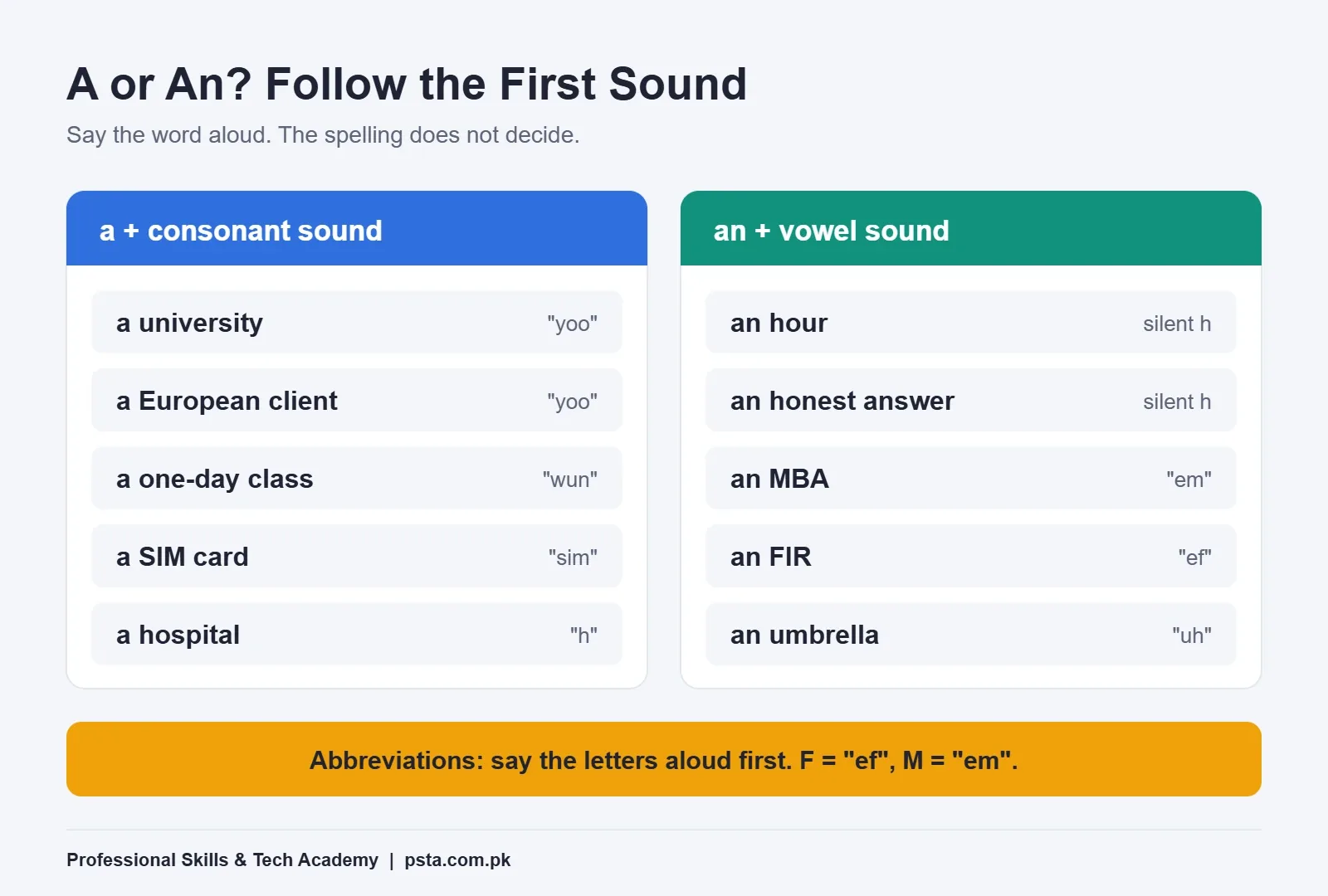
A quick check: if you can't decide, say the phrase out loud slowly. "A hour" feels like a bump in your mouth. "An hour" flows. Your ear is a better guide than spelling here.
When Do You Use "The"?
The third of the articles in English is the. Use it when your listener can tell exactly which thing you mean. That happens in a few common situations.
You Mentioned It Before
"I applied for a job last week. The job is in Rawalpindi." The first mention uses a. After that, both of you know which job, so it becomes the.
The Situation Makes It Clear
In an office, "Please switch off the AC" works without any earlier mention. There's one AC in the room, and everyone knows it.
Only One Exists
The sun, the internet and the Prime Minister of Pakistan all take the, because there is only one in that context.
Superlatives and Ranking Words
Words like best, first, last and only point to one specific item, so they almost always come with the. "She is the best student in the batch" is correct. "She is best student" is one of the most frequent slips we hear in class.
A Particular Group
The British Council separates "kangaroos" in general from "the kangaroos" at one zoo. The same works locally: "Students need practice" is general, while "The students in Batch 4 need practice" means one group.
When Should You Use No Article at All?
Not every noun needs one of the articles in English, and this is where Pakistani learners often overcorrect. After being told "you forgot the article," some students start adding the everywhere. English leaves the article out in these common cases:
- Plural or uncountable nouns in a general sense. "Life is busy." "Education changes families." "Mobile phones need regular updates." Writing "The life is busy" sounds translated.
- Languages, subjects and sports. Purdue's guide lists these as no-article nouns. "She teaches English." "I failed physics." "Cricket is on every channel."
- Most countries, cities and streets. "I live in Pakistan." "The office is on Mansehra Road." Never "the Pakistan" or "the Abbottabad."
- Meals and many daily routines. "We had breakfast at eight." "I go to work by bus." Compare "by the bus," which sounds like you are standing next to it.
Which Article Do You Need? A Two-Question Test
When you're stuck, run every noun through two questions. Question one: does the listener know which one I mean? Question two: is the noun singular and countable, or is it plural or uncountable? The answers place you in one of four boxes, and those boxes handle most choices with articles in English.
| Singular countable | Plural or uncountable | |
|---|---|---|
| General or new | a / an: "I need a laptop." | No article: "Laptops are costly." |
| Specific, listener knows | the: "The laptop on my desk." | the: "The laptops in Lab 2." |
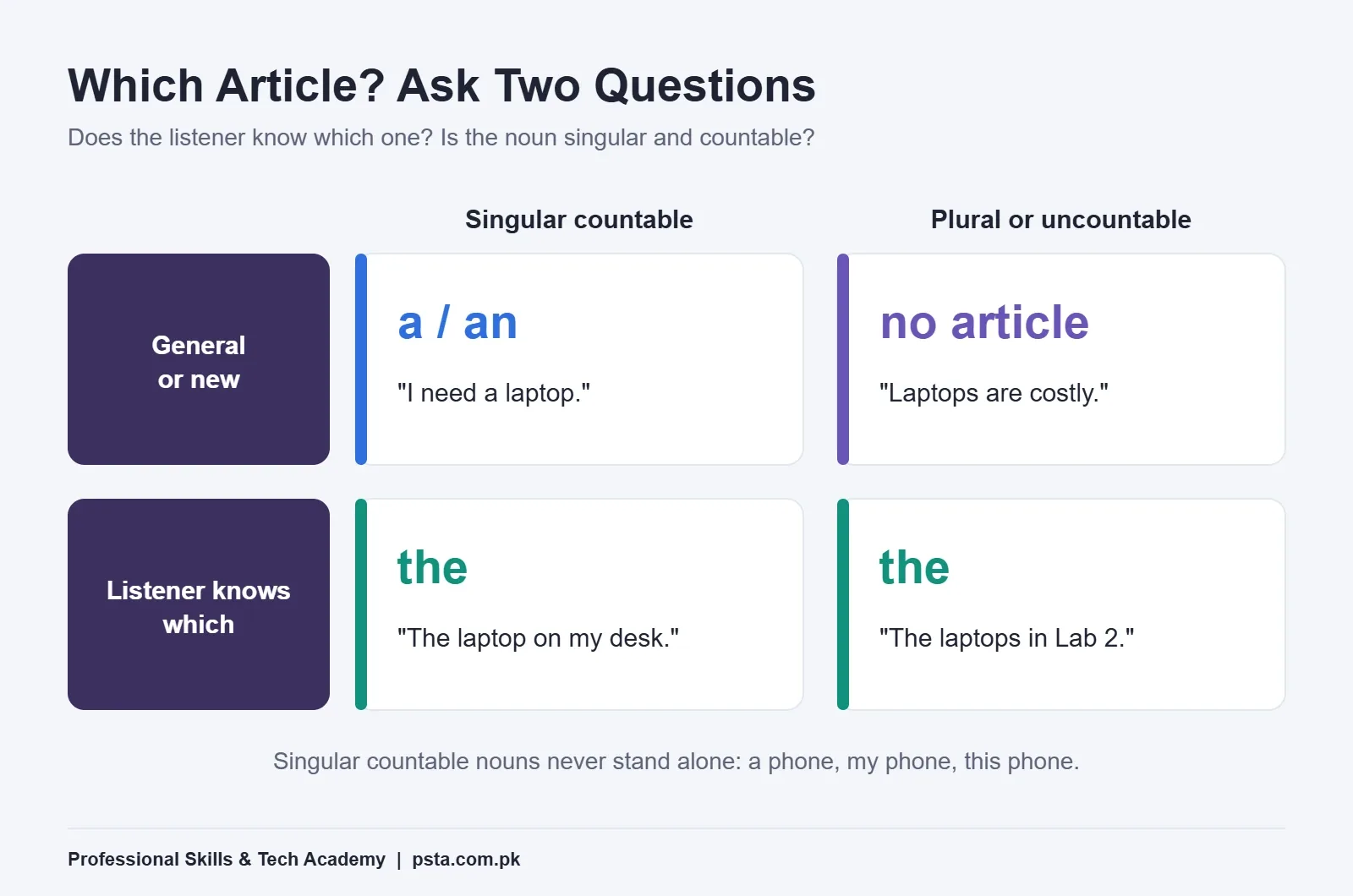
One firm rule sits inside that grid. The British Council notes that singular countable nouns always need an article or another determiner, such as my, this or every. "I bought new phone" is never complete. It's "a new phone," "my new phone" or "this new phone."
Uncountable nouns like information, advice, equipment and furniture never take a or an. "Can you give me an information?" should be "some information" or "a piece of information."
Articles With Pakistani Place Names
Place names are the trickiest corner of articles in English, so here is a short list built on Purdue's geography rules. Rivers, seas, deserts and mountain ranges take the. Single mountains, most countries, cities and streets don't. Countries whose names contain a plural or a word like "united" usually take the.
| Takes "the" | No article |
|---|---|
| the Indus (river) | Pakistan, Abbottabad, Lahore |
| the Arabian Sea | K2 (a single mountain) |
| the Karakoram (range) | Mansehra Road, Jinnah Avenue |
| the Thar Desert | Asia, Europe |
| the United Arab Emirates, the UK | Saudi Arabia, China |
The Article Mistakes We Correct Most Often
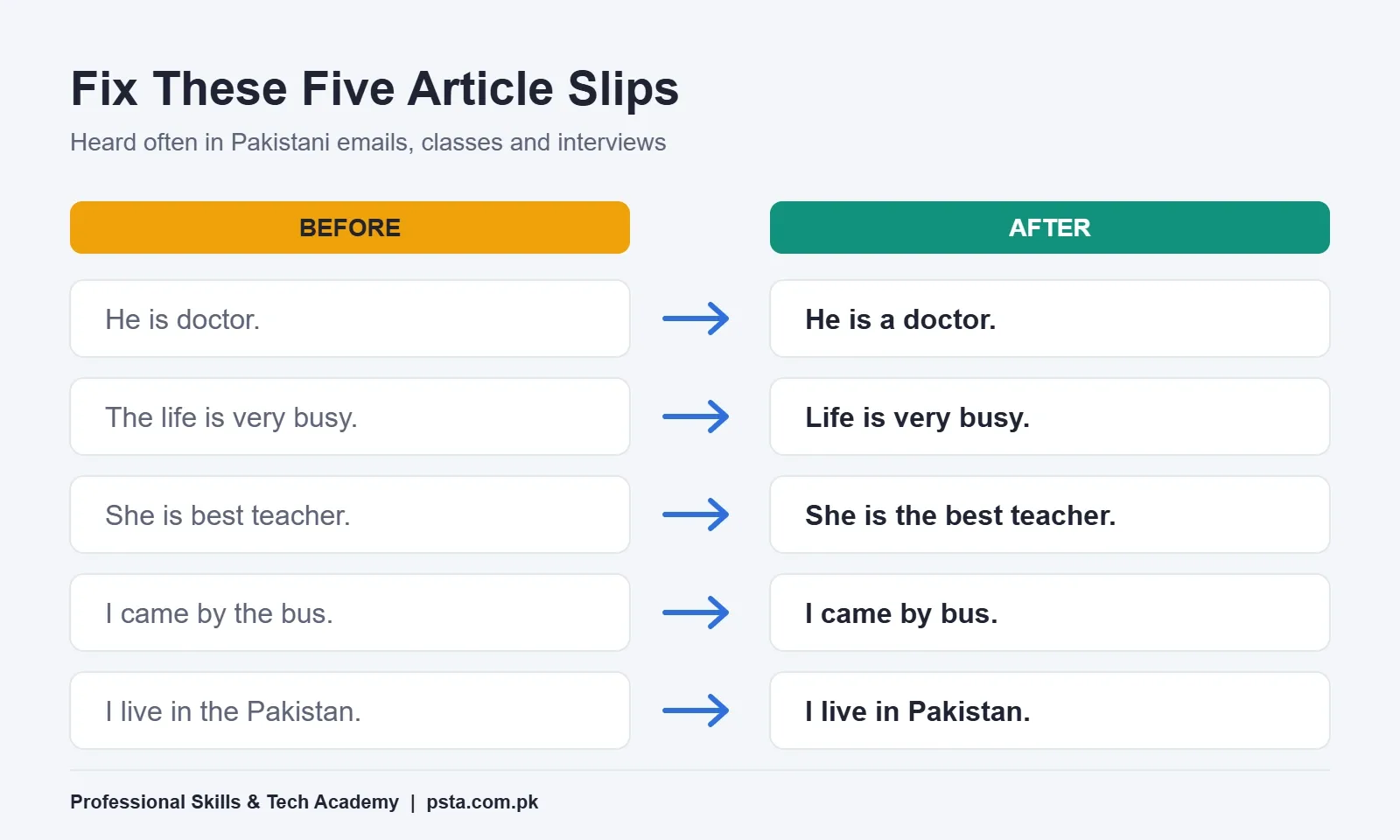
These are the slips with articles in English that come up week after week in our spoken English batches, in interview practice and in student emails. Each one has a reason behind it, which makes it easier to stop.
| Common version | Correct version | The rule |
|---|---|---|
| He is doctor. | He is a doctor. | Jobs take a or an |
| I got an university admission. | I got a university admission. | "Yoo" is a consonant sound |
| The life is very busy. | Life is very busy. | General uncountable noun |
| She is best teacher. | She is the best teacher. | Superlatives take the |
| I came by the bus. | I came by bus. | "By" + transport, no article |
| Please send me an information. | Please send me the information. | Information is uncountable |
| I live in the Pakistan. | I live in Pakistan. | Most countries take no article |
If you want a wider list beyond articles, our guide to common English mistakes Pakistani learners make covers tenses, questions and prepositions too. Prepositions trip up the same students, so the prepositions of time and place guide is a good next read.
Do Articles Matter in Job Emails, CVs and Interviews?
Yes, but with one sensible exception. In full sentences, a missing article makes your writing look rushed. Compare these two lines from an application email:
- "I am applying for post of Computer Operator advertised in newspaper."
- "I am applying for the post of Computer Operator advertised in the newspaper."
The second reads like someone who checks their work, and that is exactly what an employer is hiring for. Our guide on writing a job application email shows full examples you can adapt.
The exception is CV bullet points. Recruiters expect short, clipped phrases there, so "Managed stock records for a 3-branch pharmacy" is normal and fine. Your summary paragraph and cover letter still need complete sentences with articles.
In interviews, articles affect how fluent you sound. "I am fresh graduate from Hazara University" should be "I am a fresh graduate." If you are preparing your opening answer, practise it with the tips in our tell me about yourself guide and record yourself checking only for articles.
Can You Pass This 10-Sentence Article Test?
Fill each gap with a, an, the or nothing (write "x"). Cover the answers first.
- My brother is ___ engineer in Islamabad.
- I waited for ___ hour at the bank.
- She wants to join ___ university in Lahore.
- ___ Indus ends in the Arabian Sea.
- Can you give me ___ advice about my CV?
- He scored ___ highest marks in his class.
- I bought a phone yesterday. ___ phone already freezes.
- ___ English is spoken in most offices.
- He filed ___ FIR at the police station.
- We usually have ___ dinner at nine.
Answers
1. an (engineer starts with a vowel sound). 2. an (silent h). 3. a ("yoo" sound). 4. The (rivers take the). 5. x, or "some" or "a piece of," because advice is uncountable. 6. the (superlative). 7. The (mentioned before). 8. x (languages take no article). 9. an ("ef" sound). 10. x (meals take no article).
If you got 8 or more right, your rules are fine and the problem is speed in speech. If you got fewer than 6, go back to the two-question test above and read it with your own sentences.
How Do You Fix Article Mistakes for Good?
Knowing the rules of articles in English and using them while speaking are different skills. This routine works because it trains your ear, not just your memory.
- Underline nouns, not articles. Take any paragraph you wrote and underline every noun. Then ask the two questions for each one. You will catch the missing articles faster this way.
- Collect your own errors. Keep one page in your notebook for article slips a teacher or friend corrects. Most people repeat the same three or four patterns.
- Read aloud for five minutes. Choose a short news report in English and read it slowly. Pause at each article and ask why the writer chose it.
- Record one minute of speech. Describe your day on your phone, then listen once only for articles. Count the slips and try to beat that number tomorrow.
- Learn nouns in chunks. Instead of memorising "university," memorise "a university." Instead of "information," memorise "some information." The article comes out automatically later.
Once articles are steady, tenses are the next big area for most learners. Our English tenses chart works well alongside this routine.
Practising Articles in PSTA's Spoken English Class
Article rules stick when someone hears you speak and corrects you on the spot. That is the core of the English Spoken & Grammar Course at PSTA. Here are the details from the course page:
- Duration: 12 weeks
- Fee: Rs. 12,000 (listed price Rs. 14,000)
- Mode: on campus in Abbottabad or live online from anywhere in Pakistan
- Relevant modules: Parts of Speech & Sentence Formation; Tenses & Grammar Usage in Speaking; Email, CV & Message Writing; Role Plays and Group Discussions
- Finish: a final presentation and certification assessment
The class suits students preparing for interviews, job seekers working on office emails, and anyone who knows grammar on paper but hesitates when speaking. You can compare it with other programs on the courses page, or read how enrolment works on the admission page. Questions about batch timings get the quickest reply on WhatsApp (+92 314 5424399). The campus is on Mandian, Old College Road, opposite FIMS College.
Tonight: Check One Email for Articles
Open the last formal email or message you sent in English. Underline every noun, run the two-question test and rewrite any line that fails. It takes about ten minutes, and it shows you your personal pattern. Do the same with one email each day this week, and you'll start hearing the right article before you write it.
Frequently asked questions
What are the three articles in English?
English has three articles: a, an and the. A and an are indefinite articles used with singular countable nouns when the thing is new or general, as in "a laptop." The is the definite article, used when the listener knows which thing you mean. Grammar books also describe a zero article, which simply means using no article before general plural or uncountable nouns.
Is it "a university" or "an university"?
The correct form is "a university." The choice between a and an depends on the first sound, not the first letter. University begins with a "yoo" sound, which is a consonant sound, so it takes a. The same applies to "a European client," "a uniform" and "a user." Say the word aloud and listen to how it starts.
Why do we say "an hour" but "a house"?
In hour, the letter h is silent, so the word starts with a vowel sound and takes an. In house, the h is pronounced, so the word starts with a consonant sound and takes a. The same pattern gives "an honest answer" and "a hospital." Your ear decides here, so read the phrase aloud if you are unsure.
Is it "an MBA" or "a MBA"?
Write "an MBA." When you read an abbreviation letter by letter, the article follows the sound of the first letter. M is pronounced "em," which starts with a vowel sound. That is why we also say "an FIR" and "an NTN." If an abbreviation is read as a word, such as SIM, it follows the word sound instead: "a SIM card."
When should I not use any article?
Leave the article out with plural or uncountable nouns used in a general sense, such as "Life is busy" or "Laptops are costly." Most languages, academic subjects, sports, meals and country names also take no article: "She speaks English," "We play cricket," "I live in Pakistan." Countries with plural or "united" names, like the UAE, are the main exception.
Can I leave out articles in my CV?
In CV bullet points, yes. Recruiters expect short, clipped phrases such as "Managed stock records for a 3-branch pharmacy," and dropping some articles there is normal. Your profile summary, cover letter and emails are different. They are full sentences, so missing articles make them look rushed. Check those parts noun by noun before you send them.
How can I stop making article mistakes when I speak?
Practise in small, repeated steps. Learn new nouns together with their article, like "a university" or "some information." Record one minute of speech each day and listen only for articles. Keep a page of the errors a teacher corrects, because most learners repeat a few patterns. Regular speaking practice with feedback, such as in a spoken English class, speeds this up.
Sources & references
- Articles: a, an, the (British Council LearnEnglish) learnenglish.britishcouncil.org
- Using Articles (Purdue Online Writing Lab) owl.purdue.edu
- When to use a or an (EC English) ecenglish.com
- Urdu language profile (British Council, via The Bell Foundation) bell-foundation.org.uk
- Persistent Errors in English Writing and Speech Made by Urdu Undergraduates at UAJK (Kashmir Journal of Language Research, 2016) kjlr.pk
- Error Analysis of English Language Speakers in the Use of Articles in Pakistan (Journal of Educational Research, 2018) prdb.pk
Last reviewed & updated on by Umar Qureshi. Written by the PSTA team in Abbottabad, Pakistan.

Umar Qureshi

English Spoken & Grammar Course in Pakistan – Build Confidence, Speak Fluently (Online & Campus)
Turn this guide into a career: hands-on training with real projects, online across Pakistan or on-campus in Abbottabad · 12 Weeks.
Comments
No comments yet — ask a question or share your experience.