Quick answer
Conditional sentences link a condition to a result. Use zero for facts, first for a real future (if + present, will), second for imaginary situations (if + past, would), third for an imagined past (if + had done, would have done), and mixed when past and present meet. Never put will or would in the if-clause.
Key takeaways
- • Ask two questions: when is it happening, and how real is it?
- • For a real future, keep the if-clause in the present: "If it rains," not "If it will rain."
- • Second conditional (if + past, would) is for imaginary or unlikely situations now.
- • Third conditional (if + had done, would have done) replays a past you can't change.
- • Use "If I were you" for advice in exams, interviews and formal writing.
- • Unless already means "if not," so never follow it with don't.
Table of contents 14 sections
- What Are Conditional Sentences?
- The Five Types of Conditional Sentences at a Glance
- Zero Conditional: Facts and Rules That Always Hold
- First Conditional: Real Plans and Possible Results
- Unless, As Long As and Other Words That Replace If
- Second Conditional: Unlikely or Imaginary Now
- If I Were You or If I Was You?
- Third Conditional: Replaying the Past
- Mixed Conditionals: When Past and Present Meet
- How Do You Choose the Right Conditional?
- Mistakes Pakistani Learners Make With If-Clauses
- Practice Set: Ten Sentences to Fix
- Where Conditionals Fit in PSTA's Spoken English Course
- Say Three If-Sentences Out Loud Tonight
Conditional sentences are if-sentences that tie a condition to a result, and English builds them in five common patterns: zero, first, second, third and mixed. To pick the right one, ask two questions. When is the situation happening, and how real is it? Those two answers decide the verb forms on both sides of the comma.
The skill matters most when you speak. On EF's English Proficiency Index page for Pakistan, the country's reading score is 524 while its speaking score is 485. The gap isn't unique to Pakistan. EF's 2026 report found that the average global speaking score trails reading by 57 points. In our classes, if-sentences are one of the clearest places where that gap appears: students recognize the pattern on paper, then say "if I will get the job" out loud.
This guide covers:
- how each of the five patterns is built, with a ready formula
- the meaning each one carries, with a Roman Urdu sense to anchor it
- a quick way to choose the right conditional while you're talking
- the mistakes Pakistani learners repeat most, and how to correct them
- a ten-sentence practice set with answers
What Are Conditional Sentences?
All conditional sentences have two halves. The if-clause states the condition. The main clause states what follows from it. In "If the bus is late, I'll take a rickshaw," the bus being late is the condition and taking a rickshaw is the result.
The halves can swap places without changing the meaning. The British Council's LearnEnglish lesson on zero, first and second conditionals makes the same point, and its examples put a comma after the if-clause when it comes first. So you can write "If you call me, I'll answer" or "I'll answer if you call me." In the second order, you usually don't need a comma.
What changes from type to type is the verb form, and the verb form carries the meaning. A small tense shift turns a likely plan into a daydream, or a daydream into a regret. That's why memorizing one "if formula" never works. You need the set, and you need to know which signal each one sends.
The Five Types of Conditional Sentences at a Glance
Keep this table open while you practice. The Roman Urdu column isn't a word-for-word translation. It gives the feeling each pattern carries, which is often easier to remember than the grammar label.
| Type | If-clause | Main clause | Used for | Example | Roman Urdu sense |
|---|---|---|---|---|---|
| Zero | present simple | present simple | facts, rules, habits | If you heat ice, it melts. | jab bhi aisa ho, yehi hota hai |
| First | present simple | will + base verb | real or likely future | If it rains, the match will stop. | agar aisa hua, to yeh hoga |
| Second | past simple | would + base verb | unlikely or imaginary present and future | If I had a car, I would drive to Murree. | agar aisa hota, to main yeh karta |
| Third | past perfect | would have + past participle | an imagined different past | If I had left early, I would have caught the train. | agar aisa hua hota, to yeh ho jata |
| Mixed | past perfect or past simple | would + base verb, or would have + past participle | past cause with present result, or the reverse | If I had studied IT, I would be a developer now. | pehle aisa hota, to aaj yeh hota |
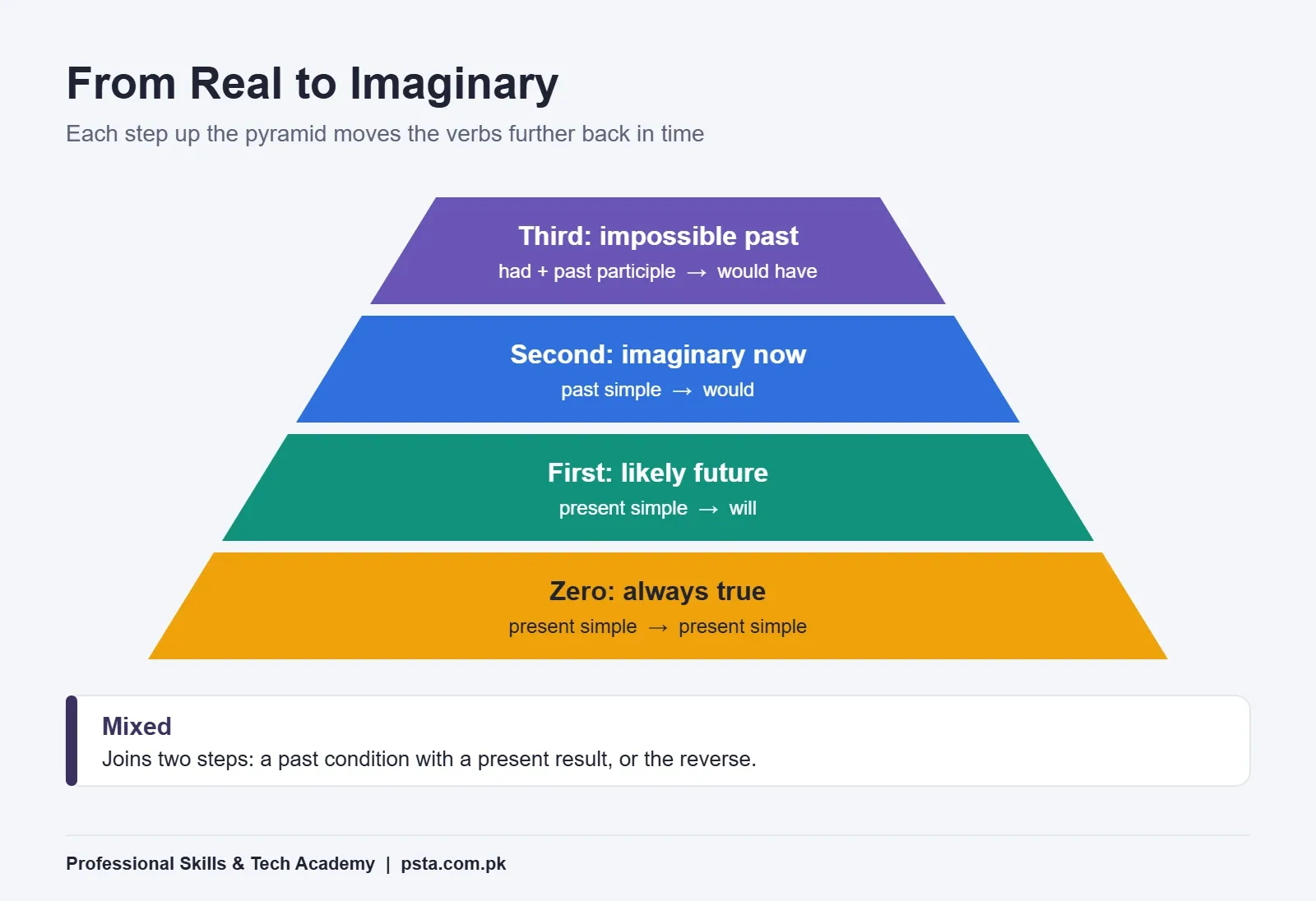
Notice the pattern running down the table. As the situation moves further from reality, the verbs step further back in time. Present for real, past for imaginary, past perfect for an imaginary past.
Zero Conditional: Facts and Rules That Always Hold
Use the zero conditional for things that are always true when the condition happens. Science facts, office rules and personal habits all fit. Both halves take the present simple, which makes it the simplest of the conditional sentences.
- If you leave milk out in June, it goes sour.
- If an employee is late three times, HR sends a warning.
- If I drink tea after 8 pm, I can't sleep.
You can usually replace "if" with "when" here and keep the meaning, because the result follows every single time. The British Council lesson lists "if/when" together for this type. That swap is a useful test. If "when" sounds wrong, you probably need the first conditional instead.
First Conditional: Real Plans and Possible Results
The first conditional talks about a future that could really happen. The if-clause uses the present simple, and the main clause uses will plus the base verb.
- If you send the file by Friday, I'll check it over the weekend.
- If the load-shedding starts at 6, we'll finish the class online.
- If she gets 7 bands in IELTS, she'll apply in March.
Here's the rule that trips up most learners: the future meaning sits in the main clause, while the if-clause stays in the present. "If it will rain" sounds natural to many Urdu speakers because the idea is in the future. In standard English, the if-clause says "if it rains."
Unless, As Long As and Other Words That Replace If
Grammarly's guide to conditional sentences points out that the condition is often introduced by if or unless. The British Council lesson adds that unless, as long as, as soon as and in case often stand in for "if" in first conditionals. Each one shifts the meaning a little:
- unless means "if not": Unless you register by Monday, you'll miss the batch.
- as long as sets a condition that must stay true: You can use the lab as long as you log out after.
- as soon as points to the moment something happens: I'll message you as soon as the results come.
- in case means "to be ready for": Take a charger in case the meeting runs late.
Watch for a double negative with unless. "Unless you don't pay" means the opposite of what most people intend. Say "unless you pay" or "if you don't pay."
Second Conditional: Unlikely or Imaginary Now
The second conditional is for situations that are unreal or unlikely in the present or future. The verbs look past, but the meaning is not past. The if-clause uses the past simple, and the main clause uses would plus the base verb.
- If I lived in Islamabad, I'd join an evening class. (I don't live there.)
- If the shop had a website, it would get more orders. (It doesn't have one.)
- If you won a scholarship abroad, which country would you choose? (Possible, but unlikely right now.)
Compare "If I get the job, I'll move to Lahore" with "If I got the job, I'd move to Lahore." The first speaker thinks the job is a real chance. The second is imagining it. Interviewers and clients hear that difference, so choose deliberately.
If I Were You or If I Was You?
Both appear in everyday English. The British Council lesson calls "if I were" and "if he were" grammatically correct, and adds that "was" is also common in speech, especially with he and she. For exams, formal email and interviews, use "were" with every subject. "If I were you, I'd ask for the offer in writing" is the safe, polished choice for advice.
Third Conditional: Replaying the Past
The third conditional imagines a different past. Nothing can change now, so third conditional sentences usually carry regret, relief or criticism. The if-clause takes the past perfect (had + past participle), and the main clause takes would have + past participle. The British Council's lesson on third and mixed conditionals gives the same formula.
- If I had saved my work, I wouldn't have lost the assignment.
- If the client had read the brief, we wouldn't have redone the logo.
- If you hadn't reminded me, I would have missed the deadline.
In speech, "would have" often shrinks to "would've," and both "had" and "would" shrink to "'d." So "If I'd known" (had) and "I'd go" (would) share the same contraction. The verb after it tells you which one it is. A past participle after "'d" means had. A base verb means would.
Mixed Conditionals: When Past and Present Meet
Real life doesn't always stay in one time frame. A mixed conditional joins a past condition to a present result, or a present fact to a past result.
Past condition, present result. If + past perfect, then would + base verb.
- If I had learned Excel at college, I'd be faster at this job now.
- If we hadn't moved to Abbottabad, my kids wouldn't speak Hindko.
Present situation, past result. If + past simple, then would have + past participle.
- If he weren't so careful, he would have signed that contract.
- If I didn't trust you, I wouldn't have lent you my laptop.
You don't need mixed conditionals on day one. Learn them after the first three types feel automatic, because they're built entirely from parts you already know.
How Do You Choose the Right Conditional?
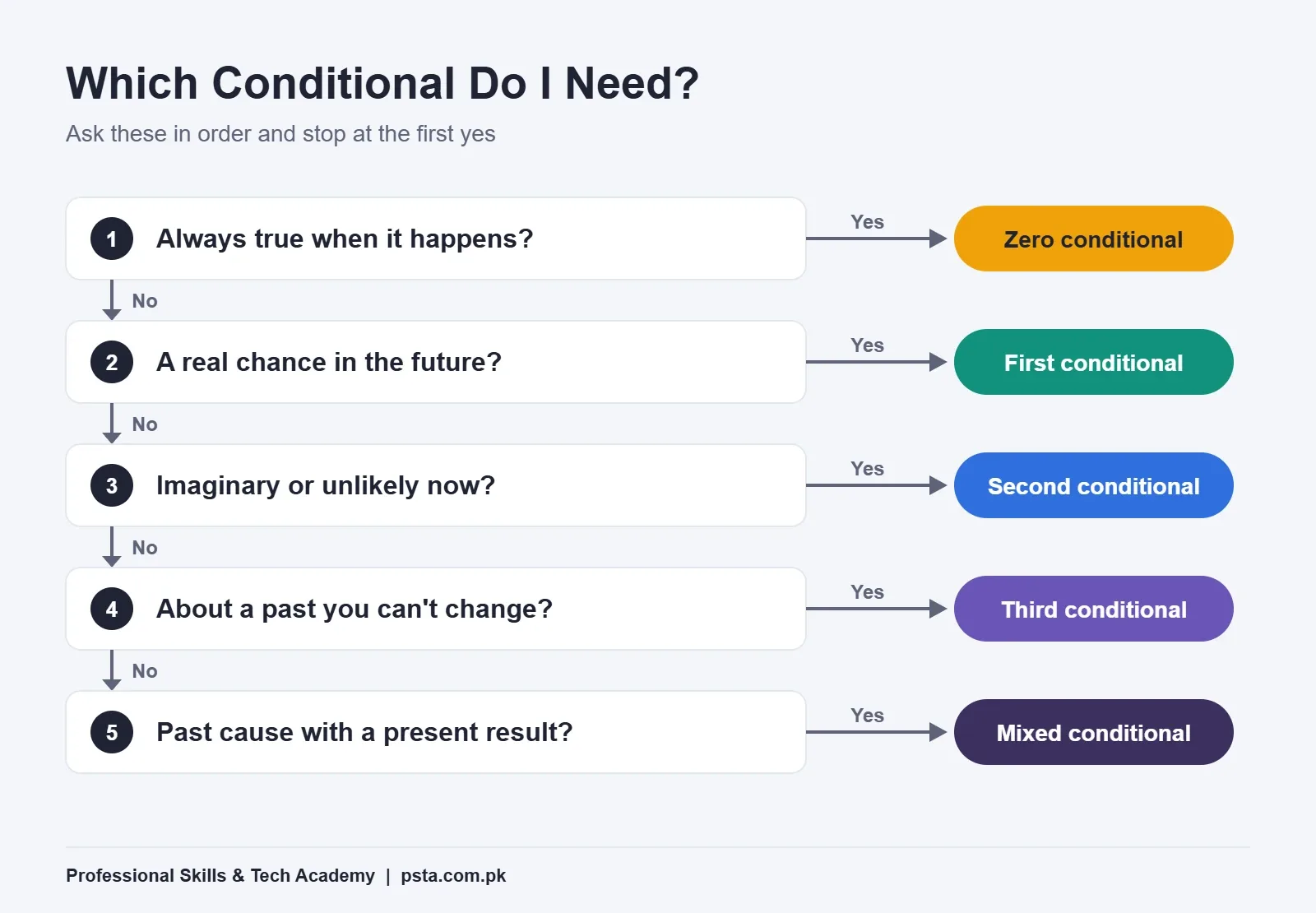
When you build conditional sentences in a live conversation, you won't have time to recall a table. Run through these questions in order instead:
- Is the result always true when the condition happens? Use zero.
- Is it a real possibility in the future? Use first.
- Is it imaginary or unlikely now or later? Use second.
- Is it about a past that can't change? Use third.
- Does a past event affect the present, or a present fact explain the past? Use mixed.
Try it with one idea. "Learn freelancing" can become a zero conditional about a habit, a first conditional about your plan this winter, a second about a dream, or a third about a missed chance. Saying the same idea four ways is one of the fastest drills we know for making the choice feel natural.
Mistakes Pakistani Learners Make With If-Clauses
Most errors in conditional sentences come from translating "agar ... to" straight from Urdu, or from carrying a future idea into the wrong clause. Here are six errors our teachers mark again and again:
| Common mistake | Corrected sentence | Why |
|---|---|---|
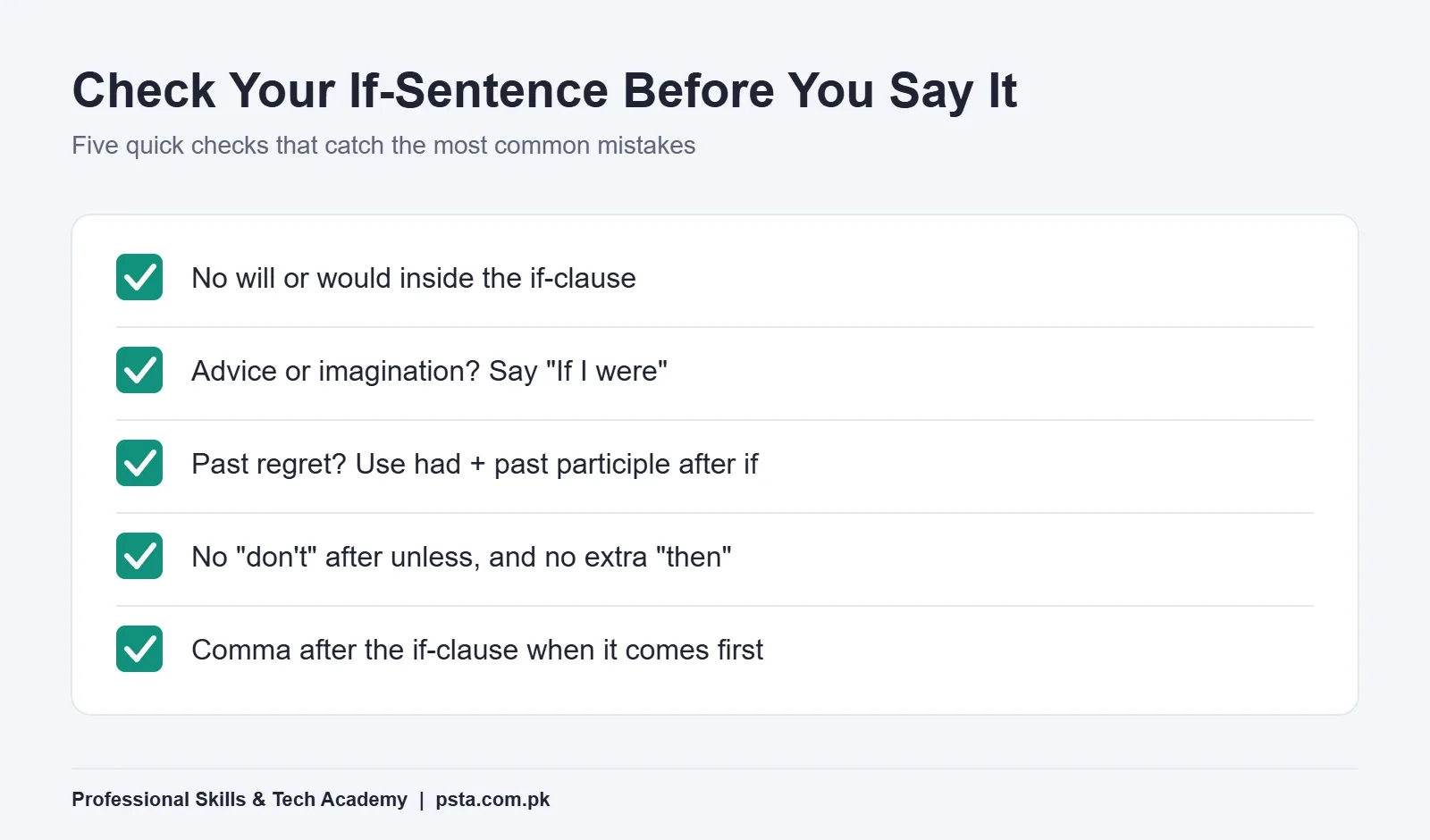
| If I will pass, I will join. | If I pass, I will join. | The if-clause stays in present simple for a real future. |
| If I would have known, I would have come. | If I had known, I would have come. | The third conditional needs past perfect after if. |
| If I was you, I will apply. | If I were you, I would apply. | Advice is imaginary, so use were and would. |
| If you will come, then I will go. | If you come, I'll go. | English doesn't need "then" in most if-sentences. |
| Unless you don't call, I won't wait. | Unless you call, I won't wait. | Unless already means "if not." |
| If I would have money, I would buy it. | If I had money, I would buy it. | Would belongs in the main clause, not the if-clause. |
One more habit to drop is mixing the second and third types halfway through: "If I had a car, I would have gone." If the car is about now, say "If I had a car, I would go." If it's about last week, say "If I had had a car, I would have gone." Yes, "had had" is correct English, and it's worth getting used to the sound of it.
Practice Set: Ten Sentences to Fix
Correct each of these conditional sentences, then check the answers below. Say every corrected version out loud twice. Writing it isn't enough, because the speaking habit is what you're training.
- If the internet will stop, I will use mobile data.
- If I would be rich, I would open a school.
- If she had came on time, she would have met the manager.
- If you mix blue and yellow, you will get green always.
- Unless you don't submit the form, you can't sit the test.
- If I was the principal, I will change the timetable.
- If he had took the course, he would be confident now.
- If you will need help, call me.
- If they would have asked, I would have helped.
- If I knew about the sale, I would have bought two.
Answers: 1. If the internet stops, I'll use mobile data. 2. If I were rich, I'd open a school. 3. If she had come on time, she would have met the manager. 4. If you mix blue and yellow, you get green. 5. Unless you submit the form, you can't sit the test. 6. If I were the principal, I would change the timetable. 7. If he had taken the course, he would be confident now. 8. If you need help, call me. 9. If they had asked, I would have helped. 10. If I had known about the sale, I would have bought two.
Score yourself honestly. Eight or more means you're ready for mixed conditionals. Fewer than six means it's worth another week on the first and second types before you move on. For related grammar that feeds straight into this, our English tenses chart and the guide to modal verbs in English are good next reads.
Where Conditionals Fit in PSTA's Spoken English Course
Conditional sentences sit inside the "Tenses & Grammar Usage in Speaking" module of PSTA's English Spoken & Grammar Course. It's a 12-week, beginner-level program, and the course page currently lists the fee as Rs. 12,000 (down from Rs. 14,000). You can join at our Abbottabad campus, live online from anywhere in Pakistan, or in a mix of both.
Classes run Monday to Saturday between 9:00 AM and 9:30 PM, and a new batch starts each month. Grammar isn't taught in isolation. You'll practice conditionals in role plays, mock interviews and group discussions, which is where "If I were you" and "If I had known" start coming out without effort. At the end, each student gives a short presentation and sits an assessment for the certificate. If office work is your goal, the 4-week English and Urdu typing course pairs well with it.
If you also need English for interviews, see our list of English interview questions and answers. When you're ready, the admission form takes a few minutes, or browse all PSTA courses first. You can also ask about batch timings on WhatsApp at +92 314 5424399, or visit us in Mandian, Old College Road, opposite FIMS College.
Say Three If-Sentences Out Loud Tonight
Pick one real situation from your week, such as a job interview, an exam or a family plan. Build three conditional sentences around it. Say one first conditional about what will happen, one second conditional about what you'd do differently in a perfect world, and one third conditional about something from last year. Record them on your phone and listen once. You'll hear which verb forms still feel uncertain, and that tells you exactly what to practice tomorrow.
Frequently asked questions
How many types of conditional sentences are there in English?
Most grammar courses teach five patterns: zero, first, second, third and mixed. Zero covers facts and rules, first covers a real future, second covers imaginary or unlikely situations, and third imagines a different past. Mixed conditionals join a past condition to a present result, or the reverse. Learn the first three well before you move on to mixed ones.
Can I use will in the if-clause?
In normal first conditional sentences, no. The if-clause stays in the present simple and will goes in the main clause, so you say "If it rains, we'll stay home," not "If it will rain." This is one of the most common errors Pakistani learners make, because the idea feels like the future when they think in Urdu.
Is "If I was you" wrong?
It's common in casual speech, and the British Council notes that was is often heard, especially with he and she. However, "If I were you" is the standard form for advice. Use were in exams, interviews, formal emails and presentations, where a polished choice makes a better impression on the reader or listener.
What is the difference between the second and third conditional?
The second conditional imagines something now or in the future: "If I had time, I would help." The third conditional imagines a different past: "If I had had time, I would have helped." The second uses past simple and would. The third uses past perfect and would have plus the past participle.
Do I need a comma in conditional sentences?
When the if-clause comes first, put a comma after it: "If you call me, I'll answer." When the main clause comes first, you usually don't need one: "I'll answer if you call me." The meaning stays the same in both orders, so choose the order that reads more naturally.
What does unless mean in a conditional sentence?
Unless means "if not." "Unless you register by Monday, you'll miss the batch" means "If you don't register by Monday, you'll miss the batch." Because the negative is already inside the word, never add don't after unless. "Unless you don't pay" says the opposite of what you mean.
How long does it take to use conditionals correctly when speaking?
It depends on how often you practice out loud. Knowing the rules takes a few days, but saying them correctly without thinking takes regular speaking practice. Short daily drills, such as saying one idea in all four types, help far more than reading rules again. Recording yourself also shows which forms still feel uncertain.
Sources & references
- British Council LearnEnglish: Conditionals, Zero, First and Second learnenglish.britishcouncil.org
- British Council LearnEnglish: Conditionals, Third and Mixed learnenglish.britishcouncil.org
- Grammarly: The 4 Types of Conditional Sentences grammarly.com
- EF English Proficiency Index: Pakistan ef.com
- EF EPI 2026: Global English Proficiency Declines for Fifth Consecutive Year ef.edu
Last reviewed & updated on by Umar Qureshi. Written by the PSTA team in Abbottabad, Pakistan.

Umar Qureshi

English Spoken & Grammar Course in Pakistan – Build Confidence, Speak Fluently (Online & Campus)
Turn this guide into a career: hands-on training with real projects, online across Pakistan or on-campus in Abbottabad · 12 Weeks.
Comments
No comments yet — ask a question or share your experience.