Quick answer
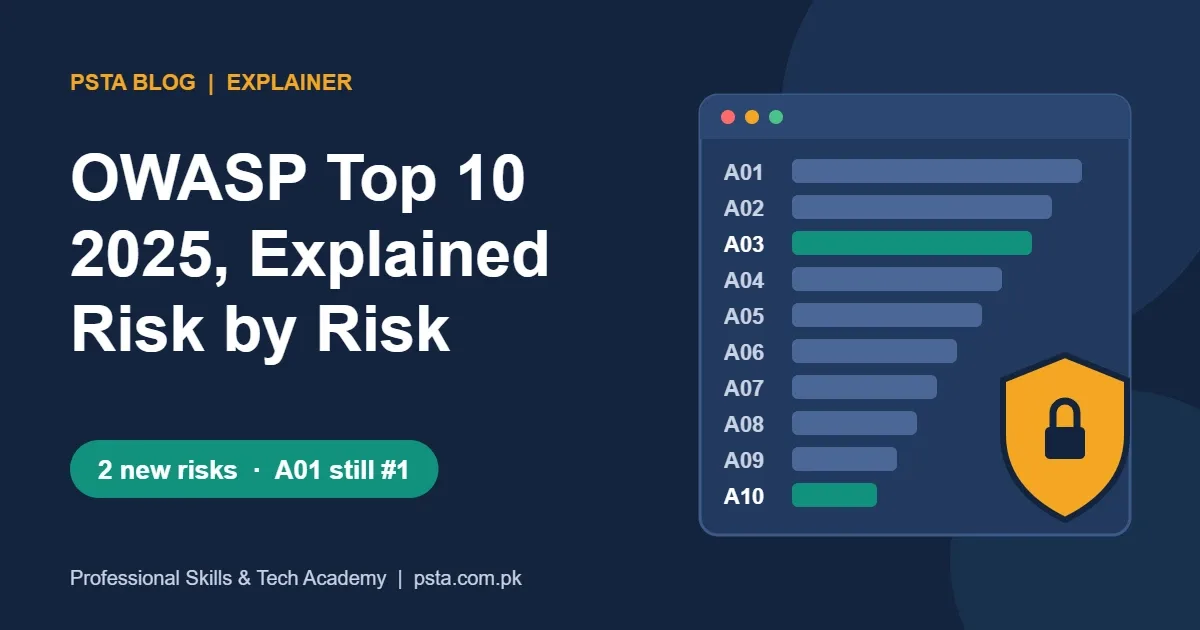
The OWASP Top 10 2025 is the latest list of the ten biggest web application security risks, based on data from over 2.8 million applications. Broken Access Control stays first, Security Misconfiguration rises to second, and two categories are new: Software Supply Chain Failures (A03) and Mishandling of Exceptional Conditions (A10).
Key takeaways
- • Broken Access Control is still A01, and SSRF has been merged into it.
- • Security Misconfiguration climbed from fifth place in 2021 to second in 2025.
- • Software Supply Chain Failures (A03) and Mishandling of Exceptional Conditions (A10) are the two new categories.
- • Eight categories were ranked from testing data and two were promoted by a community survey.
- • SBP's mobile app guidelines echo several of these risks, which makes the list useful in Pakistani fintech interviews.
- • Start with free PortSwigger labs, test only what you have permission to test, and write every finding as a report.
Table of contents 22 sections
- What Is the OWASP Top 10, and Who Uses It?
- How the OWASP Top 10 2025 Ranking Was Built
- The OWASP Top 10 2025 List at a Glance
- What Changed Since the 2021 Edition?
- A01 to A03: Access, Configuration and the Supply Chain
- A01 Broken Access Control
- A02 Security Misconfiguration
- A03 Software Supply Chain Failures
- A04 to A06: Cryptography, Injection and Design
- A04 Cryptographic Failures
- A05 Injection
- A06 Insecure Design
- A07 to A10: Logins, Integrity, Alerts and Errors
- A07 Authentication Failures
- A08 Software or Data Integrity Failures
- A09 Security Logging and Alerting Failures
- A10 Mishandling of Exceptional Conditions
- Why Does the OWASP Top 10 2025 Matter in Pakistan?
- Common Misreadings of the List
- How Can You Learn to Test for These Risks?
- Studying Web App Testing at PSTA
- Pick One Category and Break a Practice App This Week
The OWASP Top 10 2025 is the newest ranking of the most serious security risks in web applications, and it was built from data on more than 2.8 million applications. Broken Access Control is still number one. Two categories are new this time: Software Supply Chain Failures and Mishandling of Exceptional Conditions.
If you're learning ethical hacking, building websites, or preparing for a web application security interview, this list is the shared vocabulary you'll hear everywhere. Here's what this guide covers:
- What each of the ten categories means, in plain words with one small example each
- Exactly what moved, merged or got renamed since the 2021 edition
- Why the list matters for banks, fintech apps and small business sites in Pakistan
- Free ways to practice finding these flaws legally
- A sensible order for learning web application testing from scratch
What Is the OWASP Top 10, and Who Uses It?
OWASP, the Open Worldwide Application Security Project, is a nonprofit community that publishes free security guidance. Its Top 10 is the project most people know, and the OWASP Top 10 2025 is what the official write-up calls the 8th installment.
The authors describe it as a data-driven awareness document, according to The Register's report from its launch at Global AppSec USA. That wording matters. It's a way to decide what to fix and learn first. It isn't a full testing checklist, and passing "the Top 10" doesn't make an app secure.
In practice, you'll see it used by four groups:
- Developers use it to know which mistakes to avoid in code reviews.
- Penetration testers use the category names in reports, so clients can compare findings.
- Managers and auditors use it to ask vendors pointed questions.
- Trainers and students use it as the backbone of web security courses.
How the OWASP Top 10 2025 Ranking Was Built
The official OWASP introduction explains the method. Contributors donated testing data covering over 2.8 million applications. The team looked at 589 weakness types (CWEs) in that data, and the final ten categories hold 248 of them. Each category is capped at 40 CWEs.
Eight categories come straight from the data. Two were promoted by a community survey, because practitioners felt the data underplayed them. Those two are A03 Software Supply Chain Failures and A09 Security Logging and Alerting Failures. Frequency is counted per application, so one app with 50 copies of the same bug still counts once.
The OWASP Top 10 2025 List at a Glance
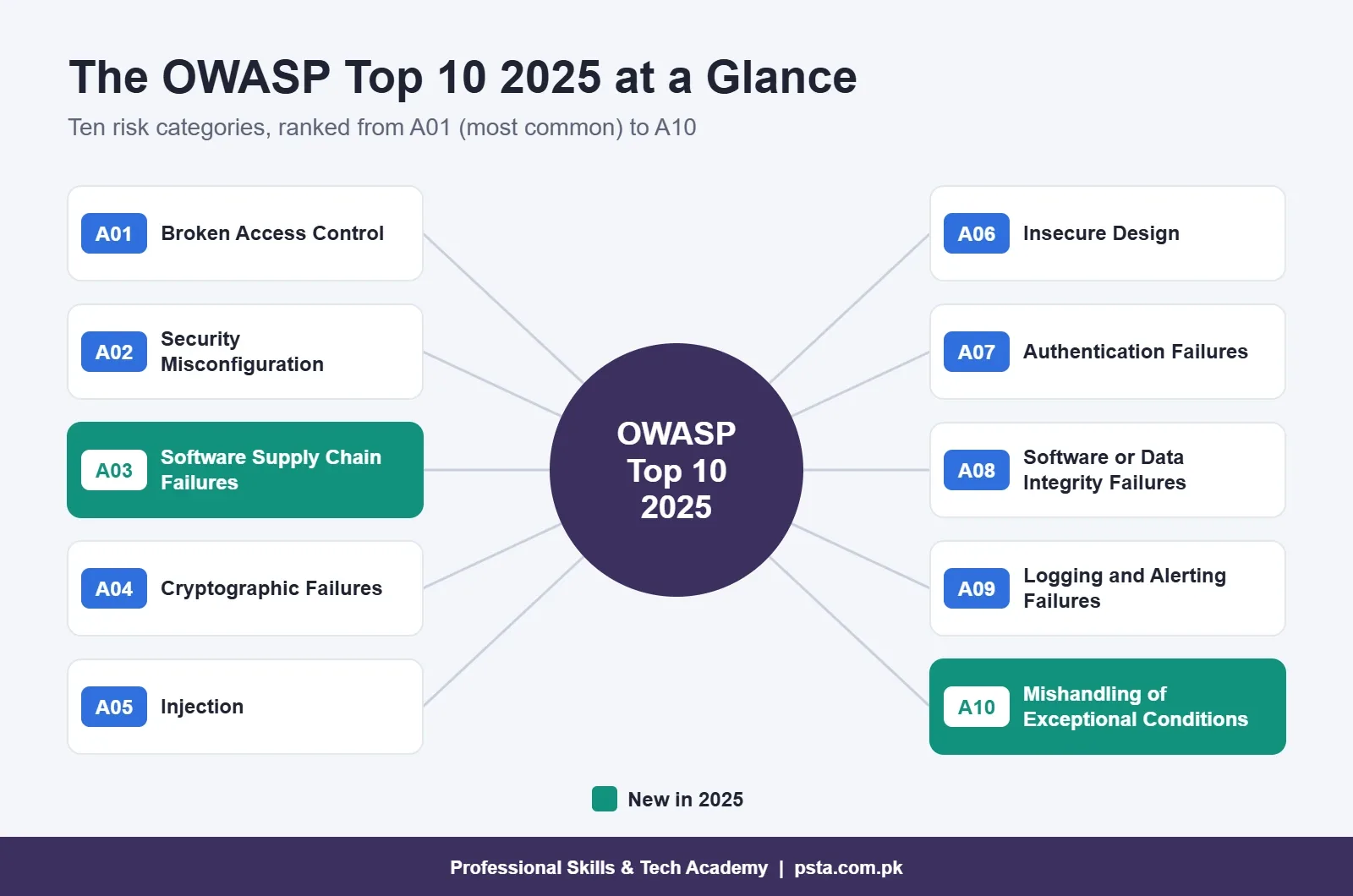
Here's the full OWASP Top 10 2025 list with the change from 2021 and a one-line meaning you can remember. Scroll back to it whenever a category name below feels unfamiliar.
| Rank | Category | Change From 2021 | What It Means in One Line |
|---|---|---|---|
| A01 | Broken Access Control | Still #1, now includes SSRF | Users can see or do things they shouldn't |
| A02 | Security Misconfiguration | Up from #5 | Unsafe defaults, open admin panels, verbose settings |
| A03 | Software Supply Chain Failures | New (expands Vulnerable and Outdated Components) | Risk arriving through libraries, tools and updates |
| A04 | Cryptographic Failures | Down from #2 | Weak, missing or misused encryption |
| A05 | Injection | Down from #3 | Untrusted input runs as code or a query |
| A06 | Insecure Design | Down from #4 | The plan itself has a security gap |
| A07 | Authentication Failures | Same rank, renamed | Logins and sessions can be bypassed or abused |
| A08 | Software or Data Integrity Failures | Same rank | Code or data is trusted without checking it |
| A09 | Security Logging and Alerting Failures | Same rank, renamed | Attacks happen and nobody gets told |
| A10 | Mishandling of Exceptional Conditions | New | The app breaks unsafely when something unexpected happens |
What Changed Since the 2021 Edition?
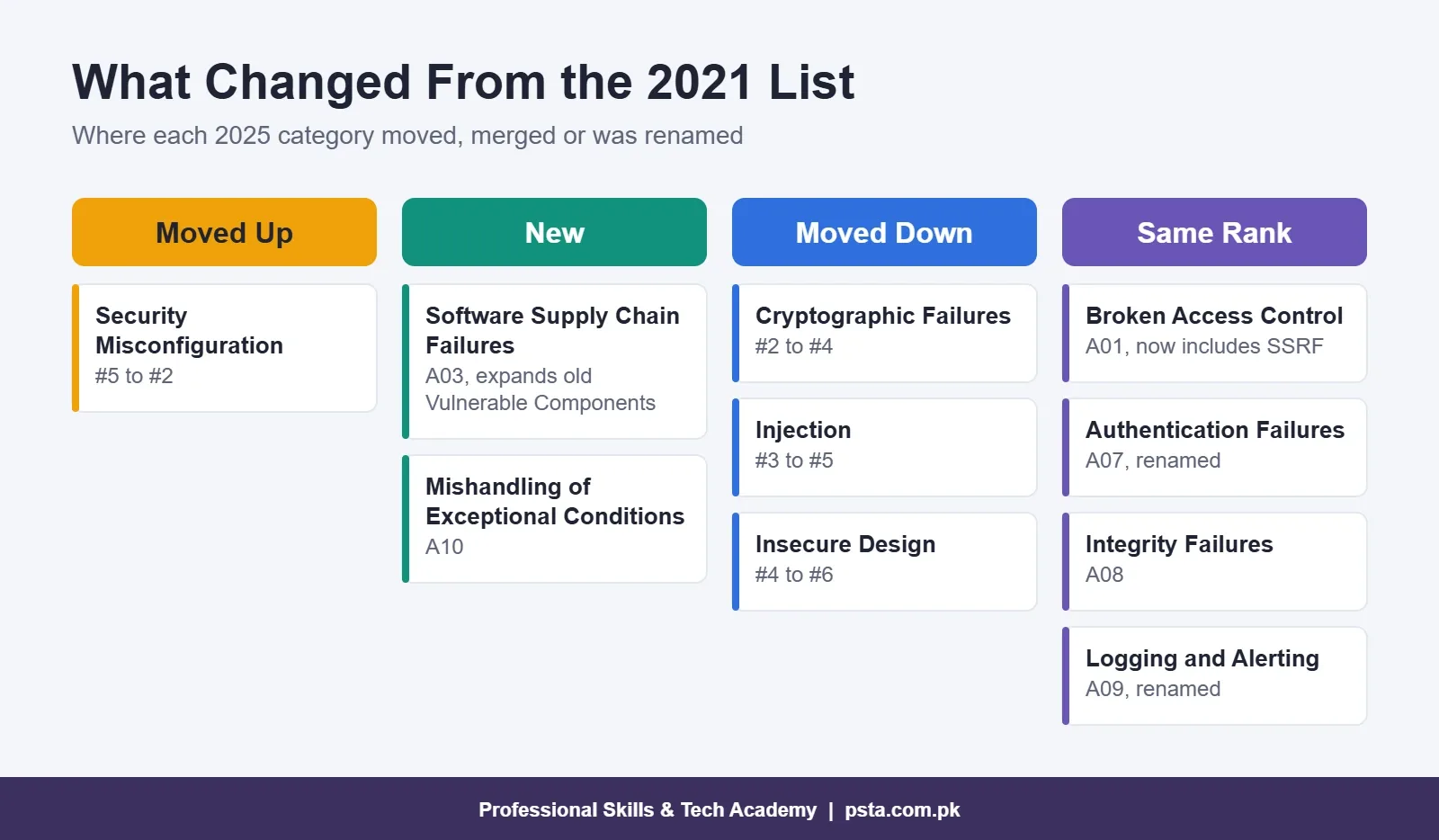
If you studied the 2021 list in university or for CEH, you don't need to start over to learn the OWASP Top 10 2025. Four categories kept their positions, and most of the rest shifted by two or three places. These are the changes worth memorizing:
- SSRF disappeared as its own item. Server-Side Request Forgery was folded into Broken Access Control.
- Security Misconfiguration jumped from #5 to #2. The Register's report links this to more of an application's security living in configuration files and cloud settings.
- Supply chain risk got a wider frame. The old "Vulnerable and Outdated Components" item became Software Supply Chain Failures, covering how software is built, shipped and updated, not only old versions.
- Injection slid from #3 to #5. It still includes SQL injection and cross-site scripting. Lower rank doesn't mean low risk.
- Two names changed. "Identification and Authentication Failures" is now Authentication Failures, and "Monitoring" became "Alerting" in A09 to stress that someone has to be notified.
- A10 is brand new. Mishandling of Exceptional Conditions covers what an app does when things go wrong.
A01 to A03: Access, Configuration and the Supply Chain
A01 Broken Access Control
This is the "can this user really do this?" category. The OWASP A01 page says every tested application had some form of it, with an average incidence rate of 3.74% and over 1.8 million occurrences in the data.
A simple example: a school portal shows your result at /result?roll=1042. You change the number to 1043 and see a classmate's marks. The server never checked that roll 1043 belongs to you. Another version is an admin page that's hidden from the menu but opens for anyone who types its address.
The main fix OWASP gives is short: deny by default, except for public resources. Put access checks in server-side code once and reuse them, rather than hiding buttons in JavaScript.
A02 Security Misconfiguration
Misconfiguration means the code may be fine, but the settings around it aren't. Think default admin passwords on a hosting panel, directory listing switched on, a cloud storage bucket set to public, or debug mode left running on a live site. These are dull mistakes, and that's exactly why they're common.
A03 Software Supply Chain Failures
Modern apps pull in dozens of outside packages. If one of them is outdated, abandoned or deliberately poisoned, your app inherits the problem. The OWASP A03 page notes that exactly 50% of survey respondents ranked this category first.
OWASP lists real cases, including the Log4Shell flaw in Log4j and a 2025 npm worm called Shai-Hulud that spread through stolen publishing tokens. For a WordPress developer in Abbottabad, the everyday version is a nulled theme or a plugin nobody has updated in two years.
A04 to A06: Cryptography, Injection and Design
A04 Cryptographic Failures
This covers data that should be protected but isn't. Examples include passwords stored in plain text or with a weak hash, a login form served over plain HTTP, or encryption keys committed to a public GitHub repository. The question to ask is simple: if someone copied this database or sniffed this traffic, what could they read?
A05 Injection
Injection happens when user input is treated as part of a command. In SQL injection, a search box passes text straight into a database query. In cross-site scripting, a comment field accepts a script that then runs in other visitors' browsers. Parameterized queries and proper output encoding prevent most of it.
A06 Insecure Design
Some flaws can't be patched with one line of code because the design itself is wrong. Picture a password reset that only asks for a CNIC number and date of birth, both of which are easy to find. The code may work perfectly and still be unsafe. Threat modeling before you build is the cure here.
A07 to A10: Logins, Integrity, Alerts and Errors
A07 Authentication Failures
This is about proving who someone is. Common problems are no limit on login attempts, weak password rules, session cookies that never expire, and missing multi-factor authentication on admin accounts. If an attacker can guess or reuse their way into an account, it belongs here.
A08 Software or Data Integrity Failures
Integrity failures happen when an app trusts code or data without checking where it came from. An auto-update that downloads over an unsigned channel is one example. Another is an app that accepts a serialized object from the browser and rebuilds it on the server without validation.
A09 Security Logging and Alerting Failures
Logs alone don't stop anything. If failed logins, access-control errors and odd admin actions are written to a file that nobody reviews, an attack can run for weeks. The rename to "Alerting" pushes teams to make sure a real person gets a warning in time to act.
A10 Mishandling of Exceptional Conditions
The OWASP A10 page describes this as failing to prevent, detect or respond to unexpected situations. It maps 24 CWEs, with an average incidence rate of 2.95%.
Two examples from OWASP make it clear. A database error that prints full system details hands an attacker a map for a targeted SQL injection. A money transfer that's interrupted halfway, without a full rollback, may let someone send funds more than once. The safe rule is to fail closed: if a multi-step action breaks, undo all of it.
Why Does the OWASP Top 10 2025 Matter in Pakistan?
Banks, wallets and fintech apps in Pakistan handle money and personal data every day, and regulators expect them to be tested. When the State Bank of Pakistan issued mobile app security guidelines, ProPakistani's summary listed requirements such as encryption in transit and at rest, security testing of APIs before go-live, and error messages that don't reveal sensitive information.
Read those again with the OWASP Top 10 2025 table in mind. They map neatly to A04, A01 and A10. If you can explain an SBP-style requirement in OWASP terms, you'll sound much more prepared in a bank or fintech interview.
Senior jobs in penetration testing in Pakistan ask for proof of skill too. A recent penetration tester opening at TPL Insurance in Karachi asked for five to eight years of experience and listed OSCP and CEH as preferred certifications. That's a reminder that the OWASP Top 10 2025 is the starting line, not the finish.
For freelancers, the list is also a selling language. A small business owner may not know the term "broken access control", but "anyone could open other customers' invoices by changing a number" is a finding they understand. If you build sites, our WordPress security checklist applies several of these categories to client websites.
Common Misreadings of the List
Students often draw the wrong conclusions from the OWASP Top 10 2025 ranking. Watch out for these:
- "Injection dropped, so I can skip it." It's still in the top half, and SQL injection remains one of the first things testers check.
- "Number one is the most dangerous bug." The rank blends how often a weakness shows up with exploit and impact scores. A rarer flaw can still cause more damage on a given app.
- "Fixing all ten means the app is secure." It's an awareness list. Business logic flaws and app-specific risks won't always fit neatly into it.
- "It only applies to big websites." A five-page clinic site with a contact form and an old plugin can hit A02, A03 and A05 at once.
How Can You Learn to Test for These Risks?
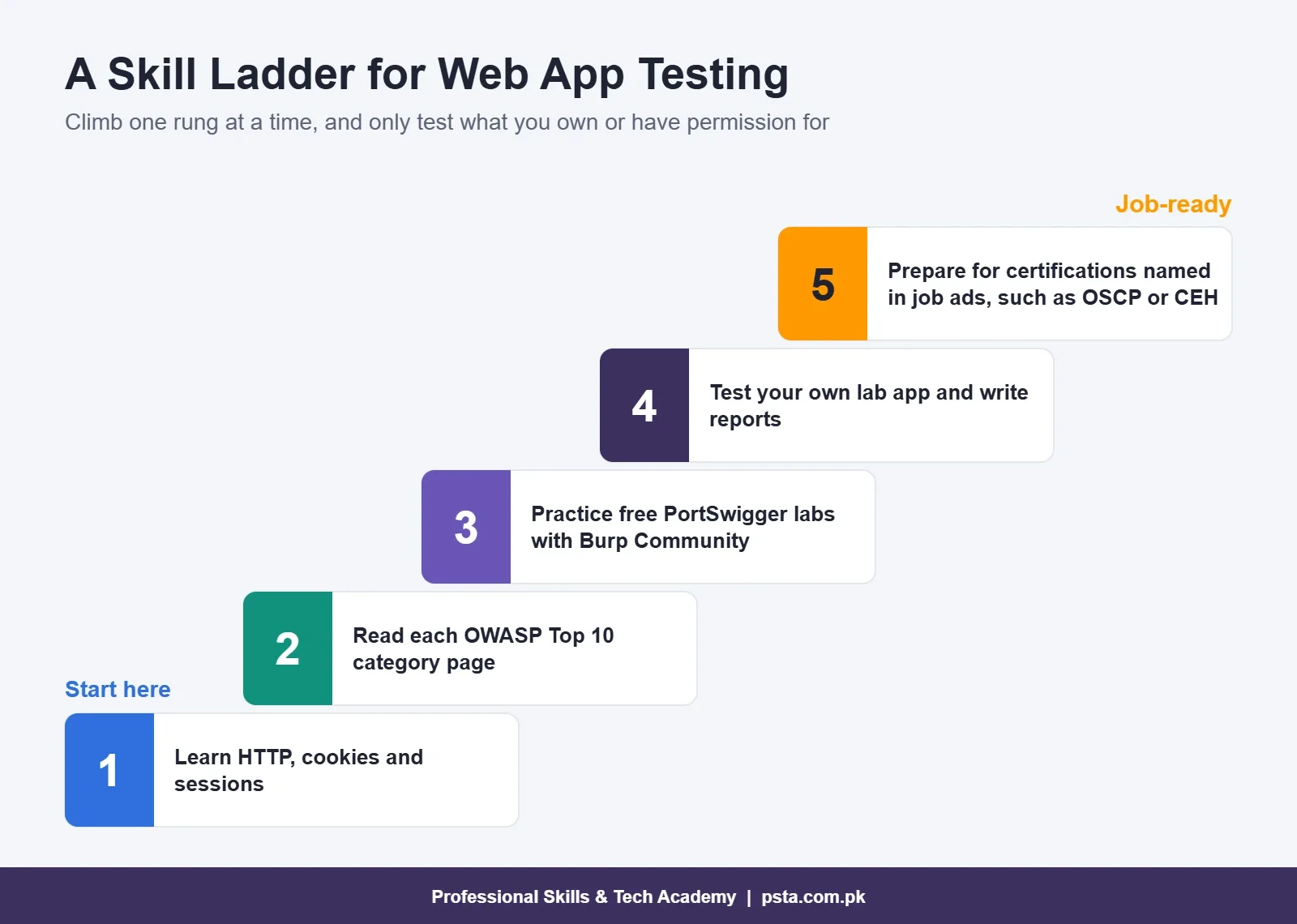
You don't need expensive tools to start. You do need patience, a lab, and the habit of only testing what you're allowed to test. This order works well for most of my students:
- Understand how the web works. Learn HTTP requests and responses, cookies, sessions and status codes. Basic HTML and JavaScript help a lot.
- Read the official pages. Plenty of blogs have the OWASP Top 10 explained in summary form, but go through each official category page once anyway, focusing on the example attack scenarios.
- Practice on free labs. PortSwigger's Web Security Academy says it's 100% free and includes labs on SQL injection, XSS, access control and more. It pairs with the free Burp Suite Community Edition.
- Build your own target. Set up an isolated lab, as in our ethical hacking lab setup guide, and test a deliberately vulnerable app you control.
- Write findings like a professional. For each bug, record the OWASP category, the steps to reproduce, the impact and the fix. Two or three clean sample reports make a stronger portfolio than a list of tools.
- Move to real programs carefully. Once your reports are solid, our bug bounty roadmap explains how to pick programs and stay within scope. For certifications, see which cyber security certification to take first.
One rule doesn't bend: never test a website, app or network without written permission from its owner. Pakistan's Prevention of Electronic Crimes Act 2016 applies to unauthorized access, and "I was only learning" isn't a defense.
Studying Web App Testing at PSTA
PSTA's ethical hacking and penetration testing program is a 12-week, intermediate-level course. Module 8 is dedicated to web application testing: the OWASP Top 10, manual and automated SQL injection with SQLmap, reflected, stored and DOM-based XSS, parameter tampering, directory traversal, and Burp Suite for full assessments.
The other modules cover reconnaissance, Nmap and Nessus scanning, Metasploit, wireless testing, and a final module on writing penetration test reports and setting up HackerOne, Bugcrowd, Fiverr and Upwork profiles. The listed fee on the course page is Rs. 30,000, reduced from Rs. 37,000. Students near Hazara usually sit the lab sessions on campus, while learners in other cities join the same lectures live online, and some switch between the two. New batches open every month.
If you'd rather begin with defense, firewalls and incident response, the Cyber Security and Ethical Hacking course is the better first step. Developers who want to write safer code can look at our Full-Stack Web Development with AI course. You can compare all options on the courses page.
Pick One Category and Break a Practice App This Week
Don't try to master all ten at once. Choose A01 Broken Access Control, since it's both the top risk and the easiest to understand. Spend this week on the access control labs, then write one short report for one flaw you found, using the format from step 5.
When you're ready for structured practice with an instructor checking your reports, the admission page has the steps. Quick questions about batch timings can go to +92 314 5424399 on WhatsApp.
Frequently asked questions
How often is the OWASP Top 10 updated?
There's no fixed schedule. The 2025 list is the 8th edition, and the two before it came out in 2017 and 2021, so a new version has tended to appear every three to four years. OWASP collects fresh testing data and runs a community survey before each release, which is why updates take time.
Where did SSRF go in the 2025 list?
Server-Side Request Forgery is no longer a separate category. In the 2025 edition it was merged into A01 Broken Access Control. You'll still test for SSRF in exactly the same way, but in a report you would now place the finding under A01 rather than under its own heading.
Is the OWASP Top 10 a security standard I can certify against?
No. Its authors describe it as a data-driven awareness document that helps teams decide what to fix first. It doesn't list every test an application needs, so passing a Top 10 review doesn't prove an app is secure. Treat it as a starting map for learning and for prioritizing fixes.
Which tool should I learn first for OWASP testing?
Start with Burp Suite Community Edition, which is free and is the tool PortSwigger's free labs are built around. It lets you intercept and change requests between your browser and a web app, which is how you find most access control, injection and session problems. Learn your browser's developer tools alongside it.
Do I need to know programming to learn web application testing?
You don't need to be a developer, but basic HTML, JavaScript and SQL make a big difference. Without them, injection and access control bugs are hard to understand. Many students learn enough by reading small code samples and editing requests in Burp Suite, then pick up Python later for simple scripts.
Is it legal to practice hacking on real websites in Pakistan?
Only with clear written permission from the owner, or inside a bug bounty program's published scope. Testing a site without permission can fall under the Prevention of Electronic Crimes Act 2016. Use your own lab, deliberately vulnerable apps and free online labs until you're ready for authorized programs.
Is the OWASP Top 10 enough to get a penetration testing job?
It's the foundation, not the whole picture. Employers also look for networking basics, Linux skills, hands-on lab work and well-written reports. Senior roles in Pakistan often list certifications such as OSCP or CEH as preferred. Knowing the Top 10 well helps most in junior interviews and freelance client conversations.
Sources & references
- OWASP Top 10:2025 Introduction top10.owasp.org
- OWASP A01:2025 Broken Access Control top10.owasp.org
- OWASP A03:2025 Software Supply Chain Failures top10.owasp.org
- OWASP A10:2025 Mishandling of Exceptional Conditions top10.owasp.org
- The Register: Broken access control still tops OWASP list theregister.com
- PortSwigger Web Security Academy portswigger.net
- ProPakistani: SBP security guidelines for mobile payment apps propakistani.pk
- Penetration Tester job posting, TPL Insurance (Workable) jobs.workable.com
Last reviewed & updated on by Umar Qureshi. Written by the PSTA team in Abbottabad, Pakistan.

Umar Qureshi

Advanced Ethical Hacking & Penetration Testing Course in Abbottabad
Turn this guide into a career: hands-on training with real projects, online across Pakistan or on-campus in Abbottabad · 12 Weeks.
Comments
No comments yet — ask a question or share your experience.