Quick answer
Meta ads campaign objectives tell Meta which result to find for you. Choose Sales when your website or app can report purchases, Leads for phone numbers and forms, Traffic for real page visits, Engagement for chats and video views, Awareness for reach, and App Promotion only if you have an app.
Key takeaways
- • Meta now has six objectives: Awareness, Traffic, Engagement, Leads, App Promotion and Sales.
- • Old options such as Messages and Video Views now sit inside these objectives as goals or conversion locations.
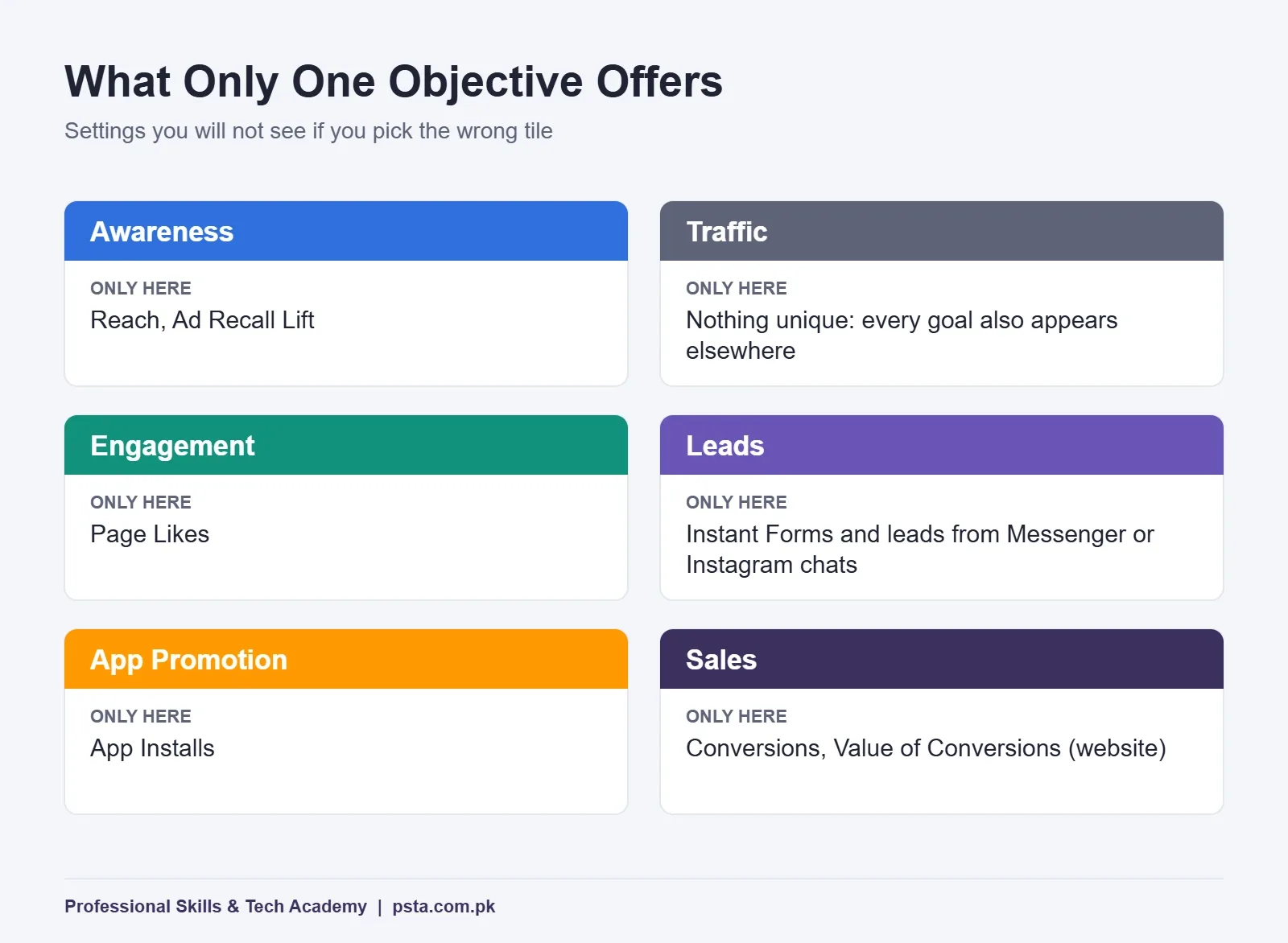
- • Some settings appear under one objective only, such as Page Likes in Engagement and Instant Forms in Leads.
- • Sales works properly only when the Pixel or Conversions API sends purchase events to Meta.
- • You cannot change the objective of a live campaign; duplicate it and pick a new one.
- • Choose an objective whose result happens often enough for your budget to exit the learning phase.
Table of contents 17 sections
- What Are Meta Ads Campaign Objectives?
- Where Did the Old Objectives Go?
- Meta Ads Campaign Objectives Mapped to the Customer Funnel
- The Six Objectives One by One
- Awareness
- Traffic
- Engagement
- Leads
- App Promotion
- Sales
- What Only One Objective Can Do
- Which Objective Should a Pakistani Business Choose?
- How Many People Can Your Ads Reach in Pakistan?
- Can You Switch Objectives Once a Campaign Is Live?
- Why Your Objective Needs Enough Results: The Learning Phase
- Practicing Campaign Setup in PSTA's Social Media Marketing Course
- A Five-Minute Exercise for Your Next Login
Which objective should you pick when Ads Manager shows you six tiles? It's one of the first questions new students raise in a Meta ads class. The short answer: Meta ads campaign objectives tell the system what result you're paying it to find, so pick the one that matches the action you can actually measure. A clothing store that tracks purchases on its website picks Sales. A tuition academy that wants phone numbers picks Leads. A new brand that only needs to be noticed picks Awareness.
This guide explains each objective in plain words, with examples from the kinds of businesses you see in Pakistan. In the next few minutes you will learn:
- What each of the six objectives asks Meta to optimize for
- Which settings appear under only one objective, so a wrong pick can hide the option you need
- How to match a shop, clinic, academy or online store to the right objective
- Why you can't switch objectives on a live campaign, and what to do instead
- How many people Meta says your ads can reach in Pakistan
What Are Meta Ads Campaign Objectives?
Every campaign you build in Meta Ads Manager starts with one choice: the objective. It sits at the campaign level, above your ad sets and ads. Once you choose it, Meta uses it to decide which people in your audience should see the ad. If you ask for link clicks, the system looks for people who tend to click. If you ask for purchases, it looks for people who tend to buy.
That is why two campaigns with the same budget, audience and creative can produce very different results. The objective changes who gets shown the ad, not just what the report shows.
There are six objectives today. Awareness and Traffic come first in the list, followed by Engagement, Leads, App Promotion and Sales. Under each one you then choose a conversion location (where the action happens, such as a website or a chat) and a performance goal (the exact result Meta should chase, such as landing page views).
Where Did the Old Objectives Go?
If you watched an older YouTube tutorial, you probably saw names like Reach, Brand Awareness, Video Views, Messages, Conversions and Catalog Sales. Those were separate objectives once. In December 2021, Meta's developer blog announced it would fold its 11 objectives into six broader ones built around business outcomes. The same post said advertisers who mainly ran Conversions, Messages and Video Views campaigns would feel the change most.
A February 2023 update from Meta then confirmed that from Marketing API v17.0, new campaigns could only be created with the simplified objectives. It listed 15 older objective values as deprecated, including MESSAGES, VIDEO_VIEWS, PAGE_LIKES and CONVERSIONS. Old campaigns kept running, but nothing new could be built on them.
So the old options didn't vanish. They moved one level down. "Video views" is now a performance goal you can pick inside Awareness or Engagement. "Messages" became a conversion location you can pick inside several objectives. Once you see it that way, old tutorials stop being confusing.
Meta Ads Campaign Objectives Mapped to the Customer Funnel
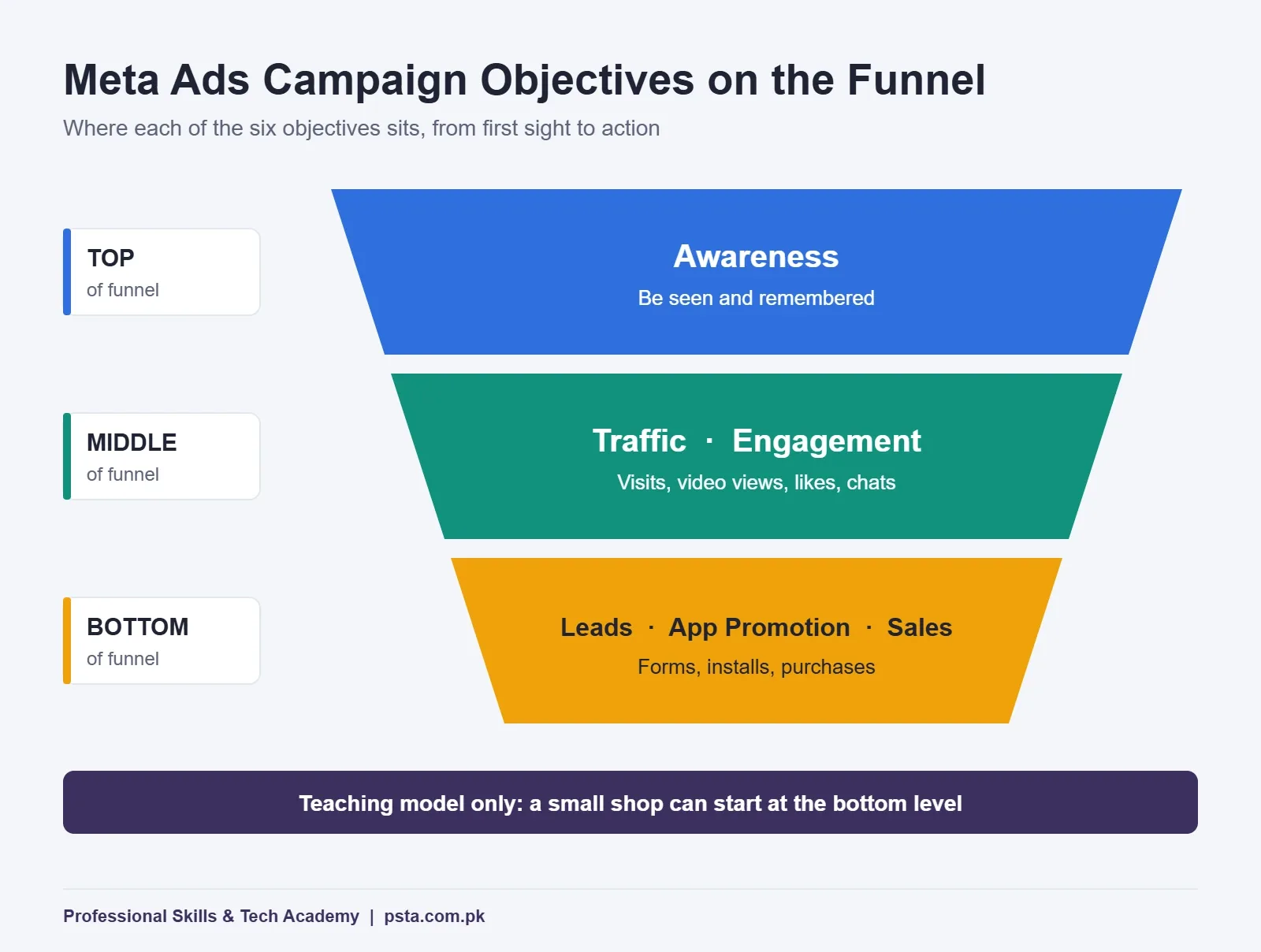
A simple way to remember the Meta ads campaign objectives is to place them on a funnel. At the top, people have never heard of you. In the middle, they are curious. At the bottom, they are ready to fill in a form, install an app or pay.
- Top: Awareness, for being seen and remembered.
- Middle: Traffic and Engagement, for visits, video views, likes and conversations.
- Bottom: Leads, App Promotion and Sales, for actions that have direct business value.
The funnel is a teaching model, not a rule. A small shop can run only a bottom-funnel campaign and do well. But the picture helps you notice when your objective and your real goal sit at different levels.
The Six Objectives One by One
The descriptions below draw on Meta's current setup as documented by Meta ads specialist Jon Loomer, who lists the conversion locations and performance goals each objective offers.
Awareness
Awareness asks Meta to show your ad to as many relevant people as possible, or to people most likely to remember it. Its performance goals include Reach, Ad Recall Lift, Impressions and video view goals such as ThruPlay. There is no conversion location, because you are not asking anyone to do anything yet.
Use it for a new branch opening, a seasonal launch, or a brand that already sells well and wants more people to recognize its name. Don't use it if you need to count orders. A 2026 objectives guide from Flighted gives the same warning: Awareness is the wrong pick when you need measurable conversions.
Traffic
Traffic sends people somewhere: a website, an app, a messaging app or a phone call. Its goals include Link Clicks, Landing Page Views, Conversations and Calls.
The catch is that a click is cheap and easy to get. Many clicks come from accidental taps. If you choose Traffic for a website, pick Landing Page Views rather than Link Clicks, so Meta counts only visits where the page actually loaded. Flighted recommends the same setting for that reason.
Engagement
Engagement asks for interaction. That can be a like, comment or share on the ad, a video view, a Page like, an event response or a conversation started in a messaging app. Page Likes is a goal you'll find only here.
Engagement with a messaging destination suits sellers whose customers like to ask "price?" in a chat before buying. That works when someone replies quickly. If your inbox sits unanswered for a day, you are paying to start conversations nobody finishes. Our guide to click-to-WhatsApp ads walks through that setup in detail.
Leads
Leads collects contact details. You can use Instant Forms (a form that opens inside Facebook or Instagram), Messenger or Instagram chats, your website, calls or an app. Instant Forms, and leads gathered through Messenger or Instagram chats, are available only under this objective.
This suits businesses where the sale happens later, by phone or in person: academies, clinics, real estate agents, car dealers and software firms. One more option, Conversion Leads, tries to find people likely to become customers after they submit a form. Flighted notes that it needs your lead outcomes sent back to Meta, usually through a CRM connection.
App Promotion
App Promotion is for installs and in-app actions. App Installs as a goal exists only here, and the only conversion location is an app. If you don't have an app on the Play Store or App Store, skip this tile entirely.
Sales
Sales asks Meta to find people likely to complete a purchase or another valuable action on your website, in your app, in a chat or on a call. Conversions and Value of Conversions (which aims for higher order value, not just more orders) are website-based goals that only Sales offers. Jon Loomer also points out that Meta now accepts any website conversion event under Sales, not only purchases.
The requirement is tracking. For website sales, Meta must receive the purchase event, which means a working Pixel and ideally the Conversions API. If you haven't set that up, follow our Meta Pixel setup guide first. Without it, a Sales campaign is guessing.
What Only One Objective Can Do
Here is the practical reason the first click matters. Some performance goals and conversion locations appear under just one objective. Pick the wrong tile and the setting you wanted simply won't be on the screen.
Traffic is the exception. Loomer notes that it has no goal of its own; everything it offers also appears under another objective. His advice is to decide the result you want first, then pick the objective that offers it. That's sound advice for beginners too.
Which Objective Should a Pakistani Business Choose?
The table below matches common business types to one of the Meta ads campaign objectives as a starting point. These are teaching examples, not rules. Your own tracking and sales process decide the final answer.
| Business (example) | What it really needs | Starting objective | Conversion location |
|---|---|---|---|
| Lawn and clothing store on Shopify with Pixel installed | Online orders | Sales | Website |
| Home-based food seller taking orders in chat | Order conversations | Engagement or Sales | Messaging apps |
| Tuition academy or computer institute | Names and phone numbers | Leads | Instant Forms or Messenger |
| Dental or skin clinic | Appointment calls | Leads or Traffic | Calls |
| Restaurant opening a new branch | Local people knowing it exists | Awareness | None |
| Blog or news site earning from page views | Real visits | Traffic | Website (Landing Page Views) |
| Ride or delivery startup with an app | Installs and first orders | App Promotion | App |
Notice how often the honest answer depends on tracking. The clothing store and the food seller want the same thing, which is sales. The store can prove its sales to Meta through the Pixel. The food seller usually can't, so a conversation is the closest result Meta can measure.
How Many People Can Your Ads Reach in Pakistan?
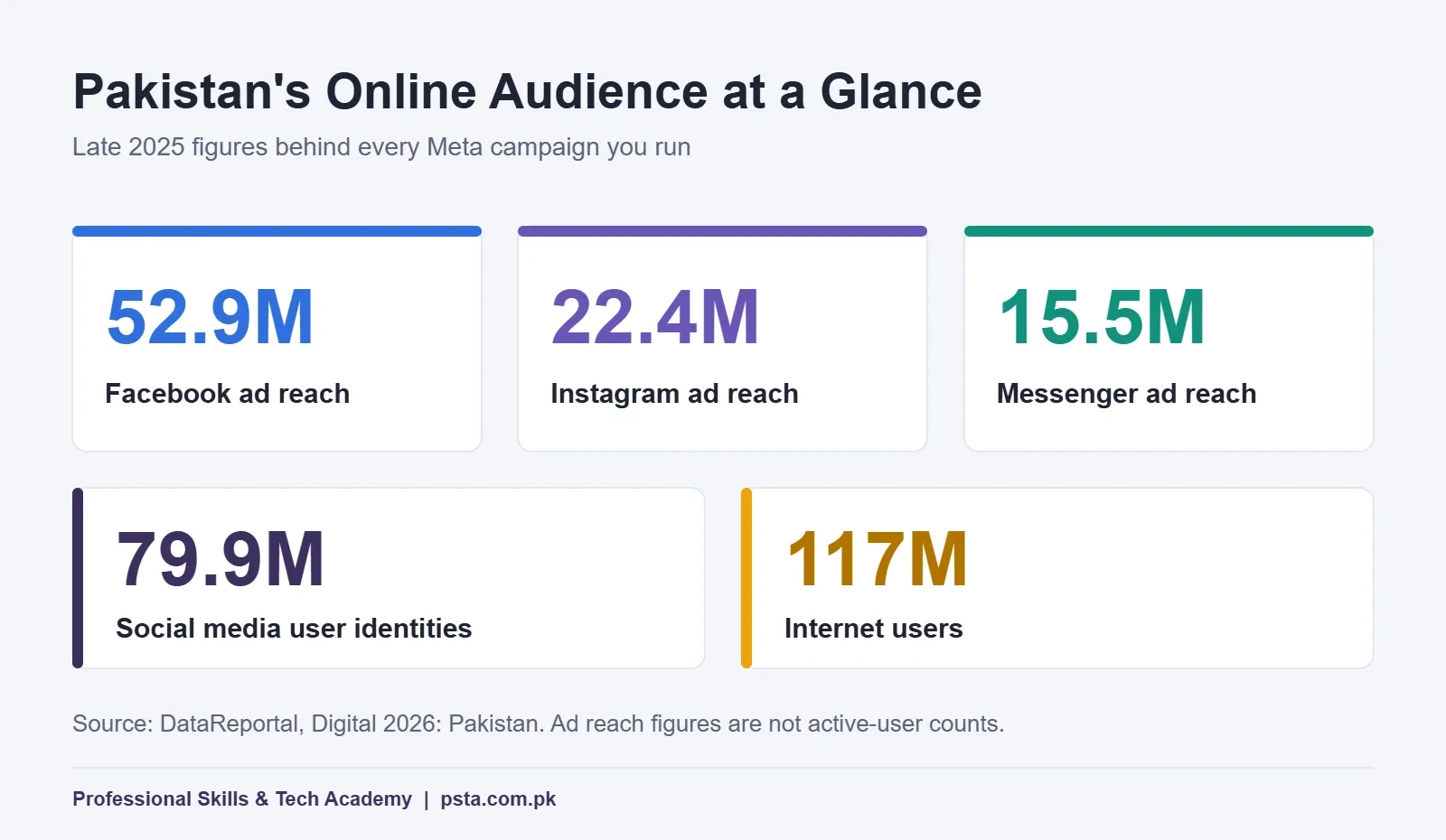
Before you worry about the objective, it helps to know the size of the room. According to DataReportal's Digital 2026: Pakistan report, Meta's tools showed 52.9 million people reachable with Facebook ads in late 2025. Instagram's ad reach was 22.4 million and Messenger's was 15.5 million. The same report counts 79.9 million social media user identities and 117 million internet users.
Two cautions. These are reach figures from Meta's ad tools, not counts of active people, and DataReportal warns they may not compare directly with older reports. Still, they suggest why Facebook placements can supply more volume for Pakistani campaigns, while Instagram's smaller audience can matter more for fashion, beauty and younger buyers.
Can You Switch Objectives Once a Campaign Is Live?
No. Once a campaign is published, its objective is locked. Flighted's guide confirms this and gives the usual workaround: duplicate the campaign and choose a new objective on the copy.
Keep three habits because of this:
- Decide before you build. Write the one result you'll judge the campaign by on paper first. If it's "orders," your objective is Sales. If it's "phone numbers," it's Leads.
- Expect a fresh start. A duplicated campaign with a new objective begins learning again, so its first few days won't look like the old one.
- Name campaigns clearly. Put the objective in the campaign name, such as "Sales | Winter Lawn | Nov." When you have 10 campaigns, you'll thank yourself.
Why Your Objective Needs Enough Results: The Learning Phase
After launch, each ad set goes through a learning phase while Meta works out who responds. Jon Loomer reports that Meta's documentation still describes this as needing about 50 optimization events in seven days. He also saw a temporary lower threshold in his own account before it returned to 50.
This matters for small budgets in Pakistan. If your budget can buy only five purchases a week, a Sales campaign optimized for purchases may never get the signal it needs. Flighted suggests a fallback in that case: optimize for an earlier event, such as Add to Cart, until volume grows. Another practical option is a Leads or messaging campaign, where each result costs less and arrives more often.
The lesson: choose an objective whose result happens often enough for your budget. A perfect objective with too few results can perform worse than a slightly earlier one with plenty.
Practicing Campaign Setup in PSTA's Social Media Marketing Course
Reading about Meta ads campaign objectives helps, but the choice becomes natural only after you've built and compared real campaigns. In our Social Media Marketing (SMM) and Meta Ads course, Module 4 covers Ads Manager structure, objectives, ad sets and creatives, along with how the Meta auction works. Module 5 then covers the Meta Pixel, the Conversions API and standard versus custom events, which is the tracking that makes the Sales objective work.
The course runs for 12 weeks, and you can join on campus in Abbottabad, online or in a hybrid mode. Right now the course page shows a discounted fee of Rs. 24,000 against the regular Rs. 30,000. If you want search ads and SEO alongside social, compare it with our Advanced Digital Marketing course. Store owners may also find the E-Commerce course useful.
Other programs, with their fees and durations, are listed together on the courses page. To enroll, fill in the short admission form, or reach the admissions desk on WhatsApp (+92 314 5424399) if you'd like to ask about the next batch. Campus classes meet in Mandian, Abbottabad, on Old College Road across from FIMS College.
A Five-Minute Exercise for Your Next Login
Open Ads Manager and click Create, but don't publish anything. Click each of the six Meta ads campaign objectives in turn and note which conversion locations and performance goals appear under it. Then write one line for your own business: "The result I can measure is ___, so my objective is ___."
If that line is hard to fill in, the problem is usually tracking, not the objective. Fix the tracking, and the choice gets easy. If you're still unsure whether to run ads at all, our comparison of boosting a post versus Ads Manager is a good next read.
Frequently asked questions
What are the 6 Meta ads campaign objectives?
The six objectives are Awareness, Traffic, Engagement, Leads, App Promotion and Sales. Meta introduced this simpler set in place of 11 older objectives. Under each one you then pick a conversion location, such as a website, chat or form, and a performance goal, such as landing page views or purchases.
Which Meta objective is best for a small business in Pakistan?
It depends on the result you can measure. An online store with a working Pixel should usually start with Sales. A business that closes deals by phone, such as an academy or clinic, often does better with Leads. A seller who takes orders in chat can start with Engagement and a messaging destination.
Is the Traffic objective good for getting sales?
Not usually. Traffic asks Meta for clicks or page visits, not purchases, so it finds people who like to click. If you can track purchases, Sales is the better choice. If you must use Traffic, select Landing Page Views as the goal so accidental taps are not counted.
Can I change my campaign objective after publishing?
No. Meta locks the objective once a campaign is live. To test a different objective, duplicate the campaign and choose the new objective on the copy. Expect the copy to go through the learning phase again, so give it a few days before comparing results.
Do I need the Meta Pixel to run a Sales campaign?
For website sales, yes. Meta can only optimize for purchases it can see, so the Pixel, ideally together with the Conversions API, must send purchase events. Without that tracking, the Sales objective has little signal to learn from and often performs like a weaker Traffic campaign.
What happened to the Messages and Video Views objectives?
They were folded into the newer objectives. Video views are now performance goals you can select inside Awareness or Engagement. Messaging is now a conversion location available inside several objectives, including Traffic, Engagement, Leads and Sales, so you can still run ads that open a chat.
How many results does a Meta campaign need to leave the learning phase?
Meta documentation describes the learning phase as needing about 50 optimization events in seven days for each ad set. With a small budget, choose a goal that happens more often, such as leads or add to cart, so the campaign can gather enough results to stabilize.
Sources & references
- Simplifying Campaign Objectives (Meta for Developers, Dec 2021) developers.facebook.com
- Outcome-Driven Ad Experiences Update (Meta for Developers, Feb 2023) developers.facebook.com
- Meta Campaign Objectives Best Practices (Jon Loomer) jonloomer.com
- Is the Learning Phase 10 or 50 Events? (Jon Loomer) jonloomer.com
- Every Meta Campaign Objective Explained for 2026 (Flighted) flighted.co
- Digital 2026: Pakistan (DataReportal) datareportal.com
Last reviewed & updated on by Umar Qureshi. Written by the PSTA team in Abbottabad, Pakistan.

Umar Qureshi

Social Media Marketing (SMM) & Meta Ads Course
Turn this guide into a career: hands-on training with real projects, online across Pakistan or on-campus in Abbottabad · 12 Weeks.
Comments
No comments yet — ask a question or share your experience.