Quick answer
Off-page SEO is the work done outside your website that helps Google trust it: earned backlinks, brand mentions, local profiles and community presence. Start with your Search Console Links report, publish one page worth linking to, ask real partners, pitch relevant publishers, and avoid paid or bulk links, which Google treats as link spam.
Key takeaways
- • Google lists bought links, bulk directories, link swaps and optimized comment links as link spam.
- • Paid placements are allowed when marked with rel="sponsored" or rel="nofollow".
- • Your first good backlinks usually come from partners, suppliers and unlinked brand mentions.
- • The free Links report in Search Console is a sample, capped at 1,000 rows per table.
- • Most sites never need the disavow tool; Google reserves it for manual-action risk.
- • Judge success by a monthly habit, not by rankings after four weeks.
Table of contents 19 sections
- What Is Off-Page SEO, Really?
- Which Signals Count as Off-Page SEO?
- What Google Says About Links Before You Build Any
- Fix These Three Things on Your Own Site First
- Off-Page SEO in 8 Steps
- Step 1: Check Your Current Backlinks in Search Console
- Step 2: Make One Page Worth Linking To
- Step 3: List Real Relationships You Already Have
- Step 4: Claim Local and Industry Listings People Actually Use
- Step 5: Pitch Useful Data or Expertise to Pakistani Publishers
- Step 6: Answer Questions in Communities Without Dropping Links
- Step 7: Turn Unlinked Brand Mentions Into Links
- Step 8: Track, Record and Repeat Every Month
- How Do You Judge Whether a Link Is Worth Having?
- Which Off-Page SEO Techniques Should You Avoid?
- Do You Need the Disavow Tool?
- A Realistic Four-Week Starter Plan
- Practising Off-Page Work in PSTA's Digital Marketing Course
- Write Your Link List Tonight
A lot of beginners think off-page SEO means submitting a new website to 200 free directories and waiting for rankings. That idea is out of date. Google's own spam policies list low-quality directory and bookmark links as link spam. Real off-page SEO is slower and more human: you earn mentions and links from sites that already have readers who care about your topic.
I teach this every month to students who run shops, client sites and their own blogs. This guide is the process I give them, written for a site in Pakistan with little or no budget.
Here is what this guide covers:
- Which signals count as off-page SEO, and which ones Google ignores or penalizes
- An 8-step method to earn your first good backlinks
- A simple test to judge any link before you chase it
- When the disavow tool makes sense (rarely) and when it doesn't
- A four-week starter plan you can follow alongside a job or classes
What Is Off-Page SEO, Really?
Off-page SEO is everything that happens away from your own website that helps search engines trust it. On-page work is what you control directly: titles, headings, content and internal links. Off-page work depends on other people choosing to mention, recommend or link to you.
Links still matter here. Google explains in how Search ranks results that when other prominent websites link to or refer to content, it is generally a good sign the information is trustworthy. Links also help discovery. The SEO Starter Guide says Google mainly finds new pages through links on pages it has already crawled.
But the same guide is clear that PageRank, Google's link-based algorithm, is only one of many signals. So treat off-page SEO as the second half of the job. If your pages are thin, no amount of link building will hold them up. If you haven't done the basics yet, start with our on-page SEO checklist and come back.
Which Signals Count as Off-Page SEO?
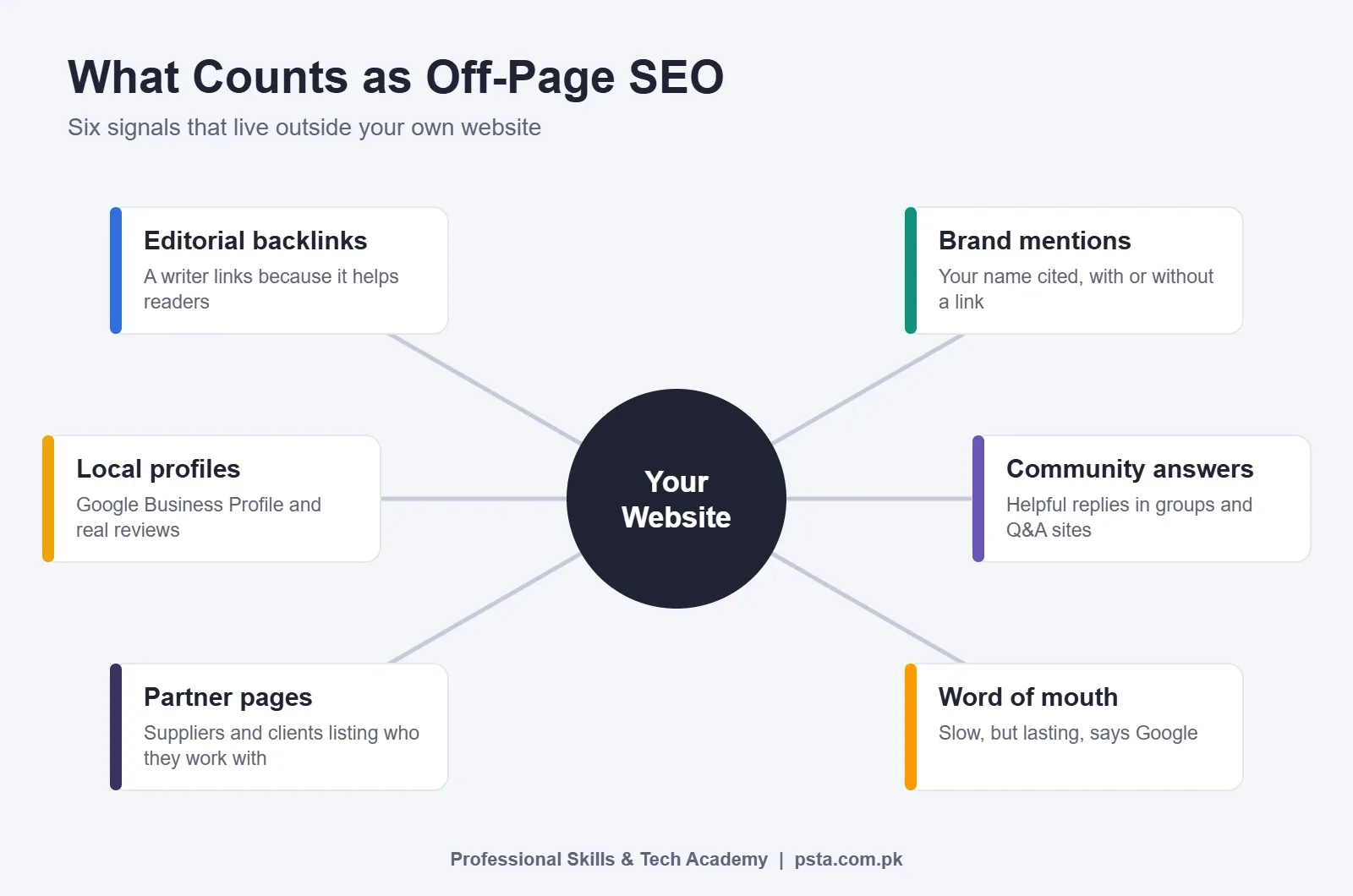
Backlinks get most of the attention, but a healthy off-page profile has several parts. For a local business in Abbottabad, Mardan or Multan, some of these matter more than links from far-off blogs.
- Editorial backlinks: a journalist, blogger or partner links to your page because it helps their readers.
- Brand mentions: your business name appears in an article or forum, with or without a link.
- Local profiles and reviews: a complete Google Business Profile and genuine customer reviews. Our Google Business Profile guide for Pakistan covers the setup.
- Community presence: useful answers in Facebook groups, LinkedIn and Q&A sites where your buyers ask questions.
- Partnerships: suppliers, clients, event organizers and associations that list the businesses they work with.
- Word of mouth: the SEO Starter Guide calls it one of the most effective and lasting ways to promote a site, while admitting it takes time.
What Google Says About Links Before You Build Any
Read the rules once before you spend a single evening on outreach. Google defines link spam as creating links to or from a site mainly to manipulate rankings. Its spam policies, last updated in August 2026, give examples that many beginner tutorials still recommend:
- Buying or selling links that pass ranking credit, including sending a free product in return for a linked review
- Excessive link exchanges ("you link to me, I link to you")
- Automated programs or services that create links for you
- Guest posts, press releases and advertorials with keyword-stuffed links that pass ranking credit
- Low-quality directory or bookmark site links
- Forum comments with optimized links in the post or signature
Paid placements themselves aren't banned. Google accepts that advertising and sponsorship are normal, as long as those links are marked. Its page on qualifying outbound links explains three rel values:
| Attribute | Use It For | Example |
|---|---|---|
rel="sponsored" |
Ads, paid placements, paid reviews | A brand pays a tech blog in Karachi for a review |
rel="ugc" |
User-generated content such as comments and forum posts | A link someone posts in a comment on your blog |
rel="nofollow" |
Links you don't want Google to associate with your site | A source you mention but don't trust |
Google notes that links with these attributes generally won't be followed. That doesn't make them worthless to you. A sponsored link on a busy local news site can still send real visitors and real customers. It just shouldn't be your plan for rankings.
Fix These Three Things on Your Own Site First
Outreach fails when the page you're promoting gives people no reason to link. Before step one, check these:
- Your site is indexed. Verify it in Google Search Console. Our Search Console setup guide walks through it.
- You have at least one page better than what already ranks. Search your main topic and read the top three results honestly. Is your page more complete, more current or more local?
- Your contact details are consistent. The same business name, phone number and address on your site, your Google profile and your social pages. Mismatched numbers confuse customers and look careless.
Off-Page SEO in 8 Steps
These steps are in the order I'd do them for a new site. Each one builds on the one before.
Step 1: Check Your Current Backlinks in Search Console
Open the Links report in Search Console. It shows your top linked pages, top linking sites and top linking text (the anchor words other sites use). Write down what you find in a spreadsheet.
Know its limits. Google says the report is a sample, not a complete list. Its tables stop at 1,000 rows, and it doesn't tell you whether a link is nofollow. For a small site, though, it's free and accurate enough to start.
Step 2: Make One Page Worth Linking To
People link to things that save them work. For Pakistani audiences, the pages that earn links usually look like this:
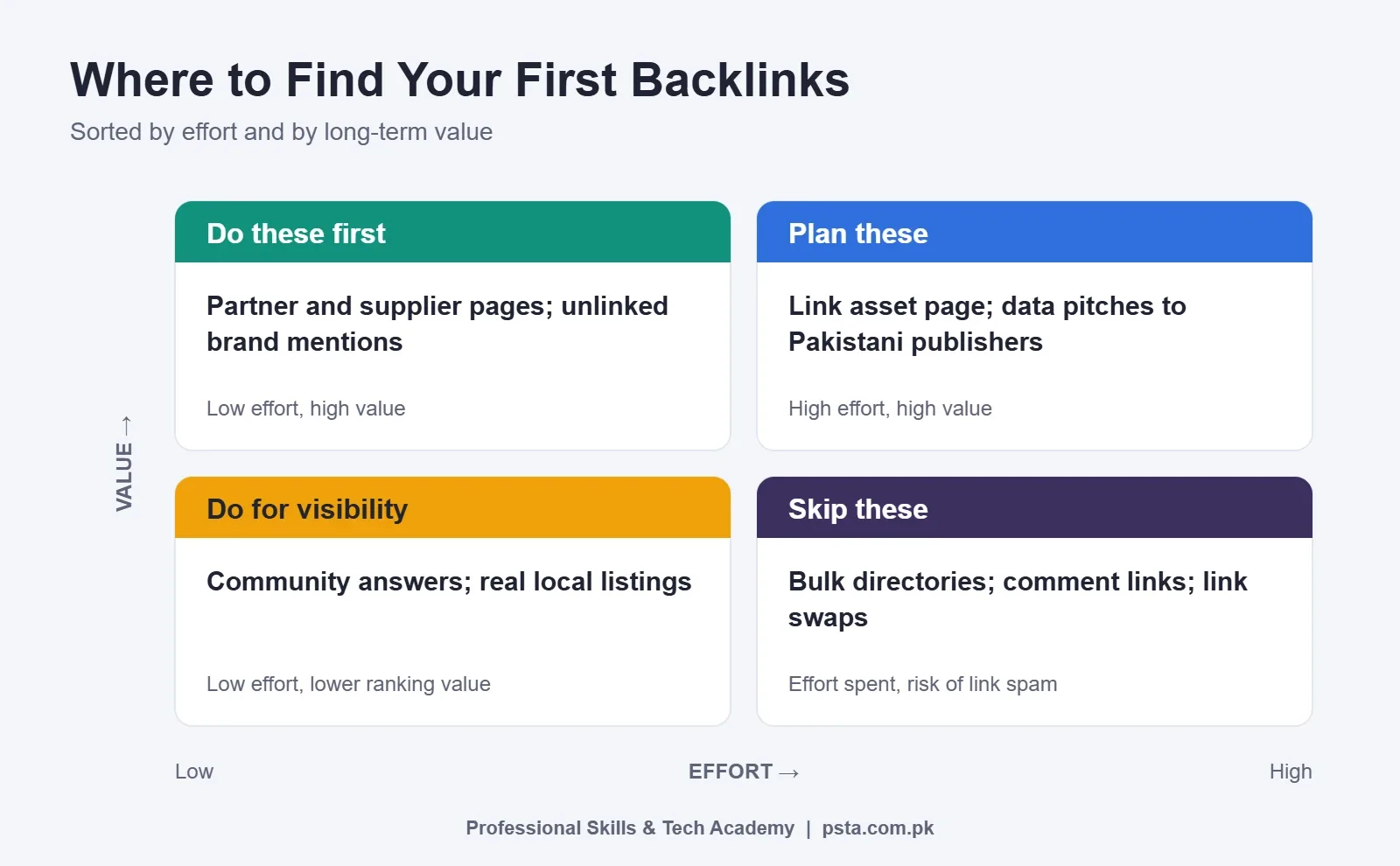
- A price or fee comparison you update every few months, such as solar panel rates in your city
- A practical local guide, for example "documents needed to register a shop in Abbottabad"
- A free template, calculator or checklist
- Original photos or simple survey results from your own customers
Pick one idea that fits your business and make it the best version online. This page is your "link asset". Everything that follows points people to it.
Step 3: List Real Relationships You Already Have
Your easiest links come from people who already know you. Open a sheet and list every supplier, client, sponsor, former teacher, alumni group and trade body you deal with. Many of them have a "partners", "clients" or "members" page.
Take a hypothetical example: a furniture workshop in Lahore that supplies three cafés and buys wood from one importer. That's four natural places to ask for a mention. A short, polite message works better than a template: "We supplied your café's tables last spring. If you ever list your suppliers, we'd be glad to be included."
Step 4: Claim Local and Industry Listings People Actually Use
Listings (often called local SEO citations) help customers find your name, address and phone number. The rule is simple: only list where real people search. Your Google Business Profile comes first. After that, choose your city's chamber of commerce, a trade association for your industry, and two or three well-known directories in your niche.
Skip any site that exists only to collect links, accepts anything without review, or has no visitors you can imagine buying from you. Those are the low-quality directories Google warns about.
Step 5: Pitch Useful Data or Expertise to Pakistani Publishers
Local news sites, tech blogs and industry newsletters need fresh stories. If your link asset contains something new, such as prices you collected or a trend you've noticed in your shop, offer it to them.
- Find five writers who have covered your topic in the last six months.
- Read two of their recent pieces so your email shows you know their work.
- Send three or four sentences: the finding, why their readers would care, and a link to the full page.
- Never ask for a specific anchor or a "dofollow" link. Let them decide how to credit you.
- Follow up once after a week, then move on.
Expect most pitches to get no reply. That's normal, and one good placement from a respected site is worth more than dozens of weak ones.
Step 6: Answer Questions in Communities Without Dropping Links
Facebook groups for small businesses, LinkedIn posts and Q&A sites are full of people asking exactly what your page answers. Write a full, useful reply in the thread itself. Add your link only when it truly helps, and never in a signature.
These links are usually marked ugc or nofollow, so the value is different: people see your name, visit your page, and some of them later link to it from their own sites or mention you to a client.
Step 7: Turn Unlinked Brand Mentions Into Links
Search Google for your business name in quotes, then exclude your own site with -site:yourdomain.com. You'll sometimes find a blog, event page or news story that mentions you without linking. Email the author, thank them, and ask if they'd add a link so readers can find you. This is one of the highest-success requests in link building because the writer already chose to mention you.
Step 8: Track, Record and Repeat Every Month
Keep one sheet with columns for the site, the page, the date, the contact person, the result and the rel value if you can see it. Check the Links report once a month. Then go back to Step 2 and improve or add one more link asset. Off-page SEO is a habit, not a one-time project.
How Do You Judge Whether a Link Is Worth Having?
Ignore the third-party "authority" scores that many sellers quote. Google's SEO Starter Guide doesn't use any such score, and those numbers come from commercial tools, not from Google. Use these questions instead:
| Question | Good Sign | Warning Sign |
|---|---|---|
| Is the site about my topic or my area? | A Peshawar food blog linking to a Peshawar restaurant | A "general" blog covering casinos, crypto and recipes |
| Does it have real readers? | Comments, shares, an active social page | No comments, no author names, hundreds of guest posts |
| Did a person choose to link? | The link sits inside useful text | The link sits in a footer, sidebar or "partners" list of 300 sites |
| Does the anchor text read naturally? | Your brand name or a plain description | An exact keyword phrase you asked for |
| Would I want this link if Google didn't exist? | Yes, it could send customers | No, it's only there for rankings |
Google's link best practices back up the anchor text point: link text should be descriptive and concise, and keyword stuffing should be avoided.
Which Off-Page SEO Techniques Should You Avoid?
You'll see gigs offering "500 high DA backlinks" for a few dollars. Here's why I tell students to walk away from them, and what to do instead:
| Tactic | The Problem | Better Alternative |
|---|---|---|
| Bulk backlink packages | Paid links that pass ranking credit break Google's spam policies | Pitch one link asset to five relevant writers |
| Mass directory submission | Low-quality directory links are named as link spam | Five listings where your customers really look |
| Blog comment links | Optimized comment links are named as spam, and most are ugc anyway | Thoughtful comments that build a relationship with the author |
| Link exchange groups | Excessive "link for link" swaps are named as spam | Genuine partner pages with businesses you work with |
| Guest posts written only for anchors | Keyword-rich guest post links are named as spam | Guest articles that teach something, with a brand-name credit |
Do You Need the Disavow Tool?
Probably not. Google's help page on disavowing links sets a high bar. You should have a considerable number of spammy or artificial links pointing to your site, and they should have caused, or be likely to cause, a manual action. It also says most sites don't need it because Google can usually work out which links to trust.
If a client did buy links in the past and has a manual action, try removing them at the source first. Only then upload a disavow file: a plain .txt file with one URL or domain:example.com entry per line. Google calls this an advanced feature that can hurt your performance if used wrongly, so don't experiment with it on a healthy site.
A Realistic Four-Week Starter Plan
Here is how I'd spread the work for someone with about an hour a day. It assumes your site is already indexed.
- Week 1: Record your current links from the Links report, study the top three competing pages, and outline your link asset.
- Week 2: Publish the link asset, then list 20 people and organizations you already know.
- Week 3: Complete your Google Business Profile and three relevant listings, and send your first partner requests.
- Week 4: Pitch five writers, answer five community questions, and search for unlinked mentions.
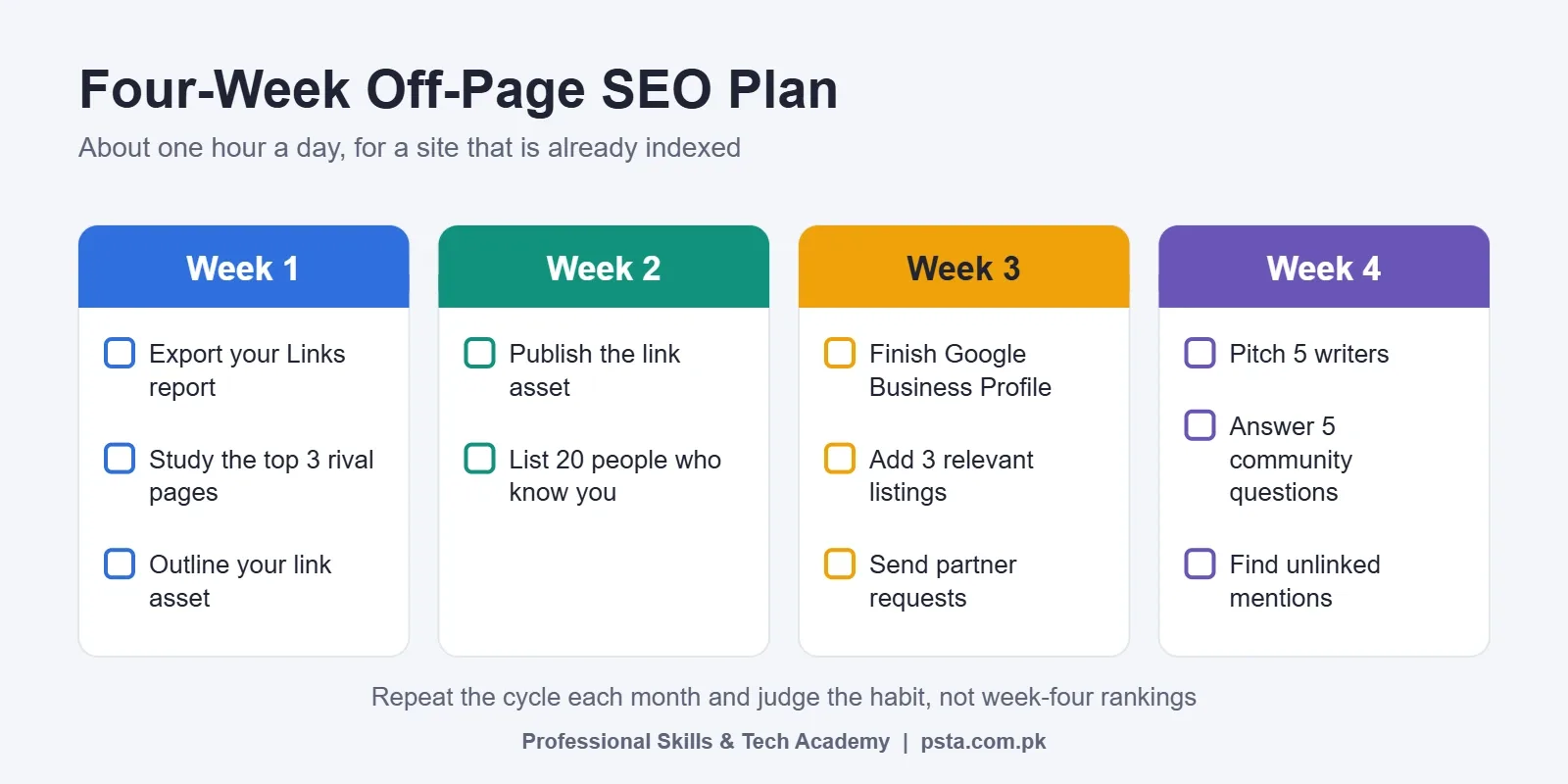
Don't judge the results after four weeks. Links arrive slowly, and Google needs time to crawl them. Judge the habit: did you send the messages and improve the page? If yes, repeat the cycle next month.
Practising Off-Page Work in PSTA's Digital Marketing Course
In our Advanced Digital Marketing course, SEO is taught as one connected module that moves from keyword research through on-page and technical fixes to off-page work. Local SEO and Google Business Profile follow straight after. Your class projects include a small business site on WordPress or Wix, tuned for search page by page, and a fully optimized Google Business Profile with a plan for gathering reviews. Those are the same foundations every step above depends on.
The course runs for 12 weeks. Classes happen on campus in Abbottabad (Mandian, opposite FIMS College on Old College Road), live online from any city in Pakistan, or as a hybrid of the two. Fees right now: Rs. 30,000 instead of the usual Rs. 35,000, paid in up to two installments. A new batch starts every month. It doesn't promise a job or a fixed income; it gives you work you can show a client.
If you'd like to build sites yourself, the WordPress course goes deeper into themes and speed. If paid social is your main interest, see the Social Media Marketing & Meta Ads course. You can compare everything on the courses page or read our keyword research guide before you start. To ask about batch timings, send a WhatsApp message to +92 314 5424399. When you're ready, the admission form takes a few minutes.
Write Your Link List Tonight
Open a blank sheet and write down ten businesses, people or groups who already know your work and have a website. Next to each, note one honest reason they might mention you. That list is the start of your off-page SEO, and it costs nothing but an evening.
Frequently asked questions
Is off-page SEO only about backlinks?
No. Backlinks are the biggest part, but brand mentions, a complete Google Business Profile, genuine reviews, partner listings and helpful community answers all count. For a local shop or clinic, reviews and an accurate profile often bring more customers than a link from a distant blog. Treat links as one part of a wider reputation you build outside your site.
How many backlinks do I need to rank on Google?
No fixed number exists. Google uses many signals, and its SEO Starter Guide says PageRank is only one of them. One relevant link from a respected site in your field can matter more than dozens from unrelated pages. Compare your page with the top results for your keyword instead of chasing a target count.
Are nofollow backlinks useless?
Not for your business. Google says links marked nofollow, sponsored or ugc generally won't be followed, so they pass little ranking value. But a nofollow link on a busy forum or news site can still send visitors, enquiries and sales. Some of those visitors may later link to you from their own sites.
Is guest posting against Google's rules?
Writing a guest article is fine. The problem is guest posts written mainly to place keyword-rich links that pass ranking credit, which Google lists as link spam. Write for sites your customers read, teach something real, and accept a simple brand-name credit or a nofollow link if the editor prefers it.
Should I buy backlink packages from Fiverr or other sellers?
I advise against it. Buying links that pass ranking credit breaks Google's spam policies, and cheap bulk packages usually come from low-quality directories, comment spam or link networks. If you want paid exposure, buy a clearly marked sponsored placement for the traffic it brings, not for rankings.
How long does off-page SEO take to show results?
Expect months rather than weeks. Outreach replies are slow, links appear gradually, and Google has to crawl the linking pages before they count. That's why the plan in this guide judges the first month by the work you completed, not by rankings. Keep a monthly routine and review your Links report each month.
Can I do off-page SEO for a new website with no budget?
Yes. Search Console's Links report is free, and the best early links come from people who already know you: suppliers, clients, your college, associations and event organizers. Add a complete Google Business Profile, answer questions in communities your buyers use, and publish one genuinely useful page to point people toward.
Sources & references
- Spam policies for Google web search developers.google.com
- Qualify your outbound links to Google developers.google.com
- Link best practices for Google developers.google.com
- SEO Starter Guide developers.google.com
- How Search works: ranking results google.com
- Links report, Search Console Help support.google.com
- Disavow links to your site, Search Console Help support.google.com
Last reviewed & updated on by Umar Qureshi. Written by the PSTA team in Abbottabad, Pakistan.

Umar Qureshi

Advanced Digital Marketing Course in Pakistan and Abbottabad
Turn this guide into a career: hands-on training with real projects, online across Pakistan or on-campus in Abbottabad · 12 Weeks.
Comments
No comments yet — ask a question or share your experience.