Quick answer
OpenAI API cost depends on the model, the tokens going in and out, and monthly volume. In November 2026, GPT-6 Luna costs $0.10 input and $0.50 output per million tokens, while GPT-6 Astra costs $10 and $50. A 3,000-question WhatsApp bot runs about Rs. 212 a month on Luna or Rs. 21,190 on Astra.
Key takeaways
- • OpenAI bills per token, and output tokens cost more than input tokens.
- • GPT-6 Luna is 100 times cheaper than GPT-6 Astra on both input and output.
- • Batch API calls cost 50% less when results can wait up to 24 hours.
- • Hidden reasoning tokens and web search calls add to the bill beyond the visible reply.
- • API credits are sold only in US dollars, with a $5 minimum and a one-year expiry.
Table of contents 16 sections
- What Does One API Call Actually Cost?
- OpenAI API Pricing in November 2026: The Four Main Models
- How to Work Out OpenAI API Cost in Rupees
- Example 1: A WhatsApp FAQ Bot for a Clinic
- Example 2: Lead Replies for a Small Business
- Example 3: Reading 10,000 Documents Overnight
- Hidden Costs Beginners Miss
- Reasoning Tokens
- Tool Calls
- Conversation History
- Retries and Testing
- Which Model Should You Pick for Each Job?
- How Do You Pay for API Credits From Pakistan?
- Keeping Your Bill Under Control
- Building Cost-Aware Automations at PSTA
- Price One Workflow Before You Quote a Client
Here's an example we use in class. A clinic in Abbottabad wants a WhatsApp bot that answers questions about timings, fees and doctor availability. The owner asks a freelancer one thing before anything else: "What will the AI part cost me every month?" Most beginners guess. A professional opens the price list, counts tokens and gives a number in rupees.
The honest answer is that OpenAI API cost depends on three things you control: which model you call, how much text goes in and out, and how often the workflow runs. For that clinic bot, the bill can be about Rs. 212 a month or more than Rs. 21,000, depending only on the model you pick.
Read on and you'll learn:
- What a token is and how to estimate tokens from words
- The current per-token prices of OpenAI's main models
- A five-step method to turn any workflow into a monthly rupee figure
- Three worked examples from small Pakistani businesses
- How to buy API credits from Pakistan and keep the bill under control
All prices in this guide were checked on OpenAI's official pricing page on 15 November 2026. Prices change, so check again before you quote a client.
What Does One API Call Actually Cost?
OpenAI API cost isn't counted per message or per month. OpenAI charges per token, which is a small piece of text. The model reads your input tokens (instructions, customer message, any data you attach) and writes output tokens (its reply). Input and output have different prices, and output usually costs several times more.
OpenAI's help article on tokens gives a simple rule for English: one token is roughly four characters, and 100 tokens are roughly 75 words. So a 300-word reply is about 400 tokens. The same article warns that other languages can split differently, so Urdu or Roman Urdu text should be measured with OpenAI's tokenizer rather than guessed.
Prices are quoted per 1 million tokens. That sounds huge, but a busy workflow reaches it faster than you think. A bot that reads 1,800 tokens per question and answers 3,000 questions a month uses 5.4 million input tokens.
OpenAI API Pricing in November 2026: The Four Main Models
OpenAI launched GPT-6 Sol and GPT-6 Luna on 22 September 2026 and cut API prices by half compared with the previous generation, according to VKTR's report on the launch. The current flagship list on the official OpenAI API pricing page looks like this at standard speed:
| Model | Input (per 1M tokens) | Cached input (per 1M) | Output (per 1M tokens) | Typical use |
|---|---|---|---|---|
| gpt-6-luna | $0.10 | $0.01 | $0.50 | High-volume, simple tasks |
| gpt-6.1-terra | $1.00 | $0.05 | $5.00 | Everyday business writing and extraction |
| gpt-6.1-sol | $2.00 | $0.10 | $10.00 | Harder reasoning and agent steps |
| gpt-6-astra | $10.00 | $1.00 | $50.00 | The most demanding work |
The "Typical use" column is our teaching advice, not OpenAI's wording. Notice the spread. Astra's output costs 100 times more than Luna's. Picking the right model is the biggest cost decision you'll make, far bigger than tweaking prompts.
The same page lists two more things worth knowing. Flex and Batch rates are half the standard price, and specialized models such as gpt-6-cyber sit far above the main four. If you see an older tutorial quoting GPT-4o or GPT-5 mini prices, treat those numbers as history.
How to Work Out OpenAI API Cost in Rupees
You can price almost any automation with five steps and a calculator. We'll use this method in all three examples below.
- Count the runs. How many times will the workflow call the model in a month? Use real numbers from the client: WhatsApp chats, form leads or documents per month.
- Estimate input tokens per run. Add your instructions, any FAQ or product data, the conversation history and the user's message. Convert words to tokens with the 75-words-per-100-tokens rule.
- Estimate output tokens per run. A short WhatsApp reply might be 150 tokens. A summary email might be 400.
- Multiply by the price. (runs × input tokens ÷ 1,000,000 × input price) + (runs × output tokens ÷ 1,000,000 × output price) gives you dollars per month.
- Convert to rupees and add a margin. The State Bank of Pakistan's weighted average customer rate on 6 November 2026 was about Rs. 276.80 per dollar for selling. We round to Rs. 277 here. Your card's actual rate, bank charges and any taxes will push the real figure higher, so quote with a buffer.
Keep the working in a Google Sheet, with one row per workflow and one column for OpenAI API cost in rupees. When the client asks for twice the volume or a smarter model, you change one cell instead of redoing the math.
Example 1: A WhatsApp FAQ Bot for a Clinic
Back to the clinic. This is an example, not a real client, but the sizes are realistic for a small clinic. Assume 3,000 patient questions a month. Each call sends about 1,800 input tokens (instructions, a clinic FAQ of roughly 1,000 words and the patient's message) and gets back a 150-token reply.
That's 5.4 million input tokens and 450,000 output tokens a month. Here is what each model would cost:
| Model | Monthly cost (USD) | Approx. monthly cost (Rs.) |
|---|---|---|
| gpt-6-luna | $0.77 | Rs. 212 |
| gpt-6.1-terra | $7.65 | Rs. 2,119 |
| gpt-6.1-sol | $15.30 | Rs. 4,238 |
| gpt-6-astra | $76.50 | Rs. 21,190 |
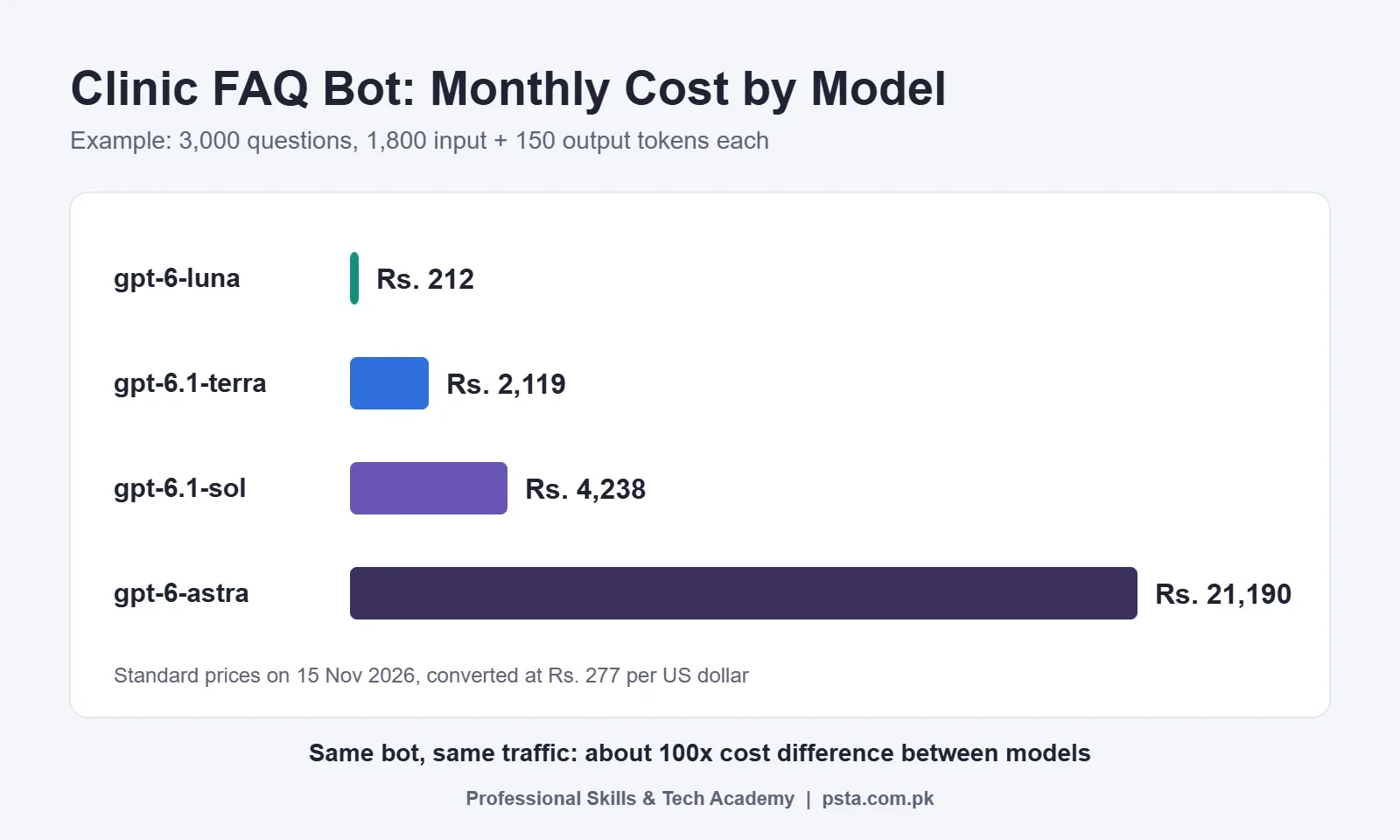
For answering "What time does Dr. Ayesha sit on Thursday?", Luna is usually enough. Test it on 50 real questions first. If it gets facts wrong or sounds stiff, move up to Terra. Jumping straight to Astra for an FAQ bot is like hiring a senior engineer to answer the reception phone.
The 1,800-token input is the expensive part, because the FAQ goes along with every message. That's why trimming the FAQ and using cached input matter so much, as you'll see in Example 3.
Example 2: Lead Replies for a Small Business
A second example: a furniture shop in Rawalpindi runs Facebook lead ads and gets about 600 form leads a month. An n8n workflow saves each lead to Google Sheets and asks the model to draft a personal first reply. Each call uses about 800 input tokens and 250 output tokens.
On Terra, that's 480,000 input tokens and 150,000 output tokens, which comes to $1.23, or roughly Rs. 341 a month. On Luna, it drops to about Rs. 34. Even on Sol it stays near Rs. 681.
The lesson for freelancers: for low-volume business workflows, the AI bill is tiny compared with the value of a fast reply. What the client is really paying you for is the workflow design, testing and upkeep. Price your service on that, and show the API cost as a separate, transparent line.
If you're building lead flows like this, our earlier guide comparing n8n, Zapier and Make helps you pick the automation tool that sits around the model.
Example 3: Reading 10,000 Documents Overnight
Now a heavier job. Picture a distribution company that wants 10,000 scanned invoices sorted each month: supplier name, amount and category. After OCR, each invoice sends about 2,000 input tokens and needs only a 100-token answer.
On Sol at standard speed, that's $50, or about Rs. 13,850 a month. But nobody needs these results within seconds. OpenAI's Batch API guide offers a 50% discount compared with normal calls, in exchange for results that complete within 24 hours. That alone halves the bill to about Rs. 6,925.
Then look at the prompt. If you remove repeated instructions and keep only the invoice text, input might drop to 1,200 tokens. Run that on Terra through Batch, and the month costs $8.50, close to Rs. 2,355. Same job, about one-sixth of the starting price.
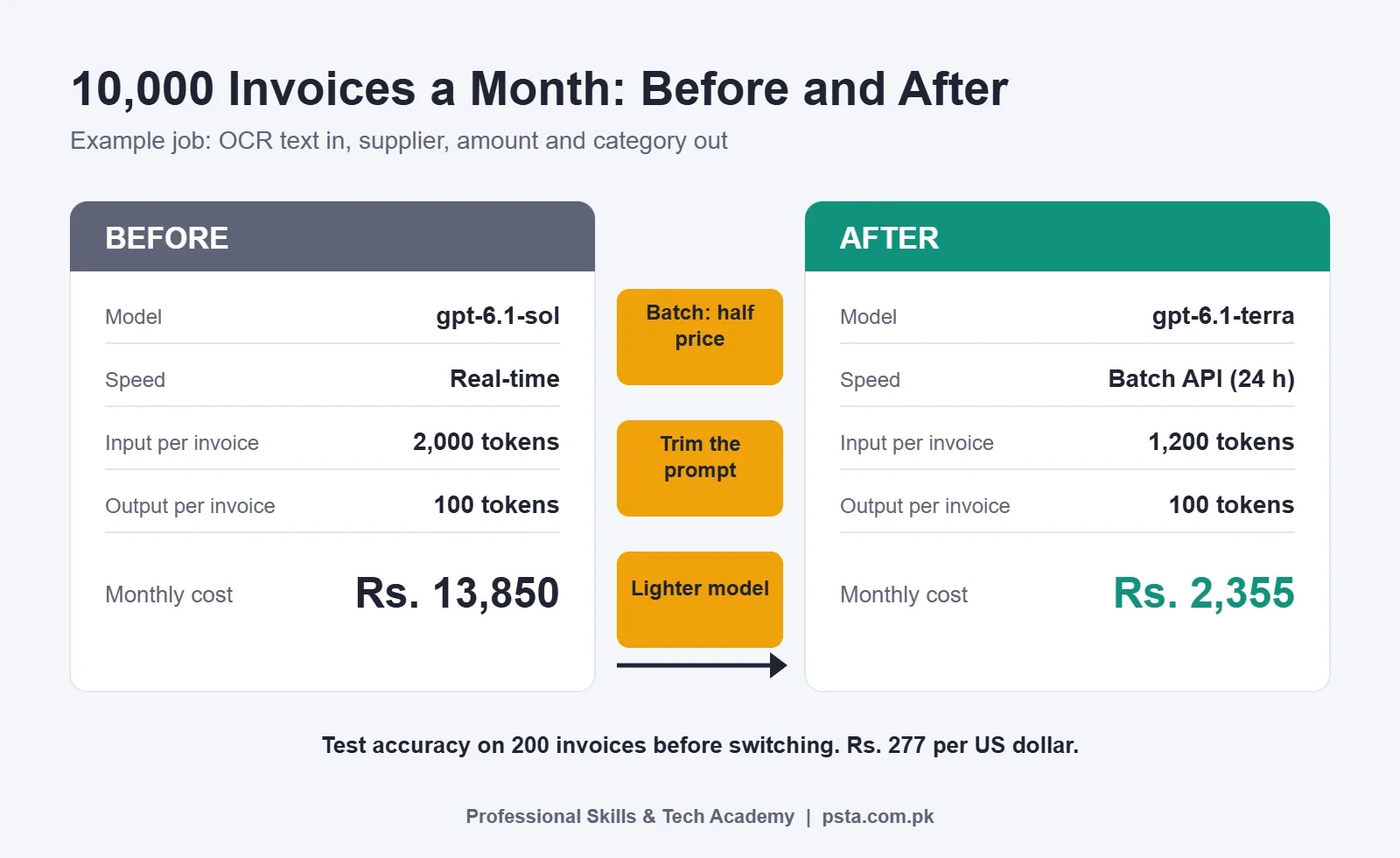
Always test quality before you switch. Run 200 invoices through both setups and compare accuracy by hand. A cheaper setup that makes errors costs more in staff time than it saves.
Hidden Costs Beginners Miss
The price table is only half of your real OpenAI API cost. These four items surprise students when they see their first real bill.
Reasoning Tokens
Newer models can "think" before answering. OpenAI's reasoning guide says these reasoning tokens aren't visible through the API but are billed as output tokens. A 150-token reply can quietly cost like a 1,500-token one. Set the reasoning effort to the lowest level that still gives good answers.
Tool Calls
If your agent searches the web, you pay for that too. The pricing page lists web search at $10 per 1,000 calls plus the search content tokens. That's about Rs. 2.77 per search before tokens, so an agent that searches on every message adds up fast.
Conversation History
Chatbots resend earlier messages so the model remembers context. By the tenth message, the history can be larger than the FAQ. Keep only the last few turns, or summarize older ones.
Retries and Testing
Failed runs, loops in an agent and your own testing all use tokens. Budget extra for the first month while you debug.
Which Model Should You Pick for Each Job?
Think about two questions: how hard is the task, and how many times will it run? Simple, high-volume jobs (tagging messages, short FAQ answers, sorting leads) belong on the cheapest model that passes your quality test. Hard, low-volume jobs (a weekly report, a tricky client proposal) can afford a stronger model because they run rarely.
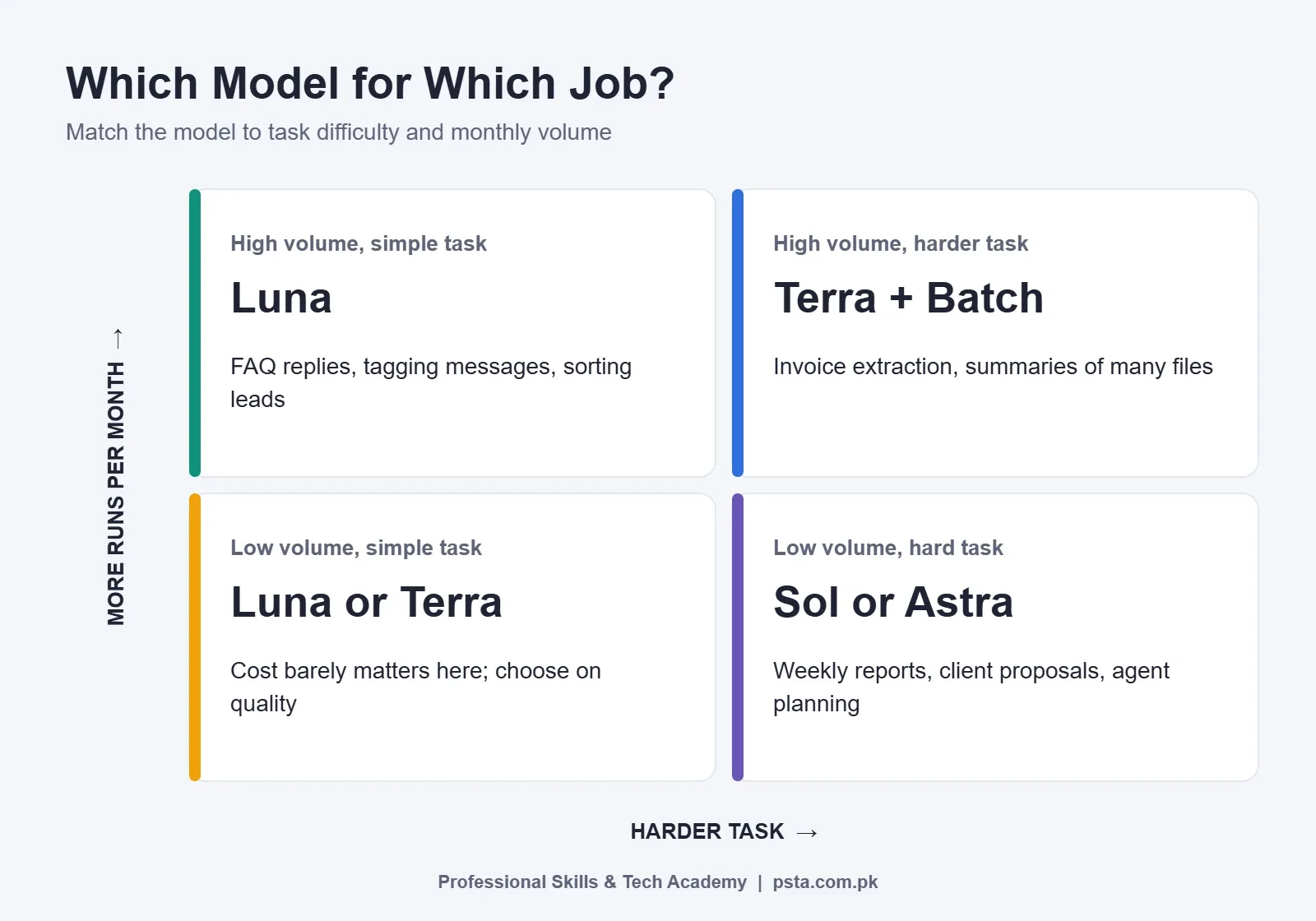
A practical pattern we teach is routing: let Luna handle every incoming message, and pass only the confusing ones to Sol. Most messages stay cheap, and the hard ones still get a careful answer. Our guide on AI agents vs automation explains when a task needs an agent at all.
How Do You Pay for API Credits From Pakistan?
API billing works differently from a ChatGPT subscription. OpenAI's multicurrency billing article lists the Pakistani rupee for ChatGPT plans, but says API credit purchases are limited to US dollars. So you need a card that works for international online payments in dollars.
The API runs on prepaid credits. According to OpenAI's prepaid billing help page:
- The minimum purchase is $5, about Rs. 1,385 at our rate, and the default is $10.
- Purchased credits expire one year after purchase and generally can't be refunded.
- When credits run out, requests fail with a billing error, so a live client bot simply stops replying.
Before you buy, call your bank and confirm your debit or credit card is enabled for international e-commerce. Ask what exchange rate and charges apply. A sensible first step is a $5 purchase, just to see exactly how many rupees leave your account. That one test tells you the true rate to use in quotes.
For client work, ask the client to open their own OpenAI account and add their own card. They pay OpenAI directly, you don't carry their usage risk, and their API key stays in their name.
Keeping Your Bill Under Control
Use these habits on every project, even small ones:
- Cap auto-recharge. OpenAI's billing settings let you set a threshold and an optional monthly limit on automatic top-ups. Set one on day one.
- Use one project per client. Separate projects and API keys make it easy to see who used what.
- Limit output length. Ask for short replies and set a maximum output in the workflow.
- Reuse the same opening text. The pricing page shows cached input reads at a tenth of the normal input price, so keep instructions identical across calls.
- Check usage weekly. Compare actual tokens with your estimate and fix the gap early.
If you self-host your workflows, our self-hosting n8n guide covers the server side of the monthly bill, which is a separate cost from the AI model.
Building Cost-Aware Automations at PSTA
Our AI Automation Course is an 8-week, beginner-level program taught by Umar Qureshi. You build workflows in n8n, Make and Zapier, connect the OpenAI API, and finish projects such as a lead follow-up workflow, an OCR invoice reader and a WhatsApp support bot. The five-step method above works for every one of those projects.
The fee is Rs. 22,000 (regular Rs. 28,000), split into two installments. Classes run at the Mandian campus on Old College Road, opposite FIMS College, live online from any city, or as a mix of both. If you want to write your own scripts around the API later, the Advanced Python course is the natural next step. Marketers who run lead ads often pair automation with the Advanced Digital Marketing course.
See the steps on our admission page, compare programs on the courses page, or send a WhatsApp message to +92 314 5424399 to ask about the next batch.
Price One Workflow Before You Quote a Client
Pick one automation you've built or plan to sell. Write down runs per month, input tokens and output tokens, then work out the cost on Luna and on Terra. Put both numbers in your next proposal as the expected OpenAI API cost. A client who sees a clear rupee estimate trusts you more than one who hears "it's very cheap, don't worry."
Frequently asked questions
What is the minimum amount I can add to the OpenAI API?
OpenAI's prepaid billing page says the minimum credit purchase is $5, and the default amount is $10. At about Rs. 277 per dollar, $5 is roughly Rs. 1,385 before your bank's charges. Purchased credits expire one year after purchase and are generally non-refundable, so start small and top up as your usage becomes clear.
Can I pay for OpenAI API credits in Pakistani rupees?
No. OpenAI's billing help says ChatGPT plans can be priced in local currencies, including the Pakistani rupee, but API credit purchases are limited to US dollars. You need a debit or credit card enabled for international online payments. Ask your bank which exchange rate and charges apply before your first purchase.
Which OpenAI model is cheapest for a WhatsApp chatbot?
On the November 2026 price list, gpt-6-luna is the lowest-priced flagship model at $0.10 per million input tokens and $0.50 per million output tokens. For simple FAQ answers it is a sensible starting point. Test it on 50 real customer questions, and move up to gpt-6.1-terra only if answers are wrong or unclear.
How many words are in one million tokens?
OpenAI's rule of thumb for English is that 100 tokens equal about 75 words, so one million tokens is roughly 750,000 English words. Treat this as an estimate. Urdu and Roman Urdu can split into tokens differently, so measure a sample of your real messages with OpenAI's tokenizer before you quote a client.
What happens when my OpenAI API credits run out?
Your API requests start failing with a billing error, so a live chatbot or workflow stops working until you add credits. OpenAI also notes that usage can continue briefly after the balance runs out, creating a small negative balance that comes off your next purchase. Auto-recharge with a monthly cap helps avoid surprises.
How can I reduce OpenAI API cost on large jobs?
Use four levers. Send jobs that can wait through the Batch API, which costs 50% less. Trim repeated instructions from your prompt. Keep the opening text identical so cached input pricing applies. Finally, test a lighter model such as Terra or Luna on a sample, and switch only if accuracy stays acceptable.
Why is my API bill higher than my estimate?
The usual reasons are hidden reasoning tokens, which OpenAI bills as output tokens, long conversation history resent with every message, web search tool calls priced at $10 per 1,000, and retries or testing runs. Compare your usage dashboard with your estimate each week and adjust the prompt, history length or model.
Do I need coding skills to use the OpenAI API in automations?
Not to get started. Tools such as n8n, Make and Zapier let you connect the OpenAI API to forms, Google Sheets and WhatsApp with visual workflows. Some coding helps later when you want custom logic or your own scripts, which is where a Python course becomes useful.
Sources & references
- OpenAI API Pricing developers.openai.com
- OpenAI Help: What Are Tokens help.openai.com
- OpenAI Help: Prepaid API Billing help.openai.com
- OpenAI Help: Multicurrency Billing help.openai.com
- OpenAI Batch API Guide developers.openai.com
- OpenAI Reasoning Models Guide developers.openai.com
- State Bank of Pakistan: Weighted Average Customer Exchange Rates, 6 Nov 2026 sbp.org.pk
- VKTR: OpenAI Launches GPT-6 Sol and Luna vktr.com
Last reviewed & updated on by Umar Qureshi. Written by the PSTA team in Abbottabad, Pakistan.

Umar Qureshi

AI Automation Course: Beginner to Pro (Dominate Workflows)
Turn this guide into a career: hands-on training with real projects, online across Pakistan or on-campus in Abbottabad · 8 Weeks.
Comments
No comments yet — ask a question or share your experience.