Quick answer
Learn PHP first if you want WordPress sites and local client work soon, since it runs on cheap shared hosting and powers 69.2% of sites with a known server language. Learn Node.js first if you aim for software houses and app work, because it reuses the JavaScript you need for the browser anyway.
Key takeaways
- • PHP runs 69.2% of websites with a known server language (W3Techs), while 48.7% of developers used Node.js in Stack Overflow's 2025 survey.
- • PHP handles each request as a separate job; Node.js serves many visitors from one process with an event loop.
- • PHP sites run on shared cPanel hosting; Node.js apps usually need a VPS or an app platform.
- • Use PHP 8.3 or later for new work, and Node.js 24 or 22 LTS for production apps.
- • Pick PHP and WordPress for quick local client work, or Node.js and the MERN stack for app development roles.
Table of contents 16 sections
- PHP vs Node.js at a Glance
- What Are PHP and Node.js, Exactly?
- How Does Each One Handle a Website Visitor?
- The PHP Way
- The Node.js Way
- What the 2025–2026 Numbers Show
- Where Each Skill Gets You Work in Pakistan
- Where PHP Leads
- Where Node.js Leads
- Hosting and Deployment: The Practical Difference
- Which Is Easier for a Complete Beginner?
- Is PHP Still Worth Learning in 2026?
- PHP vs Node.js: Which Should You Learn First?
- Can You Learn Both Without Getting Confused?
- Where PHP and Node.js Sit in PSTA's Full-Stack Course
- Build the Same Contact Form Twice
Myth: PHP is dead, so a beginner in Pakistan should skip it and go straight to Node.js. The data doesn't back that up. W3Techs finds PHP running on 69.2% of websites whose server-side language it can detect, while Node.js was the most used web technology in the 2025 Stack Overflow Developer Survey. So the real PHP vs Node.js question isn't which one survives. It's which one fits the work you want to do first.
In this comparison, you'll see:
- How PHP and Node.js differ in the way they run your code
- What the latest survey and usage figures say about each one
- Where each skill leads in Pakistani jobs and freelance work
- Why hosting matters more than most beginners expect
- A short decision path for picking your first one, and a plan for learning both
PHP vs Node.js at a Glance
Here is the short PHP vs Node.js summary before we go into detail. Read across each row and notice that neither column wins every time.
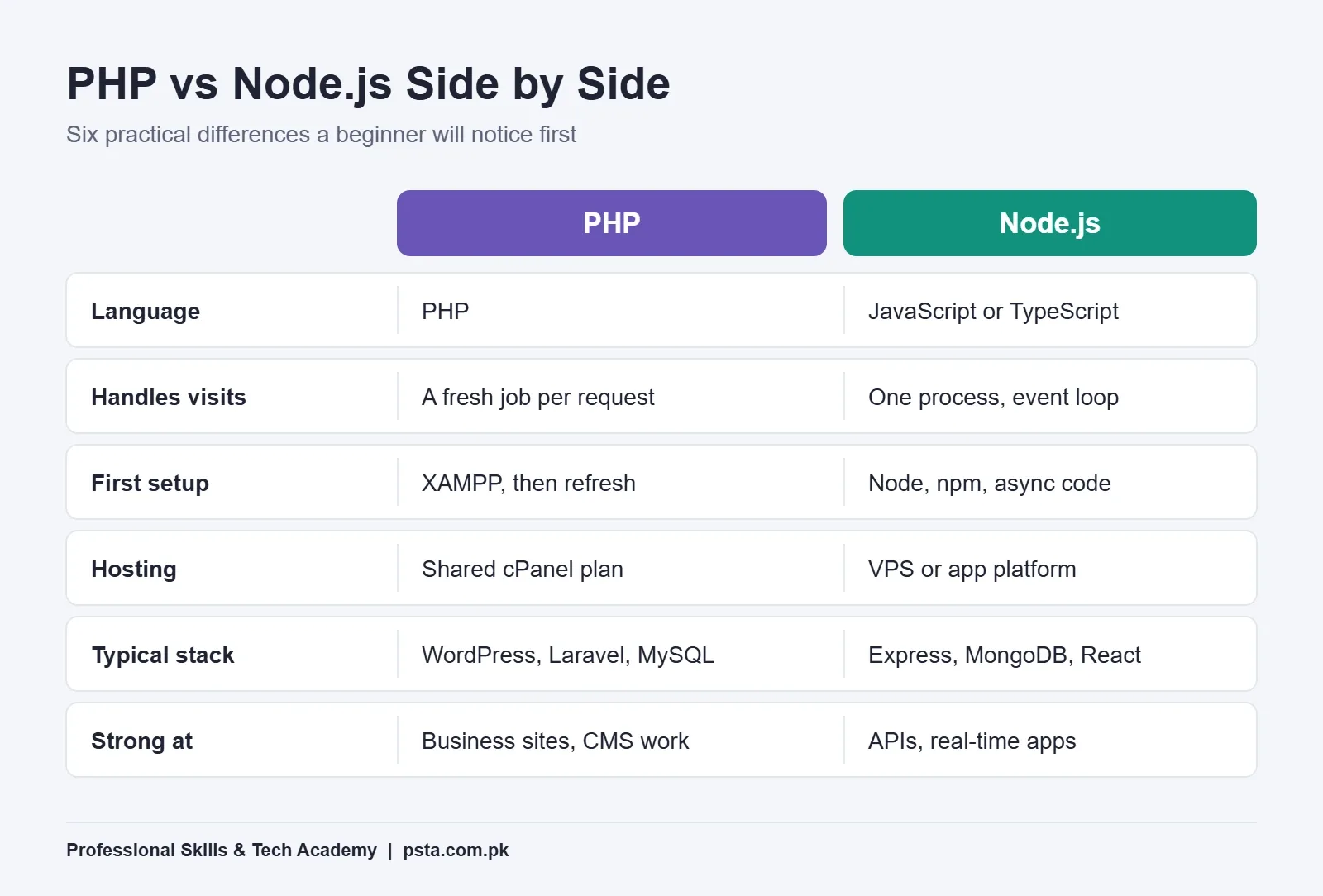
| Point | PHP | Node.js |
|---|---|---|
| What it is | A server-side language | A runtime that runs JavaScript on the server |
| Language you write | PHP | JavaScript (or TypeScript) |
| Current versions (Oct 2026) | PHP 8.5 is the newest branch | Node.js 24 and 22 are LTS; 26 is Current |
| Typical stack | WordPress or Laravel with MySQL | Express with MongoDB, plus React on the front end (MERN) |
| Common hosting | Cheap shared cPanel hosting works out of the box | Usually a VPS or an app platform |
| Best first project | A business website or a simple CMS | A REST API or a real-time chat app |
| Where the work is | Local client sites, WordPress agencies, Laravel shops | Software houses, startups, remote product teams |
What Are PHP and Node.js, Exactly?
Beginners often frame PHP vs Node.js as if they were the same kind of thing. They aren't, and the difference explains most of what follows.
PHP is a programming language built for the web. You write a .php file, the web server hands each request to PHP, and PHP sends back HTML or JSON. WordPress, Laravel and most cPanel hosting plans are built around it.
Node.js is not a language. It's a runtime that lets JavaScript, the language of the browser, run on a server. You still write JavaScript. The benefit is that one language covers both your front end and your back end, which is why Node.js sits at the centre of the MERN stack (MongoDB, Express, React, Node.js).
So when someone asks "PHP or Node.js?", they are really asking "PHP or server-side JavaScript?" Keep that in mind and the rest gets easier.
How Does Each One Handle a Website Visitor?
Picture an example: a coaching centre in Abbottabad has a results page. At 5 PM, 300 students open it at the same moment.
The PHP Way
Classic PHP treats every visit as a fresh, separate job. The server starts the script, it reads the database, builds the page, sends it and forgets everything. Many visits run side by side in separate workers. This model is simple to reason about. One slow page rarely freezes the others, and you don't have to think about shared state.
The Node.js Way
Node.js runs one long-lived process with an event loop. When a request needs the database, Node.js doesn't wait. It moves to the next visitor and comes back when the data arrives. That makes it very efficient for apps with many open connections, such as live chat, notifications or dashboards that update every few seconds.
The trade-off is discipline. In Node.js, a heavy loop or a badly written function can hold up every visitor at once. In PHP, the same mistake usually hurts only the request that triggered it. For the results page above, PHP vs Node.js makes little difference; both would cope fine. The difference shows up in real-time features, not in ordinary page loads.
What the 2025–2026 Numbers Show
Two kinds of data matter here: what developers use, and what websites run on. They tell different stories, and you need both.
- Developers: Stack Overflow's 2025 survey results show 48.7% of respondents used Node.js, 19.9% used Express and 8.9% used Laravel. On the language side, 66% used JavaScript and 18.9% used PHP.
- Websites: W3Techs reports PHP on 69.2% of sites whose server-side language it can identify. For server-side JavaScript, its October 2026 figure is 8.2%.
- WordPress: W3Techs also counts WordPress on 39.6% of all websites, and WordPress runs on PHP.
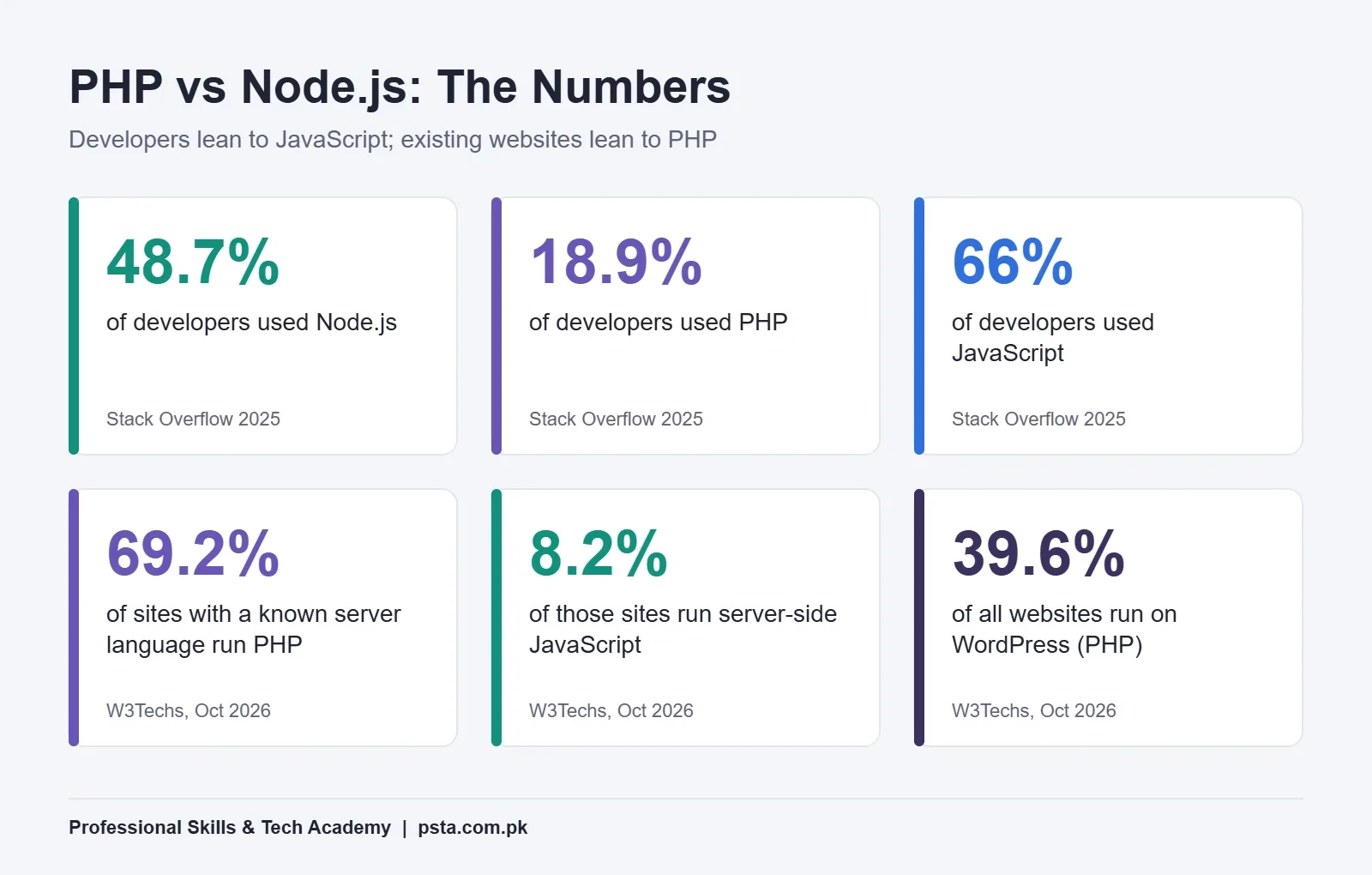
Read those together, because PHP vs Node.js looks different from each angle. Developers building new products lean toward JavaScript and Node.js. Meanwhile, the existing web, full of business sites, blogs and stores, still runs mostly on PHP. That existing web needs people to build, fix, update and speed it up. Both sides create paid work.
Where Each Skill Gets You Work in Pakistan
Pakistan's tech exports give useful context. According to State Bank data reported by The Express Tribune, telecom, computer and information services exports reached a record $4.6 billion in FY2025-26, up 21% from $3.814 billion. That figure covers many kinds of services, and web development is only one of them, but it shows the size of the market you'd be selling into.
Where PHP Leads
- Local clients: schools, clinics, real estate agents and shops usually want a WordPress site they can edit themselves. That's PHP work, even if you write little PHP by hand at first.
- Freelance gigs: fixing a broken WordPress theme, moving a site to new hosting or adding a WooCommerce feature are common small orders on Fiverr and Upwork.
- Laravel software houses: Laravel is a common choice for client portals and admin panels, so check local job ads for it.
Where Node.js Leads
- Product companies and startups: teams building apps with React front ends often want the same language on the server.
- API work: mobile apps need back ends, and Express APIs are a common choice.
- Real-time features: chat, live tracking and notifications suit the event loop.
Job titles vary a lot between companies. Before you decide, open five current local job ads for "web developer" and write down which stack each one names. That small exercise tells you more about your own city than any national average.
Hosting and Deployment: The Practical Difference
This is the PHP vs Node.js point most tutorials skip, and it matters a lot for freelancers.
A PHP site can live on ordinary shared cPanel hosting. You upload files, create a MySQL database and the site works. Pakistani hosting companies sell these plans widely, and small business clients already understand them.
A Node.js app needs a process that keeps running. Most cheap shared plans aren't built for that, so you'll usually deploy to a VPS or an app platform. You'll also learn extra tools such as a process manager, environment variables and a reverse proxy. That's valuable knowledge, but it adds steps for a first project. Want to try a free option first? Our comparison of free hosting platforms for students covers ones that suit each stack.
Keep versions current on both sides:
- PHP's supported versions page lists 8.2, 8.3, 8.4 and 8.5. PHP 8.2 gets security fixes only until 31 December 2026, so don't start a new client project on it.
- WordPress recommends PHP 8.3 or later with MySQL 8.0+ or MariaDB 10.11+.
- The Node.js releases page advises production apps to run LTS versions. Today that means Node.js 24 or 22.
Which Is Easier for a Complete Beginner?
In a PHP vs Node.js race to the first working page, PHP usually wins. Install XAMPP, drop a file in a folder and refresh the browser. Our walkthrough on installing WordPress on localhost uses exactly that setup.
Node.js asks for more up front. You install Node, use npm, learn modules and get comfortable with asynchronous code (callbacks, promises and async/await). That last part confuses most beginners for a week or two.
On the other hand, if you already plan to learn JavaScript for the browser, Node.js saves you a second language. You'll reuse the same syntax, the same array methods and the same debugging habits. That's a real time saving over six months.
Is PHP Still Worth Learning in 2026?
Yes, if your goals include WordPress, local clients or Laravel jobs. The language is actively maintained, with PHP 8.5 released in November 2025 and a clear two-year active plus two-year security support cycle for each branch. Modern PHP has types, a fast engine and a mature package manager (Composer).
What has faded is old-style PHP: one huge file mixing HTML, SQL and logic. If you learn PHP, learn it the modern way. Use prepared statements for every database query, keep logic out of templates and move to a framework like Laravel once the basics are solid.
PHP vs Node.js: Which Should You Learn First?
Answer these three questions honestly. Your answers point you to a starting stack.
- Who do you want to work for in the next 12 months? Local businesses and small agencies point to PHP and WordPress. Software houses that build apps point to JavaScript and Node.js.
- Do you already know some JavaScript? If yes, Node.js lets you build on it straight away. If you're starting from zero, either path works, but you'll need JavaScript for the browser regardless.
- Do you want to earn from small projects soon? WordPress work has a shorter route to a first paid order. MERN projects take longer but lead to larger app work.
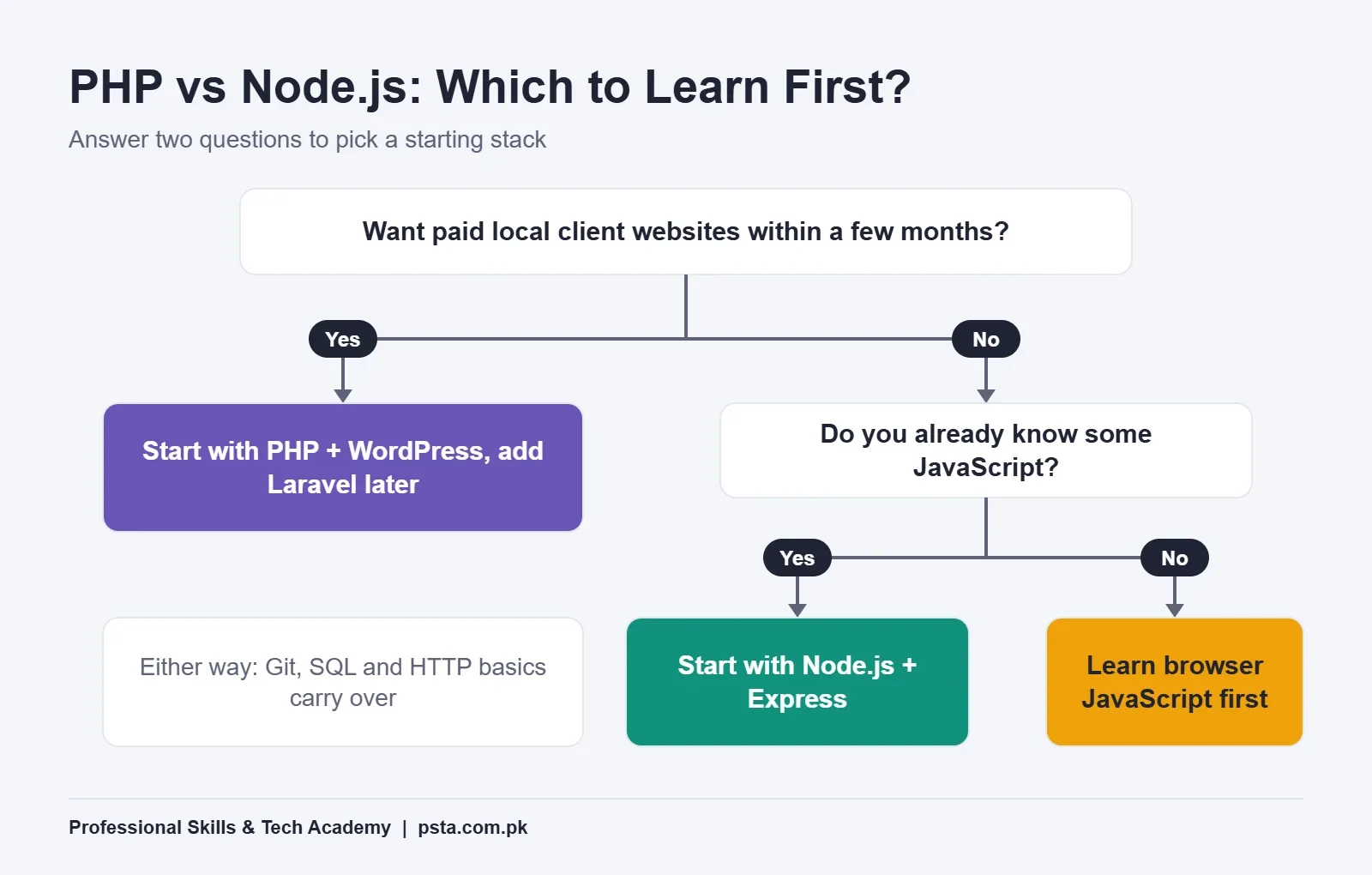
Whichever you pick, you're not locked in. Variables, loops, functions, HTTP, databases and Git carry across. Your second back end will take far less time than your first.
Can You Learn Both Without Getting Confused?
Yes, if you learn them in sequence rather than in the same week. A practical order looks like this:
- Weeks 1–6: HTML, CSS and plain JavaScript. Build two static pages.
- Weeks 7–10: PHP basics with MySQL. Build a contact form that saves to a database.
- Weeks 11–12: WordPress. Set up a client-style site with a child theme.
- Weeks 13–18: Node.js and Express. Rebuild the same contact form as a REST API.
- Weeks 19–24: React and MongoDB. Connect a front end to your API and deploy it.
Rebuilding the same small feature in both stacks is the quickest way to settle PHP vs Node.js for yourself. If React is your next question after this, read our comparison of React and Next.js for beginners.
Where PHP and Node.js Sit in PSTA's Full-Stack Course
We teach both stacks in one programme, because many web developers end up needing both. Our 6-month Full-Stack Web Development course includes a module on AI coding tools and is designed for beginners with no coding background.
- Node side: modules on Node.js, Express and REST APIs, MongoDB with Mongoose, and React with Hooks and Redux Toolkit.
- PHP side: a dedicated module on PHP fundamentals and advanced WordPress development for local client work, plus SQL with MySQL.
- Extras: ChatGPT and GitHub Copilot for faster debugging, an Upwork and Fiverr bootcamp, and a deployed capstone app.
The current fee is Rs. 45,000 (regular Rs. 60,000), payable in 2 installments. Classes run on campus in Mandian (Old College Road, across from FIMS College) and live online for students elsewhere in Pakistan. If you only want the WordPress side, the 12-week WordPress Website Development course is a shorter route. If JavaScript is your gap, the 12-week JavaScript course is a good place to start. Every programme is listed on the courses page, and you can apply through the online admission page whenever it suits you. For batch timings, send a message to +92 314 5424399 on WhatsApp.
Build the Same Contact Form Twice
Here's a practical test for this week. Build a three-field contact form in PHP that saves to MySQL. Then build the same form with Node.js and Express. Time both attempts and note what felt natural. The stack that felt easier to debug is a sensible first choice, and the other one becomes your second skill a few months later.
Frequently asked questions
Is PHP dead in 2026?
No. PHP 8.5 was released in November 2025, and W3Techs still finds PHP on 69.2% of websites whose server-side language it can detect. What has faded is old, messy PHP code. Modern PHP with Composer, prepared statements and a framework such as Laravel is still used for new projects.
Is Node.js faster than PHP?
It depends on the work. Node.js handles many open connections well, which suits chat, live updates and APIs with lots of waiting on databases. For ordinary page loads on a business site, a well-configured PHP setup is fast enough, and the bigger speed gains usually come from caching and good queries.
Do I need to know JavaScript before learning Node.js?
Yes. Node.js runs JavaScript, so learn variables, functions, arrays, objects and async/await in the browser first. Once those feel comfortable, Node.js mostly adds modules, npm packages, file handling and building servers with a framework like Express.
Which pays more in Pakistan, PHP or Node.js?
There is no reliable public salary dataset that compares the two across Pakistan. Pay depends more on the company, your portfolio, your communication and whether you work for local or foreign clients. Check current job ads in your city and on remote boards to see what each stack is offered.
Should I learn Laravel or plain PHP first?
Learn plain PHP first: forms, sessions, MySQL queries with prepared statements and simple file organisation. After a few small projects, move to Laravel. The framework will make far more sense once you have felt the problems it solves, such as routing, validation and database migrations.
Can WordPress run on Node.js?
No. WordPress is written in PHP and needs a PHP server with MySQL or MariaDB. WordPress.org recommends PHP 8.3 or later. You can use WordPress as a headless back end and build a separate JavaScript front end, but the WordPress part itself still runs on PHP.
How long does it take to learn PHP or Node.js?
With about two hours of practice a day, most beginners can build a simple database-backed form in PHP within a few weeks of learning HTML, CSS and JavaScript. Node.js takes a little longer because of asynchronous code. Plan for around six months to become job-ready in either stack.
Sources & references
- Stack Overflow Developer Survey 2025: Technology survey.stackoverflow.co
- W3Techs: Usage statistics of PHP for websites w3techs.com
- W3Techs: Usage statistics of JavaScript as server-side language w3techs.com
- W3Techs: Usage statistics of WordPress w3techs.com
- PHP: Supported Versions php.net
- Node.js: Previous Releases nodejs.org
- WordPress.org: Requirements wordpress.org
- The Express Tribune: IT exports hit record $4.6b tribune.com.pk
Last reviewed & updated on by Umar Qureshi. Written by the PSTA team in Abbottabad, Pakistan.

Umar Qureshi

Full-Stack Web Development Course with AI Tools
Turn this guide into a career: hands-on training with real projects, online across Pakistan or on-campus in Abbottabad · 6 Months.
Comments
No comments yet — ask a question or share your experience.