Quick answer
A 4G solar CCTV camera is a battery camera that charges from a small solar panel and uses a mobile SIM for alerts and live view. Before buying, check that its LTE bands include B3, that the seller can show PTA approval, and that your SIM gets good signal at the site.
Key takeaways
- • It sleeps and wakes on motion, so it suits remote sites but not 24/7 recording.
- • Check the LTE band list: look for B3 plus B1, B8 or B40 before you buy.
- • Reolink's figures put 4K live view at about 1.28GB an hour, while alerts alone fit a 2GB to 5GB monthly plan.
- • Shade, dust and heat above 50°C can shorten battery life and stress the camera in many parts of Pakistan.
- • Ask the seller for proof of PTA approval, because SIM devices are registered through DIRBS.
Table of contents 12 sections
- What Is a 4G Solar CCTV Camera?
- How the Panel, Battery, SIM and Memory Card Depend on Each Other
- Will a 4G Solar CCTV Camera Connect on Jazz, Zong, Ufone or Telenor?
- How Much Mobile Data Does It Use in a Month?
- Reading the Spec Sheet: Three Real Cameras Side by Side
- Heat, Dust and Shade: Pakistani Conditions to Plan For
- Do You Need PTA Approval for a SIM Camera?
- Myths That Lead to Bad Purchases
- Where It Fits, and Where a Wired System Is Better
- Setting It Up: A Seven-Step Install Order
- Where PSTA's CPCST Course Covers This Work
- Before You Pay, Get Three Answers in Writing
How do you watch a tube well, a farmhouse gate or a half-built house when the site has no Wi-Fi and the grid supply comes and goes? Students in our CCTV class ask some version of this almost every batch. The usual answer is a 4G solar CCTV camera: a battery camera that charges from a small panel and sends alerts over a mobile SIM, so it needs neither a power line nor a broadband connection.
It's a good tool for the right site and an expensive disappointment on the wrong one. This explainer shows you how the parts work, what the spec sheet is really telling you and where these cameras fall short.
Read on and you'll come away knowing:
- What each part of the camera does and how the four parts depend on each other
- How to confirm a camera will connect on a Pakistani network before you pay
- How much mobile data to budget for, using figures from a manufacturer
- Which Pakistani conditions (heat, dust, shade) quietly shorten battery life
- When a wired DVR or NVR system is the better choice
What Is a 4G Solar CCTV Camera?
A 4G solar CCTV camera is a self-contained outdoor camera with four parts in one kit: a lens and sensor, a rechargeable battery, a small solar panel and a 4G LTE modem that takes a nano-SIM. Most models also have a microSD slot for local recording.
Unlike a normal wired camera, this kind of battery CCTV camera doesn't stream video around the clock to a recorder. It sleeps most of the time. A motion sensor (usually PIR, which reacts to body heat) wakes it, it records a short clip, saves it to the card and pushes an alert to your phone over the mobile network. When you open the app, it wakes again and streams live.
That sleep-and-wake design is the whole trick. It's why a battery the size of a large power bank can run a camera for weeks, and it's also the reason these cameras behave differently from the wired systems most installers know.
How the Panel, Battery, SIM and Memory Card Depend on Each Other
Think of the four parts of a 4G solar CCTV camera as a chain. If one link is weak, the whole camera looks faulty, even when the camera itself is fine.
- The panel refills the battery. Reolink pairs its Go PT Ultra with a 6W solar panel and tells buyers to mount it where it gets direct sun every day, because heavy shade cuts charging.
- The battery decides how often the camera can wake. Every motion clip and every minute of live view drains it. Reolink notes that colour night vision uses more power and suggests infrared mode for busy, unwatched spots.
- The SIM carries alerts and live view. Weak signal makes the modem work harder, which also drains the battery. EZVIZ's datasheet for the EB8 4G lists carrier network stability and signal strength among the factors that change battery life.
- The microSD card keeps the evidence. If the data package runs out, clips can still sit on the card until you check them, depending on the model.
So when a customer says the camera "stops working after a week," the cause is usually one of these links: a shaded panel, weak signal, an empty data package or too many false triggers from a tree branch.
Will a 4G Solar CCTV Camera Connect on Jazz, Zong, Ufone or Telenor?
Network compatibility is the most expensive mistake buyers make, and it's easy to avoid. A 4G modem only works on the LTE bands it was built for, and the same camera is often sold in different regional versions.
Look at Reolink's Go PT Ultra page. The US version lists bands B2, B4, B5, B12, B13, B14, B66 and B71. The European version lists B1, B3, B7, B8, B20 and B28A. Those are two different modems inside two identical-looking cameras.
Pakistani operators hold spectrum in bands like 900, 1800 and 2100 MHz. In LTE numbering those are B8, B3 and B1. Jazz, for example, says it holds spectrum in the 700, 900, 1800, 2100, 2300, 2600 and 3500 MHz bands, according to ProPakistani's March 2026 report. The 2300 MHz band is B40 in LTE terms.
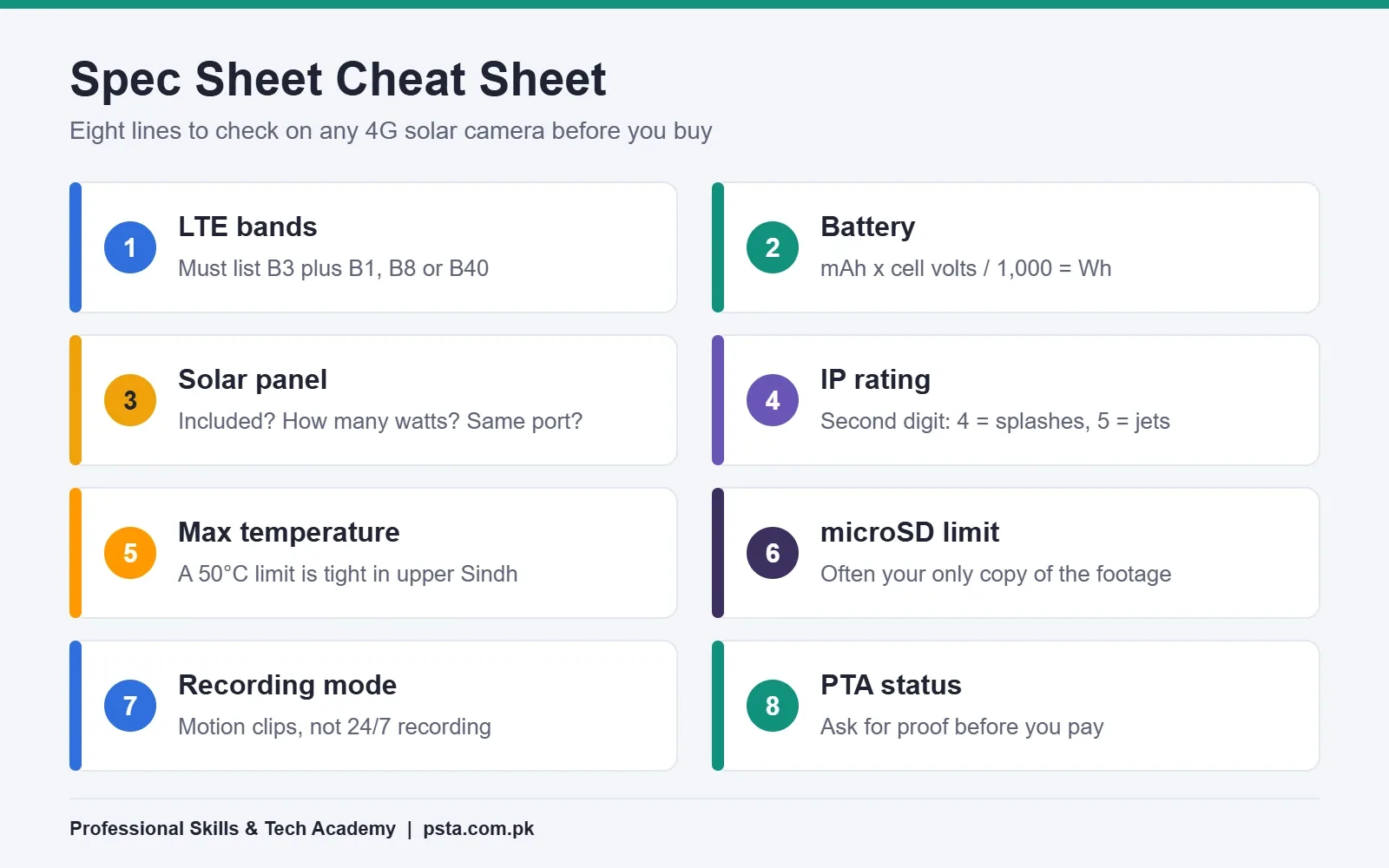
Here's a simple rule we teach. Before buying, find the exact model and version number on the box, open its datasheet and check that it lists B3 and at least one of B1, B8 or B40. A US-only version may connect poorly or not at all, even if the seller says "4G supported."
Then test coverage at the site itself. Stand where the camera will go, put the SIM you plan to use in your phone and run a speed test. Mobile networks are crowded. PhoneWorld, citing PTA data, reported 204.771 million mobile subscribers in February 2026, with 155.930 million on 3G and 4G. A tower that's fine at noon can slow down in the evening.
How Much Mobile Data Does It Use in a Month?
A 4G solar CCTV camera uses less data than most people fear if you rely on alerts, and far more than they expect if you watch live in full resolution. The Reolink Go PT Ultra review on Reolink's own blog gives three useful numbers:
- Live view in Clear mode (4K at 3 Mbps) uses about 1.28GB per hour.
- Live view in Fluent mode (a 672 kbps sub-stream) uses about 1GB for three or more hours.
- Event-based use, with 10 to 15 motion triggers a day and short live checks, fits a 2GB to 5GB monthly plan.
Now do the sum for your own habits. Ten minutes of live 4K a day adds up to five hours a month, or roughly 6.4GB. The same ten minutes in Fluent mode comes to under 2GB. Half an hour of 4K a day climbs past 19GB.
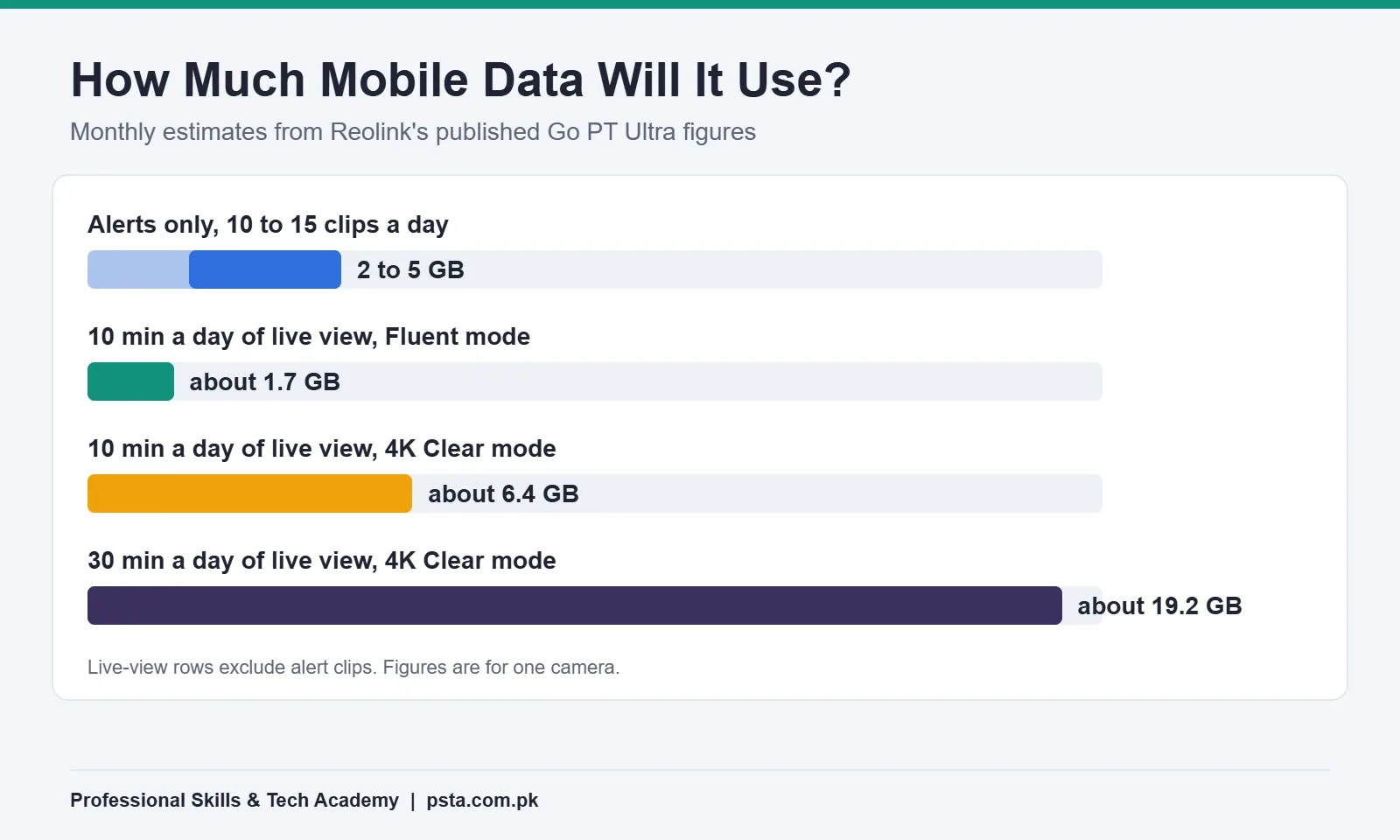
The practical takeaway: set the app to the lower-quality stream for routine checks and switch to full resolution only when you need to read a number plate or a face. These figures are for one camera. Other brands compress video differently, so check their numbers too.
Reading the Spec Sheet: Three Real Cameras Side by Side
Every solar security camera comes with a spec sheet, and they use different units, which makes comparison harder than it should be. The table below puts three models on the same grid, using each maker's or seller's published figures.
| Spec | Reolink Go PT Ultra | EZVIZ EB8 4G | Imou Cell PT 4G |
|---|---|---|---|
| Resolution | 3840 x 2160 (8MP) | 2304 x 1296 (3MP) | 2304 x 1296 (3MP) |
| Battery | 21.6Wh | 10,400mAh | 15,000mAh |
| Solar panel | 6W panel named as the match | Sold separately (Type-C EZVIZ panels) | Optional, not included |
| Power draw | Not listed | Max. 10W | Under 3.5W |
| microSD (max) | 128GB | 512GB | Not listed by the seller |
| Weather rating | IP64 | IP65 | Not listed by the seller |
| Operating temperature | -10 to 55°C | -20 to 50°C | Not listed by the seller |
Sources: Reolink product page, EZVIZ EB8 4G datasheet and a Pakistani retailer's Imou Cell PT 4G listing, which marks that model as discontinued.
Three things jump out. First, battery size is given in watt-hours by one maker and milliamp-hours by the others. To compare them, multiply mAh by the cell voltage on the datasheet and divide by 1,000. Second, IP64 and IP65 differ in the second digit, which covers water: 5 means protection from water jets, 4 from splashing. Third, an empty cell on a seller's page isn't a "no." It means you should ask for the full datasheet.
Heat, Dust and Shade: Pakistani Conditions to Plan For
Most spec sheets are written for mild climates. Much of Pakistan isn't mild. Dawn reported that Dadu set a new record of 51.5°C in May 2026, with Jacobabad also touching 51°C. Compare that with the upper limits in the table: 55°C for the Reolink and 50°C for the EZVIZ. A camera in direct afternoon sun on a metal pole runs hotter than the air around it.
For sites in Sindh, south Punjab or Balochistan, a few habits help:
- Mount the camera under an eave or a small shade hood, and leave the panel in the open. They can sit apart if the cable allows it.
- Wipe the panel every couple of weeks. A layer of dust after a windy day cuts charging more than most owners notice.
- In hilly or tree-covered places like the Galyat or Kaghan, check where the shadow falls in winter, when the sun stays lower. A spot that's sunny in June can be shaded by December.
Do You Need PTA Approval for a SIM Camera?
A SIM card CCTV camera has a SIM slot and an IMEI, so it's treated differently from a Wi-Fi gadget. PTA's Type Approval FAQs list IoT and M2M devices, and trackers with SIM or IMEI functions, among the equipment that needs approval. The list is described as "including but not limited to," so it isn't complete. The same document explains that approved device codes are added to DIRBS, the system that registers IMEIs on Pakistani networks.
The FAQ doesn't name 4G cameras directly. So the safe approach is practical. Buy from a seller who can show the model is PTA approved or registered, and keep the receipt. This matters more for a 4G solar CCTV camera than for most gadgets, because it will sit on a mobile network for years. A cheap import that the network later blocks costs more than the price difference. If you're unsure, PTA's Type Approval division can confirm.
Myths That Lead to Bad Purchases
Most complaints we hear about a 4G solar CCTV camera come from expectations, not faults. The graphic below sets five common beliefs against what the manufacturers' own pages say.
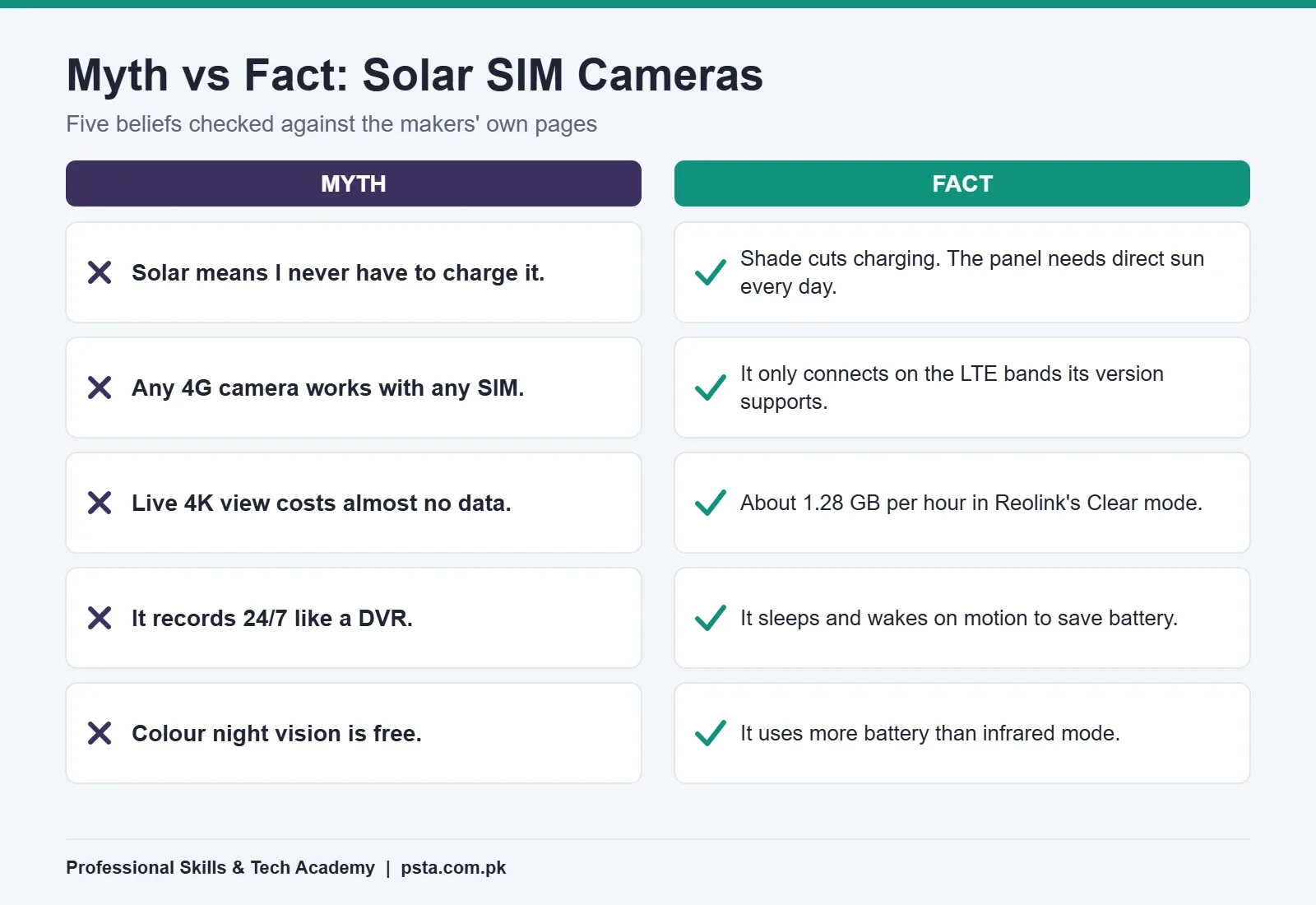
One more worth adding: cloud backup isn't available everywhere. Reolink says its cloud service runs only in some countries, and EZVIZ says the same about CloudPlay. For many buyers in Pakistan, the microSD card is the only recording, so a good-quality card matters.
Where It Fits, and Where a Wired System Is Better
A 4G solar CCTV camera is a strong choice for places where pulling cable and power is the hard part. It's the obvious CCTV camera without WiFi for:
- Farmhouses, tube wells, orchards and poultry sheds outside the city
- Construction sites and empty plots in new housing societies
- A gate or boundary wall far from the main building
- Temporary sites where the camera will move after a few months
It's a weak choice when you need continuous recording, more than a few cameras, or a shop counter where every second matters. Reolink states that continuous RTSP and ONVIF streaming is disabled on the Go PT Ultra to save battery. A wired system with a recorder and a UPS records all the time. Our guides to WiFi cameras versus CCTV and choosing a UPS for CCTV cover that route in detail.
Setting It Up: A Seven-Step Install Order
Doing these in order saves a second trip to the site.
- Charge the battery fully over USB-C before mounting. Reolink says a full charge takes roughly four to six hours.
- With the camera switched off, insert the nano-SIM and the microSD card.
- Activate a data package on the SIM and turn off any PIN lock if the maker asks for it.
- Pair the camera in the app by scanning its QR code, while you're still on the ground.
- Mount the camera about 8 to 10 feet up, angled slightly down, which is the height Reolink suggests for its motion sensor.
- Point the panel toward the south with open sky above it. In Pakistan, the sun sits in the southern half of the sky for most of the year.
- Walk through the detection zone, then adjust sensitivity and switch on person or vehicle detection to cut false alerts from leaves and shadows.
Check the battery level in the app after three or four days. If it's falling every day, move the panel or lower the sensitivity before it runs flat. You can also read how we work out recording space in our CCTV storage calculation guide.
Where PSTA's CPCST Course Covers This Work
Solar SIM cameras are one part of a bigger trade. Our CPCST course in CCTV and AI security lasts 12 weeks. It's pitched at beginners, so you can start it without any wiring experience. Its modules include IP camera configuration and firmware, remote access through P2P cloud and VPNs, AI detection setup, troubleshooting and professional site surveys. At the time of writing, the course page shows a fee of Rs. 22,000 (marked down from Rs. 25,000).
Pick whichever mode suits you: lab sessions in Abbottabad, live classes over the internet, or a blend of both. Batches open monthly. Interested in protecting the networks behind these cameras as well? Look at the Cyber Security & Ethical Hacking course, or compare options on the full course list.
Want to ask about the next start date first? Send a WhatsApp to +92 314 5424399, or fill in the admission form when you're ready.
Before You Pay, Get Three Answers in Writing
Before any 4G solar CCTV camera goes into your cart, ask the seller for the exact model and regional version, its LTE band list, and proof of PTA approval. If those three answers check out, and your phone shows good 4G signal at the spot where the camera will hang, you're buying a camera that has a fair chance of doing its job.
Frequently asked questions
Does a 4G solar CCTV camera need internet at the site?
It needs mobile data, not Wi-Fi or broadband. The SIM inside the camera connects to a 4G tower to send alerts and live video to your phone. If there's no usable 4G signal where you mount it, many models can still save clips to the microSD card, but you won't get alerts until the signal improves.
Which SIM works best in a solar CCTV camera?
There's no single best network, because coverage changes from one village or street to the next. Put each SIM you're considering in your phone, stand at the exact mounting spot and run a speed test at different times of day. Choose the steadiest one, then confirm the camera's LTE bands support that operator.
How long does the battery last without sunshine?
It depends on battery size, how often motion wakes the camera and how much live view you use. Reolink says the Go PT Ultra's battery can power the camera for up to two months, including cloudy days, but it adds that settings, usage and temperature change this. Busy spots drain batteries much faster.
Can a 4G solar camera record 24/7?
Most battery-powered 4G cameras don't. They sleep and record short clips when motion wakes them, which is how they survive on solar power. Reolink, for example, disables continuous RTSP streaming on the Go PT Ultra to protect the battery. If you need round-the-clock recording, a wired DVR or NVR system with a UPS fits better.
Is a solar SIM camera a good idea for a city shop?
Usually not as the main system. A city shop normally has grid power and often broadband, so wired cameras recording continuously give better cover of the counter and door. A solar 4G camera makes more sense for a godown, rooftop or back gate where running a cable is awkward or expensive.
Can I install a 4G solar camera myself?
Yes, most kits are built for self-installation with an app and a QR code. The parts people get wrong are panel placement, mounting height and network bands. Charge the battery first, pair the camera on the ground, then mount it 8 to 10 feet up with the panel facing south and clear of shade.
Why does my solar camera's battery keep dropping?
The usual causes are a shaded or dusty panel, weak 4G signal, too many motion triggers from trees or traffic, and colour night vision left on. Clean the panel, lower the sensitivity, turn on person detection and switch to infrared night mode. If the level still falls, move the panel to a sunnier spot.
Sources & references
- Reolink Go PT Ultra product page reolink.com
- Reolink Go PT Ultra review (data usage and setup) reolink.com
- EZVIZ EB8 4G datasheet mfs.ezvizlife.com
- Imou Cell PT 4G listing, Powerhouse Express powerhouseexpress.com.pk
- PTA Type Approval FAQs (2025) pta.gov.pk
- PhoneWorld: Mobile subscribers rise to 204.7 million in February 2026 phoneworld.com.pk
- ProPakistani: Jazz's spectrum strategy (March 2026) propakistani.pk
- Dawn: Dadu sets new temperature record with 51.5°C dawn.com
Last reviewed & updated on by Umar Qureshi. Written by the PSTA team in Abbottabad, Pakistan.

Umar Qureshi

Certified Professional CCTV Surveillance & AI Security Technician (CPCST)
Turn this guide into a career: hands-on training with real projects, online across Pakistan or on-campus in Abbottabad · 12 Weeks.
Comments
No comments yet — ask a question or share your experience.