Quick answer
In March 2019, an outsider abused a misconfigured web application firewall at Capital One to obtain cloud credentials and copy data on about 106 million US and Canadian people. A GitHub user's tip exposed it in July. The attacker was convicted in 2022, and regulators fined the bank $80 million for weak cloud risk checks.
Key takeaways
- • A misconfigured firewall plus an over-broad cloud role exposed data on about 106 million people in March 2019.
- • Card numbers and logins were safe, but about 140,000 US Social Security numbers and 1 million Canadian SINs were exposed.
- • The theft was found only after a GitHub user reported the attacker's public post.
- • The OCC fined Capital One $80 million for weak risk checks before its cloud move.
- • Least-privilege roles, outbound limits and data-movement alerts would each have broken the chain.
Table of contents 13 sections
- What Was the Capital One Data Breach?
- Capital One Data Breach Timeline
- How Did the Capital One Hack Work?
- Layer 1: A Firewall That Could Be Tricked
- Layer 2: Temporary Keys Handed to the Wrong Person
- Layer 3: A Server Account With Too Much Access
- What Data Was Exposed, and What Did It Cost?
- Who Was Blamed, and How Solid Is the Case?
- What Happened After the Capital One Data Breach?
- Why the Capital One Hack Matters in Pakistan
- Seven Defensive Lessons From the Capital One Data Breach
- Practicing Cloud Incident Analysis at PSTA
- Audit One Cloud Role Before Friday
Did a hacker break into Amazon's cloud to cause the Capital One data breach? Students ask this almost every time the case comes up, and the answer is no. A single misconfigured firewall in front of the bank's own cloud apps, plus a server account with far too much access, let one outsider copy records tied to about 106 million people in the US and Canada.
This incident explainer walks through the case using court records, regulator orders and the bank's own disclosures. Here is what you will take away:
- How the 2019 Capital One hack worked, in plain language and without exploit detail
- A dated timeline from the March 2019 intrusion to the October 2022 sentence
- What data was exposed, what was not, and what the breach cost
- Why US regulators blamed weak cloud risk checks, not just the attacker
- Seven lessons that apply directly to banks and startups in Pakistan
What Was the Capital One Data Breach?
Capital One is one of the largest credit card issuers in the United States. In July 2019 it disclosed that an outside person had reached data it stored in Amazon Web Services (AWS), the cloud platform it was moving its systems onto. According to Capital One's own incident page, the access happened on March 22 and 23, 2019, and was traced to "a configuration vulnerability."
The person responsible was not a criminal gang or a foreign state. The US Department of Justice (DOJ) charged Paige Thompson, a 33-year-old former software engineer in Seattle, on July 29, 2019. The DOJ says she reached the data through a misconfigured web application firewall and then wrote about the theft on GitHub, the code-sharing site.
That public post is what exposed her. It also makes this one of the clearest cloud cases you can study, because a jury later tested the evidence in open court.
Capital One Data Breach Timeline
All dates below are US dates. Pakistan runs 9 hours ahead of US Eastern summer time, so news dated late in a US day usually reached Pakistani readers the next morning.
| Date | What happened | Source |
|---|---|---|
| 2005 to early 2019 | Credit card applications later exposed in the breach were collected over these years | Capital One |
| March 22–23, 2019 | The outsider accessed Capital One data stored in the cloud | Capital One |
| Spring–summer 2019 | Thompson posted on GitHub about taking the data | DOJ |
| July 17, 2019 | A GitHub user who saw the post warned Capital One through its responsible disclosure program | DOJ, Capital One |
| July 19, 2019 | Capital One confirmed the intrusion and contacted the FBI | DOJ |
| July 29, 2019 | Breach announced; Thompson arrested; agents seized drives holding a copy of the data | DOJ |
| August 6, 2020 | OCC fined the bank $80 million and issued a cease and desist order | OCC |
| January 27, 2021 | About 4,700 more exposed Social Security numbers identified | Capital One |
| June 17, 2022 | Jury convicted Thompson on seven federal counts | DOJ |
| September 13, 2022 | $190 million class action settlement given final approval | Top Class Actions |
| October 4, 2022 | Thompson sentenced to time served and 5 years of probation | DOJ |
Notice the gap in the Capital One data breach. The data left in March, but the bank only learned about it in July, and only because a stranger read a public post. Nearly four months passed with no internal alarm.
How Did the Capital One Hack Work?
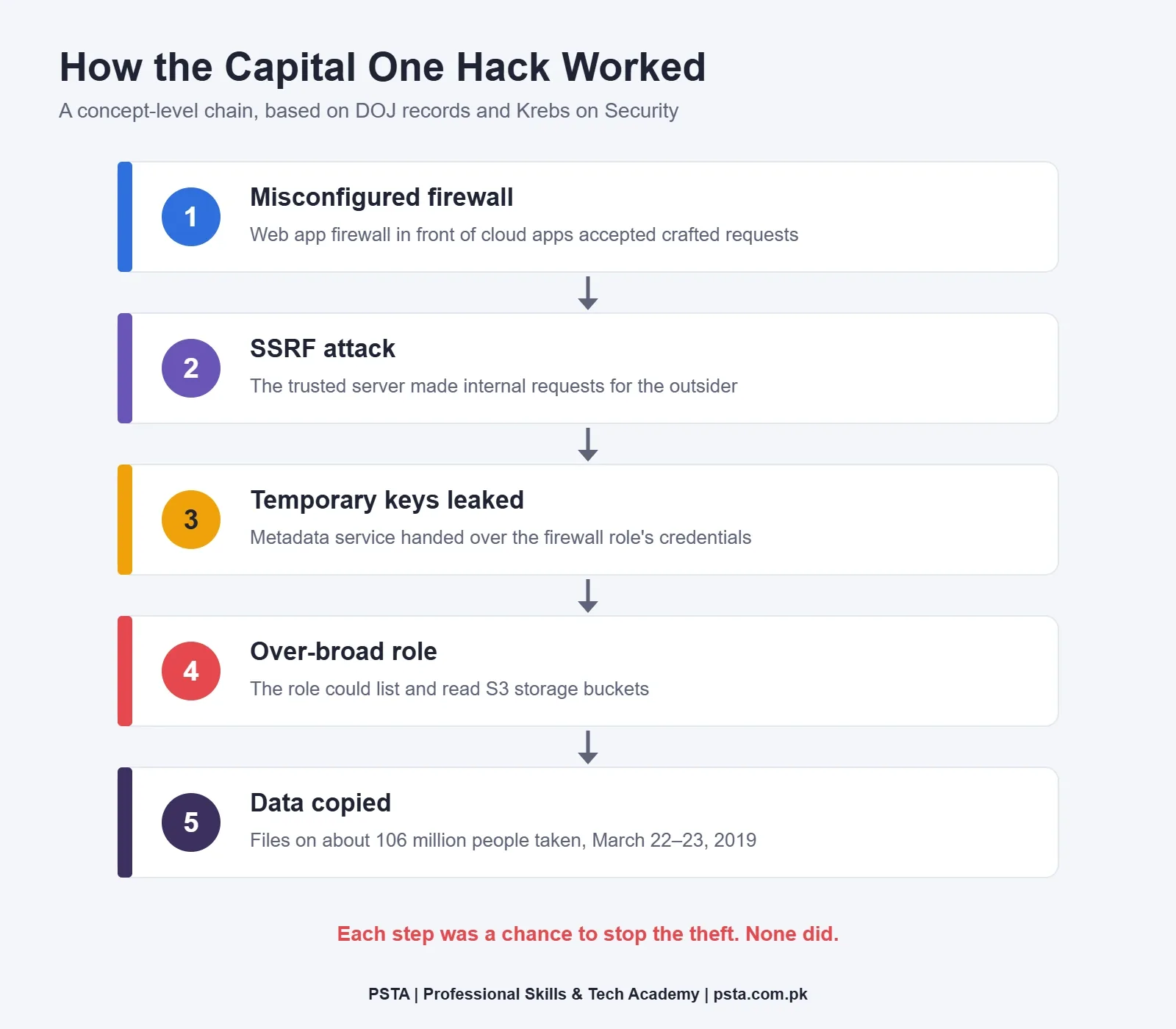
You do not need to read code to follow this. Think of three layers, each of which should have stopped the attack.
Layer 1: A Firewall That Could Be Tricked
Capital One ran a web application firewall (WAF), a filter that sits in front of web apps and blocks bad requests. Both the DOJ and the bank say this firewall was misconfigured. Security journalist Brian Krebs reported that it was the open-source ModSecurity filter, and that experts believed the attacker used a server-side request forgery, or SSRF attack.
In an SSRF attack, the outsider does not reach a protected system directly. Instead, they persuade a trusted server to make the request for them. It is like getting the office receptionist to fetch a file from the locked records room because the guard trusts the receptionist.
Layer 2: Temporary Keys Handed to the Wrong Person
Cloud servers get short-lived credentials from an internal "metadata service," so they can talk to other cloud services. Krebs explains that the tricked firewall fetched those credentials and passed them back to the attacker. From then on, she could act as the firewall's server account.
Layer 3: A Server Account With Too Much Access
That account, called an IAM role in AWS, should only have been able to do firewall work. According to the Krebs analysis, it could also list and read storage buckets in Amazon S3, which held the credit card application files. This is the core cloud misconfiguration in the case: a front-door filter that could open the vault.
Amazon told Krebs the problem came from the firewall's configuration, not from flaws in AWS itself. Treat the SSRF detail as expert reconstruction from 2019 reporting. The court record confirms the misconfiguration and the theft, while the exact request chain comes from analysts and the press.
The DOJ adds a wider picture. At sentencing it said Thompson built a tool to scan AWS accounts for misconfigurations, took data from more than 30 organizations, and installed cryptocurrency mining software on some servers she reached. Capital One was the largest victim, not the only one.
What Data Was Exposed, and What Did It Cost?
Most files taken in the Capital One data breach were credit card applications. Capital One lists names, addresses, phone numbers, email addresses, dates of birth and self-reported income. It also lists credit scores, credit limits, balances and payment history, plus fragments of transaction data from 23 days in 2016, 2017 and 2018.
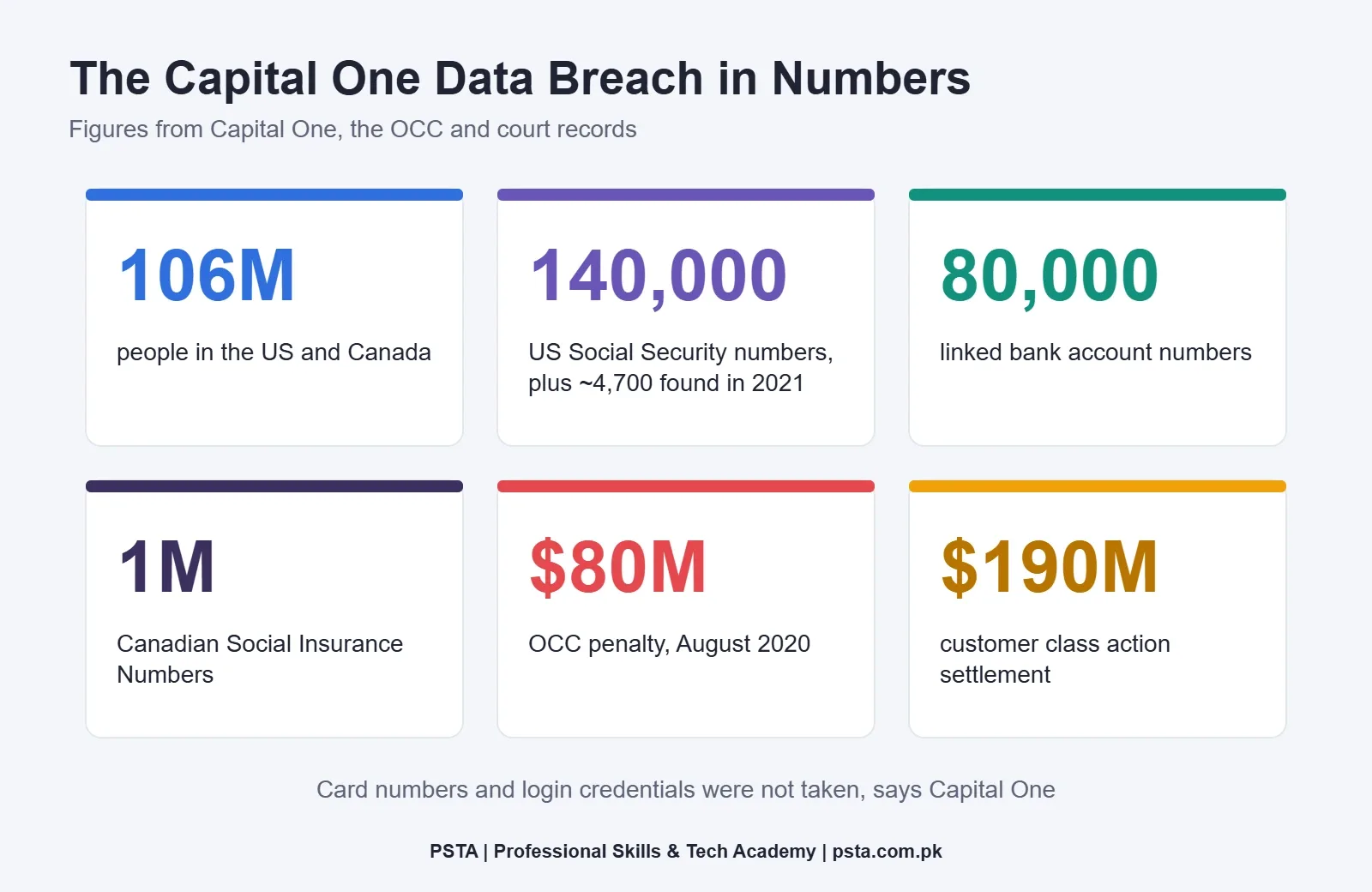
The most sensitive numbers were a smaller slice. Capital One says about 140,000 US Social Security numbers were taken at first, with about 4,700 more found in 2021. Around 80,000 linked bank account numbers and about 1 million Canadian Social Insurance Numbers were also exposed. The bank says card account numbers and login credentials were not compromised.
Estimates of the cost depend on who is counting:
- At disclosure, Capital One expected $100 million to $150 million in 2019 costs, mostly for notices, credit monitoring, technology and legal fees, SecurityWeek reported.
- The OCC added an $80 million civil penalty in 2020.
- Customers' class action settled for $190 million.
- At sentencing, the DOJ put total damage to companies and individuals above $250 million.
These figures measure different things, so they should not be added together. The bank's estimate covered its own first-year costs. The DOJ figure covered harm to all victims.
Who Was Blamed, and How Solid Is the Case?
Attribution here is unusually firm. In many hacks, blame rests on analysts linking malware or wallets to a group. In this case a federal jury heard the evidence for seven days. On June 17, 2022, the DOJ says jurors convicted Paige Thompson of wire fraud, five counts of unauthorized access to a protected computer, and one count of damaging a protected computer.
Two points keep the picture honest. First, the jury acquitted her of access device fraud and aggravated identity theft. Second, Capital One says the government believes the data was recovered, with no evidence it was used for fraud or shared. So this was a massive exposure of personal data, but not a proven wave of identity theft.
The sentence drew criticism. Prosecutors asked for seven years. Judge Robert S. Lasnik gave time served plus 5 years of probation, citing her mental health and transgender status. That outcome is a confirmed fact. Whether it was fair is opinion, and reasonable people disagree.
What Happened After the Capital One Data Breach?
The bank's own regulator went after process, not just the attacker. On August 6, 2020, the Office of the Comptroller of the Currency fined Capital One $80 million. The OCC said the bank failed to set up effective risk assessment before moving major IT work to the public cloud, and was slow to fix the gaps. It also gave the bank credit for how it notified and helped customers.
In court, customer lawsuits were combined in the Eastern District of Virginia. A $190 million settlement received final approval on September 13, 2022, according to the settlement tracker Top Class Actions. It offered refunds of documented losses of up to $25,000 and paid for lost time.
The bigger legacy of the Capital One data breach is cultural. Before this case, many teams spoke about "the cloud" as if the provider handled all security. Afterwards, cloud security for banks became a board-level topic, with regulators asking who checks each setting.
Why the Capital One Hack Matters in Pakistan
The Capital One data breach is not a distant American story. Pakistani banks, fintechs and government bodies are moving to the cloud now, which is exactly the stage at which Capital One stumbled.
The State Bank of Pakistan issued a framework in January 2023 on outsourcing to cloud service providers, Business Recorder reported. Banks may use reputable onshore providers for any workload, but material workloads on offshore providers need SBP approval. The framework says outsourcing does not move responsibility for data away from the bank, and it requires security testing of cloud systems at least once a year.
On the government side, the federal cabinet approved Pakistan's Cloud First Policy on February 15, 2022, Dawn reported. It plans a common cloud for public departments and sorts government data into five classes, from open to secret.
Both documents point to the same lesson as the OCC order: the organization owns its settings. A local bank that copies a cloud template with broad permissions could repeat this case. If you want to see how Pakistan's own card data was exposed in an earlier incident, read our case study on the 2018 Pakistan bank data breach.
For ordinary customers, the takeaway is simpler. Breached data such as your phone number, date of birth and income can feed convincing fraud calls later. Be suspicious of any caller who seems to know your details already, and never share an OTP.
Seven Defensive Lessons From the Capital One Data Breach
- Learn the shared responsibility split. The provider secures the platform. You secure your settings, accounts and data. Write down who owns each layer before you migrate.
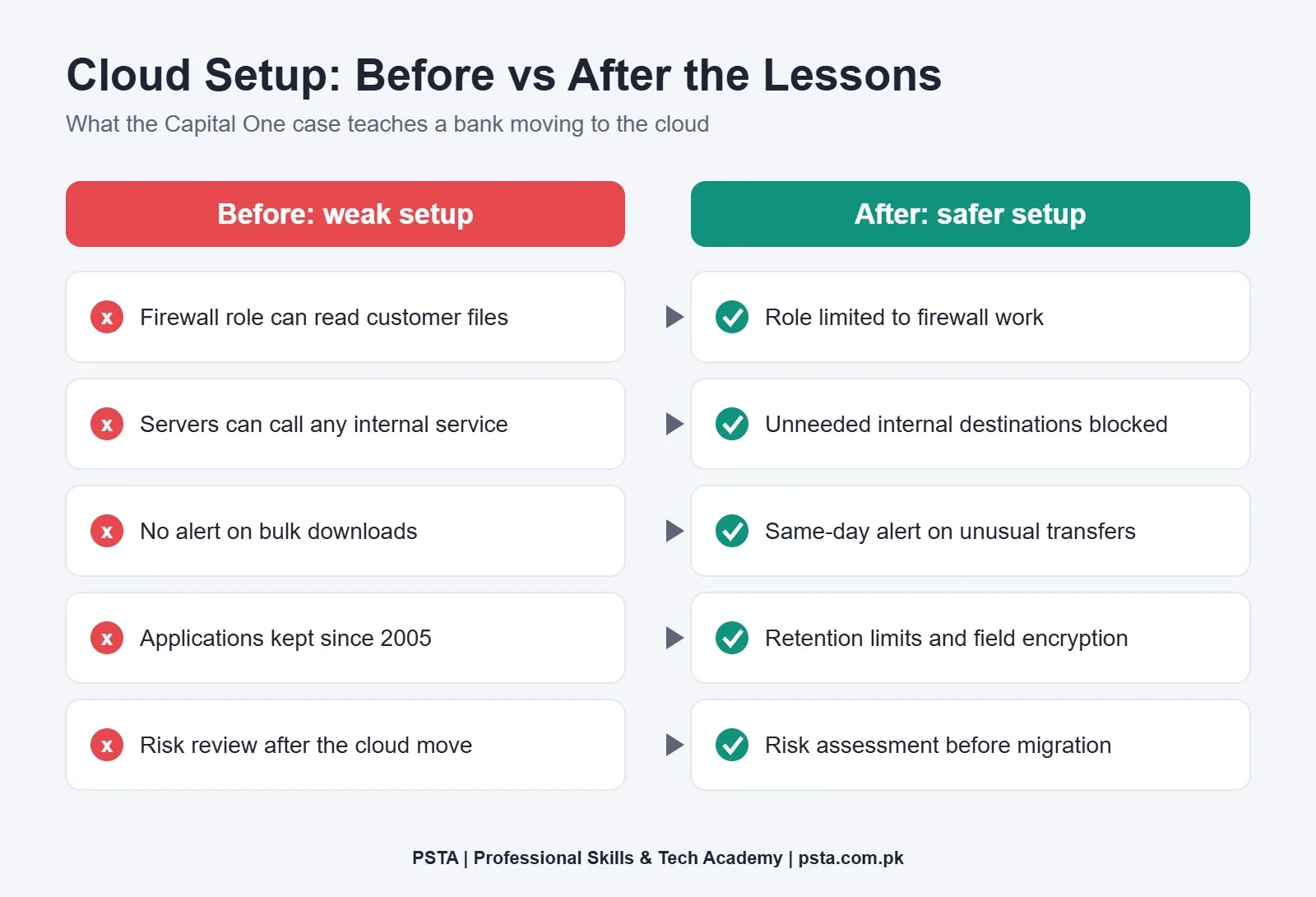
- Give every machine account the least access it needs. A firewall's role has no reason to read customer files. Review roles regularly and remove unused permissions.
- Limit what public-facing servers can reach inside your network. SSRF works because trusted servers can call internal services. Block internal destinations those servers never need.
- Alert on unusual data movement. Listing many storage buckets and copying large files in a short window should raise an alarm the same day, not four months later.
- Keep less data, and protect what you keep. Applications going back to 2005 were exposed. Set retention limits and encrypt sensitive fields separately.
- Run a responsible disclosure program. The warning arrived through one. Make it easy for outsiders to report problems, and act fast on reports.
- Assess risk before migration, not after. The OCC penalty was about missing checks before the cloud move. Strong AWS S3 bucket security and role reviews belong in the migration plan itself.
Two other series cases make good companions here. The Equifax data breach shows a patching failure at a similar scale, and the MOVEit hack shows how one weak file transfer tool exposed thousands of organizations.
Practicing Cloud Incident Analysis at PSTA
Reading a case like this is useful. Being able to explain each failure to a manager is what employers pay for. PSTA's Cyber Security and Ethical Hacking course is a 12-week, beginner-level program. Its outline moves from core ideas and common attacks through basic ethical hacking, network security, malware and threat detection, cyber law and digital forensics, with labs in a safe practice setup and a final case-study project.
You can join live online classes from any city in Pakistan or attend on campus in Abbottabad. If you already know the basics and want to test web apps and servers yourself, the Advanced Ethical Hacking and Penetration Testing course is the next step. If you are weighing exams too, our cyber security certifications for beginners comparison lays out costs and order.
This series began with the Binance hack and has since covered supply-chain attacks, ransomware and the Twitter hack 2020. Comparing them shows how different the entry points are, and how similar the missed warning signs can be.
Audit One Cloud Role Before Friday
If you manage any cloud account, pick one server role this week and list what it can actually do. Ask whether it could read data it never needs. If the answer is yes, trim it. That single review targets the exact weakness behind the Capital One data breach, and it takes less than an hour.
Frequently asked questions
Was the Capital One data breach caused by a flaw in Amazon Web Services?
No. Capital One and the US Justice Department both describe a misconfiguration in the bank's own setup, specifically a web application firewall. Amazon told Krebs on Security that its infrastructure was not at fault. The lesson is that the customer is responsible for its own settings, roles and data, even when the platform underneath is secure.
How many people were affected by the Capital One breach?
Capital One says about 100 million people in the United States and about 6 million in Canada were affected, mostly credit card applicants and customers. Around 140,000 US Social Security numbers, about 4,700 more found in 2021, roughly 80,000 linked bank account numbers and about 1 million Canadian Social Insurance Numbers were included.
Was the stolen Capital One data sold or used for fraud?
According to Capital One, the government believes the data was recovered, and there was no evidence it was used for fraud or shared. FBI agents seized storage devices holding a copy when they searched the suspect's home in July 2019. Customers were still advised to watch their accounts and enable alerts.
What happened to Paige Thompson after the Capital One hack?
A federal jury in Seattle convicted Paige Thompson in June 2022 of wire fraud and several computer intrusion charges, while acquitting her of access device fraud and aggravated identity theft. In October 2022 a judge sentenced her to time served plus 5 years of probation with monitoring. Prosecutors had asked for seven years.
What is an SSRF attack in simple words?
Server-side request forgery is when an attacker tricks a trusted server into making a request on their behalf, often to an internal system the attacker cannot reach directly. Experts believe this method was used in the Capital One case. Defenders limit the damage by restricting which internal addresses public-facing servers can contact.
Did Capital One customers receive compensation?
Yes. A $190 million class action settlement received final approval in September 2022. It offered reimbursement of documented out-of-pocket losses of up to $25,000, payment for time spent dealing with the breach, and identity protection services. Separately, the OCC fined the bank $80 million in 2020.
Could a similar breach happen to a bank in Pakistan?
Yes, if a bank moves to the cloud without strong role permissions, monitoring and risk checks. The State Bank of Pakistan's 2023 cloud outsourcing framework keeps responsibility for data with the bank and requires security testing of cloud systems at least once a year. Good configuration reviews matter more than the provider's name.
Sources & references
- Capital One: Information on the 2019 Cyber Incident capitalone.com
- US DOJ: Seattle tech worker arrested for data theft (2019) justice.gov
- US DOJ: Former Seattle tech worker convicted (2022) justice.gov
- US DOJ: Former hacker sentenced (2022) justice.gov
- OCC: $80 million civil money penalty against Capital One occ.gov
- Krebs on Security: What we can learn from the Capital One hack krebsonsecurity.com
- Business Recorder: SBP issues framework on outsourcing to CSPs brecorder.com
- Dawn: Cabinet approves Cloud First Policy dawn.com
Last reviewed & updated on by Umar Qureshi. Written by the PSTA team in Abbottabad, Pakistan.

Umar Qureshi

Cyber Security & Ethical Hacking Course in Abbottabad - PSTA
Turn this guide into a career: hands-on training with real projects, online across Pakistan or on-campus in Abbottabad · 12 Weeks.
Comments
No comments yet — ask a question or share your experience.