Quick answer
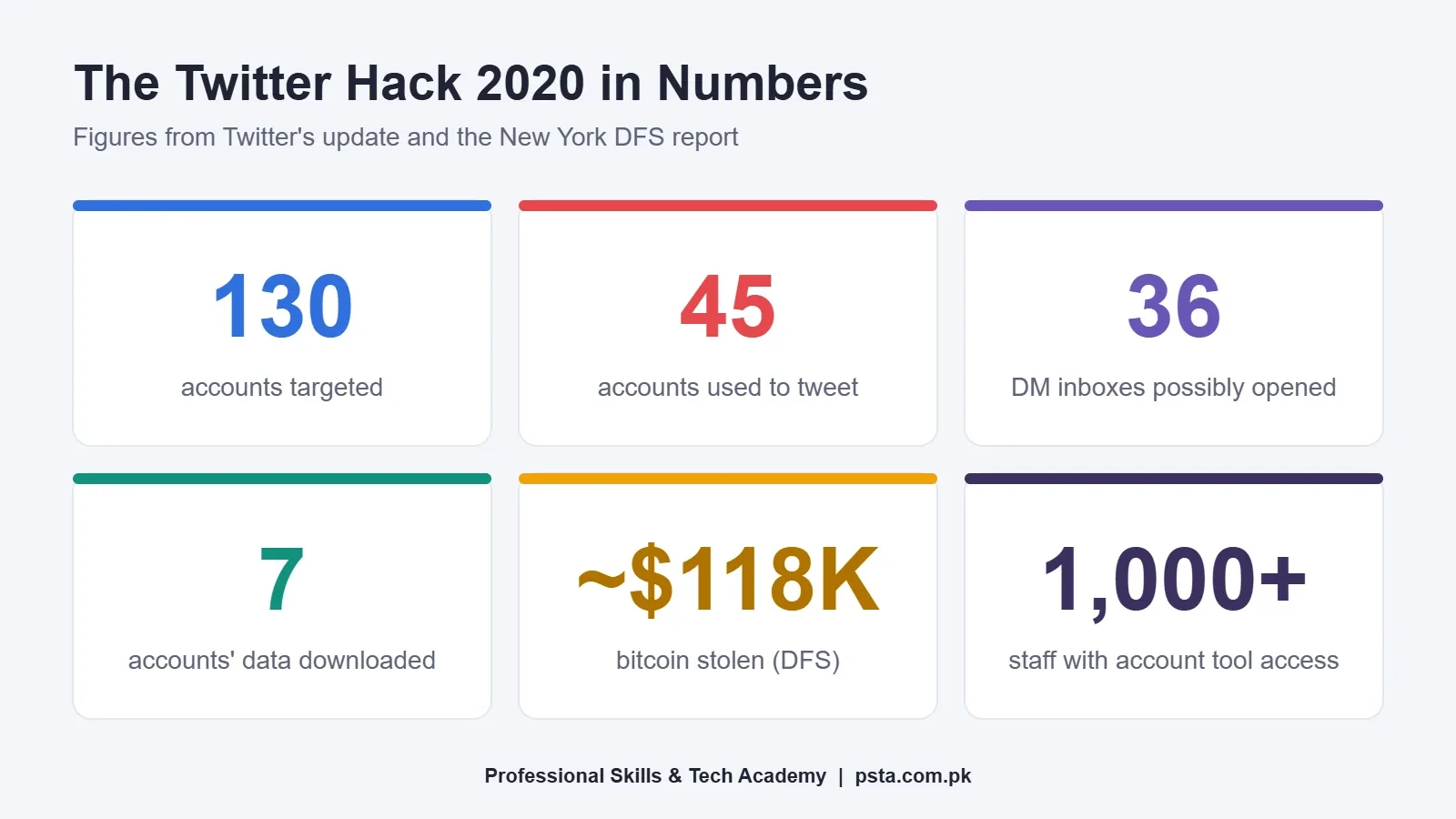
In July 2020, attackers phoned Twitter staff posing as IT support, captured their VPN logins and multi-factor approvals, then used internal tools to take over 130 accounts. Scam tweets from 45 of them raised about $118,000 in bitcoin before exchanges blocked far more. Organizers were later convicted.
Key takeaways
- • The attack began with phone calls from fake IT support, not with malware.
- • Staff approved multi-factor prompts that the attackers had triggered on a copied VPN login page.
- • More than 1,000 Twitter employees had access to account support tools, according to the DFS report.
- • About $118,000 in bitcoin reached the scammers; exchanges blocked over $1 million more.
- • Phishing-resistant keys, limited admin access and call-back checks are the main defenses.
Table of contents 12 sections
- What Was the Twitter Hack 2020?
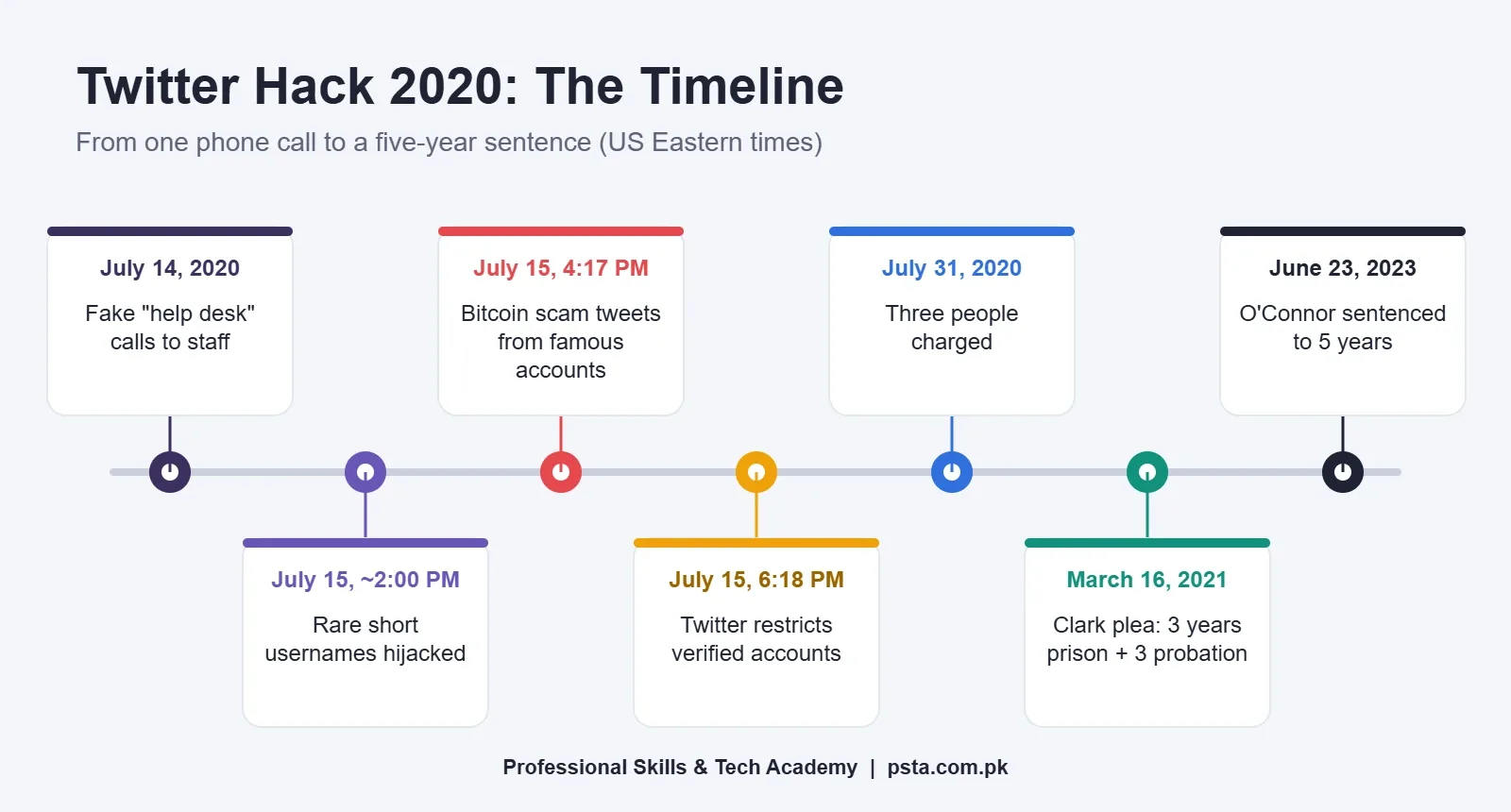
- Twitter Hack 2020 Timeline, Hour by Hour
- How Did a Phone Call Beat Twitter's Security?
- The Twitter Bitcoin Scam: What Was Lost and What Was Stopped?
- Who Was Behind It, and How Firm Is the Case?
- Settled by Plea or Sentence
- Charged in 2020
- What Happened Afterwards?
- Why Does the Twitter Hack 2020 Matter in Pakistan?
- Seven Defensive Lessons From the Twitter Hack 2020
- Studying Social Engineering Cases in PSTA's Cyber Security Course
- Test Your Own Help Desk This Month
On the afternoon of July 15, 2020, Barack Obama, Joe Biden, Elon Musk, Apple and Uber all appeared to post the same strange offer on Twitter: send bitcoin to one address and get double back. None of them wrote it. The Twitter hack 2020 did not start with malware or a clever exploit. It started the day before, with phone calls to Twitter staff from people pretending to be the company's own help desk.
This case study follows the incident hour by hour. It draws on the official probe by New York's financial regulator, Twitter's own updates and US court records. You will learn:
- Exactly how the attack unfolded over roughly 24 hours
- How a phone call got past passwords and multi-factor login
- How much bitcoin was taken and how much was blocked
- Who was charged, who pleaded guilty and what remains an allegation
- Seven habits that would have stopped it, sized for a Pakistani office
What Was the Twitter Hack 2020?
The Twitter hack 2020 was a social engineering attack. A small group took over 130 Twitter accounts, including those of world leaders, billionaires and large companies. They used some of those accounts to run a bitcoin "doubling" scam. According to Twitter's own incident update, the attackers sent tweets from 45 accounts, may have opened the direct messages of up to 36 and downloaded the account data of 7.
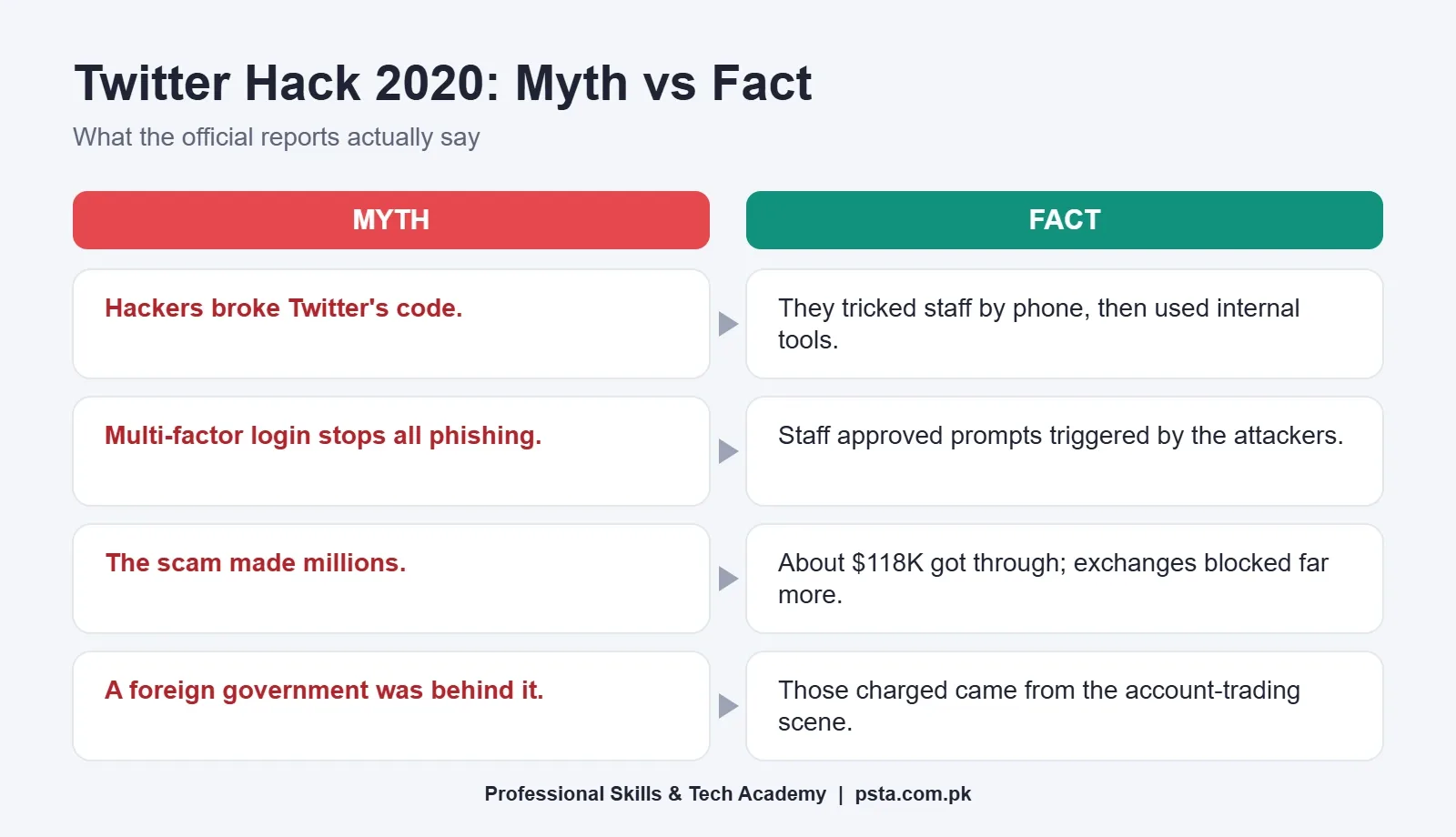
What makes the case worth studying is how ordinary the entry point was. Nobody broke Twitter's encryption. Attackers talked a few employees into typing their work passwords into a fake page. Then they used Twitter's own support tools exactly as designed.
Twitter Hack 2020 Timeline, Hour by Hour
The New York Department of Financial Services (DFS) report rebuilt the attack minute by minute. It lists all times in US Eastern Daylight Time. Pakistan is nine hours ahead, so most of the damage happened overnight for readers here.
| Date and Time (EDT) | Pakistan Time | What Happened |
|---|---|---|
| July 14, afternoon | July 14, late night | Callers posing as Twitter's help desk phone employees about a "VPN problem" |
| July 15, about 3 a.m. to 10 a.m. | July 15, noon to 7 p.m. | Hackers discuss selling short "OG" usernames they now control |
| July 15, about 2:00 p.m. | July 15, 11:00 p.m. | OG accounts hijacked; screenshots of internal tools posted |
| July 15, 3:18 p.m. | July 16, 12:18 a.m. | A major crypto exchange's account is seized |
| July 15, 3:26 to 4:12 p.m. | July 16, 12:26 to 1:12 a.m. | Ten cryptocurrency-related accounts hijacked |
| July 15, 4:17 to 6:05 p.m. | July 16, 1:17 to 3:05 a.m. | Scam tweets from high-profile people and companies |
| July 15, 5:45 p.m. | July 16, 2:45 a.m. | Twitter's first public acknowledgment |
| July 15, 6:18 p.m. | July 16, 3:18 a.m. | Twitter confirms it has restricted verified accounts and password changes |
| July 15, 8:41 p.m. | July 16, 5:41 a.m. | Most accounts can tweet again |
| July 31, 2020 | July 31, 2020 | Three people charged in Florida and federal court |
| March 16, 2021 | March 16, 2021 | Alleged mastermind agrees to a plea deal in Florida |
| June 23, 2023 | June 23, 2023 | A UK man linked to the scheme is sentenced to five years in New York |
How Did a Phone Call Beat Twitter's Security?
The method has a name: phone spear phishing, also called a vishing attack. Here is how it worked at a conceptual level, based on the DFS findings.
- Pretext. Callers said they were from Twitter's IT help desk and were fixing a VPN issue. With staff working from home during the pandemic, the story sounded normal.
- Fake login page. Employees were sent to a copy of Twitter's VPN login page. Whatever they typed, the attackers typed into the real site at the same moment.
- The multi-factor prompt. Because the real site now saw a login, it sent the employee a multi-factor approval request. Some employees approved it, believing it was part of the fix.
- Internal tools. With working credentials, the attackers reached the support tools Twitter staff used to manage accounts. The DFS report notes that more than 1,000 employees had access to such tools.
- Takeover. From those tools, attackers could change the email linked to an account, reset the password and log in as the owner.
The DFS report found no evidence that any Twitter employee knowingly helped the hackers. That detail matters. This was a social engineering attack on normal, busy people, not an inside job.
Notice what failed and what didn't. The multi-factor system worked as built. It asked a person to confirm, and that person had been told to expect the request. That is why the regulator later recommended hardware security keys, which won't approve a login on a fake site.
The Twitter Bitcoin Scam: What Was Lost and What Was Stopped?
The scam tweets promised to double any bitcoin sent to a listed address. The money that reached the attackers was small next to the fame of the victims. Two official sources give slightly different figures.
- When charges were announced, federal investigators said they had traced 415 transfers worth about $117,000 into the scam address, from more than 400 people.
- The DFS report, published later, puts the stolen amount at about $118,000.
The gap is likely down to timing and bitcoin's price movement rather than a dispute about what happened. More interesting is what didn't get through. DFS says four crypto firms, Coinbase, Square, Gemini and Bitstamp, blocked thousands of attempted transfers. Coinbase alone stopped about 5,670 transfers worth roughly $1.29 million. Coinbase, Gemini and Square blocked the addresses within about 40 minutes of their own accounts being hijacked.
The report's summary rounds the blocked total to about $1.5 million, while its line-by-line figures add up to closer to $1.35 million. Either way, quick action by exchanges stopped far more money than the scammers kept.
Who Was Behind It, and How Firm Is the Case?
It helps to separate what courts have settled from what was only alleged.
Settled by Plea or Sentence
- Graham Ivan Clark, a Tampa teenager described by prosecutors as the mastermind, was charged by Florida's Hillsborough County state attorney as a youthful offender. On March 16, 2021, he agreed to a plea deal: three years in prison followed by three years of probation.
- Joseph James O'Connor, a UK citizen known online as "PlugwalkJoe", pleaded guilty in 2023 to charges that included conspiracy to commit computer intrusion over the Twitter scheme. The US Justice Department says he was sentenced on June 23, 2023, to five years in prison, alongside other cybercrimes including SIM swapping.
Charged in 2020
- Mason Sheppard, then 19, from the UK, and Nima Fazeli, then 22, from Florida, were charged federally in July 2020 with helping sell access to hijacked accounts. The announcement described allegations, so treat their roles as charged rather than proven unless you check later court records.
Unlike many cases in this series, no government hacking group was blamed. The people involved came from the online account-trading scene, where rare short usernames sell for money. The Twitter bitcoin scam seems to have been an add-on once they had control.
What Happened Afterwards?
Twitter revoked the affected employees' access, temporarily stopped many verified accounts from tweeting and sharply limited staff access to internal tools. It also said it would run company-wide phishing exercises through the year.
DFS went further. Its report noted that Twitter had no chief information security officer from December 2019. That was about seven months before the attack. Twitter announced a new CISO in late September 2020. The regulator said large social media firms should face cyber rules like those for banks. It asked for hardware-based multi-factor login for high-risk access. It also asked for a second employee to approve sensitive account changes.
The case also showed how crypto firms can act as a brake. DFS asked exchanges to block the scam addresses that evening, and it urged them to keep faster blocking procedures for future scams.
Why Does the Twitter Hack 2020 Matter in Pakistan?
You don't need a global platform to face the same attack. The same lessons from the Twitter hack 2020 apply here. Callers who pretend to be IT support, a bank or a mobile operator are common in Pakistan too. PSTA has covered how these fraud calls in Pakistan work and what to do when a WhatsApp account is hacked after someone shares a code.
For a business in Lahore, Karachi or Abbottabad, the risk sits where it sat for Twitter. It sits with people who hold powerful admin access. Think of a call center agent who resets customer passwords. Or an accountant who approves bank transfers. Or an IT officer with full email admin rights. If any of them can be talked into approving a login, your other controls may not matter.
Crypto users should note the other side of the story too. Scams like this rely on urgency and borrowed trust. A famous name promising to double your money is a scam every time, as PSTA's case on the Binance hack and the WazirX hack also show from different angles.
Seven Defensive Lessons From the Twitter Hack 2020
- Verify every "IT support" call through a known channel. Hang up and call back on the official number from your intranet or ID card.
- Use phishing-resistant multi-factor login for admin accounts. Hardware security keys or passkeys check the real website address, so a fake page can't reuse them. Our guide to two-factor authentication methods compares the options.
- Never approve a login prompt you didn't start. Teach staff that an unexpected approval request is an alarm, not a formality.
- Cut down admin tool access. If more than 1,000 people can reset accounts, one tricked employee is enough. Grant access by role and review it every quarter.
- Require a second person for high-risk actions. Changing the email on a VIP or finance account should need a colleague's approval.
- Log and alert on unusual internal activity. A support agent resetting dozens of famous accounts in an hour should trigger an alert.
- Run vishing drills, not only email phishing tests. Phone pretexts bypass the email filters most companies rely on.
Studying Social Engineering Cases in PSTA's Cyber Security Course
PSTA (Professional Skills & Tech Academy) uses real incidents like this one to teach defense. In the Cyber Security and Ethical Hacking course, one module covers attack types such as phishing and social engineering. Another covers incident response. The last module is built around real-world case studies and a final security project. Pakistan's cyber law, PECA, is covered in the digital forensics module.
The course page lists it as a 12-week beginner program with a fee of Rs. 45,000. You can attend at the Abbottabad campus, join live online from another city or mix the two, with a new batch each month. Learners who finish the basics can move on to PSTA's advanced penetration testing track, which focuses on authorized testing. Our guide to cyber security certifications for beginners explains where each fits.
Test Your Own Help Desk This Month
If you manage a team, ask one simple question at your next meeting: what would we do if someone called claiming to be IT and asked us to log in to a link? Write the answer down as a two-line rule, share it on your staff group and run a friendly test call within 30 days. To talk through a course or a training plan for your staff, send PSTA a WhatsApp message at +92 314 5424399 or start at admission.
Frequently asked questions
How did hackers get into Twitter in 2020?
They called Twitter employees while pretending to be the company's IT help desk and sent them to a copy of the VPN login page. As staff typed their details, the attackers used them on the real site, and some staff approved the multi-factor prompts that followed. That gave access to internal tools used to manage user accounts.
How much money did the Twitter bitcoin scam make?
Federal investigators traced 415 transfers worth about $117,000 into the scam address, and the New York DFS report later put the total at about $118,000. Crypto exchanges such as Coinbase blocked thousands of further transfers to the scam addresses, worth more than $1 million, which kept losses far lower than they could have been.
Who was the mastermind of the Twitter hack?
Prosecutors named Graham Ivan Clark, then a 17-year-old from Tampa, Florida, as the mastermind. He was charged by the Hillsborough County state attorney as a youthful offender and, in March 2021, agreed to a plea deal of three years in prison followed by three years of probation.
Were any celebrities' private messages read?
Twitter said the attackers may have accessed the direct message inboxes of up to 36 of the 130 targeted accounts, and downloaded full account data for 7. Twitter named one elected official in the Netherlands among those whose messages were accessed. It did not publish a full list of affected users.
Could the Twitter hack 2020 have been prevented?
The DFS report pointed to several gaps: no chief information security officer at the time, very wide access to internal account tools and multi-factor login that a tricked employee could approve. Phishing-resistant security keys, tighter access and a second approval for sensitive changes would each have made the attack much harder.
What is a vishing attack?
Vishing is voice phishing: a scam carried out over a phone call instead of email. The caller pretends to be someone trusted, such as IT support, a bank or a mobile company, and pushes you to share a code, visit a link or approve a login. The safest response is to hang up and call back on an official number.
Is this case covered in PSTA's cyber security course?
PSTA's Cyber Security and Ethical Hacking course covers phishing and social engineering, incident response and real-world case studies, which is where incidents like this one fit. The course page lists it as a 12-week beginner program available on campus in Abbottabad, live online or in hybrid mode.
Sources & references
- Twitter Investigation Report, New York Department of Financial Services dfs.ny.gov
- An update on our security incident (Twitter) blog.x.com
- U.K. Citizen Sentenced To Five Years In Prison For Cybercrime Offenses (US DOJ, SDNY) justice.gov
- Teenage Twitter hacker pleads guilty, will serve 3 years in prison (The Record) therecord.media
- Florida 17-year-old mastermind of Twitter hack and two others face charges (NPR via GPB) gpb.org
Last reviewed & updated on by Umar Qureshi. Written by the PSTA team in Abbottabad, Pakistan.

Umar Qureshi
Cyber Security & Ethical Hacking Course in Abbottabad - PSTA
Turn this guide into a career: hands-on training with real projects, online across Pakistan or on-campus in Abbottabad · 12 Weeks.

Comments
No comments yet — ask a question or share your experience.