Quick answer
In May 2021, DarkSide ransomware hit Colonial Pipeline's office network. Colonial shut its 5,500-mile fuel line for about five days and paid a ransom of about 75 bitcoin, worth $4.4 million. The US later seized back 63.7 bitcoin. Investigators traced the entry to an unused VPN account protected only by a password.
Key takeaways
- • The Colonial Pipeline hack began with a leaked password for an unused VPN account that had no multi-factor authentication.
- • Ransomware hit the IT network, but Colonial stopped the whole pipeline as a precaution on May 7, 2021.
- • Colonial paid about 75 bitcoin, and the US Justice Department later seized 63.7 bitcoin back.
- • The FBI named the DarkSide ransomware-as-a-service group; no arrest has been announced.
- • The attack led to new TSA cybersecurity rules for US pipelines and a proposed PHMSA fine.
- • Review remote access accounts, enforce MFA and test manual operations before you need them.
Table of contents 13 sections
- What Happened to Colonial Pipeline in May 2021?
- Colonial Pipeline Hack Timeline in US and Pakistan Time
- How Did the Attackers Get In?
- What Is Ransomware-as-a-Service?
- Why Did Colonial Stop a Pipeline the Hackers Never Touched?
- The Cost in Money, Data and Fuel
- Who Was Behind It, and How Sure Are Investigators?
- What Changed After the Attack?
- Should Colonial Have Paid the Ransom?
- What Does This Mean for Businesses in Pakistan?
- Seven Defensive Lessons From the Colonial Pipeline Hack
- Turning This Case Into Lab Practice at PSTA
- Audit Your Remote Access Accounts Before Friday
The Colonial Pipeline hack began with a single password for a VPN account that nobody was meant to be using anymore. That login had no second check behind it, and about a week later it led to the shutdown of a pipeline that, according to S&P Global, moves about 45% of the gasoline and diesel used on the US East Coast. If you manage remote access for any company, this case is worth an hour of your time.
This explainer walks through the incident in plain language. Here is what you will find:
- A timeline of the attack in US Eastern time and Pakistan time
- How the attackers got in, and why the pipeline stopped even though its controls were not hit
- The ransom, the data theft and the partial recovery of the bitcoin
- Which group was named, and how solid the evidence is
- Seven defensive lessons you can apply in a Pakistani office this month
What Happened to Colonial Pipeline in May 2021?
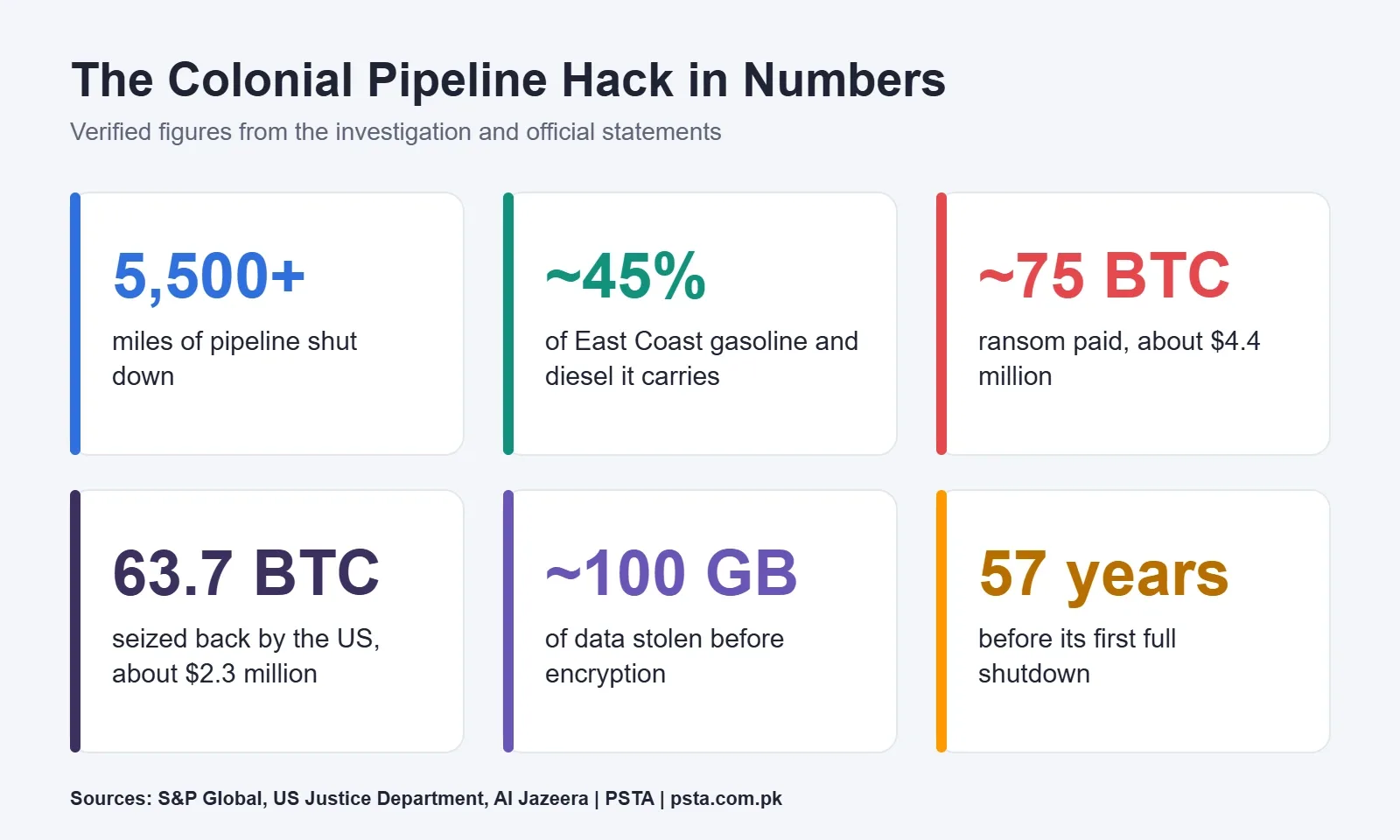
Colonial Pipeline runs more than 5,500 miles of pipe from the Houston refining hub to New York Harbor, as S&P Global reported. It carries refined fuel, not crude oil, to airports, fuel terminals and gas stations across the South and East.
On the morning of May 7, 2021, a control room employee saw a ransom note on a company computer shortly before 5 a.m. Eastern time. According to Al Jazeera's account of the CEO's interview, a supervisor started shutting the line down, and the whole system was offline by 6:10 a.m. It was the first full shutdown of the gasoline pipeline in the company's 57-year history.
The malware was ransomware, which locks files until the victim pays for a key. The group behind it called itself DarkSide. Fuel stopped flowing for about five days, and federal agencies rushed out emergency waivers while supplies ran short.
Colonial Pipeline Hack Timeline in US and Pakistan Time
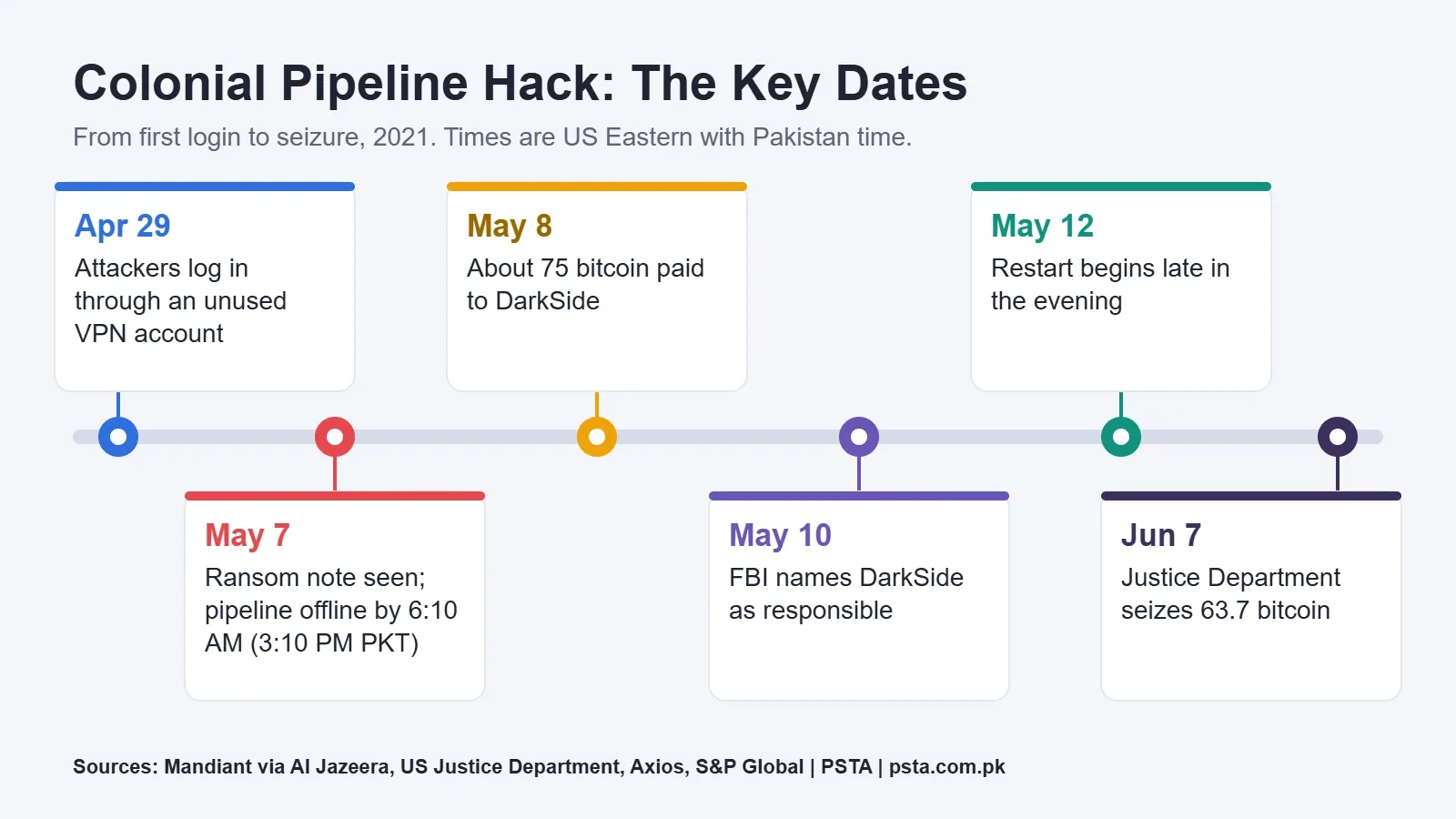
The table below is built from the sources linked in each section. In May, US Eastern time is four hours behind UTC, and Pakistan time (PKT) is nine hours ahead of US Eastern time.
| Date (US Eastern) | Pakistan time | What happened |
|---|---|---|
| April 29, 2021 | Same day or next | Attackers first log in through the old VPN account, per Mandiant's findings |
| May 7, just before 5:00 AM | May 7, about 2:00 PM | A control room employee spots the ransom note |
| May 7, 6:10 AM | May 7, 3:10 PM | The entire pipeline is offline |
| May 8 | May 8 | Colonial pays about 75 bitcoin to DarkSide |
| May 10 | May 10 to 11 | The FBI names DarkSide as responsible |
| May 11 | May 11 to 12 | CISA and the FBI publish a DarkSide advisory, and the EPA widens a fuel waiver |
| May 12, late evening | May 13, early morning | Colonial begins restarting the pipeline |
| May 27 | May 27 to 28 | TSA issues its first cybersecurity directive for pipelines |
| June 7 | June 7 to 8 | The Justice Department seizes 63.7 bitcoin from the ransom |
| May 5, 2022 | May 5 to 6, 2022 | PHMSA proposes a $986,400 civil penalty against Colonial |
Notice the gap between the first login and the ransom note. For eight days, the intruders were inside the IT network before anyone saw a sign of them.
How Did the Attackers Get In?
The entry point in the Colonial Pipeline hack was ordinary. Charles Carmakal of the security firm Mandiant, which investigated the breach, said the attackers entered on April 29 through a VPN account that was no longer in active use but could still connect to the network. The account did not require multi-factor authentication, so a username and password were enough. Al Jazeera reported these details from his interview.
A VPN, or virtual private network, lets staff reach office systems from home over an encrypted link. It is a front door. If an old door stays open after people stop using it, nobody watches it closely.
Three points from Mandiant's findings matter for defenders:
- The account's password later turned up in a batch of leaked passwords on the dark web.
- Carmakal said the employee may have reused the same password on another account that was hacked earlier, but he was not certain.
- He saw no evidence of phishing against that employee, and no attacker activity before April 29.
So the most likely story is password reuse plus a forgotten account. No advanced exploit was needed. That is why the case is taught so widely: the failure is one that almost every organization can find in its own network.
What Is Ransomware-as-a-Service?
DarkSide was not one hacker. The CISA and FBI advisory AA21-131A describes it as ransomware-as-a-service. Developers build the ransomware, and other criminals, called affiliates, use it against victims and share the payout. CISA says DarkSide affiliates had been targeting large, high-revenue organizations since August 2020, stealing data as well as encrypting it.
Why Did Colonial Stop a Pipeline the Hackers Never Touched?
Industrial companies run two kinds of networks. IT, or information technology, handles email, billing and office files. OT, or operational technology, runs the pumps, valves and sensors that physically move fuel.
In the Colonial Pipeline hack, the ransomware hit the IT side. CISA's advisory says the company proactively disconnected certain OT systems, and that there was no indication at the time that the attackers had moved into OT. Mandiant later reached the same view, according to Al Jazeera.
So why stop the fuel? The shutdown was a precaution. Nobody yet knew how far the attackers had spread, and an infection reaching the control systems of a fuel pipeline is a safety risk, not only a business one. Colonial restarted only after it judged the attack was contained.
A later regulator finding adds another angle. The Pipeline and Hazardous Materials Safety Administration (PHMSA) alleged that Colonial had not planned and prepared well enough for manual shutdown and restart, and that this contributed to the national impact while the line stayed out of service. Good IT and OT segmentation limits where an attacker can go. A tested manual fallback limits how long the business stops.
The Cost in Money, Data and Fuel
The US Justice Department says Colonial reported paying about 75 bitcoin on May 8. Al Jazeera put the Colonial Pipeline ransom at $4.4 million, and it said the attackers had also stolen nearly 100 gigabytes of data and threatened to leak it. That is the double extortion model CISA describes: lock the files, and threaten to publish them too.
The fuel impact spread fast. S&P Global reported that the EPA expanded an emergency fuel waiver late on May 11 to cover 12 states and Washington, allowing sales of off-spec gasoline through May 31. Federal agencies also relaxed truck drivers' hour limits so tankers could cover more of the gap.
Some of the money came back. On June 7, 2021, the Justice Department seized 63.7 bitcoin, then worth about $2.3 million. Investigators followed the coins across the public bitcoin ledger to an address for which the FBI held the private key. The department has not explained in that release how the FBI obtained that key, and it did not say why the seizure covered 63.7 of the roughly 75 coins. CISA's description of the affiliate model, where developers take a share of each payout, may be part of the answer, but treat that as context, not a confirmed explanation.
Who Was Behind It, and How Sure Are Investigators?
On May 10, 2021, the FBI confirmed that DarkSide was responsible for the attack on Colonial's network, as Axios reported. That attribution to the group is firm, and the Justice Department's later seizure traced the payment to DarkSide members, which supports it.
Attribution to a country is weaker, and you should keep the two apart:
- Confirmed: DarkSide ransomware was used, and DarkSide received the payment.
- Stated by officials: President Biden said there was no evidence so far that the Russian government was involved, according to Axios.
- Not public: the names of the affiliate who broke in. No arrest for this attack has been announced.
In November 2021, the US State Department offered up to $10 million for information identifying or locating DarkSide's leaders, and up to $5 million for information leading to the arrest of anyone taking part in a DarkSide-variant attack. TechCrunch also noted that DarkSide later rebranded as BlackMatter, which itself announced a shutdown that month.
What Changed After the Attack?
The incident changed the rules for US pipelines quickly. On May 27, 2021, the Department of Homeland Security announced a TSA security directive. It required critical pipeline operators to:
- Report confirmed and potential cybersecurity incidents to CISA.
- Name a cybersecurity coordinator who is reachable at all times.
- Review their current practices against TSA guidance and send the gaps and fixes to TSA and CISA within 30 days.
For Colonial itself, the visible outcomes were the bitcoin seizure, the PHMSA proposed penalty of $986,400 announced on May 5, 2022, and new security hires. Al Jazeera reported that the company shut the legacy VPN profile and brought in outside specialists to strengthen its defenses. Mandiant also installed new detection tools and found no sign that the attackers tried to come back.
If you have read our SolarWinds hack case study, notice the contrast. SolarWinds was a quiet espionage campaign that lasted months. Colonial was loud, fast and financially motivated, and its damage came from the response as much as the intrusion.
Should Colonial Have Paid the Ransom?
This is the question students argue about most when they study the Colonial Pipeline hack, and there is no clean answer. Colonial paid within about a day, before it knew how widely the attack had spread. Al Jazeera reported that the payment came shortly after the hack, and service resumed a few days later.
The case against paying is also strong. Deputy Attorney General Lisa Monaco said in the Justice Department's announcement that ransom payments fuel digital extortion. Payment also does not undo data theft: a group that holds 100 gigabytes of your files can still leak or sell them.
The practical lesson is to decide your ransom policy before an attack, with legal and leadership input, so the choice is not made in panic at 5 a.m. Our WannaCry myths vs facts guide covers why paying often fails to bring data back at all.
What Does This Mean for Businesses in Pakistan?
A ransomware attack on critical infrastructure can feel like a distant American story. The weak point at Colonial, though, exists in many Pakistani offices right now.
Many Pakistani organizations, from software houses to factories, now give staff remote access through a VPN or remote desktop tool. Those accounts are often created in a hurry. Some belong to people who have left, changed roles or finished a contract, and few companies review them on a schedule.
Three situations deserve a close look:
- Utilities, fuel and manufacturing: any site where office computers can reach plant equipment needs a clear boundary between the two.
- Banks and fintechs: our Pakistan bank data breach case study shows how quickly stolen data reaches criminal markets once it leaves a network.
- Small offices: a shared admin password reused on personal email is the same risk at a smaller scale.
Password reuse is not only a corporate problem. If you have ever had a social account taken over, our guide on what to do when your WhatsApp account is hacked explains why a unique password plus two-step verification closes the same gap Colonial left open.
Seven Defensive Lessons From the Colonial Pipeline Hack
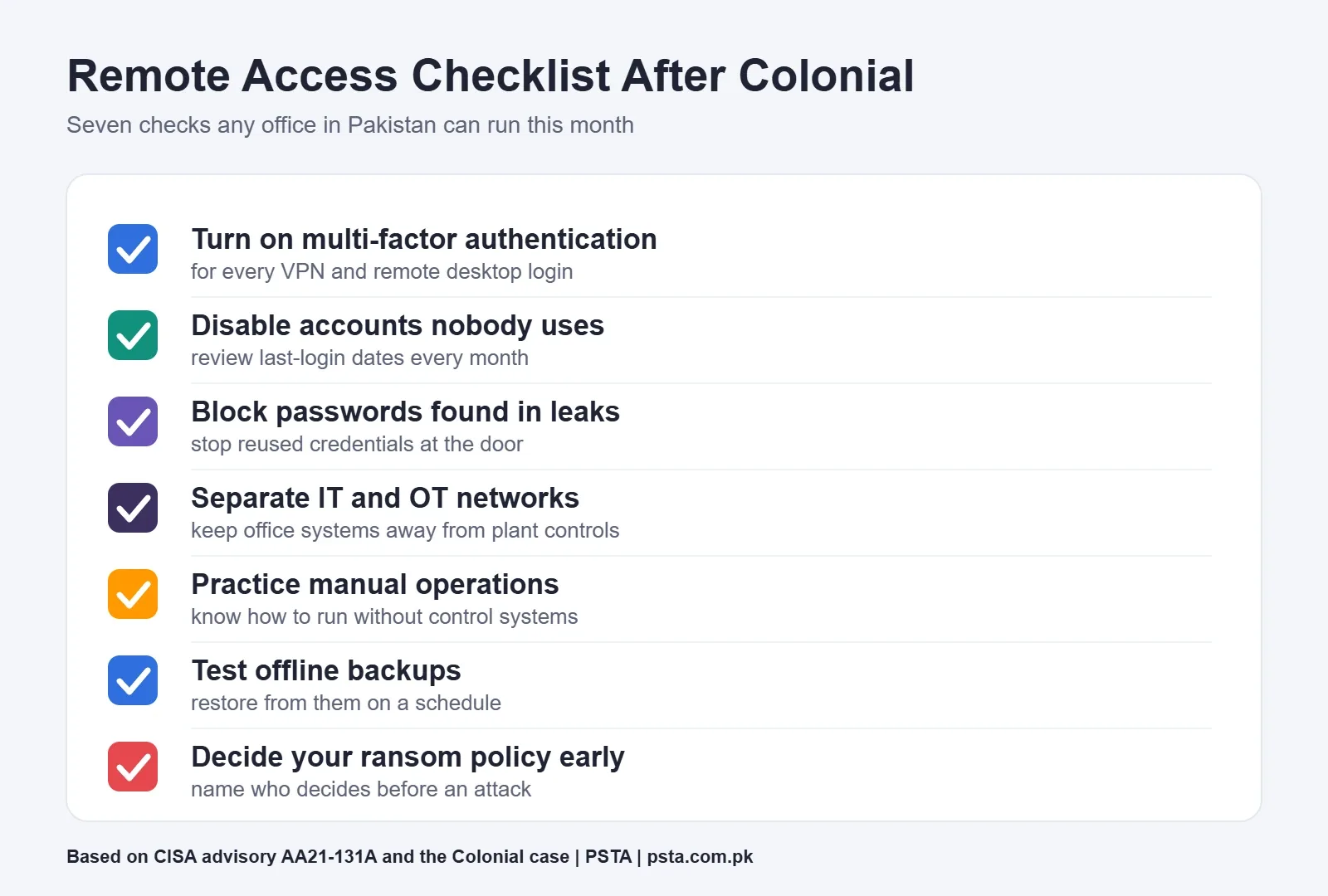
These lessons follow the mitigations in CISA's advisory and the facts of the Colonial Pipeline hack. None of them needs an expensive product.
- Require multi-factor authentication on every remote access account. CISA lists it first for remote access. A leaked password alone would not have been enough at Colonial.
- Disable accounts the day they stop being needed. Run a monthly report of VPN and admin accounts with no recent logins, and switch them off.
- Check staff credentials against known leaks. Reused passwords from old breaches are a common way in. Block passwords that already appear in breach lists.
- Separate IT and OT networks. CISA recommends strong segmentation and a buffer zone between office and control networks, so a breach on one side does not reach the other.
- Practice manual operations. Test how you would run critical functions if your control systems went offline. PHMSA's allegation against Colonial centered on this gap.
- Keep tested offline backups. Backups that sit on the same network can be encrypted too. Restore from them on a schedule to prove they work.
- Write the ransom decision into your incident plan. Name who decides, who contacts law enforcement and who talks to customers, before you need them.
If you track crypto incidents too, compare this list with the lessons in our Binance hack explainer. Both cases started with access to a trusted account, not with broken encryption.
Turning This Case Into Lab Practice at PSTA
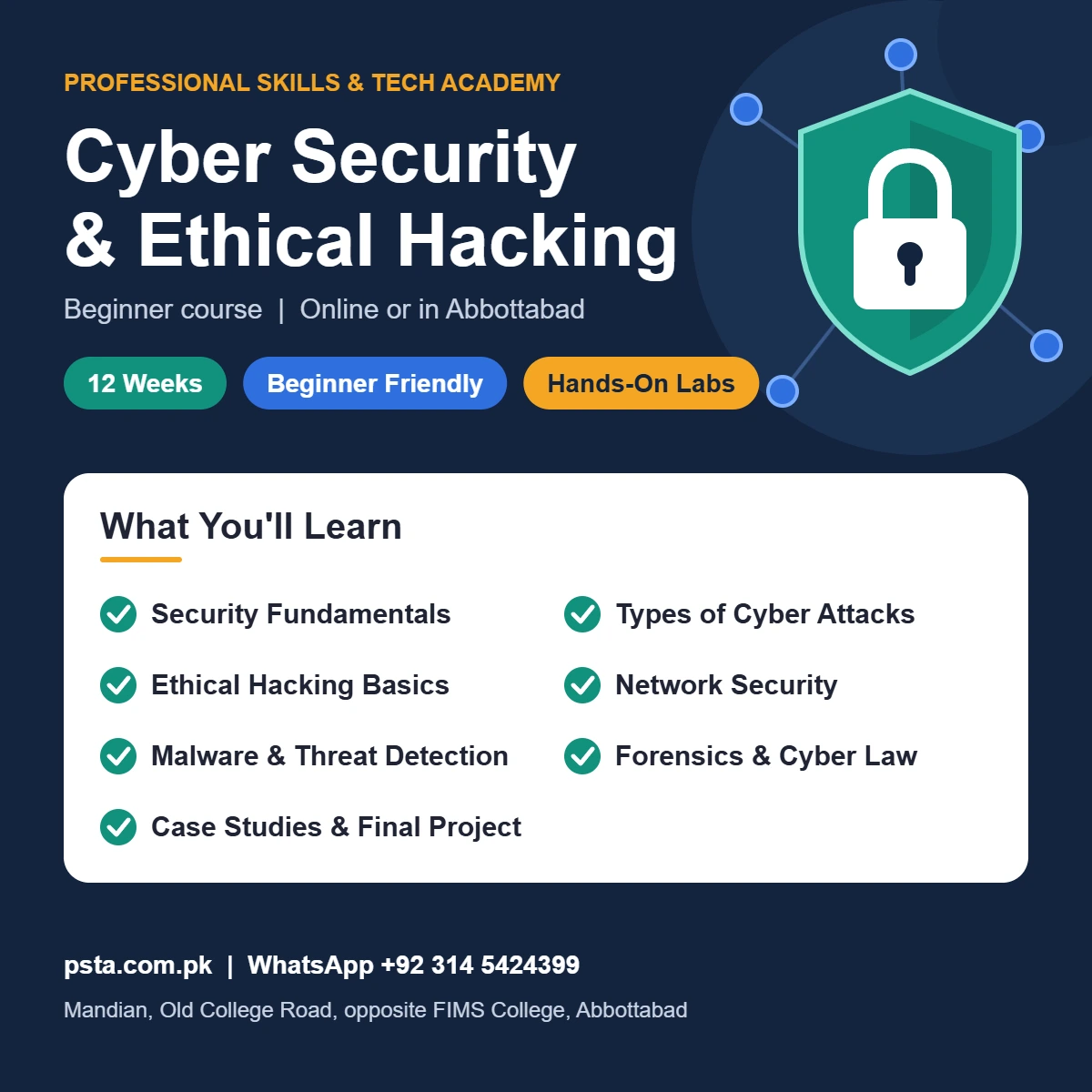
At PSTA, we use real incidents like the Colonial Pipeline hack as teaching material because they show how small gaps grow into large failures. In the 12-week course in cyber security and ethical hacking, you begin at beginner level, with no security background assumed.
Over those weeks you move from the CIA triad and risk to attack types, network defense, malware detection, Pakistani cyber law and forensics. The labs are where this case comes alive: you set up firewalls, VPNs and intrusion detection yourself, then investigate a practice incident and write up its timeline, much like the table above. Classes run on campus in Abbottabad and live online for students anywhere in Pakistan.
Once the foundations feel comfortable, our advanced course in ethical hacking and penetration testing teaches authorized testing from the attacker's side. To plan which exam to sit after that, read our comparison of cyber security certifications for newcomers.
Audit Your Remote Access Accounts Before Friday
You do not need a security team to act on this case. Ask whoever manages your VPN or remote desktop tool for a list of every account, its owner and its last login date. Switch off anything unused for 90 days, and turn on multi-factor authentication for the rest.
That single review would have closed the door used in the Colonial Pipeline hack. If you would like help planning your learning path in cyber security, message us and we can map out the options with you, with no pressure to enroll.
Frequently asked questions
Did the hackers take control of Colonial's fuel pumps and valves?
No public evidence shows that. CISA said there was no indication at the time that the attackers had moved from the IT network into operational systems, and Mandiant later reached the same view. Colonial stopped the pipeline as a precaution because it could not yet rule out spread to the systems that control fuel flow.
How much did Colonial Pipeline pay, and was any of it recovered?
The Justice Department says Colonial reported paying about 75 bitcoin on May 8, 2021, which Al Jazeera put at $4.4 million. On June 7, 2021, the department seized 63.7 bitcoin, worth about $2.3 million at the time, after tracing the payment across the public bitcoin ledger.
What is DarkSide, and is it still active?
DarkSide was a ransomware-as-a-service operation. Its developers supplied ransomware to affiliates who attacked victims and shared the ransom. It later rebranded as BlackMatter, which announced in November 2021 that it was shutting down. The US State Department offered up to $10 million for information on its leaders.
Was the Russian government behind the Colonial Pipeline attack?
The FBI blamed the DarkSide criminal group, not a government. President Biden said in May 2021 that there was no evidence so far of Russian government involvement. That is why careful reports separate the confirmed group attribution from any claim about state backing, which has not been publicly shown.
Why does multi-factor authentication matter so much in this case?
Mandiant said the VPN account used to break in was protected only by a username and password, and that password later appeared in a leak. With a second factor, such as an app code or hardware key, a stolen password alone would usually not be enough to log in from outside.
Could a similar ransomware attack happen in Pakistan?
The same weakness can exist anywhere that staff use remote access. Old VPN accounts, reused passwords and office networks that can reach plant equipment are common risks. Pakistani organizations can reduce them by reviewing accounts monthly, enforcing MFA, separating IT from OT and keeping tested offline backups.
Can I study real cases like this at PSTA?
Yes. PSTA's 12-week beginner cyber security course uses real incidents as case studies, alongside labs where you configure firewalls, VPNs and intrusion detection and document an incident timeline. You can join on campus in Abbottabad or attend live online classes from anywhere in Pakistan.
Sources & references
- Department of Justice Seizes $2.3 Million in Cryptocurrency Paid to the Ransomware Extortionists Darkside justice.gov
- CISA and FBI Advisory AA21-131A: DarkSide Ransomware cisa.gov
- Al Jazeera: Hackers breached Colonial Pipeline with one compromised password aljazeera.com
- S&P Global: Colonial Pipeline begins restart process spglobal.com
- PHMSA: Proposed civil penalty against Colonial Pipeline phmsa.dot.gov
- DHS: New cybersecurity requirements for critical pipelines dhs.gov
- Axios: FBI confirms DarkSide behind Colonial Pipeline attack axios.com
- TechCrunch: US offers $10M reward for DarkSide leaders techcrunch.com
Last reviewed & updated on by Umar Qureshi. Written by the PSTA team in Abbottabad, Pakistan.

Umar Qureshi
Cyber Security & Ethical Hacking Course in Abbottabad - PSTA
Turn this guide into a career: hands-on training with real projects, online across Pakistan or on-campus in Abbottabad · 12 Weeks.
Comments
No comments yet — ask a question or share your experience.