Quick answer
The SolarWinds hack was a supply chain attack in which intruders hid a backdoor in Orion software updates released from March to June 2020. Fewer than 18,000 customers installed them, but only about 100 companies and nine US agencies were targeted further. The US blamed Russia's SVR intelligence service in April 2021.
Key takeaways
- • The SolarWinds hack hid the SUNBURST backdoor inside signed Orion updates released from March to June 2020.
- • Fewer than 18,000 customers installed a tainted update, but only about 100 companies and nine US agencies were targeted further.
- • The US named Russia's SVR, tracked as APT29, with "high confidence" in April 2021. Russia denied it.
- • CISA ordered agencies to disconnect Orion and rebuild every monitored host from trusted sources.
- • The SEC's case against SolarWinds and its security chief ended in November 2025.
- • Protect high-access tools, limit where servers connect and keep at least 180 days of logs.
Table of contents 11 sections
- What Was the SolarWinds Hack?
- SolarWinds Hack Timeline, From First Access to Court Case
- How Did a Trusted Update Become a Backdoor?
- How Many Organizations Were Really Affected?
- Who Was Blamed, and How Firm Is the Attribution?
- After Discovery: Directives, Sanctions and a Court Case
- Eight Lessons Learned From the SolarWinds Supply Chain Attack
- What Does This Mean for Organizations in Pakistan?
- What Is Still Unclear About the SolarWinds Hack?
- Practicing Supply Chain Defense in PSTA's Cyber Security Course
- Ask Your Vendors One Question This Month
The SolarWinds hack surfaced in the second week of December 2020, and it started with a break-in at a security company. On December 8, the security firm FireEye said a state-backed attacker had broken in and taken its red-team tools, The Express Tribune reported. Five days later, FireEye's Mandiant team described something far larger. A backdoor was hiding inside signed updates for Orion, the IT monitoring software SolarWinds sold to firms and governments.
This report treats the incident the way a security team treats its own breach review. It sets out what happened, what the record confirms, and which habits would have shortened the damage. Here is what it covers:
- A dated timeline from the first break-in to the end of the SEC case
- How a trusted Orion software update carried the SUNBURST backdoor, in plain language
- Why "18,000 victims" overstates the real reach, and what the smaller number was
- Who was blamed, and how firm that attribution is
- Eight lessons you can apply to your own office, bank or software house
What Was the SolarWinds Hack?
SolarWinds is a US company that makes network and IT management tools. Its Orion platform watches servers, routers and applications so that IT staff can spot problems early. To do that job, Orion usually runs with wide access inside a network. That access is what made it valuable to an attacker.
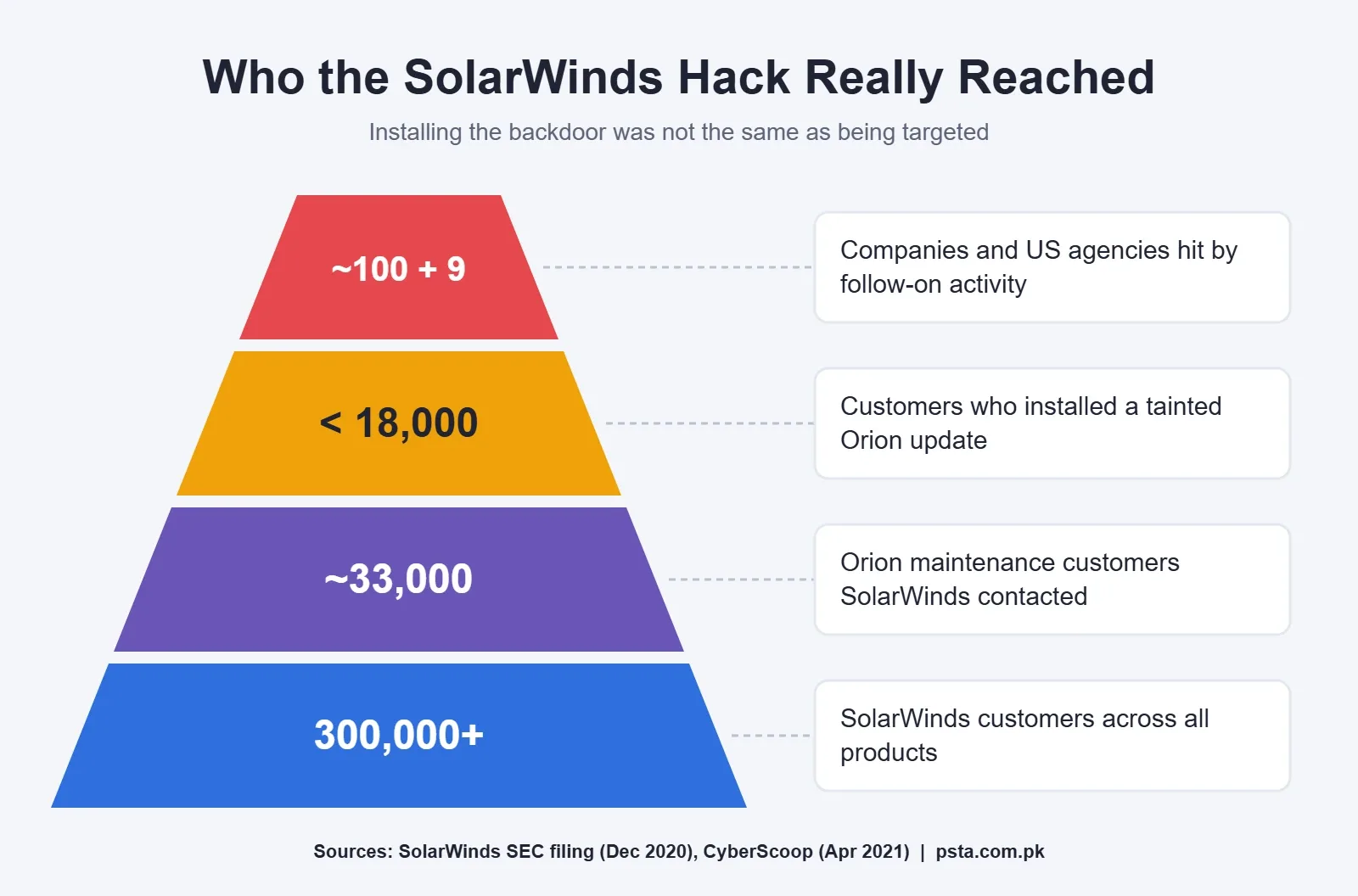
In its December 14, 2020 filing with the US Securities and Exchange Commission, SolarWinds said attackers had compromised its Orion build system. Updates released from March to June 2020 likely contained a vulnerability the attackers had inserted. The company said it had "over 300,000 customers," contacted about 33,000 Orion maintenance customers, and believed "fewer than 18,000" had installed an affected version.
Security researchers call this kind of intrusion a supply chain attack. Instead of breaking into each target directly, the attacker poisons something the targets already trust and install themselves. The SolarWinds supply chain attack is a case trainers often use to explain the idea, because every step looked normal to the victims.
SolarWinds Hack Timeline, From First Access to Court Case
The dates below come from SolarWinds' own findings, government statements and court reporting. Pakistan Standard Time (PKT) is five hours ahead of UTC and 10 hours ahead of US Eastern time in December.
| Date | What happened | Source |
|---|---|---|
| Sept 4, 2019 | Attackers first access SolarWinds systems, according to the company's investigation | Cybersecurity Dive |
| Sept 12, 2019 | First known test of code injection into the build | Cybersecurity Dive |
| Feb 20, 2020 | SUNBURST is compiled and deployed into Orion builds | Cybersecurity Dive |
| March to June 2020 | Orion updates released in this window likely carry the backdoor | SEC filing |
| June 2020 | Attackers remove the malicious code from SolarWinds' build environment | Cybersecurity Dive |
| Dec 8, 2020 | FireEye discloses that a state-sponsored actor stole its red-team tools | The Express Tribune |
| Dec 13, 2020 | CISA issues Emergency Directive 21-01; Mandiant publishes its SUNBURST findings | CISA, Mandiant |
| Dec 14, 2020 | SolarWinds files its SEC report; agencies must report to CISA by noon EST (10 PM PKT) | SEC filing, CISA |
| Jan 5, 2021 | FBI, CISA, ODNI and NSA call the actor "likely Russian in origin" | CISA |
| Apr 15, 2021 | The White House names Russia's SVR and announces sanctions | CyberScoop |
| Oct 2023 | The SEC sues SolarWinds and its security chief, Timothy Brown | Claims Journal |
| July 2024 | A federal judge dismisses much of the SEC case | Claims Journal |
| Nov 2025 | The SEC and SolarWinds jointly ask the court to end the case | Claims Journal |
One date range differs between sources. SolarWinds' SEC filing says affected updates went out from March to June 2020. Mandiant's report says the trojanized updates were signed and posted between March and May. The gap probably reflects different counting: the filing covers every download made during the window, while Mandiant describes when the tainted builds were published.
How Did a Trusted Update Become a Backdoor?
The attackers did not hack 18,000 networks one by one. They went after the factory instead. According to Cybersecurity Dive's summary of the SolarWinds and CrowdStrike findings, a tool later named SUNSPOT sat inside the company's build environment. It slipped the backdoor into Orion only while the product was being compiled, then put the original source code back. Developers reading their own code saw nothing wrong.
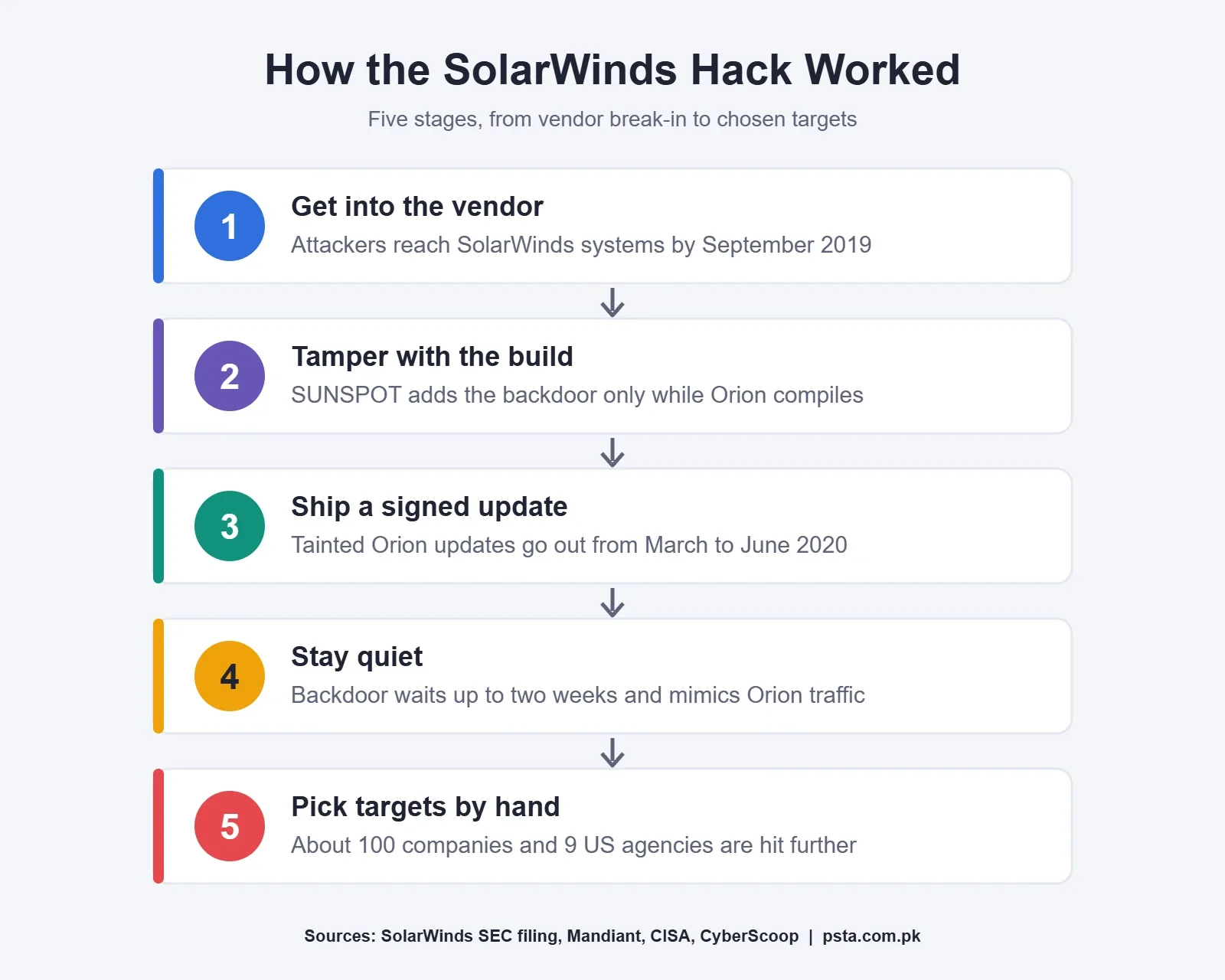
Because the finished update came from SolarWinds' normal build process, it carried the company's valid digital signature. Customers' systems trusted it by default. Here is the chain in five conceptual stages:
- Get into the vendor. The attackers reached SolarWinds' network months before any customer was touched.
- Tamper with the build, not the source. SUNSPOT changed the code only during compilation, which kept code reviews clean.
- Ship through the normal channel. Signed updates went out on SolarWinds' own download servers.
- Stay quiet. Mandiant found the SUNBURST backdoor waited up to two weeks before it called home. Its traffic looked like the normal Orion Improvement Program messages.
- Choose targets by hand. Only a small set of organizations received further intrusion tools.
The lesson in that chain is uncomfortable. Every control the victims had (signature checks, approved vendor lists, routine patching) worked as designed. The attack succeeded because those controls all trusted the same upstream source.
How Many Organizations Were Really Affected?
You will often read that the SolarWinds hack "hit 18,000 organizations." That figure is the ceiling, not the count. It is the number of customers SolarWinds believed had installed a tainted update, which is a different thing from being actively exploited.
The January 2021 joint statement from the FBI, CISA, ODNI and NSA said only a "much smaller number" of the 18,000 saw follow-on activity. It counted fewer than ten US government agencies in that group. By April, US officials put the total at nine federal agencies and about 100 private firms, CyberScoop reported. That count also covers break-ins through other vendors' products.
Even the smaller group made the SolarWinds hack serious. Mandiant listed victims in government, consulting, technology, telecoms and extractive industries across North America, Europe, Asia and the Middle East. The financial hit to SolarWinds was also visible: its SEC filing said Orion brought in about $343 million in the first nine months of 2020, roughly 45% of total revenue.
Who Was Blamed, and How Firm Is the Attribution?
Attribution moved in steps, and the confidence rose each time:
- December 2020: SolarWinds said the attack was likely by a nation-state but that it had not verified who.
- January 5, 2021: US agencies said the actor was "likely Russian in origin" and that the campaign looked like intelligence gathering.
- April 15, 2021: The White House said with "high confidence" that Russia's foreign intelligence service, the SVR, was responsible, and named the group as APT29 Cozy Bear. The UK's National Cyber Security Centre called SVR responsibility "highly likely," according to CyberScoop.
- May 2022: Mandiant merged its own tracking label, UNC2452, into APT29.
Russia denied involvement. So this is a government attribution backed by several agencies and allied states, not a court finding. No one has been tried for the intrusion. The response was a mix of diplomacy and finance: sanctions on six Russian technology firms accused of supporting intelligence hacking, and the expulsion of 10 people from Russia's diplomatic mission in Washington.
It also helps to separate espionage from crime. Officials described a nation-state cyber attack built to collect information. It did not lock files for ransom like WannaCry ransomware or drain funds like the Binance hack. That difference shapes how defenders should respond.
After Discovery: Directives, Sanctions and a Court Case
The US government's first move was blunt. CISA's Emergency Directive 21-01 told federal civilian agencies to disconnect or power down affected Orion products at once. It called disconnection "the only known mitigation" available at the time. Agencies had to treat every host Orion monitored as compromised and rebuild from trusted sources. Later guidance required at least 180 days of logging and updates within 48 hours for agencies that kept using Orion.
The longest thread was legal. In October 2023, the SEC sued SolarWinds and its security chief Timothy Brown, alleging that the company had downplayed known risks to investors. The SEC cited a 2018 slide deck. In it, Brown wrote that the "current state of security" left the firm "in a very vulnerable state" for key assets.
A judge dismissed much of the case in July 2024. The two sides said in July 2025 that they had agreed to settle. In November 2025, they jointly asked the court to end the case, Claims Journal reported. SolarWinds said it was "clearly delighted."
The case still matters for anyone who writes security reports. Internal warnings, risk registers and public statements can all be compared later. What you tell investors or clients should match what your own team knows.
Eight Lessons Learned From the SolarWinds Supply Chain Attack
These lessons are written for IT teams, managers and students. None of them needs an expensive product to start.
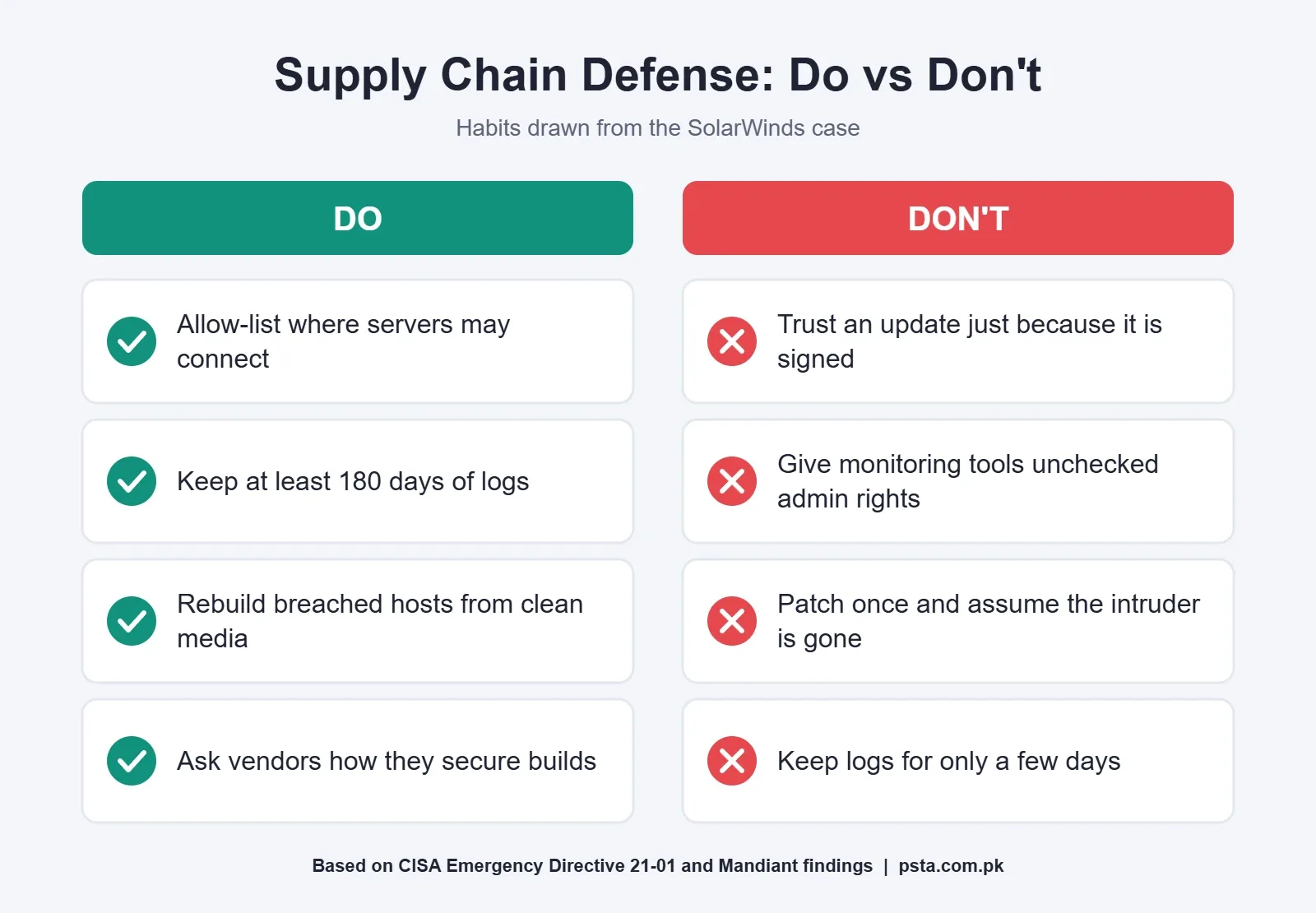
- Treat monitoring tools as high-value targets. Orion had wide access by design. List every tool in your network that holds admin rights, and protect it like a domain controller.
- A valid signature proves origin, not safety. SUNBURST was signed by SolarWinds. Pair signature checks with behavior monitoring.
- Restrict outbound traffic from servers. A monitoring server rarely needs to talk to random internet domains. Allow-list where it may connect, and alert on anything new.
- Protect the build pipeline. If you ship software, separate build servers, log every change to them, and compare build outputs with source where you can.
- Keep logs long enough to look back. SUNBURST stayed hidden for months. CISA later asked agencies to keep 180 days of logs, which is a sensible floor.
- Plan to rebuild, not just patch. CISA told agencies to treat monitored hosts as compromised. Your recovery plan should assume reinstalling from clean media.
- Ask vendors hard questions. Good software supply chain security starts when you buy. Ask how a supplier secures its builds and how fast it will tell you about a breach.
- Write honest risk reports. The SEC case showed that internal warnings can surface years later. Record risks plainly and track who accepted them.
For comparison, the Equifax data breach and Ronin Network hack case studies show two more breaches where a trusted setting went unchecked for months.
What Does This Mean for Organizations in Pakistan?
We found no public reporting that names a Pakistani organization among the SolarWinds victims. That does not make the SolarWinds hack a distant story. Pakistani banks, telecom operators, hospitals and software houses run the same kind of monitoring, backup and remote management tools. Many of them buy from foreign vendors and install updates automatically.
Three local points stand out. First, software houses that serve US and European clients sit inside someone else's supply chain. Their build servers are a target in their own right. Second, a team that keeps logs for days rather than months would struggle to trace a SUNBURST-style intrusion. Third, access without permission can be an offense under Pakistan's Prevention of Electronic Crimes Act (PECA) 2016. Incident reports need careful evidence handling from day one.
For a small office, the practical version is short. Know which tools have admin rights. Know where your servers may connect. Keep enough logs to answer "what happened last month?"
What Is Still Unclear About the SolarWinds Hack?
A good lessons-learned report also states its limits. Several questions remain open in the public record:
- Exactly how the first break-in happened. SolarWinds' timeline starts in September 2019, but the initial entry method has not been described in detail publicly.
- The full list of victims. No complete public list of the roughly 100 targeted companies has been published.
- What was taken. Officials described intelligence gathering, but the specific data stolen from agencies has not been fully disclosed.
Treat confident claims beyond these points with care, especially exact damage figures that no official source supports.
Practicing Supply Chain Defense in PSTA's Cyber Security Course
Reading about SolarWinds is useful, but rehearsing a response teaches more. The 12-week cyber security and ethical hacking program at PSTA is built for beginners, and it asks for no earlier security background. You can join online from any city in Pakistan or attend classes at the Abbottabad campus.
Two of its seven modules map closely to this case. In Module 5, the topics are malware analysis, threat intelligence and incident response. That is where you practice reading logs and building an incident timeline. The closing module, Module 7, pairs case studies like this one with a security project you present at the end. Network defenses such as firewalls and intrusion detection are covered in Module 4. If you want to see how outbound traffic looks in practice, our Wireshark for beginners guide is a good warm-up.
Students who later want to test systems from the attacker's side can continue with PSTA's advanced penetration testing track. If you are weighing exams as well, our beginner certification guide compares costs and a sensible order. Questions about the next batch can go to our team on WhatsApp at +92 314 5424399.
Ask Your Vendors One Question This Month
Pick the one tool in your network with the widest access. It may be monitoring, backup or remote support software. Ask its vendor in writing how they guard their build process. Ask how fast they would tell you about a breach. Their answer will tell you more about your real risk than any headline about the SolarWinds hack.
Frequently asked questions
Is SolarWinds Orion safe to use now?
CISA's directive listed specific Orion builds from 2019.4 to 2020.2.1 HF1 as affected and told agencies that kept using Orion to run at least version 2020.2.1 HF2. Any product can have new flaws, so the safer habit is to keep it patched, limit its admin rights, restrict where its server can connect and watch its logs.
Were any Pakistani organizations confirmed as SolarWinds victims?
We found no public reporting that names a Pakistani organization among the victims. Mandiant said victims were spread across North America, Europe, Asia and the Middle East, and no full list of private targets has been published. Local teams that ran Orion in 2020 should have checked their versions against CISA's list at the time.
What is the difference between SUNSPOT and SUNBURST?
SUNSPOT was the tool hidden in SolarWinds' build environment. It inserted malicious code while Orion was being compiled. SUNBURST was the backdoor that ended up inside the finished, signed Orion update. In short, SUNSPOT planted the problem at the vendor, and SUNBURST was what customers actually installed.
Why were only about 100 companies targeted out of 18,000 installs?
US agencies described the campaign as intelligence gathering, which usually means picking specific targets rather than hitting everyone. The January 2021 joint statement said only a much smaller number of the 18,000 customers saw follow-on activity. Officials have not published the full selection logic, so treat explanations beyond that with care.
Was anyone charged or jailed for the SolarWinds hack?
No criminal trial has taken place. The US response came through attribution, sanctions on six Russian technology firms and the expulsion of 10 people from Russia's diplomatic mission. The separate SEC civil case against SolarWinds and its security chief was about investor disclosures, not the intrusion itself, and it ended in November 2025.
How long were the attackers inside before anyone noticed?
SolarWinds' investigation traced first access to September 2019. The backdoor was publicly identified in December 2020. That means the attackers had over a year inside the vendor, and several months inside some customer networks, before discovery. Short log retention would make a similar intrusion very hard to reconstruct.
Can a small business in Pakistan face a supply chain attack?
Yes. Any business that installs vendor updates automatically depends on that vendor's security. A small office can lower the risk by listing tools with admin rights, limiting outbound connections from servers, keeping logs for months and asking suppliers in writing how they protect their software and report breaches.
Sources & references
- SolarWinds Form 8-K, December 14, 2020 (SEC) sec.gov
- CISA Emergency Directive 21-01 cisa.gov
- Joint Statement by FBI, CISA, ODNI and NSA, January 5, 2021 cisa.gov
- Mandiant: Evasive Attacker Leverages SolarWinds Supply Chain With SUNBURST Backdoor cloud.google.com
- Cybersecurity Dive: SUNSPOT Malware and the SolarWinds Build Compromise cybersecuritydive.com
- CyberScoop: White House Blames Russia's SVR, Announces Sanctions cyberscoop.com
- Claims Journal: SEC Drops SolarWinds Case claimsjournal.com
- The Express Tribune: FireEye Discloses Breach and Theft of Hacking Tools tribune.com.pk
Last reviewed & updated on by Umar Qureshi. Written by the PSTA team in Abbottabad, Pakistan.

Umar Qureshi
Cyber Security & Ethical Hacking Course in Abbottabad - PSTA
Turn this guide into a career: hands-on training with real projects, online across Pakistan or on-campus in Abbottabad · 12 Weeks.
Comments
No comments yet — ask a question or share your experience.