Quick answer
Expect graphic design interview questions on four areas: your portfolio, your software, print basics and how you take feedback. Prepare to walk through one project, explain raster vs vector, CMYK vs RGB, 300 ppi and 3 mm bleed, and use the STAR method for behavioral answers before a timed practical test.
Key takeaways
- • Practice a two-minute walk-through of your strongest project: brief, idea, change and result.
- • Know when to use Photoshop (pixels) and when to use Illustrator (vectors).
- • For print, say 300 ppi, CMYK and about 3 mm bleed, then confirm with the printer.
- • Send logos as AI, EPS, PDF or SVG, plus transparent PNGs.
- • Use the STAR method for questions about feedback and deadlines.
- • Set up the document correctly before you start any practical test.
Table of contents 30 sections
- Graphic Design Interview Questions: What Employers Really Test
- How Does a Designer Interview Usually Run?
- Questions About You and Your Portfolio
- 1. Tell Us About Yourself
- 2. Walk Us Through One Project in Your Portfolio
- 3. Why Do You Want to Work Here?
- 4. Which Designers or Brands Inspire You?
- Software Questions: Photoshop, Illustrator, CorelDRAW and Canva
- 5. When Would You Use Photoshop Instead of Illustrator?
- 6. What Is the Difference Between Raster and Vector Images?
- 7. How Do You Keep Your Layers and Files Organized?
- 8. Can You Use a Tool You Haven't Learned Yet?
- Print Production Questions That Catch Freshers Out
- 9. What Is the Difference Between RGB and CMYK?
- 10. What Resolution Should a Print File Have?
- 11. What Is Bleed, and How Much Do You Add?
- 12. Which File Formats Would You Send a Client for a Logo?
- Design Theory Questions: Type, Color and Layout
- 13. What Are Kerning, Tracking and Leading?
- 14. How Do You Choose Colors for a Brand?
- 15. How Do You Create Visual Hierarchy?
- How Do You Answer Questions About Feedback and Deadlines?
- 16. How Do You Handle a Client Who Dislikes Your Design?
- 17. How Do You Work Under a Tight Deadline?
- 18. How Do You Keep Improving as a Designer?
- What Should You Expect in the Practical Design Test?
- Smart Questions to Ask the Interviewer
- The Night-Before Checklist
- Practicing Interview Answers in PSTA's Graphic Design Course
- Rehearse One Answer Out Loud Tonight
Most graphic design interview questions for freshers in Pakistan fall into four groups: your portfolio, your software, print basics and how you take feedback. Software usually comes first. PayScale's Pakistan page for graphic designers, built from 315 salary profiles, lists Adobe Photoshop and Adobe Illustrator as the most common skills after graphic design itself, so expect a question on each.
The rest of the interview is less predictable, but it isn't random. Print shops ask about bleed and CMYK. Agencies ask about briefs and revisions. Almost everyone asks you to talk through your own work. This guide lists the graphic design interview questions in the order they tend to come up, with answers you can adapt in your own words.
Here is what this guide covers:
- How a typical designer interview runs, from CV screening to the practical test
- 18 common graphic design interview questions with sample answers to rework
- The print terms that trip up most freshers, in one quick-reference table
- What to bring, what to check and what to ask the interviewer
Graphic Design Interview Questions: What Employers Really Test
An interviewer has 30 minutes or so to answer one question: can this person take a brief and hand back a usable file without hand-holding? Every question you hear is a small piece of that.
For entry-level roles at printing presses, ad agencies, media houses and in-house marketing teams, the checks usually look like this:
- Thinking: can you explain why you made a design choice, not just what you did?
- Tools: are you quick in the software this employer actually uses?
- Production: will your files print or upload correctly the first time?
- Attitude: will you handle a client's fifth revision calmly?
Keep those four in mind. When one of the graphic design interview questions confuses you, ask yourself which of the four it's checking, and answer that.
How Does a Designer Interview Usually Run?
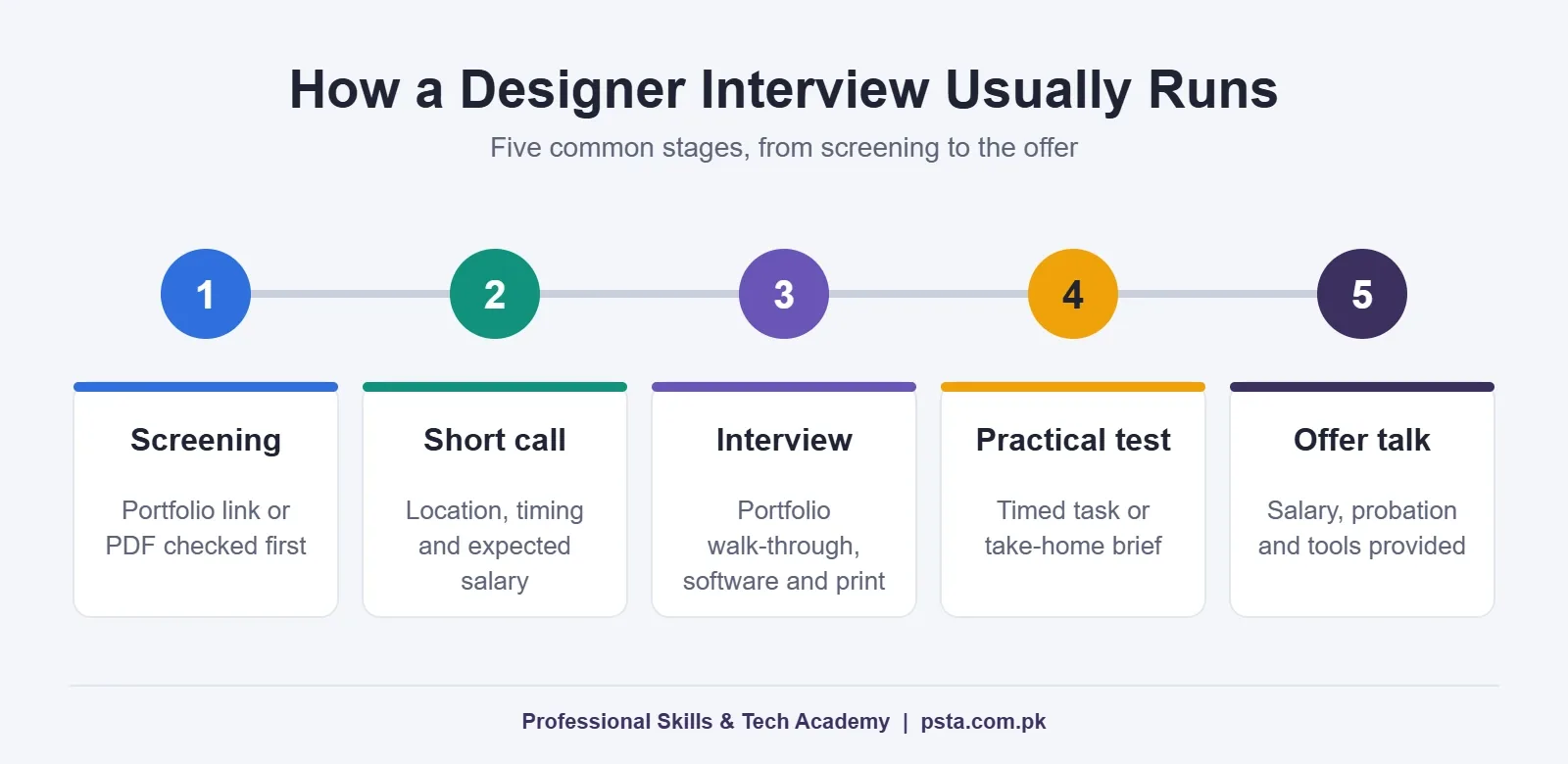
Small studios may squeeze everything into one visit. Larger agencies spread it over a week or two. The stages themselves are fairly standard:
- CV and portfolio screening. Someone opens your Behance link or PDF before calling you. A weak first project can end things here.
- A short call. Often a phone or WhatsApp call to confirm your location, availability and expected salary.
- The main interview. You walk through your portfolio and answer questions on software, print and process.
- A practical test. A timed task on their computer, or a take-home brief due in a day or two.
- The offer conversation. Salary, probation period, timings and which tools the company provides.
Questions About You and Your Portfolio
1. Tell Us About Yourself
Keep it under a minute and keep it about design. Mention your training, the kind of work you enjoy and one project you're proud of. For example: "I finished a 12-week design course, and since then I've made social media posts for two local shops. I enjoy branding work most, and my strongest project is a full identity kit for a bakery."
2. Walk Us Through One Project in Your Portfolio
This is the most important answer you'll give. Use a simple order: the brief, the audience, your first idea, what changed and the final result. Show one rejected sketch if you have it. Interviewers trust a designer who can explain a discarded idea.
3. Why Do You Want to Work Here?
Look at their recent work before the interview. Name one campaign, package or post you noticed and say what you liked about it. A specific answer beats any general praise of the company.
4. Which Designers or Brands Inspire You?
Pick one or two you can actually discuss. Saying why matters more than the name. "I like how this brand uses only two colors across every product" shows that you look at work closely.
Software Questions: Photoshop, Illustrator, CorelDRAW and Canva
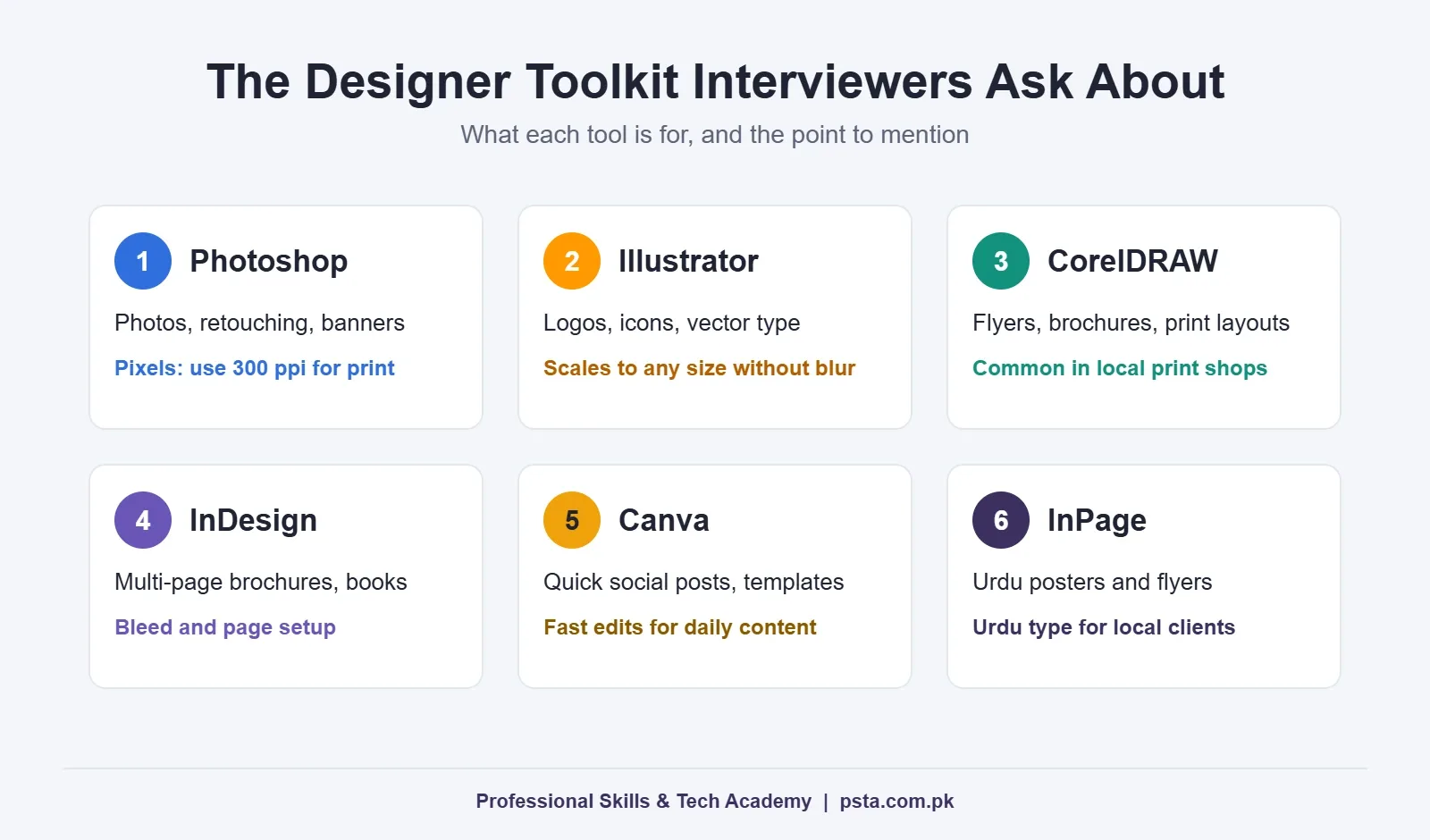
Ask yourself before the interview which tools this employer runs. A print shop in Rawalpindi or Abbottabad may live in CorelDRAW and InPage. A digital agency in Lahore is more likely to use Adobe tools and Canva, and publishers who lay out multi-page brochures or books often use InDesign. Match your examples to them.
5. When Would You Use Photoshop Instead of Illustrator?
Photoshop works with pixels, so it suits photo editing, retouching and banners built around images. Illustrator works with vectors, so it suits logos, icons and anything that must stay sharp at any size. A good answer adds that real projects often use both, such as a vector logo placed on a photo-based poster.
6. What Is the Difference Between Raster and Vector Images?
Raster images are made of pixels and get blurry when you enlarge them too far. Vector images are made from points, lines and curves, so they can scale up or down without losing quality. Adobe's own guide on raster vs vector files lists JPEG, PNG and PSD among raster formats and SVG, EPS and AI among vector formats.
7. How Do You Keep Your Layers and Files Organized?
Interviewers ask this because they'll inherit your files. Talk about naming layers, grouping related elements, using artboards for different sizes and keeping a clear folder for each client. Mention that you save an editable master file alongside every export.
8. Can You Use a Tool You Haven't Learned Yet?
If they name software you don't know, say so plainly, then explain how you'd learn it. Point to a tool you picked up quickly in the past. Honesty here protects you, because a practical test will expose any bluff within minutes.
Print Production Questions That Catch Freshers Out
This is where many fresh designers lose marks, because print-related graphic design interview questions come up at almost every press and agency. Learning these answers takes an evening, and they matter every day in a print-heavy market.
9. What Is the Difference Between RGB and CMYK?
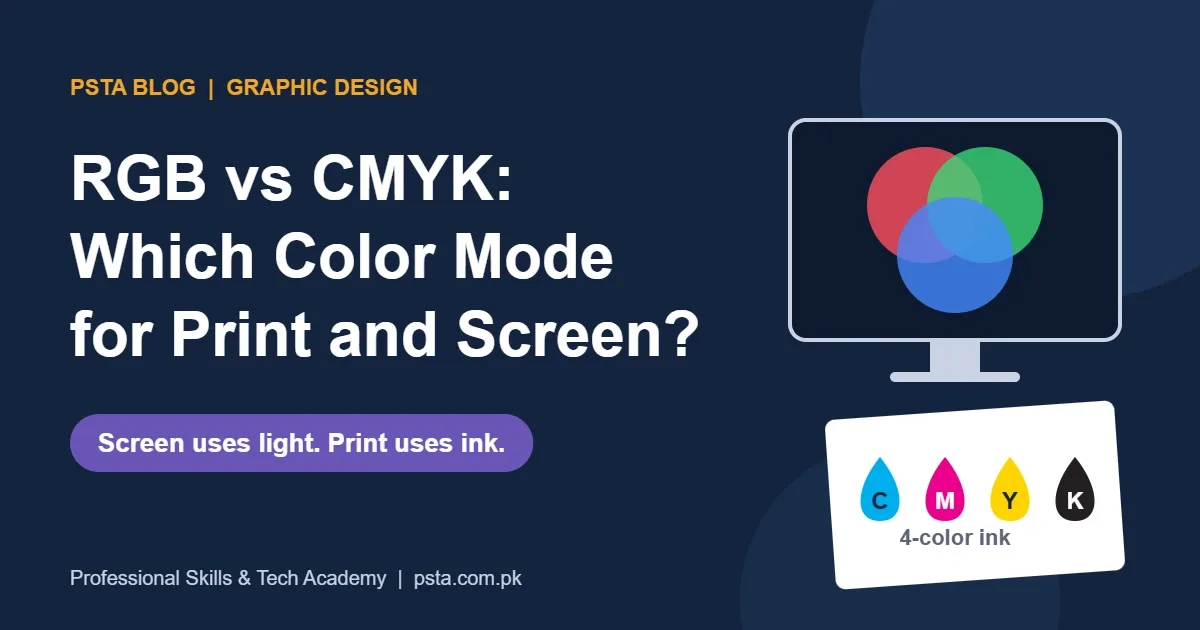
RGB mixes light and is meant for screens: social media, websites and video. CMYK mixes ink and is meant for print: cards, flyers, packaging and menus. As Vistaprint explains, bright RGB shades often print duller after conversion, and some can't be reproduced in ink at all. Add that you'd check colors with a proof before a large run. Our RGB vs CMYK guide goes further if you want examples.
10. What Resolution Should a Print File Have?
Say 300 ppi. Adobe's Photoshop help calls 300 pixels per inch the industry standard for high-quality prints, and notes that large prints viewed from far away, such as billboards, can use lower resolution. Then add the trap: increasing the ppi of a small image doesn't add detail. You need a bigger original.
11. What Is Bleed, and How Much Do You Add?
Bleed is artwork that extends past the trim line, so a small cutting error doesn't leave a white edge. Adobe's InDesign guide says the usual bleed is 0.125 inches (3 mm), and advises confirming the exact amount with your print provider. Mention that you keep text inside a safe margin, away from the trim.
12. Which File Formats Would You Send a Client for a Logo?
Send the editable source plus ready-to-use exports. Adobe describes AI, EPS, PDF and SVG as vector formats, with AI as Illustrator's native file and SVG built for the web. A complete handover usually adds PNG files with a transparent background for everyday use.
| Term | What It Means | Answer in One Line |
|---|---|---|
| RGB | Light-based color for screens | Use for social posts, web and video |
| CMYK | Ink-based color for print | Use for cards, flyers and packaging |
| 300 ppi | Standard print resolution | Start large; upscaling adds no detail |
| Bleed | Art extended past the trim line | Usually 3 mm; confirm with the printer |
| Vector file | Points and curves, no pixels | AI, EPS, PDF or SVG for logos |
| Raster file | Grid of pixels | JPEG, PNG or PSD for photos |
Design Theory Questions: Type, Color and Layout
13. What Are Kerning, Tracking and Leading?
Kerning adjusts the space between two specific letters. Tracking adjusts spacing across a whole word or line. Leading is the vertical space between lines. Give an example: tightening the kerning between "A" and "V" in a logo so the gap doesn't look uneven.
14. How Do You Choose Colors for a Brand?
Start from the audience and the message, not your favorite color. A pharmacy and a children's toy shop need very different palettes. Explain that you limit the palette to a few main colors, check contrast so text stays readable, and test how the colors look in both print and on a phone screen.
15. How Do You Create Visual Hierarchy?
Hierarchy tells the eye what to read first. You build it with size, weight, color, spacing and position. On a sale poster, the offer comes first, the shop name second and the address last. Mention white space too, since a crowded layout makes even a good offer hard to find.
How Do You Answer Questions About Feedback and Deadlines?
Behavioral questions are easier with a simple structure. Coursera's interview guide recommends the STAR method: describe the situation, the task, the action you took and the result. Prepare two short stories from your course projects or small freelance jobs.
16. How Do You Handle a Client Who Dislikes Your Design?
Show that you separate the work from your ego. Ask what exactly isn't working, repeat it back in your own words, then offer one or two focused changes. A good closing line: "I'd rather ask three questions than make three wrong revisions."
17. How Do You Work Under a Tight Deadline?
Explain how you plan. You confirm the brief first, block out the main layout early, share a rough version for approval, and polish only after the direction is agreed. That order prevents wasted hours.
18. How Do You Keep Improving as a Designer?
Name a habit you really keep, such as recreating one well-designed poster each week to study its layout, or completing a short course. Avoid saying you "follow trends." Say which ones you've tried and what you learned.
What Should You Expect in the Practical Design Test?
Many employers weigh the test as heavily as the conversation, because it shows how you work when nobody is guiding you. Common tasks include a social media post for a product, a flyer for a local event, a quick logo concept or retouching a product photo. You may get 30 minutes to two hours.
Before you start, read the brief twice and ask about sizes and the final format. Set up the document correctly first: dimensions, color mode, resolution and bleed if it's for print. Then aim for one clean, finished piece rather than three half-done ones. When you hand it in, explain your choices in two or three sentences.
Smart Questions to Ask the Interviewer
At the end you'll hear "Do you have any questions?" Have two ready. They show interest and give you useful facts about the job.
- What kind of projects would I work on in my first month?
- Who gives final approval on designs, the team lead or the client?
- Which software and fonts does the company provide licenses for?
- How is a junior designer's work reviewed during probation?
The Night-Before Checklist
Run through these the evening before, not the morning of. Small slips here undo good answers.
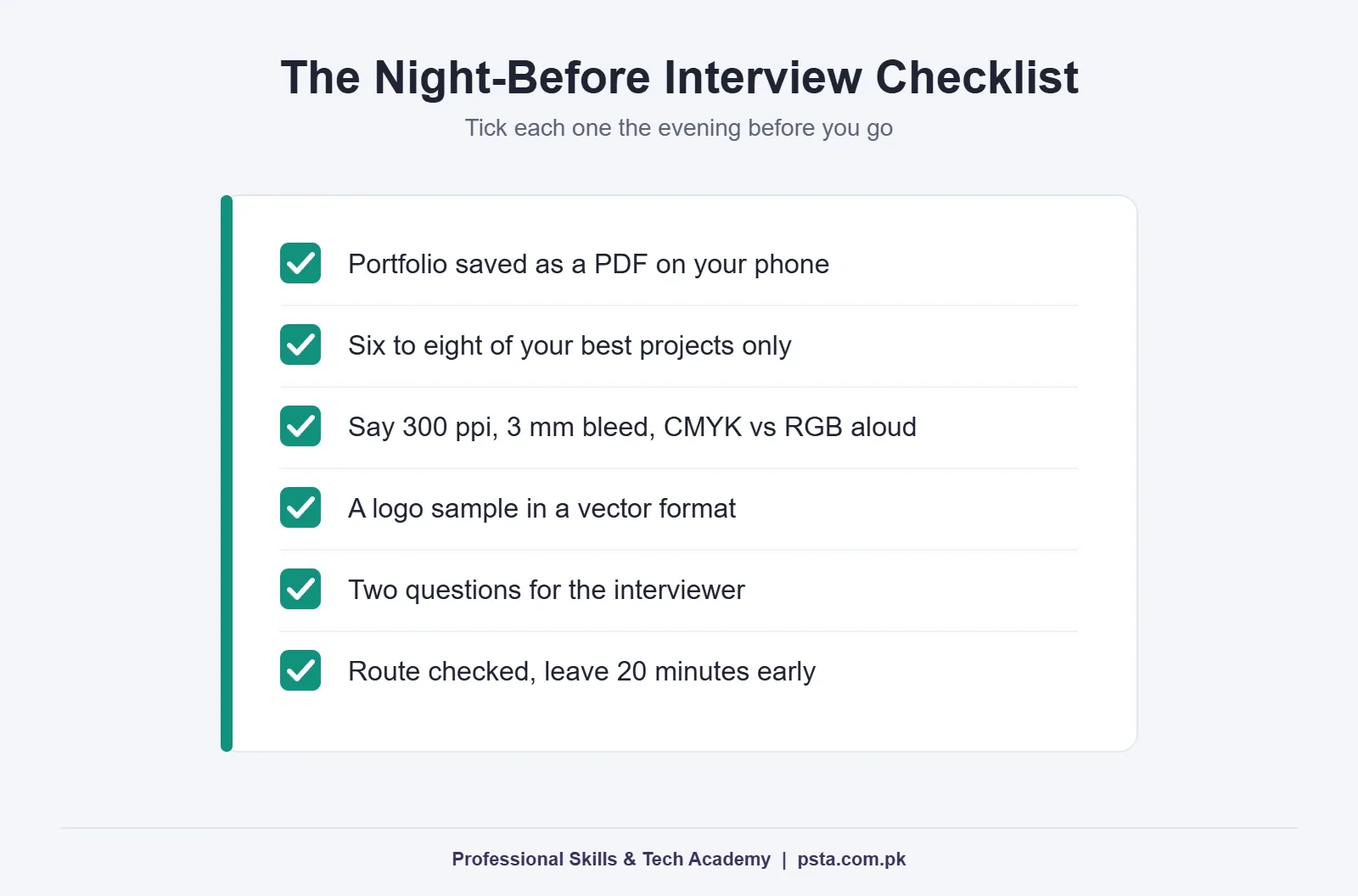
- Load your portfolio as a PDF on your phone, in case the office Wi-Fi fails.
- Choose six to eight of your best projects and remove anything weak.
- Practice saying 300 ppi, 3 mm bleed and CMYK vs RGB out loud.
- Keep a logo sample ready in a vector format.
- Write down two questions for the interviewer.
- Check the route and leave 20 minutes early.
If your portfolio still feels thin, our guide to graphic design portfolio mistakes shows what to cut and what to add.
Practicing Interview Answers in PSTA's Graphic Design Course
The Graphic Designing course at PSTA runs for 12 weeks and covers Photoshop, Illustrator, CorelDRAW, Canva, InPage for Urdu design and AI tools such as Adobe Firefly. Several projects line up with the graphic design interview questions above: a print-ready tri-fold brochure in CorelDRAW, a brand identity kit with a vector logo and a final portfolio presented in front of the class.
The fee is Rs. 18,000 (regular Rs. 20,000), payable in two installments. Classes run at our Mandian campus in Abbottabad, live online for students in other cities, or as a hybrid of both. New batches start every month. To ask about timings, message the admissions team on WhatsApp at +92 314 5424399 with your city and the mode you prefer. If you're still deciding which software to learn first, read graphic design software for beginners, and if you also want to edit video for the same clients, look at the video editing and VFX course. You can compare everything on the courses page or start on the admission page.
Rehearse One Answer Out Loud Tonight
Pick the project you're proudest of and explain it out loud in two minutes: the brief, your idea, one change you made and the result. Record it on your phone and listen once. You'll hear where you ramble, and fixing that one habit will make the rest of the interview calmer. Tomorrow, do the same with two more graphic design interview questions from this list.
Frequently asked questions
How many projects should a fresher bring to a graphic design interview?
Six to eight strong projects is a comfortable number. Pick work that shows range, such as a logo with its identity kit, a print piece like a flyer or brochure, and a set of social media posts. Remove anything you would need to apologize for. Interviewers remember your weakest project as clearly as your best one.
Is Canva enough to get a graphic design job?
Canva helps with fast social media work, and many marketing teams use it daily. For most designer roles, though, employers also expect Photoshop for images and Illustrator or CorelDRAW for vector and print work. Treat Canva as a useful extra, and make sure your portfolio shows at least one project built in a professional design tool.
Should I take my laptop to a graphic design interview?
Carry your portfolio on your phone as a PDF, and bring a laptop only if the interviewer asked you to. Many offices run the practical test on their own computer with their own software. If you do bring a laptop, close unrelated tabs and keep your project files open and ready to show.
How do I answer the expected salary question as a fresher?
Before the interview, check recent job ads for similar roles in the same city so your number is realistic. Then give a short range rather than one figure, and say you are flexible for the right learning opportunity. Ask what tools, training and probation terms come with the role, since these matter as much as the starting pay.
What if the practical test looks like real unpaid client work?
A short test of an hour or two is normal. If a company asks for a full campaign or several finished designs for free, politely ask whether the work will be used commercially. You can offer to complete a smaller version or show a similar project from your portfolio instead. Serious employers usually accept a reasonable request.
How long should I prepare for a graphic design interview?
Give yourself about a week if you can. Spend the first days tightening your portfolio, then practice the software and print answers out loud, and finish with one timed mock test at home. Even two focused evenings help if the interview is sooner, as long as you rehearse your main project walk-through.
Sources & references
- PayScale: Graphic Designer Salary in Pakistan payscale.com
- Adobe: Raster vs Vector adobe.com
- Adobe: Vector Files adobe.com
- Adobe Photoshop Help: Print Resolution for Images helpx.adobe.com
- Adobe InDesign Help: Print Bleed and Slug Areas helpx.adobe.com
- Vistaprint: RGB vs CMYK vistaprint.com
- Coursera: Graphic Design Interview Questions coursera.org
Last reviewed & updated on by Umar Qureshi. Written by the PSTA team in Abbottabad, Pakistan.
Umar Qureshi
Ultimate Graphic Designing Course in Pakistan: Master Photoshop, Illustrator, CorelDRAW & AI Tools (Practical & Beginner Friendly)
Turn this guide into a career: hands-on training with real projects, online across Pakistan or on-campus in Abbottabad · 12 Weeks.
Comments
No comments yet — ask a question or share your experience.