Quick answer
To get remote jobs from Pakistan, pick one role and one region, build three work samples, rewrite your CV for foreign readers and turn on LinkedIn's Remote filter. Expect a video interview and test task. Check whether you're a contractor or EOR employee, keep PRCs for tax, and never pay to get hired.
Key takeaways
- • Foreign firms hire you as a platform freelancer, a direct contractor or an EOR employee on local payroll.
- • Pakistan's IT exports hit a record $4.6 billion in FY2025-26, with freelancers passing $1 billion.
- • Build proof and a targeted CV before applying; send 5 tailored applications a week, not 50 copies.
- • Since April 2026, SBP needs Form R only above $25,000 and one-day processing of export receipts.
- • Genuine employers interview on video and never charge a fee; the PTA warns about fake online jobs.
Table of contents 18 sections
- Remote Jobs From Pakistan: What Actually Counts as One?
- Why Are Foreign Companies Hiring in Pakistan Now?
- Which Roles Get Hired Remotely Most Often?
- How to Get Remote Jobs From Pakistan: Seven Steps
- Step 1: Pick One Role and One Market
- Step 2: Build Proof Before You Apply
- Step 3: Rewrite Your CV for a Foreign Reader
- Step 4: Set Up LinkedIn for Remote Search
- Step 5: Apply Where Remote Employers Actually Post
- Step 6: Prepare for a Video Interview and a Test Task
- Step 7: Read the Offer Line by Line
- How Do Time Zones Shape Your Working Day?
- How Will You Get Paid in Pakistan?
- Do You Need to Register or Pay Tax?
- How Can You Tell a Real Remote Job From a Scam?
- A Home Setup That Won't Let You Down
- Building These Skills at PSTA
- Send One Tailored Application This Week
Try this quick self-test before you apply for remote jobs from Pakistan. Could you explain your last project on a 20-minute video call in English? Could you send a stranger three pieces of work you finished on your own? Would your internet and power survive a two-hour load-shedding slot? Three yeses mean you can start applying this week. Any "no" tells you what to fix first, and this guide covers each one.
By the end of this guide, you will know:
- The three ways a foreign company can hire you, and what each means for your pay and paperwork
- Which roles get hired remotely most often, and what proof each one needs
- A seven-step plan for finding, applying for and winning your first remote role
- How the money reaches your Pakistani bank account, including the SBP changes from April 2026
- How to recognize a fake remote job before you share your CNIC or pay anything
Remote Jobs From Pakistan: What Actually Counts as One?
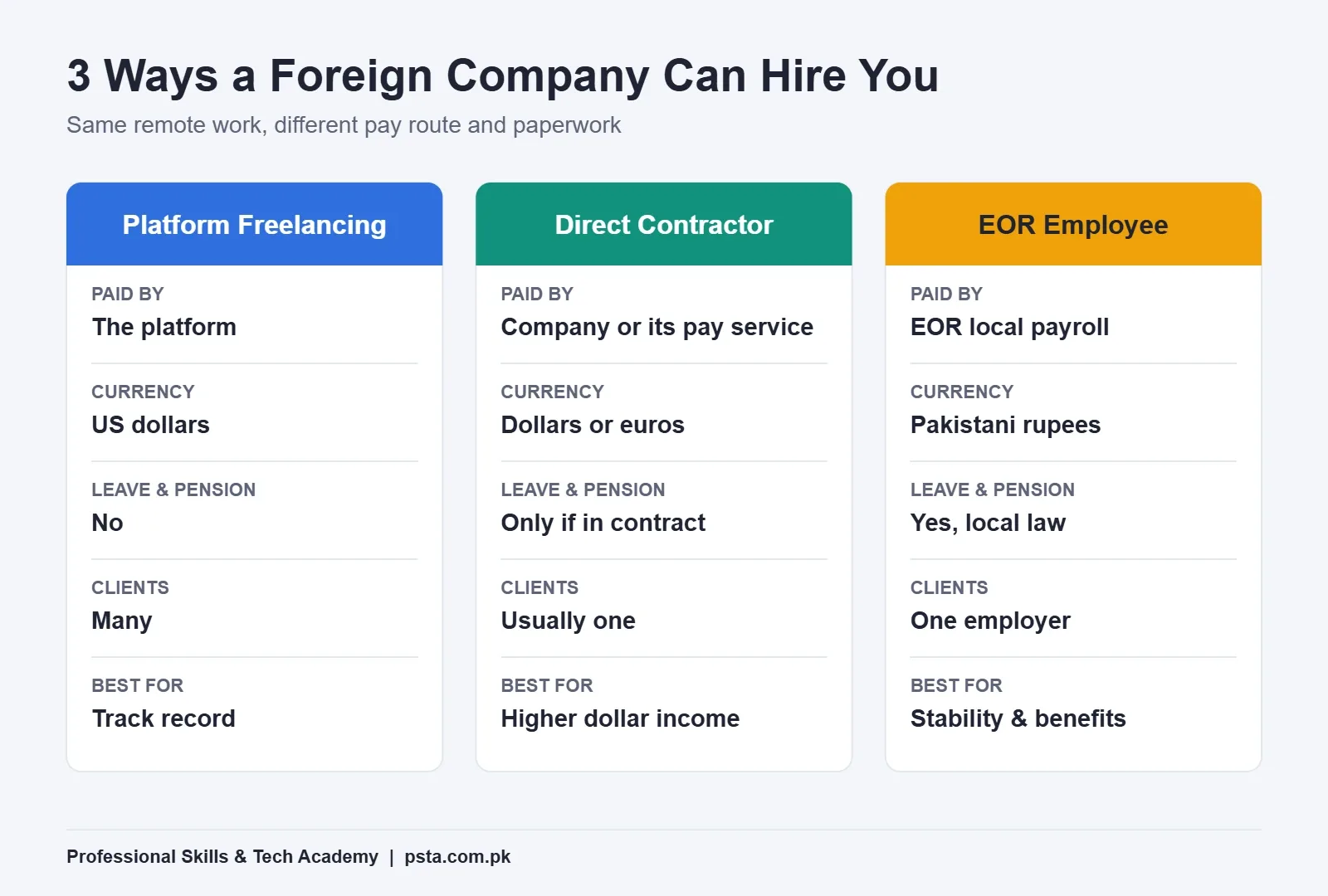
People use "remote job" for three different arrangements. Knowing which one you're being offered changes how you negotiate, how you get paid and how you file tax.
Freelancing on a platform. You win projects on Upwork or Fiverr, the platform holds the payment, and you can have many clients at once. If you're still choosing a platform, our Fiverr vs Upwork comparison covers that decision.
Direct contractor. A foreign company signs a contract with you for a fixed number of hours, usually full time. You send monthly invoices, or the company pays you through a service such as Deel or Payoneer. You get no paid leave or pension by default, so you price that into your rate.
Employee through an Employer of Record (EOR). The company has no office in Pakistan, so it uses a provider that employs you locally on its behalf. Deel's Pakistan EOR page says it runs monthly payroll in rupees and offers benefits such as a pension fund, social security and EOBI contributions. This is the closest you'll get to a normal salaried job while working for a foreign firm.
| Question | Platform Freelancing | Direct Contractor | EOR Employee |
|---|---|---|---|
| Who pays you? | The platform, after the client pays | The company or its payment service | The EOR provider, through local payroll |
| Usual currency | US dollars | US dollars or euros | Pakistani rupees |
| Paid leave and pension | No | Only if your contract says so | Yes, under local law |
| Number of clients | Many | Usually one | One employer |
| Best for | Building a track record | Higher dollar income | Stability and benefits |
Why Are Foreign Companies Hiring in Pakistan Now?
The demand shows up in the export numbers. The Express Tribune, reporting State Bank data, put Pakistan's IT exports at a record $4.6 billion in FY2025-26, up 21% on the year before. The same report says freelancer earnings crossed $1 billion for the first time, about a quarter of all IT exports.
Time zones help too. Pakistan Standard Time is UTC+5 throughout the year, according to timeanddate.com. That puts you in a workable overlap with the Gulf, the UK and Europe, and lets you cover the late afternoon of US teams if you're willing to work evenings.
Cost is the third reason, and you should be honest about it. Many companies hire here because the rate is lower than at home. Your job is to be the cheaper option that is also reliable, because reliability is what keeps a remote contract alive past the first three months.
Which Roles Get Hired Remotely Most Often?
Most remote jobs from Pakistan fall into a handful of fields, because remote hiring favors work that can be checked without anyone watching you. If your output can be shared as a link, a file or a report, the role travels well.
- Web and software development. Front-end, back-end and WordPress developers. Proof: a GitHub profile and two live projects. Our Full-Stack Web Development with AI course is built around that kind of portfolio.
- Digital marketing. SEO, paid ads and social media management. Proof: a campaign report with real numbers from a small business you helped.
- Design and video. Brand designers, thumbnail designers and video editors. Proof: a portfolio site with before and after samples.
- Customer support and virtual assistance. Email and chat support, scheduling and inbox management. Proof: clear written English, fast typing and a recorded mock call.
- Data and reporting. Excel, Power BI and data entry with cleaning. Proof: one dashboard built on public data.
Notice the pattern. Every role asks for proof, and every role needs English you can use under pressure. That second skill is the one most applicants underrate.
How to Get Remote Jobs From Pakistan: Seven Steps
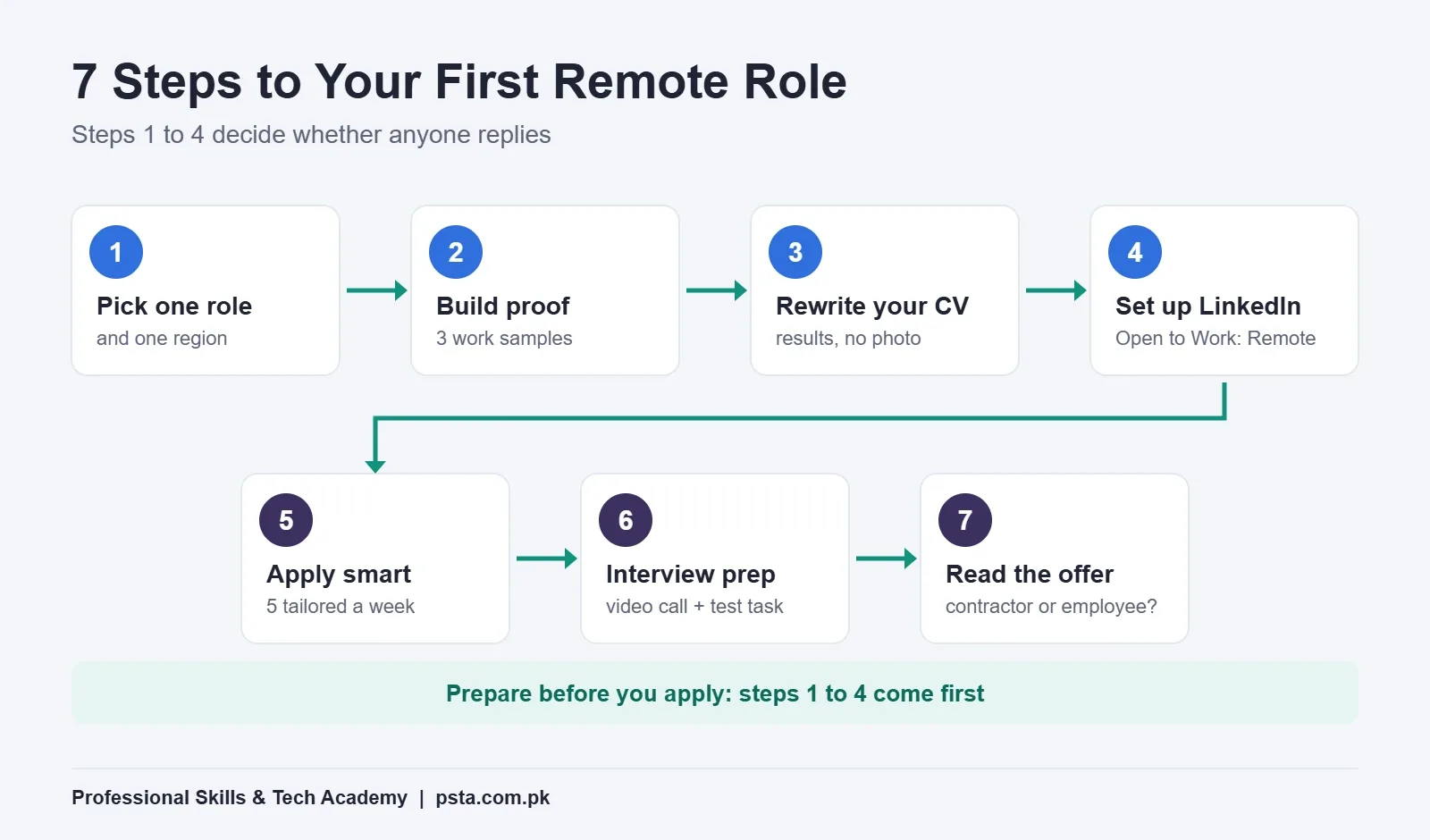
This is the order I'd follow with a student who has a skill but no remote experience. Don't skip ahead to applying; steps 1 to 4 decide whether anyone replies.
Step 1: Pick One Role and One Market
"Remote job" is not a search term that gets you hired. "WordPress developer for UK agencies" is. Choose one role title and one region whose working hours you can match. Your CV, LinkedIn headline and samples will all point at that target.
Step 2: Build Proof Before You Apply
Make three samples that look like the work the job ad describes. A support applicant can write five model replies to tricky customer emails. A marketer can audit a local shop's Facebook page and write the fix. Host everything on one page you can link to.
Step 3: Rewrite Your CV for a Foreign Reader
Drop the photo, date of birth and father's name; most international recruiters don't expect them. Lead with a two-line summary that names your target role. Put results in each bullet, such as "cut response time from one day to four hours." For the formatting traps, see our post on fresh graduate CV mistakes.
Step 4: Set Up LinkedIn for Remote Search
LinkedIn added remote, hybrid and on-site filters to job search and to its Open to Work setting, as Engadget reported. Turn on Open to Work, choose "Remote" as the workplace type, and match your headline to the role from step 1. Our guide to LinkedIn for fresh graduates walks through the profile itself.
Step 5: Apply Where Remote Employers Actually Post
- Search LinkedIn Jobs with your role title, set location to "Worldwide" or your target country, and tick the Remote filter.
- Read each ad for the words "anywhere," "worldwide" or a list of allowed countries. Many remote roles are limited to one country, so skip those quickly.
- Open the company's own careers page and apply there when you can. It's the safest route and the ad is usually more detailed.
- Send 5 tailored applications a week instead of 50 copied ones. Mention one detail from the company's product in each.
Step 6: Prepare for a Video Interview and a Test Task
Expect a short screening call, a paid or unpaid test task, and a longer call with the team lead. Practice explaining one project in two minutes without reading. Test your camera, microphone and lighting the day before. For the questions themselves, use our English interview questions and answers as a rehearsal script.
Step 7: Read the Offer Line by Line
Check whether you're a contractor or an employee, how many hours you owe, which time zone those hours follow, and how and when you'll be paid. Ask how notice works on both sides. If anything is only promised on a call, ask for it in writing.
How Do Time Zones Shape Your Working Day?
Overlap matters more than total hours. Most teams want you online for their morning meetings or their end-of-day handover. The table below uses winter clocks, when the UK is on UTC+0 and the US East Coast on UTC-5. When those countries switch to summer time, the gap shrinks by an hour, while Pakistan stays at UTC+5.
| Team Location | Their 9:00 AM Is | Their 5:00 PM Is | What It Means for You |
|---|---|---|---|
| London (winter) | 2:00 PM in Pakistan | 10:00 PM in Pakistan | Afternoon and evening shift |
| New York (winter) | 7:00 PM in Pakistan | 3:00 AM in Pakistan | Partial overlap, usually evenings only |
| Pakistan-based client | 9:00 AM | 5:00 PM | Normal day shift |
Before you accept a US role, agree in writing which hours you must be online. Many US teams only need two or three overlapping hours, and the rest can be done during your day.
How Will You Get Paid in Pakistan?
Your payment route depends on the arrangement. Platform freelancers withdraw from the platform. EOR employees are paid in rupees through payroll. Direct contractors have the most choice and the most to check.
- Bank wire (SWIFT). Paid straight into your account, ideally a dollar account. Payoneer's guide to paying Pakistani contractors says SWIFT transfers can take 1 to 5 days and that the receiver may pay $15 to $30 in charges.
- Payoneer. The same guide says you can withdraw in rupees or other currencies and that Payoneer links with JazzCash. Payoneer wrote that page, so check its current fee schedule yourself before you agree.
- Deel. Deel's contractor page says it pays out in 120 currencies and lets workers withdraw by their preferred method. The company, not you, sets up and funds the account.
Whatever the route, keep the Proceeds Realization Certificate (PRC) for every foreign payment. It proves the money came from exporting a service, and you'll need it at tax time.
The State Bank also made life easier this year. Its April 6, 2026 press release says IT exporters and freelancers now make a one-time declaration of their services instead of filing Form R for each payment. Form R is only needed above $25,000, and banks must process receipts into exporters' special foreign currency accounts within one working day.
Do You Need to Register or Pay Tax?
Yes, foreign income from a remote job is still income in Pakistan, and filing a return keeps you on the Active Taxpayers List. The rules differ for freelancers, registered IT exporters and EOR employees, whose tax is deducted through payroll. Rather than repeat them here, read our guide to filing a tax return as a freelancer and our walkthrough of PSEB registration. Talk to a tax adviser if your income is large or mixed.
How Can You Tell a Real Remote Job From a Scam?
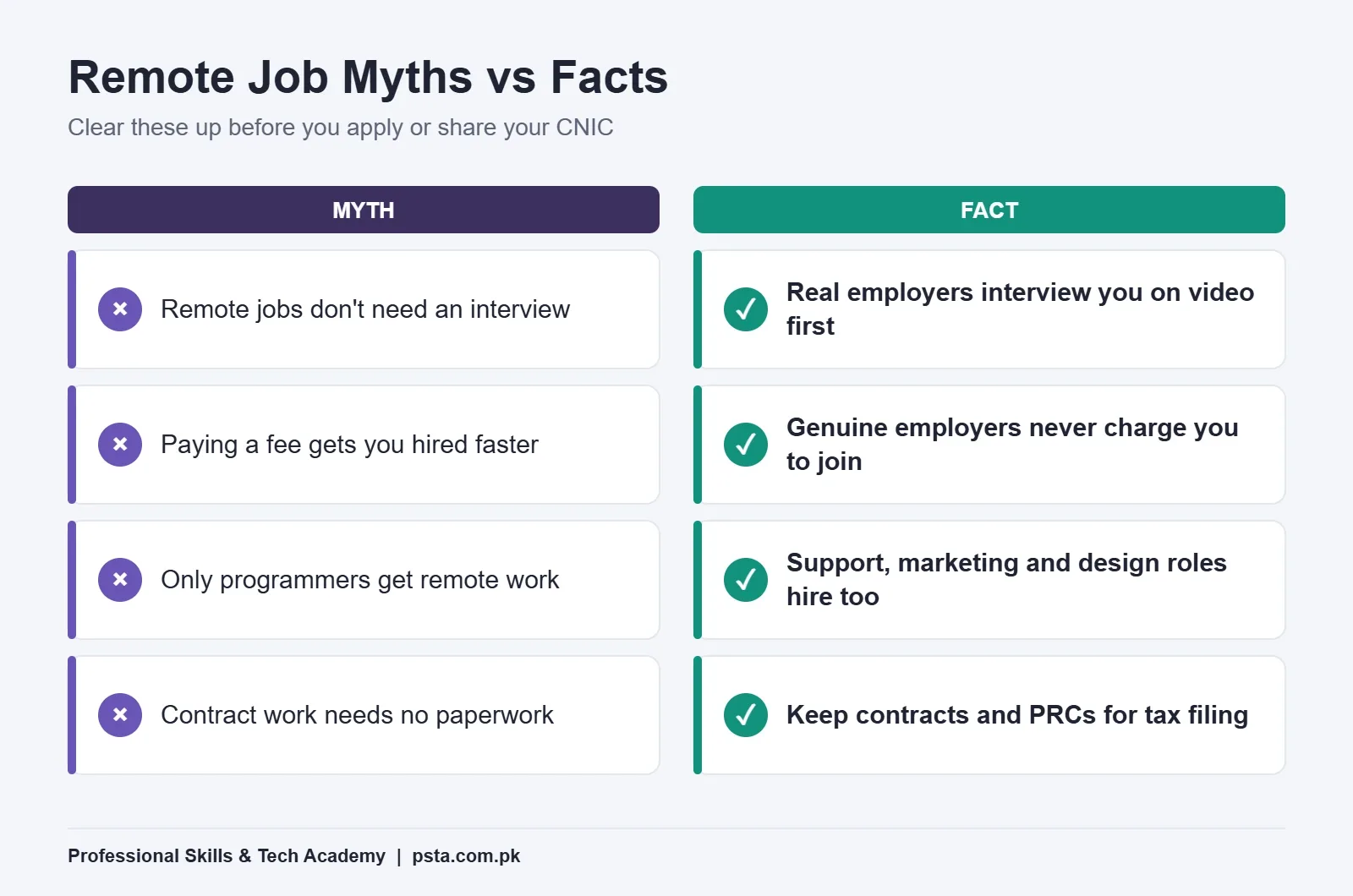
Anyone searching for remote jobs from Pakistan will meet scams sooner or later, and they're common enough that the PTA has issued public warnings. In an October 2025 warning reported by ARY News, the PTA said scammers post fake full-time and part-time jobs on social media with high pay, then collect photos, location data and other personal details. Its advice was to verify every offer before applying and never share personal or biometric details with unverified sources.
Walk away when you see any of these signs:
- You're asked to pay a registration, training or "security" fee before starting.
- The whole hiring process happens on WhatsApp or Telegram, with no video interview.
- The task is "liking videos" or "rating products" for daily payouts.
- They want your CNIC photo, bank login or a SIM in your name before any contract exists.
- The email comes from a free address while the ad claims to be from a large company.
A real employer can be found on its own website, shows you a contract before you share bank details, and never charges you to get hired.
A Home Setup That Won't Let You Down
Most remote contracts that end early end over reliability, not skill, and that's as true for remote jobs from Pakistan as anywhere else. Plan for the problems you already know about.
- Power: a UPS or inverter that keeps your router and laptop running through a load-shedding slot.
- Internet: a main connection plus a mobile data backup you have actually tested.
- Space: a quiet corner with a plain background and a cheap headset with a microphone.
- Tools: learn Google Workspace, Slack or Microsoft Teams, and a time tracker before your first day.
Tell your manager about a planned outage before it happens. One early message earns more trust than any apology.
Building These Skills at PSTA
When our students start applying for remote jobs from Pakistan, the hardest part is rarely the technical skill. It's writing a clear update, joining a call with strangers and answering follow-up questions in English. Our English Spoken & Grammar Course runs for 12 weeks at Rs. 12,000 (regular Rs. 14,000) and includes modules on interviews and meetings, role plays, formal versus informal English, and writing emails, CVs and messages.
If your computer basics are shaky, the 12-week Office Automation course covers typing, Word, Excel and PowerPoint, which most support and assistant roles test first. Both courses run on campus in Abbottabad (Mandian, Old College Road, opposite FIMS College), live online from anywhere in Pakistan, or as a mix of the two. Browse all PSTA courses to match a technical skill to your target role, then see the admission page for the next batch. You can also ask about timings on WhatsApp at +92 314 5424399.
Send One Tailored Application This Week
Pick one remote job ad that fits the role you chose in step 1. Read it twice, write down the three skills it repeats, and make sure your CV shows proof of each. Then send that single application, written for that company alone. One careful application teaches you more than a weekend of mass applying.
Frequently asked questions
Can I work remotely for a foreign company while living in Pakistan?
Yes. Foreign companies hire Pakistanis as platform freelancers, as direct contractors who invoice monthly, or as employees through an Employer of Record that runs local payroll. Each route is legal when you declare the income. Check your contract to see which one you are being offered, because it decides how you are paid, what benefits you get and how you file tax.
Do I need a degree to get a remote job from Pakistan?
Many remote employers care more about proof than paper. A portfolio, a GitHub profile, a campaign report or recorded mock calls often matter more than a degree, especially for development, design, marketing and support roles. Some companies still list a degree, so read each ad. Strong written and spoken English helps in almost every case.
Which websites should I use to find remote jobs?
Start with LinkedIn Jobs using the Remote workplace filter and a worldwide or country-specific location. Then go to the careers pages of companies you like and apply directly, since those listings are the most reliable. Read each ad for words like anywhere or worldwide, because many remote roles are limited to one country.
How do I receive a salary from a foreign company in Pakistan?
Contractors usually receive a SWIFT bank transfer, a Payoneer payment or a payout through a platform such as Deel. EOR employees are paid in rupees through local payroll. Keep the Proceeds Realization Certificate for each foreign payment, and use a dollar account where possible. Under SBP rules from April 2026, Form R is only needed above $25,000.
Is it safe to share my CNIC with a remote employer?
Only after you have verified the company through its own website, had a real video interview and seen a written contract. The PTA has warned that fake online job ads are used to collect personal data. Never send a CNIC photo, bank login or SIM details to someone who has only contacted you on WhatsApp or Telegram.
What working hours should I expect in a remote job?
It depends on where the team sits. Pakistan stays at UTC+5 all year, so a London team in winter starts work at 2:00 PM Pakistan time, while a New York team starts at 7:00 PM. Many companies need only two or three overlapping hours. Agree on your exact online hours in writing before you accept the offer.
Do I pay tax on income from a remote job?
Yes. Income from a foreign company is still taxable in Pakistan, and filing a return keeps you on the Active Taxpayers List. Freelancers, registered IT exporters and EOR employees are treated differently, and EOR employees usually have tax deducted through payroll. Keep your contracts and PRCs, and speak to a tax adviser if your income is large.
Sources & references
- IT exports hit record $4.6b (Express Tribune) tribune.com.pk
- SBP press release, 6 April 2026 sbp.org.pk
- Pay contractors and remote employees in Pakistan (Payoneer) payoneer.com
- Hire independent contractors in Pakistan (Deel) deel.com
- Deel Employer of Record in Pakistan deel.com
- PTA warns citizens against fake online job scams (ARY News) arynews.tv
- PKT time zone (timeanddate.com) timeanddate.com
- LinkedIn adds remote work filters (Engadget) engadget.com
Last reviewed & updated on by Umar Qureshi. Written by the PSTA team in Abbottabad, Pakistan.

Umar Qureshi

English Spoken & Grammar Course in Pakistan – Build Confidence, Speak Fluently (Online & Campus)
Turn this guide into a career: hands-on training with real projects, online across Pakistan or on-campus in Abbottabad · 12 Weeks.



Comments
No comments yet — ask a question or share your experience.