Quick answer
In JWT vs session, sessions keep login state on the server and send a random ID in a cookie, while JWTs put signed, readable claims in a token the client carries. For one backend and one web app, sessions are simpler and easier to revoke. Use JWTs when many services must verify one login.
Key takeaways
- • Sessions store state on the server; JWTs carry signed state to the client.
- • A signed JWT is readable by anyone, so never put personal or secret data in it.
- • Stateless JWTs stay valid until exp; a denylist fixes this but removes the stateless benefit.
- • Store login credentials in HttpOnly, Secure, SameSite cookies, not localStorage.
- • Pin the JWT algorithm, use a random secret of 160+ bits, and check exp, iss and aud.
Table of contents 17 sections
- How Does Session-Based Authentication Work?
- How Does JWT Authentication Work?
- The Registered Claims You Will See Most
- One Login Request, Traced Both Ways
- With a Session
- With a JWT
- Can Anyone Read What Is Inside a JWT?
- JWT vs Session: Side-by-Side Comparison
- The Logout Problem With Stateless Tokens
- Where Should You Store a JWT or Session ID in the Browser?
- The Three Cookie Flags to Set Every Time
- Mistakes That Turn Login Into a Security Hole
- When Should You Choose JWT, and When Sessions?
- A Quick Decision Checklist
- How to Explain JWT vs Session in a Job Interview
- Building Secure Login in PSTA's Full-Stack Course
- Your Next Commit
"Should I use JWT or sessions for login in my MERN project?" It is one of the first backend questions students ask, usually right after their React frontend starts talking to an Express API. The short answer to JWT vs session: for a single web app with its own backend, server-side sessions in an HttpOnly cookie are simpler and easier to secure. JWTs earn their place when several services or apps must trust one login. PSTA (Professional Skills & Tech Academy) trainers give that answer, then explain why, and this guide does the same.
In the next few minutes you will learn:
- How session-based authentication and JWT authentication each work, step by step
- What a JWT actually contains, and why anyone can read it
- Where to keep a token or session ID in the browser, and where not to
- The logout and revocation problem that catches JWT beginners
- A simple rule for choosing in your next project or interview
How Does Session-Based Authentication Work?
With session-based authentication, the server remembers who you are. After a correct password, it creates a random session ID, stores your details against that ID on the server, and sends only the ID to the browser in a cookie. On every request, the browser sends the cookie back and the server looks the ID up.
The ID itself means nothing. The OWASP Session Management Cheat Sheet says a session ID should carry at least 64 bits of entropy from a cryptographically secure random generator, must not contain personal data, and should keep all its meaning on the server. It also recommends using your framework's built-in session ID instead of inventing your own.
Because the server holds the record, logging someone out is simple: delete the record. The cookie in the browser becomes useless at once.
How Does JWT Authentication Work?
With JWT authentication, the server writes your details into a signed token and hands the whole token to the client. The server does not need to store it. On each request, the client sends the token back, often in an Authorization: Bearer header, and the server checks the signature before trusting what is inside.
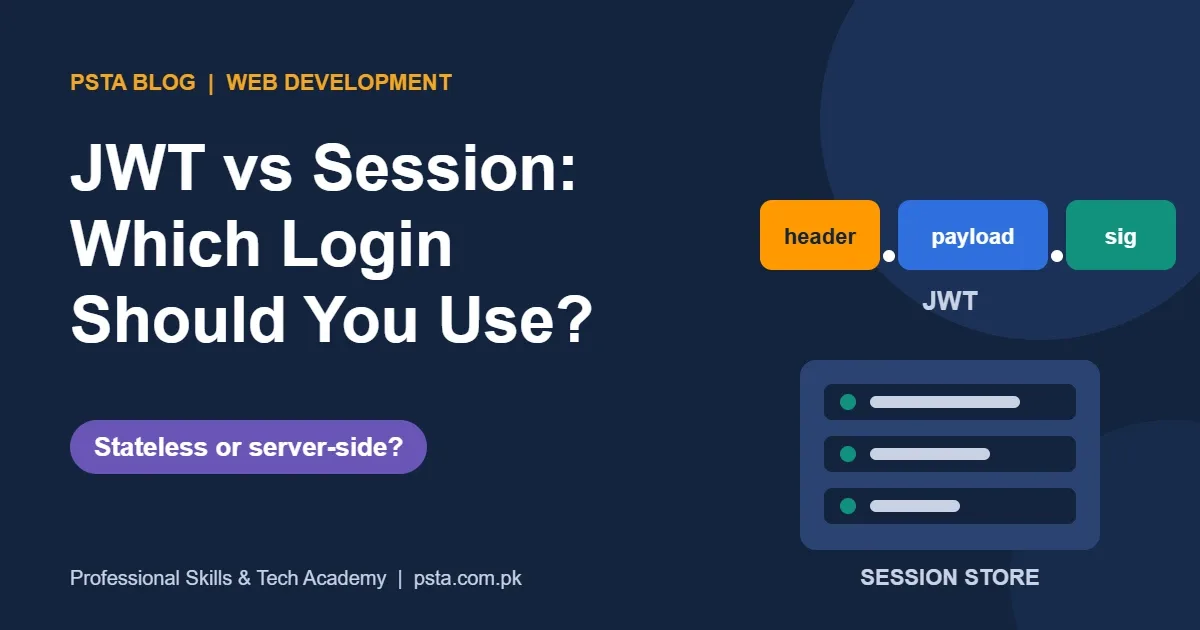
JWT is defined in RFC 7519, published by the IETF in May 2015. A signed JWT has three base64url-encoded parts separated by dots: a header that names the algorithm, a payload of claims, and a signature.
The Registered Claims You Will See Most
| Claim | Meaning in plain words |
|---|---|
| iss | Who issued the token |
| sub | Who the token is about, usually the user ID |
| aud | Which app or API the token is meant for |
| exp | When the token stops being valid |
| nbf | The time before which it must not be accepted |
| iat | When it was issued |
| jti | A unique ID for this token, useful against replay |
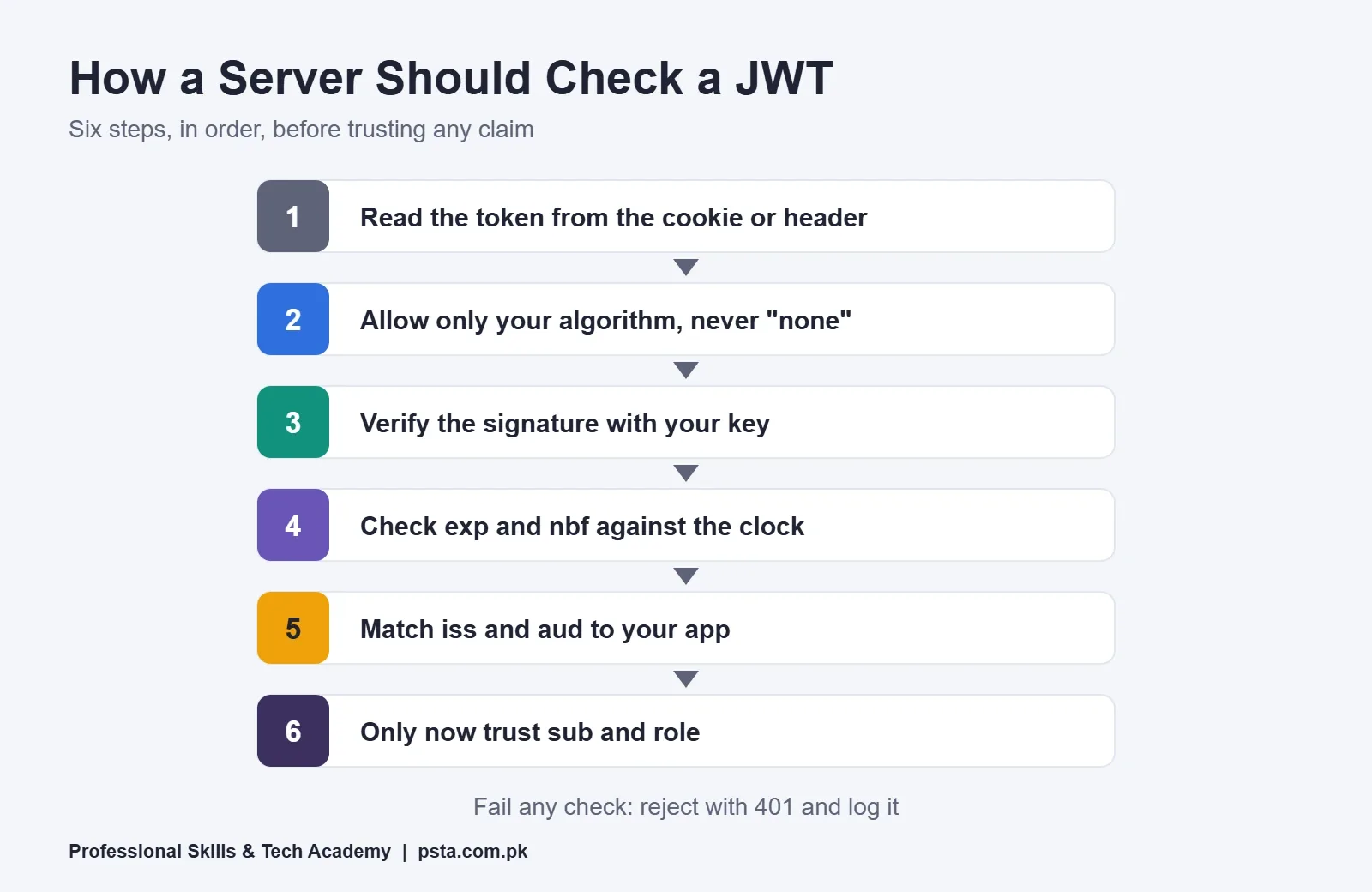
RFC 7519 marks all of these as optional. In practice, always set exp, and check iss and aud on the server. If any check fails, reject the request with a 401 status and log the attempt.
One Login Request, Traced Both Ways
Following a single login from start to finish makes the JWT vs session difference concrete. Imagine a student portal where Ayesha, an example user, signs in and opens her results page.
With a Session
- The browser posts her email and password to /login.
- The server checks the password, creates a fresh random session ID and saves her user ID and role against it.
- The response sets an HttpOnly cookie that holds only the ID.
- When she opens /results, the browser sends the cookie, the server finds the record and returns her marks.
With a JWT
- The browser posts the same login details.
- The server checks the password and signs a token with her user ID, role, iss, aud and a short exp.
- The token goes back to the client, ideally inside an HttpOnly cookie rather than in the response body for JavaScript to save.
- When she opens /results, the server verifies the signature and expiry, then trusts the claims without a database lookup.
Both flows look similar on screen. The difference is who remembers the login: the server's session store, or the token itself.
Can Anyone Read What Is Inside a JWT?
Yes. A normal signed JWT is encoded, not encrypted. The signature stops people from changing the payload, but anyone holding the token can decode and read it. The jwt.io introduction warns against putting secret information in the payload or header unless the token is encrypted.
The OWASP JWT Cheat Sheet repeats the point under a heading that says signed JWTs are not confidential. So never put a CNIC number, phone number, password hash or salary in a token. A user ID and a role are usually enough.
JWT vs Session: Side-by-Side Comparison
Here is how the two approaches compare on the points that matter in a real project.
| Point | Server-side session | JWT |
|---|---|---|
| Where user state lives | On the server, looked up by ID | Inside the token, on the client |
| What the browser holds | A meaningless random ID | A readable, signed token |
| Logout and revocation | Delete the server record | Valid until exp unless you add a denylist |
| Server storage needed | Yes, a session store | Not for basic checks |
| Works across many services | Needs a shared session store | Any service with the key can verify |
| Size on each request | Small cookie | Grows with every claim |
| Common mistakes | Missing cookie flags, no ID rotation | Weak secret, alg confusion, storage in localStorage |
jwt.io notes that some servers reject headers above 8 KB, so a token stuffed with claims can break requests. That is one more reason to keep payloads small.
The Logout Problem With Stateless Tokens
This is where stateless authentication surprises most beginners. A stateless JWT stays valid until it expires. If a token leaks, or a user clicks Logout, the server cannot simply cancel it, because the server never stored it.
OWASP's JWT guidance offers a denylist keyed on the jti and iss claims, but it also points out that once you keep a denylist, your system is no longer fully stateless. At that stage, it suggests considering plain sessions instead. The same cheat sheet recommends short expiry times to limit how long a stolen token is useful.
So the main selling point of JWTs, no server storage, often disappears in a real app that needs proper logout. That does not make JWTs wrong. It means you should pick them for the right reasons.
Where Should You Store a JWT or Session ID in the Browser?
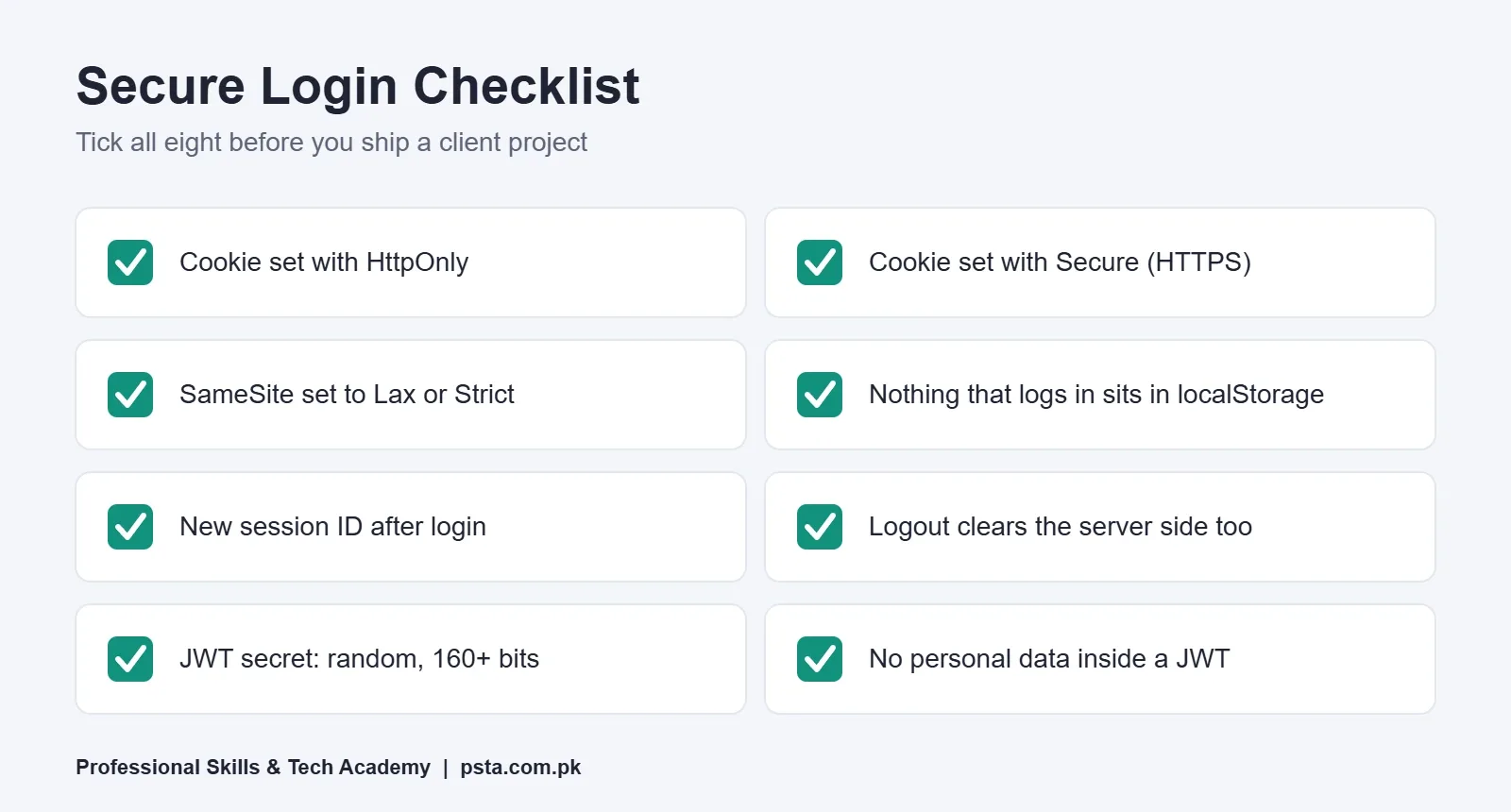
In an HttpOnly cookie that is also Secure, in most web apps. That is the usual answer to where to store JWT tokens too. MDN's Set-Cookie reference explains that HttpOnly stops JavaScript from reading the cookie through document.cookie, which helps against cross-site scripting (XSS). The browser still sends the cookie with fetch() requests.
Avoid localStorage for anything that logs a user in. The OWASP HTML5 Security Cheat Sheet says not to store session identifiers in local storage, because that data is always readable by JavaScript, and one XSS bug can steal everything there. Many React tutorials still save the JWT in localStorage. It works in a demo, but it is not how you should ship a client project.
The Three Cookie Flags to Set Every Time
- HttpOnly: scripts cannot read the cookie.
- Secure: MDN says the cookie is sent only over HTTPS, with an exception for localhost during development.
- SameSite: Strict sends it only on same-site requests. Lax also allows top-level navigation with safe methods like GET. None allows cross-site use and must be paired with Secure. MDN notes some browsers treat a missing value as Lax.
HttpOnly does not stop cross-site request forgery on its own. SameSite helps, and forms that change data still deserve CSRF protection from your framework.
Mistakes That Turn Login Into a Security Hole
The OWASP cheat sheets list several failures that show up again and again in student and freelance projects:
- Accepting alg "none": some older libraries accepted unsigned tokens by default. Always pin the algorithms your server allows.
- Algorithm confusion: a verifier that accepts both HMAC and public-key algorithms can be tricked. Allow only the one you use.
- A weak HMAC secret: OWASP asks for at least 160 bits of entropy from a secure random generator, never a password like "mysecret123".
- Skipping iss and aud checks: a token meant for another app should be rejected.
- Not rotating the session ID after login: the session cheat sheet says to issue a new ID when the user logs in or gains privileges.
- Logging out only on the client: deleting the cookie in the browser is not enough. Invalidate the session on the server.
Many of these map to the broken access control and authentication risks covered in our OWASP Top 10 2025 explainer. Adding a second factor, as described in our two-factor authentication guide, protects accounts even when a password leaks.
When Should You Choose JWT, and When Sessions?
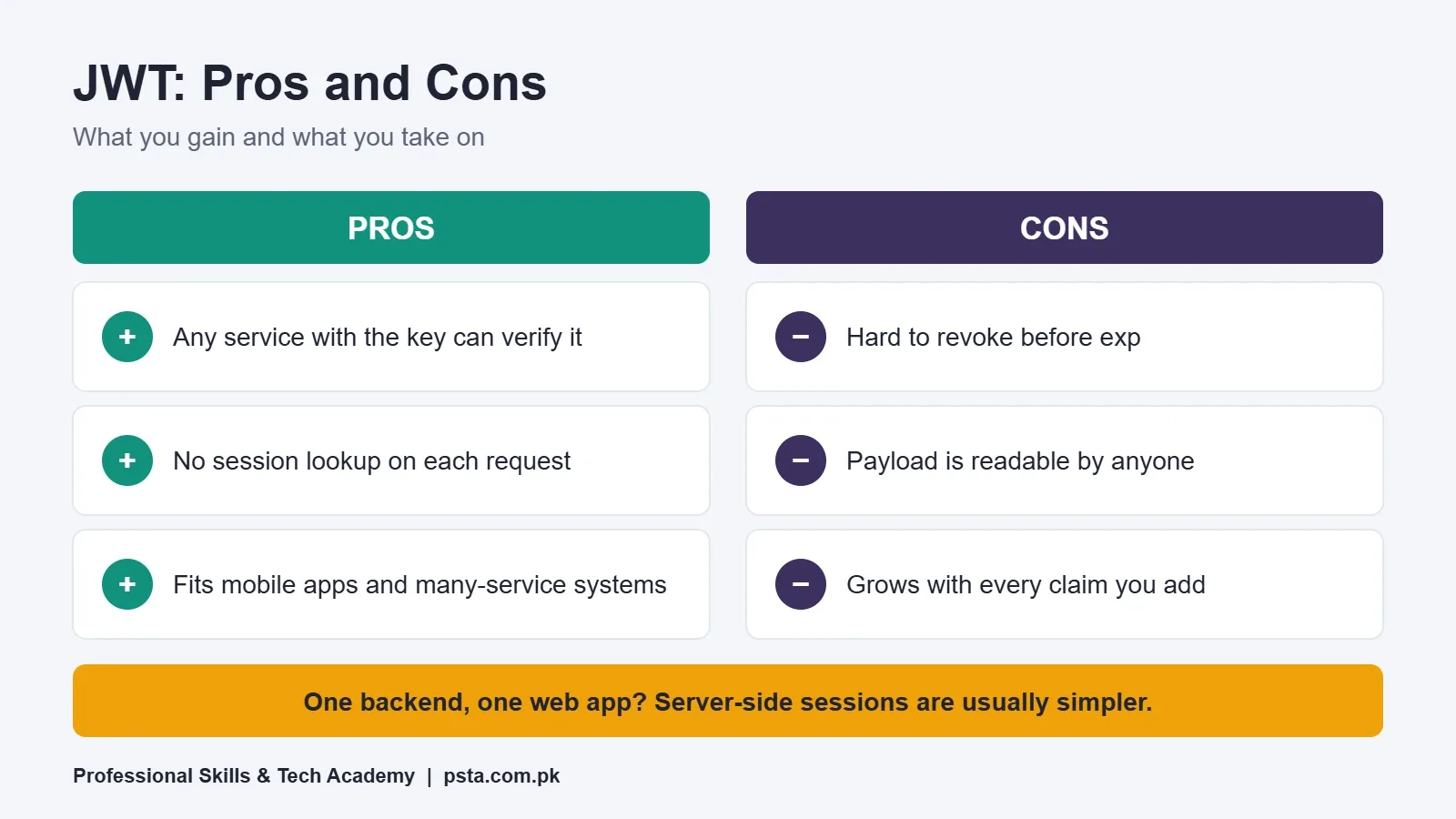
Choose server-side sessions when one backend serves one web frontend, which describes most student projects, school portals and small business sites. Choose JWTs when several separate services, a mobile app and a web app, or a third-party API must all accept the same login without sharing a session database.
jwt.io lists authorization and information exchange between parties as the main uses for JWTs, and it says JWT authorization can be stateless only "in certain cases." That phrase is worth remembering in interviews.
A Quick Decision Checklist
- Is there only one backend and one web frontend? Use sessions.
- Do you need instant logout or "log out of all devices"? Sessions make this easy.
- Must several services verify the user without calling one central server? JWTs fit.
- Is a native mobile app talking to your API? JWTs are common there, with short expiry.
- Whichever you pick, keep the credential out of localStorage in a browser app.
How to Explain JWT vs Session in a Job Interview
For junior MERN and Laravel roles, this question is a quick way to test whether you understand where login state lives. A strong answer takes under a minute:
- Define both: the session keeps state on the server; the JWT carries signed state to the client.
- Name the trade-off: JWTs avoid a lookup but are hard to revoke before they expire.
- Mention storage: HttpOnly, Secure, SameSite cookies rather than localStorage.
- Give your choice for their kind of app, with one reason.
Practise saying it aloud once. If you are building your first API, our REST API for beginners guide covers the request and status-code basics, and the MERN stack roadmap shows where authentication fits in a full project.
Building Secure Login in PSTA's Full-Stack Course
The Express backends where you would implement login are covered in Module 4 (Node.js, Express.js and RESTful APIs) of the PSTA full-stack web development program, which also teaches AI coding tools. The course page lists a 6-month, beginner-friendly program covering the MERN stack, MySQL, PHP and WordPress, with a capstone where you build and deploy a complete full-stack app. The fee shown is Rs. 45,000, reduced from Rs. 60,000, in two installments.
Classes run on the Abbottabad campus, live online for students anywhere in Pakistan, or as a mix of the two, and the certificate is verifiable on psta.com.pk. If your frontend work needs more depth first, the React.js course is listed alongside the rest of the PSTA catalog.
Your Next Commit
Open the login code of your current project and check one thing: where does the token or session ID live in the browser? If the answer is localStorage, move it to an HttpOnly, Secure, SameSite cookie this week and test that logout really ends the session on the server.
When you want a trainer to review your auth code, apply through PSTA admission or message +92 314 5424399 on WhatsApp.
Frequently asked questions
Is JWT better than session authentication?
Neither is better everywhere. Sessions are simpler and easier to revoke when one backend serves one web app, because the server holds the login record. JWTs suit systems where several services or apps must verify the same user without sharing a session database. Choose by your architecture, not by popularity in tutorials.
Is it safe to store a JWT in localStorage?
It is risky. OWASP advises against keeping session identifiers in local storage because JavaScript can always read it, so a single cross-site scripting bug can steal the token. For browser apps, place the token or session ID in an HttpOnly, Secure cookie with a SameSite setting instead.
Can a JWT be decoded without the secret key?
Yes. A normal signed JWT is only base64url-encoded, so anyone holding it can read the header and payload. The secret or key is needed to create or verify the signature, not to read the contents. Keep personal and sensitive data out of the payload, or use an encrypted JWT.
How do you log out a user with JWT?
Deleting the token on the client stops your app from sending it, but the token itself stays valid until exp. To end it early, the server must keep a denylist of revoked token IDs, which OWASP notes makes the system no longer fully stateless. Short expiry times reduce the risk window.
What is the difference between a session ID and a JWT?
A session ID is a random, meaningless string that points to a record stored on the server. A JWT carries the user's claims inside the token itself, protected by a signature. The server must look up a session ID, while it can verify a JWT using only its key.
Do I need JWT for a MERN stack project?
No. Express apps can use server-side sessions with an HttpOnly cookie, and for a single React frontend talking to one API that is often the simpler, safer choice. JWTs become useful when you add a mobile app, several APIs or a separate authentication service that others must trust.
Which JWT claims should I always check?
Check the signature with an algorithm you have pinned, then exp and nbf against the current time, then iss and aud against your own values. RFC 7519 defines these registered claims as optional, so your server must decide to require and verify them. Reject the token if any check fails.
Sources & references
- RFC 7519: JSON Web Token (IETF) datatracker.ietf.org
- JSON Web Token Cheat Sheet (OWASP) cheatsheetseries.owasp.org
- Session Management Cheat Sheet (OWASP) cheatsheetseries.owasp.org
- HTML5 Security Cheat Sheet (OWASP) cheatsheetseries.owasp.org
- Set-Cookie header (MDN Web Docs) developer.mozilla.org
- Introduction to JSON Web Tokens (jwt.io) jwt.io
Last reviewed & updated on by Umar Qureshi. Written by the PSTA team in Abbottabad, Pakistan.

Umar Qureshi

Full-Stack Web Development Course with AI Tools
Turn this guide into a career: hands-on training with real projects, online across Pakistan or on-campus in Abbottabad · 6 Months.



Comments
No comments yet — ask a question or share your experience.