Quick answer
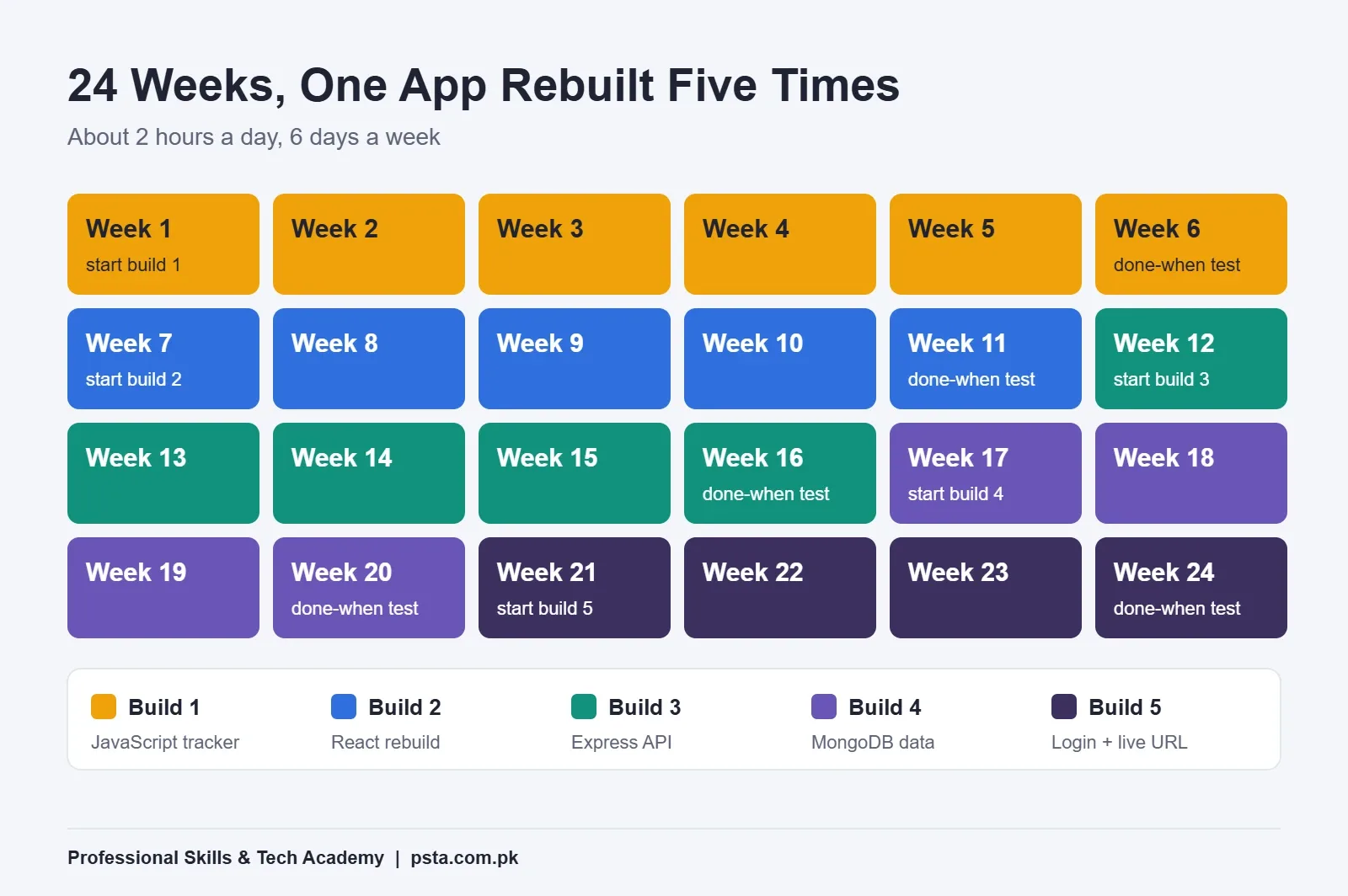
Learn MERN in this order over about 24 weeks: plain JavaScript (weeks 1–6), React (7–11), a Node.js and Express API (12–16), MongoDB with Mongoose (17–20), then login and deployment (21–24). Rebuild one small app at each stage and move on only when its done-when test passes.
Key takeaways
- • You don't need to learn the letters in M-E-R-N order; start with JavaScript, then React, then the server and database.
- • Rebuilding one expense tracker five times shows exactly why each new tool exists.
- • Install a current Node.js LTS release (26 or 24) and Express 5, and skip Create React App, which is deprecated for new apps.
- • MongoDB Atlas has a free 512 MB cluster, enough for a portfolio project.
- • A deployed app with login, a clear README and steady commits is stronger proof than several half-finished tutorials.
Table of contents 14 sections
- What Does MERN Stand For, and How Do the Four Parts Talk?
- Is the MERN Stack Still Worth Learning in 2026?
- The MERN Stack Roadmap at a Glance
- Build 1 (Weeks 1–6): A Plain JavaScript Expense Tracker
- Set Up Your Machine First
- What to Build
- Build 2 (Weeks 7–11): Rebuild the Tracker in React
- Build 3 (Weeks 12–16): Give the Tracker Its Own API
- Build 4 (Weeks 17–20): Store Real Data in MongoDB
- Build 5 (Weeks 21–24): Add Login and Put It Online
- Habits That Make a MERN Portfolio Worth Opening
- How Do MERN Developers Find Their First Work in Pakistan?
- Following This Roadmap in PSTA's Full-Stack Course
- Your First Hour: Sketch One Expense on Paper
A realistic MERN stack roadmap takes about 24 weeks of steady practice: JavaScript first, then React, then Node.js with Express, then MongoDB, and finally login and deployment. You don't have to learn the letters in M-E-R-N order. The two biggest pieces are also among the most used tools in web work. In Stack Overflow's 2025 Developer Survey, 48.7% of respondents to the web technology question reported using Node.js, and 44.7% reported using React.
Instead of a list of topics, this guide follows one small app, a personal expense tracker in rupees, and has you rebuild it five times as your skills grow. Here's what you'll come away with:
- What each of the four tools does, and how one request travels between them
- A week-by-week plan split into five builds, each with a clear "done when" test
- Which current versions to install, and which old tutorials to skip
- How to turn the finished app into a portfolio piece an employer can check
- Where MERN developers in Pakistan usually find their first paid work
What Does MERN Stand For, and How Do the Four Parts Talk?
MERN is a set of four tools that together cover a complete web application, and all of them use JavaScript:
- MongoDB stores your data as documents that look a lot like JavaScript objects.
- Express is a small framework that runs on Node.js and decides what happens when someone requests a URL.
- React builds the screens the user sees, types into and clicks.
- Node.js runs JavaScript on a server rather than inside a browser.
Follow a single click to see how they connect. A user presses "Add expense" in the React app. React sends a request such as POST /api/expenses to your server. Express, running on Node.js, receives it, checks the data and asks MongoDB to save it. MongoDB confirms, Express replies with JSON, and React updates the list on screen without reloading the page.
That loop is the whole stack. Each build below adds one more link to it, so you always know why the next tool is on your plate.
Is the MERN Stack Still Worth Learning in 2026?
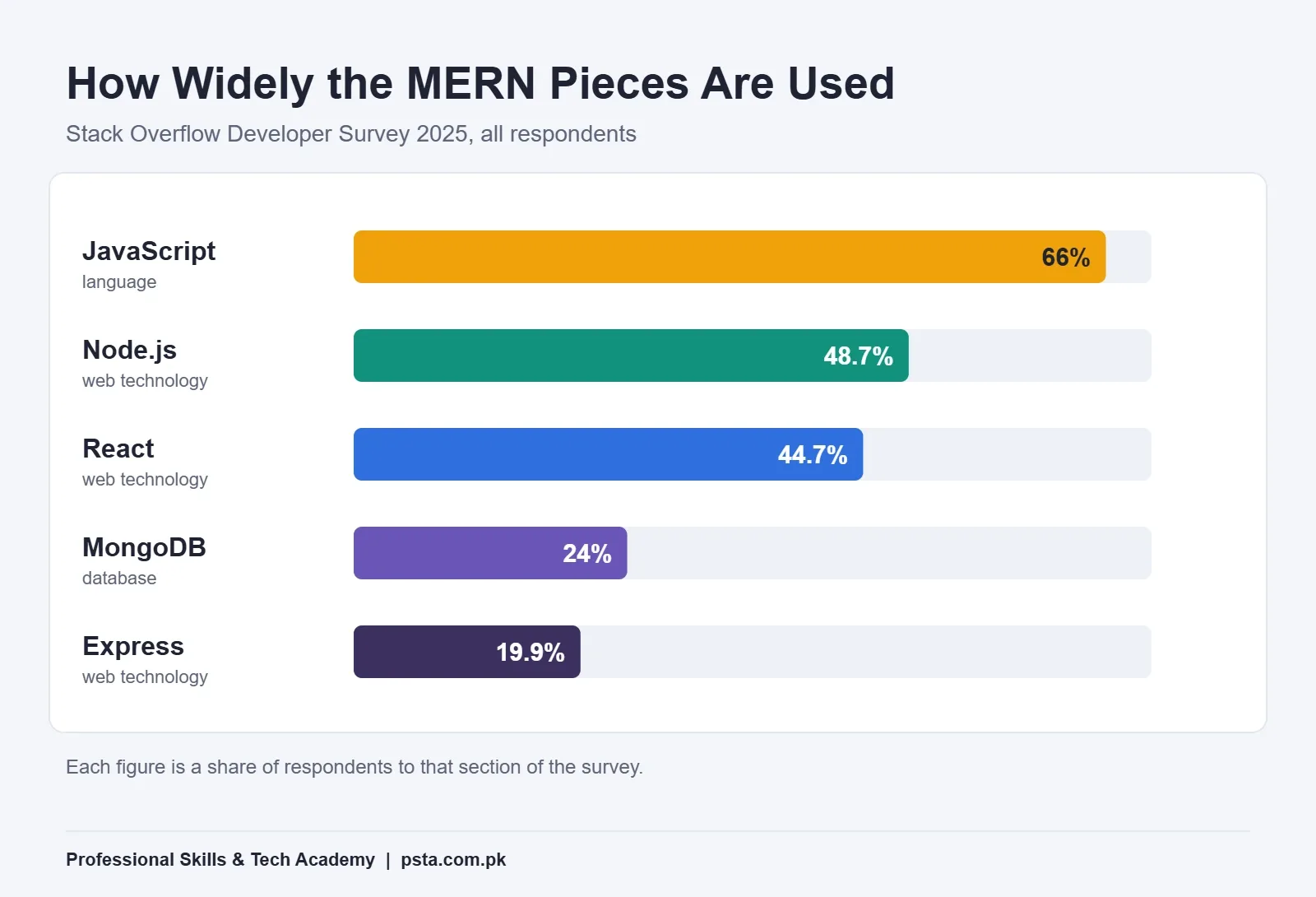
For most beginners, yes, and the main reason is that every layer speaks one language. JavaScript was used by 66% of respondents to the language question in the Stack Overflow 2025 Developer Survey. In the same survey, MongoDB reached 24% in the database section and Express 19.9% in the web frameworks section.
The local numbers point the same way. Pakistan's IT exports hit a record $4.6 billion in FY26, up 21% from $3.8 billion the year before, according to Topline Securities data reported by Profit. When exports grow, software houses take on more client projects and need juniors to help build them.
There are trade-offs, though. MERN isn't the only route into web development. PHP with Laravel, Python with Django and .NET all have their own job listings in Pakistan. MongoDB also suits some apps better than others: accounting systems with many linked tables usually fit a SQL database better. Pick MERN because you enjoy building interactive web apps in one language, not because you think it's the only stack that hires.
The MERN Stack Roadmap at a Glance
This MERN stack roadmap assumes about two hours a day, six days a week. If you have less time, stretch each build rather than skipping one.
| Build | Weeks | What You Learn | Done When |
|---|---|---|---|
| 1. JavaScript tracker | 1–6 | HTML, CSS, modern JavaScript, the DOM, Git | The tracker adds, deletes and totals expenses in the browser, and the code is on GitHub |
| 2. React rebuild | 7–11 | Components, props, state, hooks, Vite | The same tracker runs as a React app with a month filter |
| 3. Express API | 12–16 | Node.js, Express, REST routes, an API client | A local API returns and saves expenses as JSON |
| 4. MongoDB data | 17–20 | MongoDB Atlas, Mongoose schemas, queries | Expenses survive a server restart, and bad data is rejected |
| 5. Login and live URL | 21–24 | Hashed passwords, protected routes, environment variables, deployment | Anyone can sign up at a live URL and see only their own records |
Build 1 (Weeks 1–6): A Plain JavaScript Expense Tracker
Set Up Your Machine First
Install VS Code, Git and a Node.js LTS release. According to endoflife.date, Node.js 26 is in Active LTS until October 2027, and Node.js 24 is in maintenance with security fixes until April 2028. Either is fine for learning. Skip Node.js 20 and older, because their security support has already ended.
Open a free GitHub account and push code from the first week. A steady commit history shows a reviewer that you built the work yourself, over time.
What to Build
Any sensible MERN stack roadmap begins without a framework, so keep this build plain. Make one page with a form (description, amount in Rs., category, date) and a list underneath. Use JavaScript to add items to an array, draw them on the page, delete them and show a monthly total. Save the array in localStorage so it survives a refresh.
A few JavaScript topics carry straight into the later builds: array methods such as map, filter and reduce; objects and destructuring; modules; and fetch with async/await. If promises still feel slippery, read our guide to async/await in JavaScript before moving on, since React and Express both rely on it every day.
Self-check: could you rewrite the delete button from memory? If not, give this build one more week.
Build 2 (Weeks 7–11): Rebuild the Tracker in React
Now split the same page into components: ExpenseForm, ExpenseList, ExpenseItem and MonthlyTotal. Keep the expenses in state with useState, pass data down through props, and use useEffect only for side effects such as saving to localStorage.
Be careful with older tutorials here. Many of them begin with create-react-app, but the React team deprecated Create React App for new apps in February 2025 and recommends frameworks or build tools such as Vite instead, as explained on the React blog. For a practice app that will later talk to your own Express API, a Vite single-page app keeps things simple. The current major version is React 19, and the React versions page lists 19.3 as the latest release, from September 2026.
Add one feature that felt clumsy in plain JavaScript: a month filter plus a spending breakdown by category. You'll quickly see why component state is easier to reason about than hand-written DOM updates.
If you'd like more time on the frontend before adding a server, our frontend developer roadmap covers that stretch in more depth.
Build 3 (Weeks 12–16): Give the Tracker Its Own API
Until now, your data lived inside one browser. In this build, it moves to a server you write with Node.js and Express. Create these five routes:
GET /api/expensesreturns every expense.GET /api/expenses/:idreturns a single expense.POST /api/expensescreates one from the JSON in the request body.PUT /api/expenses/:idupdates one.DELETE /api/expenses/:idremoves one.
Keep the data in a plain array for now, and test every route with Postman or a similar API client before you touch React. Then connect the React app with fetch. You will almost certainly hit a CORS error at this point. Treat it as a lesson in how browsers protect users, not as something to silence with a copied snippet.
Install Express 5. The Express team made version 5.1.0 the default latest release on npm on March 31, 2025, according to the Express blog, so a normal npm install express gives you v5. Plenty of tutorials still show v4 code. Most of it carries over, but read the migration notes when something behaves differently.
One more version change is worth knowing. The Node.js project has announced that, starting with Node.js 27, it will ship one major release a year, each April, and every release will become LTS. Older guides that say "odd numbers are never LTS" will soon be out of date.
New to APIs in general? Our REST API guide for beginners explains methods and status codes with simple examples.
Build 4 (Weeks 17–20): Store Real Data in MongoDB
Replace the array with a real database. MongoDB Atlas offers a free cluster with 512 MB of storage, shared RAM and up to 100 operations per second, according to MongoDB's pricing page. That's plenty for a portfolio app, because a few thousand small expense records fit easily.
Use Mongoose to define an Expense schema with types and rules. The amount must be a positive number, the category must come from a fixed list, and the date is required. Server-side validation matters because anyone can send a request to your API, not only your own React form.
Learn a handful of query skills too: sorting by date, filtering by month, and an aggregation that totals spending per category. That aggregation replaces the JavaScript total you wrote in Build 1, and explaining the switch makes a good interview answer.
When is SQL the better choice? If your data has many strict relationships, such as invoices, payments and ledgers, a relational database like MySQL usually fits better. Knowing both makes you more useful to a small software house.
Build 5 (Weeks 21–24): Add Login and Put It Online
A tracker that shows everyone's spending to everyone isn't finished. Add user accounts and deploy it:
- Create a
Usermodel and hash passwords with a library such as bcrypt. Never store a plain password. - Issue a token or session after login, and protect the expense routes so each user sees only their own records.
- Move secrets, such as the database connection string, into environment variables and keep the
.envfile out of Git. - Deploy the API to a Node.js host and the React build to a static host, then point the frontend at the live API address.
- Open the live site on a phone over mobile data, not only on your laptop's Wi-Fi.
Hosting companies change their free plans often, so check each provider's current limits before you choose one. A free plan that sleeps when idle is fine for a portfolio; just mention the slow first load in your README.
Finish with a README that covers what the app does, the stack, how to run it locally and a link to the live version. Two clear screenshots help a busy reviewer decide to click.
Habits That Make a MERN Portfolio Worth Opening
Recruiters and clients see the same tutorial apps again and again. A few small choices make your project read as your own work.
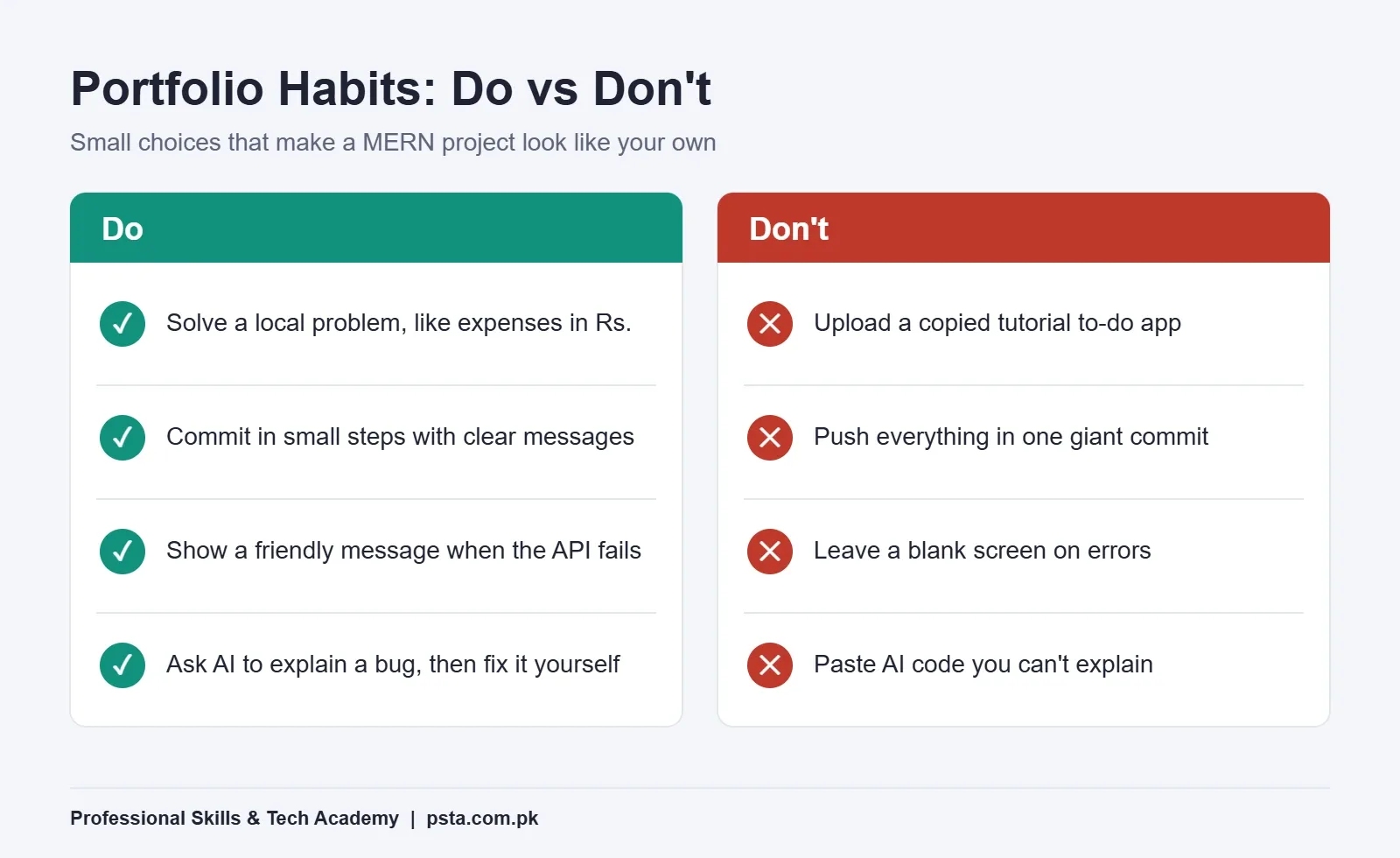
- Solve a local problem. An expense tracker in rupees, with categories like fuel, groceries and hostel mess, reads as yours. A to-do list copied from a video doesn't.
- Commit in small steps. Thirty commits with clear messages show how you work. One giant upload hides it.
- Handle errors on screen. Show a helpful message when the API is down or a field is invalid, instead of a blank page.
- Use AI tools to explain, not to paste. Ask an assistant why a bug happens, then fix it yourself so you can talk through it in an interview.
After the tracker, build one more app with a different data shape, such as a booking system for a tuition center or a stock list for a small shop. Two finished apps beat six half-built ones, and that applies to any MERN stack roadmap you follow.
How Do MERN Developers Find Their First Work in Pakistan?
Most first jobs come through one of three doors, and plenty of developers use more than one:
- Software houses. Job boards such as Rozee.pk and LinkedIn carry listings titled "MERN Stack Developer" for cities like Lahore and Islamabad. Expect questions about your deployed projects and your Git workflow.
- Remote roles. Some Pakistani and foreign companies hire MERN developers to work from home. These roles usually expect clear written English and the ability to work without close supervision.
- Freelancing. Upwork and Fiverr both carry requests for bug fixes, admin dashboards and small full-stack apps. Start with small, well-defined jobs. Our full-stack developer salary guide looks at pay across these routes.
Whichever route you choose, the live tracker from Build 5 is your evidence. In an interview, be ready to walk through one request from React to MongoDB and back, the same loop described near the top of this guide.
Following This Roadmap in PSTA's Full-Stack Course
If you'd rather follow this MERN stack roadmap with an instructor reviewing your code, PSTA's Full-Stack Web Development Course with AI Tools runs for 6 months and assumes no coding background. The modules move from responsive HTML and CSS to modern JavaScript and the DOM, React with Hooks, Context API and Redux Toolkit, then Node.js and Express APIs, MongoDB with Mongoose alongside MySQL, PHP and WordPress for local clients, AI tools for developers and a freelancing bootcamp. The final module is a capstone MERN app that you build and deploy.
Classes run at our Abbottabad campus in Mandian, on Old College Road opposite FIMS College, and through live online sessions that are recorded, so learners outside Abbottabad can take part too. The fee is Rs. 45,000 (regular fee Rs. 60,000), split into 2 installments, and a fresh batch begins each month. Prefer to start smaller? The separate JavaScript course takes you from the basics up to React.
You can compare programs on the all courses page and read how enrollment works on the admission page. Questions about class timings? Send us a note on WhatsApp at +92 314 5424399 and mention which city you study from.
Your First Hour: Sketch One Expense on Paper
Before you install anything, write down what a single expense looks like: a description, an amount in rupees, a category and a date. Under it, list the four actions the app needs: add, view, edit and delete. Those few lines become your JavaScript object in Build 1, your React state in Build 2, your API routes in Build 3 and your Mongoose schema in Build 4. Once they're on paper, write the HTML form tonight.
Frequently asked questions
How long does it take to learn the MERN stack from scratch?
If you start with no coding background and practice about two hours a day, six days a week, expect around six months to finish one complete, deployed MERN app. If you already write JavaScript comfortably, you can often skip most of the first build and finish in three to four months. Consistency matters more than speed.
Should I learn MongoDB or SQL first?
For a MERN project, MongoDB comes first because the whole stack is built around it. Still, learn basic SQL soon after. Many Pakistani software houses also run MySQL or PostgreSQL, and apps with strict relationships, such as invoices and payments, usually fit a relational database better. Knowing both makes you easier to hire.
Can I become a MERN developer without a computer science degree?
Yes. Employers mainly judge MERN candidates on working projects, clean code on GitHub and how well they explain their decisions in an interview. A degree helps with some companies and with understanding theory, but a deployed app with login, a clear README and a steady commit history is what gets most juniors a first conversation.
Do I need TypeScript to get a MERN job?
You don't need it to start. Finish the five builds in plain JavaScript first so you understand what the code actually does. After that, convert one project to TypeScript, because many job listings mention it. Adding types to an app you already understand is much easier than learning both at the same time.
Is Next.js part of the MERN stack?
Not strictly. Next.js is a React framework that can handle routing and some server work itself, while classic MERN uses a separate Express API. Learn the Express version first, since it shows clearly how a frontend and a backend talk. Moving to Next.js later is a natural next step, not a replacement for these basics.
What laptop do I need for MERN development?
A laptop with an SSD and at least 8 GB of RAM handles VS Code, Node.js, a browser and a local database comfortably. 16 GB helps if you keep many browser tabs or Docker running. You don't need a dedicated graphics card. A reliable internet connection matters more, because MongoDB Atlas and deployment both happen online.
Can I find freelance work with only MERN skills?
You can, but start small. Bug fixes, admin dashboards and small features on existing apps are realistic first jobs on Upwork or Fiverr. Clients look for a live demo and clear communication, so link your deployed tracker in every proposal. Larger, full builds usually come after a few reviews and repeat clients.
Sources & references
- Stack Overflow Developer Survey 2025: Technology survey.stackoverflow.co
- Node.js release dates and support (endoflife.date) endoflife.date
- Evolving the Node.js Release Schedule nodejs.org
- React Versions react.dev
- Sunsetting Create React App (React blog) react.dev
- Express 5.1.0: Now the Default on npm expressjs.com
- MongoDB Atlas Pricing mongodb.com
- Pakistan's IT exports hit record $4.6 billion in FY26 (Profit) profit.pakistantoday.com.pk
Last reviewed & updated on by Umar Qureshi. Written by the PSTA team in Abbottabad, Pakistan.

Umar Qureshi

Full-Stack Web Development Course with AI Tools
Turn this guide into a career: hands-on training with real projects, online across Pakistan or on-campus in Abbottabad · 6 Months.
Comments
No comments yet — ask a question or share your experience.