
Quick answer
Learn a PLC first if you want factory, panel or maintenance work, because industrial employers hire for PLC, HMI and panel wiring skills. Start with an Arduino if you mainly want to build gadgets or study electronics and code. Arduino-based micro PLCs such as the Opta can bridge the two.
Key takeaways
- • An Arduino is a bare 5 V development board; a PLC is a DIN-rail industrial controller for 24 V field signals.
- • UNO R4 pins are rated 8 mA each, so every real load needs a relay or driver stage you design.
- • PLCs use IEC 61131-3 languages such as ladder, which plant technicians can read and fix.
- • Factory job ads in Pakistan ask for PLC, HMI and Modbus skills, not Arduino.
- • The Arduino Opta Lite is a micro PLC that runs ladder and Arduino sketches on 12 to 24 V DC.
- • Learn in panel order: schematics, hardwired starters, ladder, timers and sensors, then HMI.
Table of contents 13 sections
- What Is the Real Difference Between a PLC and an Arduino?
- How Each One Runs Your Program
- PLC vs Arduino: Side-by-Side Comparison
- Where Does an Arduino Fall Short on a Factory Floor?
- Why Do Factories in Pakistan Still Ask for PLC Skills?
- The Middle Ground: Arduino Opta and Other Arduino-Based PLCs
- Cost Compared: Board Price vs Total Project Cost
- A Worked Example: One Conveyor, Two Controllers
- PLC vs Arduino: Which Should You Learn First?
- Can Arduino Experience Help You Learn PLCs Faster?
- A Practical Learning Order for Factory Automation
- Where PSTA's Panel Wiring and PLC Course Fits
- Before You Buy Any Board, Wire One Relay Circuit
Here is a quick self-test to settle PLC vs Arduino for your own plans. Answer three questions before you read further: Do you want to work inside a factory or a panel-building shop? Will the thing you build run 24 hours a day near motors and 220 V or 400 V wiring? Will someone other than you have to fix it at 3 AM? If you said yes to any of them, learn the PLC first. If you said no to all three, an Arduino is the cheaper and faster place to start.
The two get compared all the time because both read inputs, run a program and switch outputs. They were built for different jobs, though, and employers in Pakistan treat them very differently.
In this guide you'll find:
- What actually separates a PLC from an Arduino board, in plain terms
- A side-by-side table with current prices, ratings and programming languages
- Why factory job ads still ask for PLC skills and almost never for Arduino
- Where Arduino-based PLCs such as the Opta fit between the two
- A decision tree and a learning order you can follow from this month
What Is the Real Difference Between a PLC and an Arduino?
An Arduino is a microcontroller development board. The Arduino UNO R4 Minima, for example, carries a Renesas RA4M1 chip running at 48 MHz, works at 5 V and gives you 14 digital pins and 6 analog inputs on a bare circuit board. You write a sketch in Arduino's C++-based language, upload it over USB-C, and the board runs it.
A PLC (programmable logic controller) is an industrial computer sold as a finished product. It mounts on a DIN rail inside a control panel, takes 24 V field signals from sensors and push buttons, and switches contactors, valves and drives. It is programmed in the languages defined by IEC 61131-3, the international standard that PLCopen summarizes as Ladder Diagram, Function Block Diagram, Structured Text, Instruction List and Sequential Function Chart.
Whether you phrase it as PLC vs Arduino, Arduino vs PLC or microcontroller vs PLC, the gap isn't about which chip is faster. It's about packaging, electrical ratings, the programming model and who supports the system after you leave.
How Each One Runs Your Program
Both repeat their program in a loop. An Arduino sketch has a setup() function that runs once and a loop() function that repeats as fast as the code allows. Timing, debouncing and fault handling are your job.
A PLC runs a fixed scan: read all inputs, solve the logic, write all outputs, then repeat. Timers, counters and PID blocks come ready-made. A technician can go online with the laptop, watch each rung turn green and spot the open contact without reading a single line of C++. If ladder logic is new to you, our ladder logic walkthrough builds eight rungs step by step.
PLC vs Arduino: Side-by-Side Comparison
The table compares three real products from the official pages we checked in November 2026: a hobby board, an Arduino-based micro PLC and a compact Siemens PLC used widely in industry.
| Point | Arduino UNO R4 Minima | Arduino Opta Lite (micro PLC) | Siemens S7-1200 G2 |
|---|---|---|---|
| What it is | Bare development board | DIN-rail micro PLC made with Finder | Compact industrial PLC |
| US store price seen | $14 (sale; regular $20) | $128.35 (sale; regular $151) | Not listed; quoted by distributors |
| Supply | 5 V logic; 6 to 24 V input | 12 to 24 V DC | Model-dependent; check the manual |
| Outputs | Pins rated 8 mA each | 4 relays, 250 V AC, 10 A | Signal modules and boards add I/O |
| Rated temperature | Not listed on store page | -20 °C to +50 °C | -20 °C to 60 °C (horizontal) |
| Programming | Arduino sketches (C++) | Sketches plus IEC 61131-3 languages | TIA Portal V20 or later |
| Mounting | None; needs your own enclosure | DIN rail, IP20 | DIN rail |
Two rows matter most for a beginner. First, 8 mA per pin is enough to light an LED, not to pull in a contactor coil, so every real load on an Arduino needs a relay or driver stage you design yourself. Second, Siemens' own S7-1200 G2 migration guideline recommends planning for a derated maximum of 40 °C and using only about half the I/O between 40 °C and 60 °C. A closed panel in a Punjab or Sindh summer can get that hot, which is why panel ventilation is a skill in its own right.
Where Does an Arduino Fall Short on a Factory Floor?
In 2017, an engineer writing for Control Design ran the same flow-control job on an Arduino and on a PLC and wrote up the result in PLC vs. Arduino for industrial control. Both worked. The Arduino version, however, needed hand-written PI code, display graphics built from scratch and home-made converters, because the board's analog inputs read 0 to 5 V and its analog outputs are PWM rather than the 4 to 20 mA signals that industrial transmitters use. Once he added power conditioning, a display and mounting, the price gap shrank, and the engineering hours went the other way.
That matches what you'll see in practice. The weak points are rarely the processor. They are:
- Signal levels. Field sensors work at 24 V. A 5 V board needs interface circuits for every input.
- Electrical noise. Contactors, VFDs and welding sets throw spikes that reset or confuse an unprotected board.
- Maintenance. A plant electrician can read ladder logic. Very few can debug someone else's C++ file.
- Spare parts. A failed PLC I/O module can be swapped like for like. A custom shield usually can't.
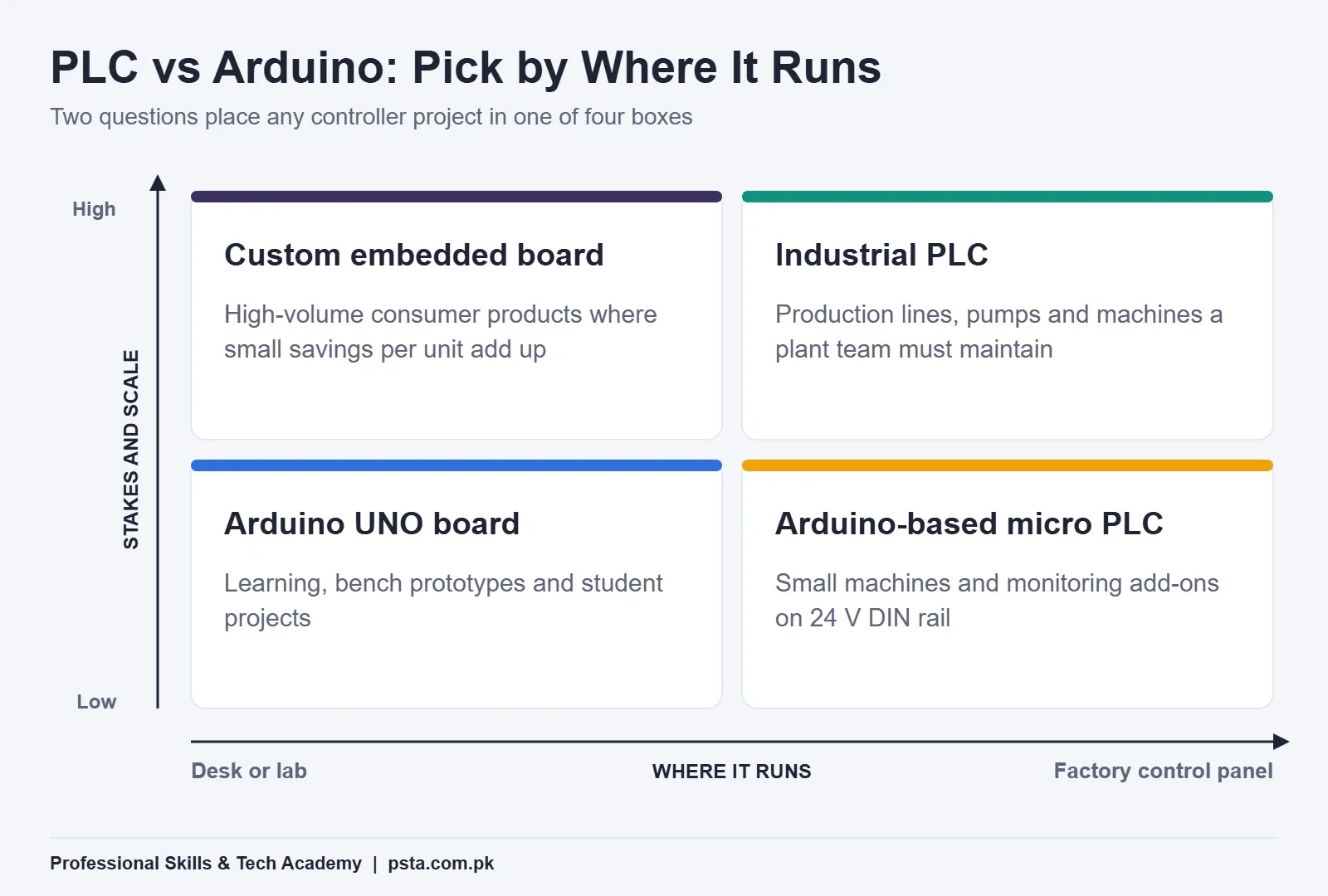
A 2019 guide from the engineering firm DMC lands in the same place: Arduino for learning, prototypes and low-power designs; PLCs for rugged industrial work; custom embedded boards for high-volume consumer products.
Why Do Factories in Pakistan Still Ask for PLC Skills?
Look at what employers actually write. A PLC Programmer / Automation Engineer ad posted on Rozee.pk on November 1, 2026 by a Karachi engineering firm asked for PLC programming and testing, HMI design, Modbus, Profibus and Ethernet/IP, plus commissioning support. It accepted a diploma in electronics, mechatronics or industrial electronics, wanted three to five years of hands-on experience, and its description stated pay of Rs. 60,000 to Rs. 80,000 a month. Arduino wasn't mentioned once.
That's one ad, not a salary survey, but the pattern is typical of industrial automation jobs. Textile mills, food plants, steel units and water schemes run on PLCs because a maintenance team can support them for many years. When an employer says "automation", they almost always mean PLC, HMI, VFD and panel wiring. Our industrial automation explainer shows how those pieces connect.
Arduino skills earn their place elsewhere: university projects, IoT prototypes, product startups, research labs and teaching. They're valuable, just in a different job market.
The Middle Ground: Arduino Opta and Other Arduino-Based PLCs
The PLC vs Arduino line has blurred in recent years. The Arduino Opta Lite is a DIN-rail micro PLC co-designed with Finder, a relay maker. It runs on 12 to 24 V DC, has 8 inputs that can read digital or 0 to 10 V analog signals, 4 relay outputs rated 250 V AC at 10 A, Ethernet with Modbus TCP, and cULus, ENEC and CE marks. Through the Arduino PLC IDE you can program it in Ladder, Function Block, Structured Text, Sequential Function Chart or Instruction List, or write ordinary Arduino sketches.
That makes it a fair bridge for someone who already knows Arduino and wants to learn PLC languages on real 24 V hardware. Keep expectations honest, though. When we checked, the store page showed an average of 2.9 out of 5 from seven buyer reviews, with complaints about USB-C connection problems, software crashes and missing I/O status lights. Large plants also standardize on one or two PLC brands for spares and support, so an Opta is more likely to show up on a small machine or a monitoring add-on than on a main production line.
Cost Compared: Board Price vs Total Project Cost
On price tags alone, PLC vs Arduino looks one-sided: $14 against $128.35 for the Opta Lite on Arduino's US store, and more again for a branded PLC with I/O modules. That comparison misleads, because the board is a small slice of any real job.
Add up what a working machine controller needs:
- A 24 V DC power supply and protection (MCB, fuses)
- Input interfaces for 24 V sensors and push buttons
- Relays or contactors for every load
- An enclosure, DIN rail, terminals and ferrules
- An operator display or HMI
- Your hours for wiring, coding, testing and documentation
- Someone's hours to fix it later
With a PLC, items 2 and 3 are partly built in, and items 6 and 7 shrink because the logic is readable by any trained technician. With a bare Arduino you design all of it. For a one-off student project, that's fine and educational. For a client's packaging machine, the hidden hours usually cost more than the PLC.
A Worked Example: One Conveyor, Two Controllers
This is a teaching example, not a real client job. A small bottling unit wants a conveyor that starts from a green button, stops from a red button or an emergency stop, and halts when a photo sensor sees a jammed bottle for more than three seconds.
On a PLC, this is a classic start/stop latch with a timer. Four or five rungs of ladder logic. The 24 V sensor wires straight into an input terminal. The output drives the motor contactor through the PLC's relay or transistor output, and the overload contact goes into the stop chain. A technician who has never met you can open the program and follow it.
On an Arduino, you need opto-isolated input modules for the 24 V sensor and buttons, a relay module for the contactor coil, debouncing code, a non-blocking timer using millis(), and a plan for what happens if the board resets mid-run. It works on the bench in an afternoon. Making it trustworthy on a dusty, noisy shop floor takes much longer.
Neither approach is wrong. The PLC version is simply the one a factory will accept, insure and maintain. If you want to see why the sensor type matters for that input, read our PNP vs NPN sensor guide first.
PLC vs Arduino: Which Should You Learn First?
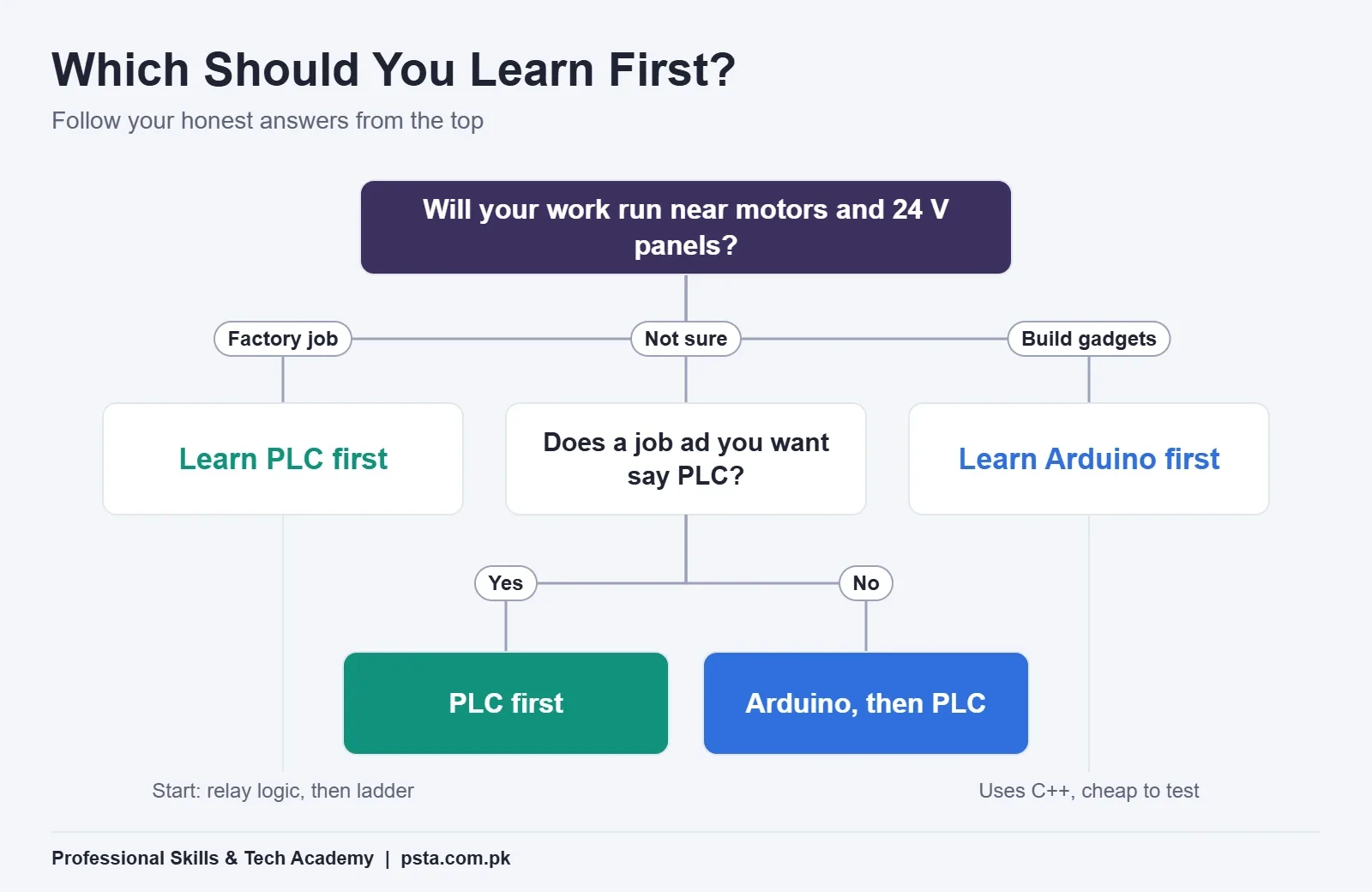
Go back to the self-test at the top and use this tree to turn your answers into a starting point.
A few common situations:
- DAE Electrical or Electronics student aiming for a mill or industrial estate job: PLC first. Arduino later, as a hobby.
- Working electrician who already wires DOL and star-delta starters: PLC. You already understand relay logic, and ladder logic is its direct descendant.
- BS Computer Science or Software Engineering student: Arduino first, since it uses the C++ you already study. Add PLC if you're drawn to industrial IoT.
- Matric or FSc student who just wants to build things: Arduino. It's cheap, and mistakes at 5 V are forgiving.
If you pick the PLC route, our guide to the five IEC 61131-3 PLC programming languages explains which one to learn after ladder.
Can Arduino Experience Help You Learn PLCs Faster?
Yes, partly. If you've built Arduino projects, you already think in inputs, outputs, states and timing. You understand why a sensor bounces and why a loop must never get stuck. Those habits transfer.
What doesn't transfer is the wiring discipline. Industrial work means reading IEC schematics, sizing protection, labeling wires, using ferrules, testing insulation and following lockout procedures. None of that comes up when you plug jumper wires into a breadboard. Plan for that gap rather than assuming code skills cover it.
The reverse is also true. A PLC technician who later learns Arduino often finds C++ syntax hard at first but understands the control problem instantly.
A Practical Learning Order for Factory Automation
If your goal is an automation job, build skills in the order a panel is actually built and commissioned. Each step uses the one below it.

- Read IEC schematics. Know the symbols for contactors, overloads, timers and sensors before touching a PLC.
- Wire hardwired starters. DOL, forward/reverse and star-delta circuits teach the latching logic that ladder copies.
- Write a start/stop latch in ladder. Use a simulator first, then real hardware.
- Add timers, counters and sensors. Most everyday machine logic is built from these three.
- Connect an HMI and learn Modbus basics. These are the skills named in the job ad above.
Keep an Arduino on your desk for weekend experiments if you enjoy it. It's a cheap way to practice logic, and it'll make you more useful when a plant wants a quick sensor logger or a test rig.
Where PSTA's Panel Wiring and PLC Course Fits
The industrial automation course at PSTA covers this ground in the same sequence. Classes last 12 weeks, no prior experience is assumed, and the listed fee on the course page is Rs. 28,000. The eight modules move from industrial electricity and safety, through control components, hardwired motor circuits, sensors, drives and soft starters, to PLC and HMI integration, fault finding and a final project.
You can join at the Abbottabad campus in Mandian, opposite FIMS College on Old College Road, or attend live online from anywhere in Pakistan, or mix both. A new batch opens every month. If you'd rather start from the coding side, the C++ course for beginners builds the language that Arduino sketches use. You can compare everything on the full course list, and when you're ready, the admission form takes a few minutes. Questions about batch timing can go to WhatsApp at +92 314 5424399.
Before You Buy Any Board, Wire One Relay Circuit
Here's one thing to do before spending money on either platform. Draw a start/stop latch on paper: a normally open start button, a normally closed stop button, a contactor coil and one auxiliary contact holding it in. Trace how the current flows when you press each button.
If that drawing makes sense to you and you want to see it on a real motor, the PLC path will feel natural. If you'd rather turn it into code and blink an LED first, buy an Arduino. Either way, you'll have answered the PLC vs Arduino question with your own hands instead of a forum thread.
Frequently asked questions
Is a PLC better than an Arduino?
Neither is better in general. A PLC is built for factory panels: 24 V inputs, relay or transistor outputs, DIN-rail mounting and ladder logic that technicians can maintain. An Arduino is a cheap development board for learning and prototypes. For a production machine, a PLC is the safer choice. For a student project or a gadget, an Arduino is quicker and far cheaper.
Can an Arduino replace a PLC in a factory?
It can run simple control logic, but it needs extra interface circuits for 24 V sensors, relays for every load, a proper enclosure and protection from electrical noise. Maintenance staff also need to read and fix the program. For those reasons most factories in Pakistan stick with PLCs, while Arduino-based micro PLCs such as the Opta suit small machines and add-ons.
Which is easier to learn, PLC or Arduino?
Many electricians find ladder logic easier because it looks like the relay circuits they already wire. Students who already know C++ often find Arduino easier because sketches use that language. Ease depends on your background. What matters more is the job you want, since factory work asks for PLC, HMI and panel wiring skills.
What is Arduino Opta?
Arduino Opta is a family of micro PLCs made with Finder. The Opta Lite runs on 12 to 24 V DC, has 8 inputs that read digital or 0 to 10 V signals, 4 relay outputs rated 250 V AC at 10 A, and Ethernet with Modbus TCP. It can be programmed with Arduino sketches or IEC 61131-3 languages such as ladder.
Do PLC jobs in Pakistan accept a diploma?
Many do. One Karachi PLC programmer ad on Rozee.pk in November 2026 accepted a diploma in electronics, mechatronics or industrial electronics, but also asked for three to five years of hands-on experience. Entry-level candidates usually start as panel wiring or maintenance technicians and build PLC experience on the job.
Which PLC programming language should I learn first?
Start with Ladder Diagram. It is the most common language on factory machines and maps directly to relay logic, so you can follow a program by tracing contacts and coils. After that, Function Block Diagram and Structured Text are useful, especially for analog control and calculations. All of them are defined in the IEC 61131-3 standard.
Does PSTA teach PLC programming?
Yes. The Industrial Automation: Panel Wiring, PLC and VFD course runs for 12 weeks at beginner level, with modules on safety, control components, motor circuits, sensors, drives, and PLC and HMI integration. You can attend at the Abbottabad campus, live online from anywhere in Pakistan, or mix both.
Sources & references
- Arduino UNO R4 Minima (Arduino Store) store-usa.arduino.cc
- Arduino Opta Lite (Arduino Store) store-usa.arduino.cc
- IEC 61131-3: Programming Languages (PLCopen) plcopen.org
- S7-1200 G2 Migration Guideline (Siemens) cache.industry.siemens.com
- PLC vs. Arduino for industrial control (Control Design) controldesign.com
- Automation with an Arduino, PLC, or Custom Embedded Controls? (DMC) dmcinfo.com
- PLC Programmer / Automation Engineer, Karachi (Rozee.pk) rozee.pk
Last reviewed & updated on by Umar Qureshi. Written by the PSTA team in Abbottabad, Pakistan.

Umar Qureshi

Master Industrial Automation: Single & Three-Phase Panel Wiring, PLC & VFD Certification
Turn this guide into a career: hands-on training with real projects, online across Pakistan or on-campus in Abbottabad · 3 Months (12 Weeks).



Comments
No comments yet — ask a question or share your experience.