Quick answer
Start with React if front-end work is new to you or you want freelance and startup roles, since 44.7% of 2025 survey respondents used it against 18.2% for Angular. Choose Angular first if your target employer uses it or you already write TypeScript, Java or C# comfortably.
Key takeaways
- • React is a UI library; Angular is a full framework with routing, forms and HTTP built in.
- • In the Stack Overflow 2025 survey, 44.7% of respondents used React and 18.2% used Angular.
- • React moved to the React Foundation in February 2026; React 19.3 arrived in September 2026.
- • Angular v22 shipped in June 2026, and majors now come every 12 months with about 24 months of support.
- • Check React and Angular listings on Pakistani job boards for your city before you commit.
- • Learn one tool to job-ready level first; the second takes a few weeks later.
Table of contents 16 sections
- React vs Angular at a Glance
- Library or Framework: Why Does It Matter?
- What This Means for a Beginner
- How Widely Are React and Angular Used?
- How Steep Is Each Learning Curve?
- The Same Small Component, Written Twice
- What Changed for Both Tools in 2026?
- React: New Owner, New Features
- Angular: Slower Majors, Longer Support
- Which Projects Suit Each One?
- React vs Angular for Jobs in Pakistan: Check Your Own Market
- When Is Angular the Better First Pick?
- Should You Learn Both?
- Mistakes That Waste Months
- Where PSTA's React and JavaScript Courses Fit
- Open Two Job Boards Before You Decide
Should you pick React vs Angular as your first front-end tool if you want a developer job in Pakistan? It's one of the questions CS students and fresh graduates ask most often once they finish JavaScript basics. The short version: React is the safer first choice for most learners because more developers and clients use it, while Angular rewards you when you're aiming at large company projects that value one fixed structure.
Neither choice is permanent. The core skills carry over, and plenty of working developers in Lahore, Islamabad and Karachi know both. What matters is picking the one that gets you to a first project, and a first job, sooner.
In this comparison you'll find:
- How the two tools differ in design, not just in syntax
- Current usage figures from the latest Stack Overflow survey
- What changed in 2026, including the React Foundation and Angular v22
- A simple way to check which skill employers in your own city want
- A week-by-week plan if you eventually want both
React vs Angular at a Glance
Any fair frontend framework comparison starts with the basics, so here's the side-by-side view. Read it once, then use the sections below to go deeper into the rows that matter for your situation.
| Point | React | Angular |
|---|---|---|
| What it is | A UI library for building components | A complete framework with routing, forms and HTTP built in |
| Who looks after it | The React Foundation, hosted by the Linux Foundation | A team at Google |
| Language | JavaScript or TypeScript, your choice | TypeScript by default |
| Latest release (Nov 2026) | React 19.3, September 2026 | Angular v22, June 2026 |
| Release rhythm | Minor releases through the year | One major release every 12 months from v22 |
| Usage in 2025 survey | 44.7% of respondents | 18.2% of respondents |
| Typical first project | Portfolio site, shop front, dashboard | Admin panel or form-heavy internal tool |
| Starting point | Next.js, React Router or Expo | Angular CLI |
Library or Framework: Why Does It Matter?
People often type "React or Angular which is better" into Google, but the honest answer depends on what each one is. React only handles the view layer. You write components, React updates the screen when data changes, and you choose the rest yourself: a router, a form library, a way to fetch data. The official React docs now recommend starting a new app with a framework such as Next.js, React Router or Expo, rather than wiring everything by hand.
Angular takes the opposite approach. The Angular overview lists components, signals, dependency injection, routing, forms, server-side rendering and a CLI as parts of one package. Two Angular projects from different companies usually look alike, which helps large teams.
What This Means for a Beginner
With React, you make more decisions early, and you'll see tutorials that solve the same problem in five ways. With Angular, the decisions are made for you, but there are more concepts to absorb before your first screen works. Decorators, services and dependency injection feel heavy if you've only written plain JavaScript.
How Widely Are React and Angular Used?
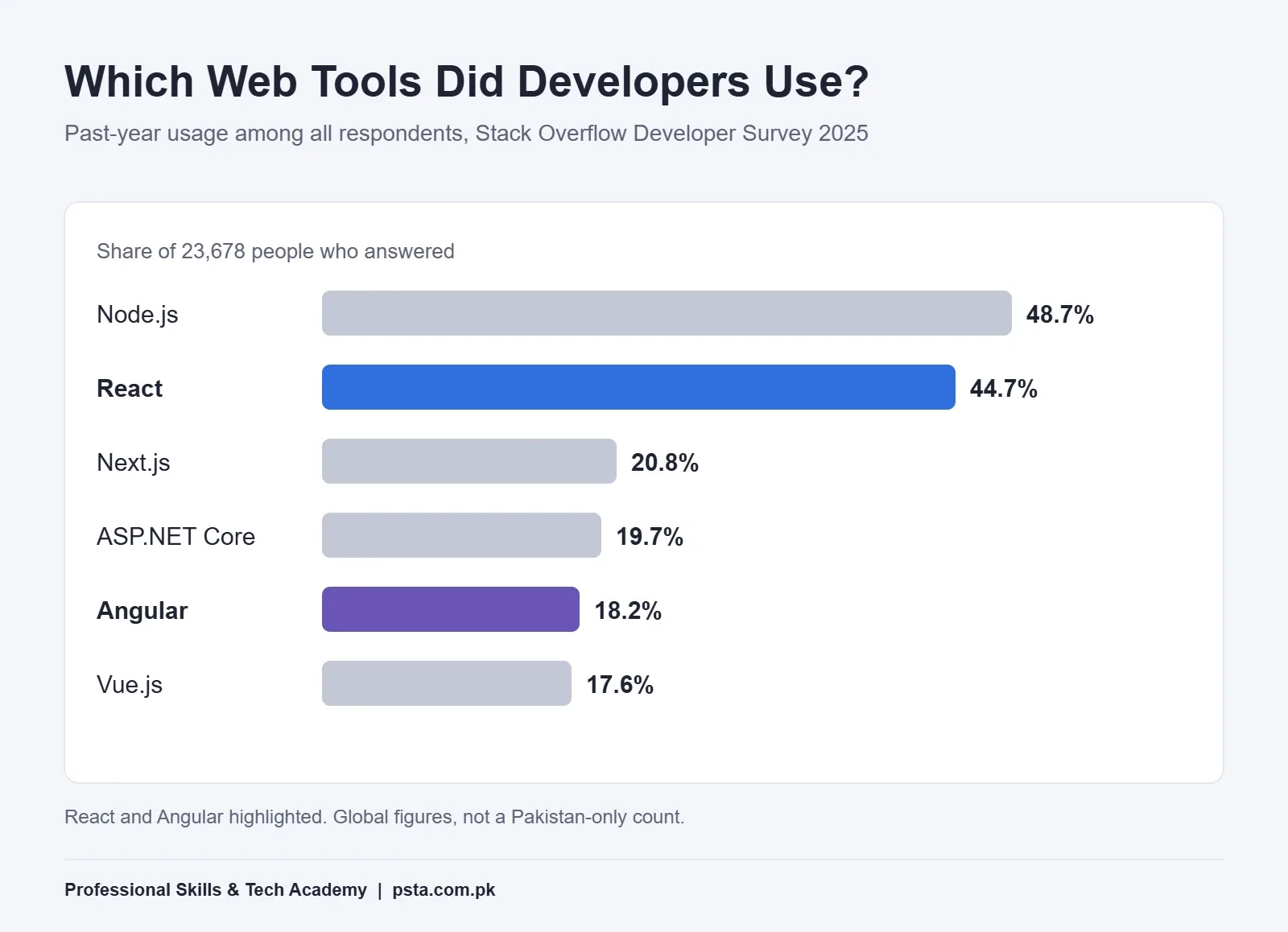
The Stack Overflow Developer Survey 2025 asked which web frameworks people had used in the past year. Among the 23,678 people who answered, 44.7% had used React and 18.2% had used Angular. Among professional developers only, the figures were 46.9% and 19.8%.
Two other numbers in the same table help explain React's lead. Next.js, which is built on React, came in at 20.8%, slightly ahead of Angular on its own. Vue.js stood at 17.6%.
Keep in mind this is a global survey, not a Pakistan-only count. It tells you React has the bigger community and more tutorials. It doesn't tell you which one your target company uses.
How Steep Is Each Learning Curve?
On the React vs Angular learning curve, the two tools feel very different in the first month. Most students who already know JavaScript can render a working React component on day one. A function that returns JSX is enough. The harder parts come later: state management, effects that run at the wrong time, and choosing libraries.
Angular front-loads the effort. Before a screen works, you meet TypeScript types, the CLI's generated files, components with decorators, and services. Once that clicks, adding a form or a route is predictable because there's one documented way to do it.
A practical rule: if you struggle with TypeScript, learn React first and add TypeScript inside React. If you already write TypeScript comfortably, Angular's start will feel much less steep. Our TypeScript vs JavaScript guide explains that step in detail.
The Same Small Component, Written Twice
Seeing a tiny example side by side shows the React vs Angular difference better than any definition. Here's a button that counts clicks.
In React, it's one function:
function Counter() {
  const [count, setCount] = useState(0);
  return <button onClick={() => setCount(count + 1)}>Clicked {count} times</button>;
}
In Angular, it's a class with a decorator, and the template lives inside it:
@Component({
  selector: 'app-counter',
  template: '<button (click)="count.set(count() + 1)">Clicked {{ count() }} times</button>'
})
export class Counter {
  count = signal(0);
}
Both are short. The difference is what surrounds them. The React function can sit in any file you like. The Angular class follows a set shape, and the CLI expects it in a set place. That pattern repeats across every feature you add, from forms to routing.
What Changed for Both Tools in 2026?
React: New Owner, New Features
On February 24, 2026, the React team announced that React now lives in the React Foundation, hosted by the Linux Foundation. React and React Native are no longer owned by Meta. The founding members include Amazon, Meta, Microsoft and Vercel, among others.
React 19.3 followed on September 9, 2026. It made View Transitions and Fragment Refs stable. Earlier, in October 2025, React Compiler 1.0 shipped with automatic memoization, so you write less manual performance code.
Angular: Slower Majors, Longer Support
Angular v22 was released on June 3, 2026. The v22 release page says Signal Forms, Asynchronous Signals and Angular Aria are now stable.
The bigger change is the calendar. According to the Angular release policy, majors now arrive every 12 months instead of every six, and each one is supported for about 24 months. For learners, that means fewer breaking upgrades to chase.
Which Projects Suit Each One?
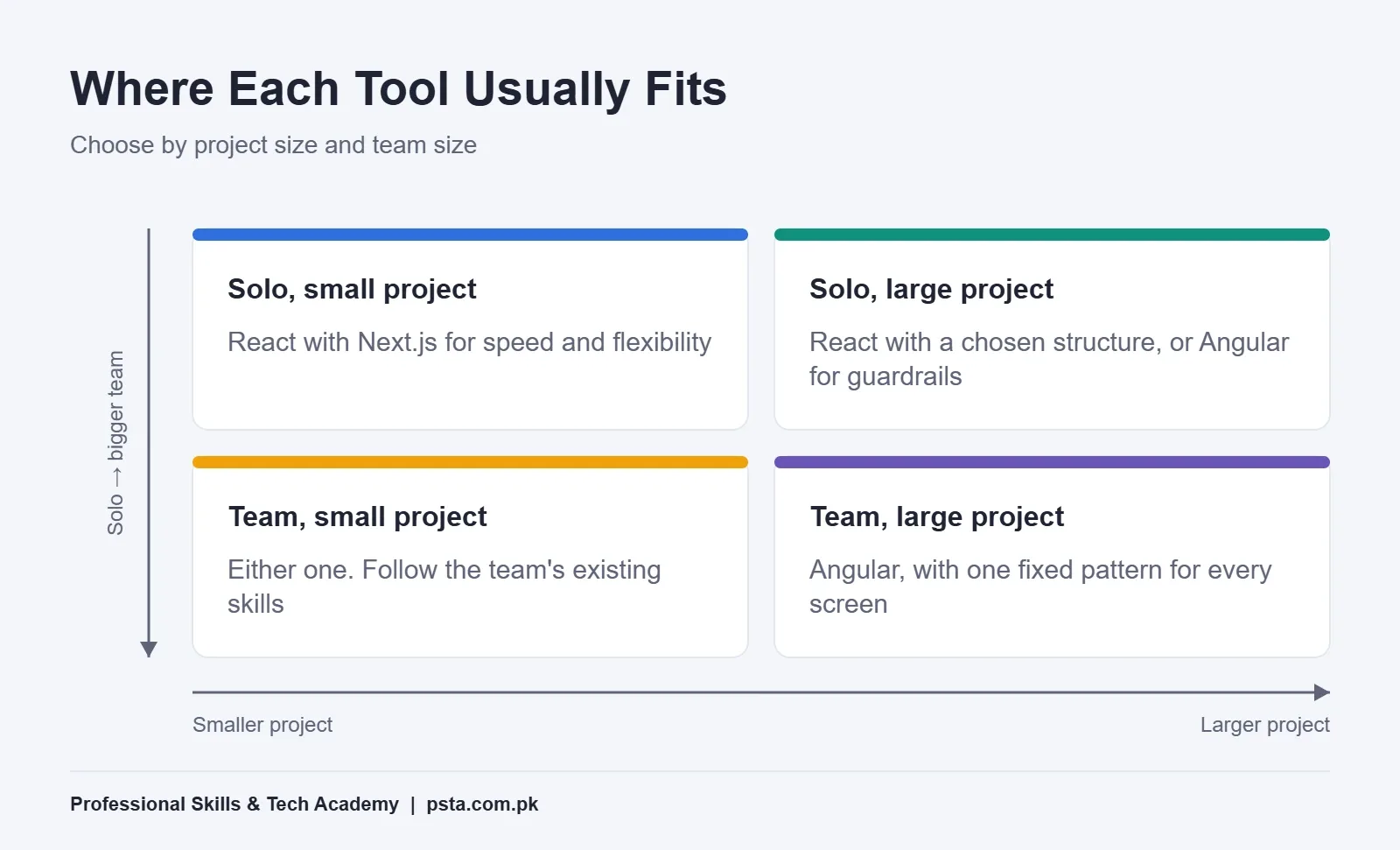
Project size and team size are the two things that decide this most often. A solo freelancer making a shop front for a Peshawar clothing brand needs speed and flexibility. A team of 15 building a loan-processing portal for a bank needs every screen built the same way.
- Small project, solo developer: React, usually through Next.js, fits best.
- Small project, team: either works; follow the team's existing skills.
- Large project, solo developer: React with a chosen structure, or Angular if you want guardrails.
- Large project, big team: Angular's fixed patterns shine here.
If you plan to build mobile apps later, React has one extra benefit. The React docs list Expo for native Android and iOS apps, so your component skills carry into React Native.
React vs Angular for Jobs in Pakistan: Check Your Own Market
Global survey numbers are a starting point. Your real answer sits in the job listings for the city or remote market you're targeting. You can check it in under an hour, and it tells you more about React developer jobs in Pakistan than any global ranking.
- Open Rozee.pk, LinkedIn Jobs and Indeed Pakistan in separate tabs.
- Search "React developer" and then "Angular developer" for your city, and note the number of results for each.
- Repeat the search with "remote" and with "Pakistan" as the location.
- Open ten listings for each and note the other skills named, such as Node.js, .NET, Java or TypeScript.
- Write down which back-end language appears next to each framework most often.
That last step matters more than the raw count. If the Angular listings in your notes keep naming Java or .NET, and the React ones keep naming Node.js, your back-end plans can settle the React vs Angular question for you. A student already strong in Java or C# from university may find Angular's style familiar.
Also check freelance demand if you plan to work online. Search both terms on Upwork and Fiverr and read what clients actually ask for in the first ten results. Note the budget ranges you see, but treat them as a snapshot, since they change week to week.
When Is Angular the Better First Pick?
If you've searched Angular vs React for beginners, most answers lean toward React, and that's fair for most people. Still, there are clear cases where Angular makes more sense:
- Your internship company or target employer already uses Angular.
- You're comfortable with TypeScript and object-oriented code from Java or C#.
- You want to build enterprise admin panels with many forms.
- You prefer one official way of doing things over choosing libraries.
If none of these apply, React will usually get you to a portfolio faster.
Should You Learn Both?
Eventually, maybe. At the start, no. Splitting your first months between two tools leaves you half-ready in both. Get job-ready in one, build two or three real projects, and then pick up the second in a few weeks when a job or client needs it.
A sensible order for a full-time learner looks like this: about four weeks of JavaScript fundamentals, two weeks of TypeScript, eight weeks of React with Next.js while you build two projects, then two weeks polishing your portfolio and applying. Angular comes afterwards, in roughly three to four weeks, when a job or client asks for it.
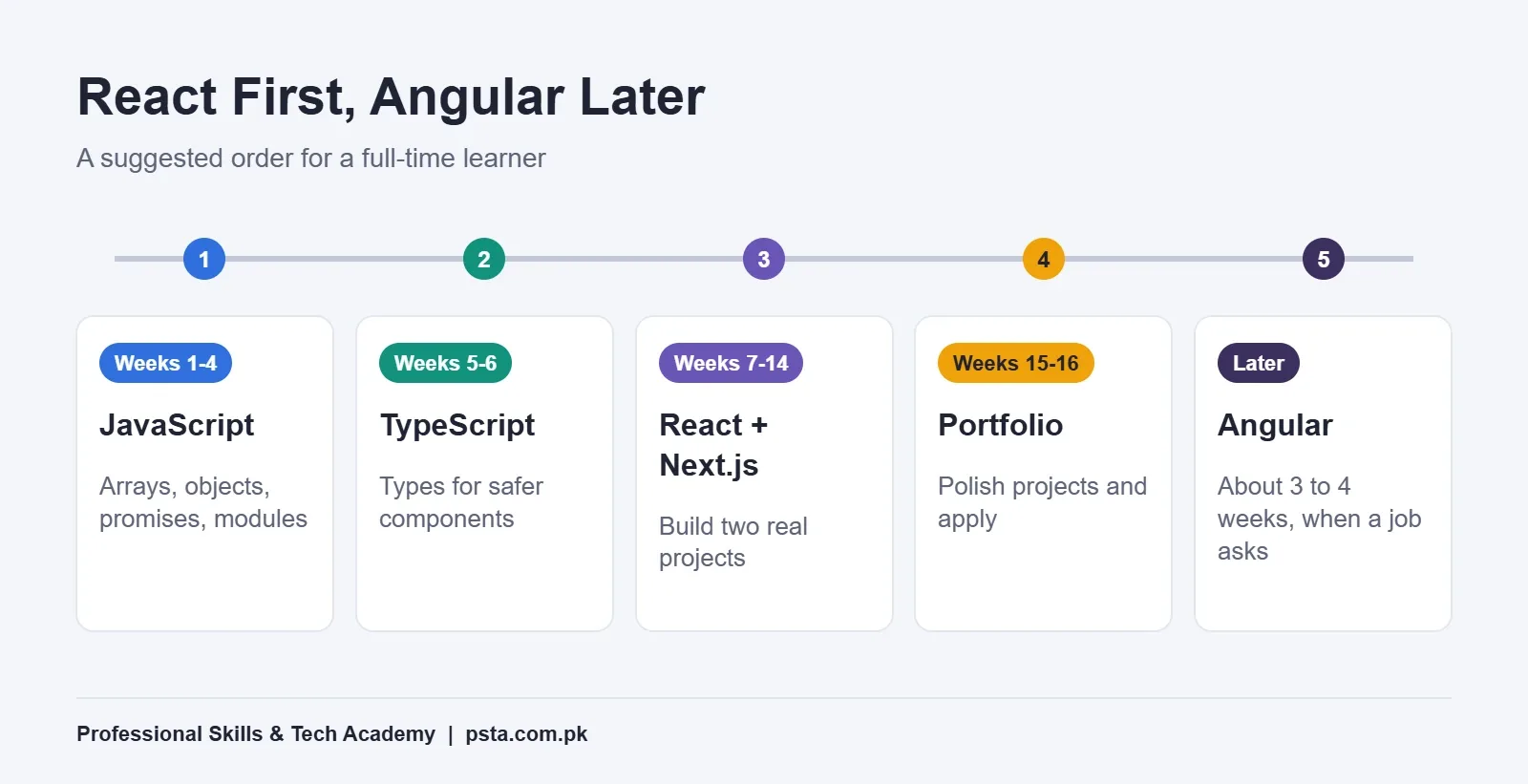
The timeline above is a guide, not a promise. Someone studying two hours a day will move slower than a full-time learner. For a fuller plan, read our front-end developer roadmap for Pakistan.
Mistakes That Waste Months
- Skipping JavaScript fundamentals. Both tools assume you understand arrays, objects, promises and modules.
- Switching after two weeks. Every tool feels hard at first. Give your choice at least two months.
- Copying tutorial projects only. Employers want to see an app you planned yourself.
- Ignoring the framework layer. For React, learn Next.js or React Router too, because the docs point new apps there.
Once you've chosen React, our React projects for beginners list gives you ideas that suit a Pakistani portfolio, and React vs Next.js explains the next decision.
Where PSTA's React and JavaScript Courses Fit
If you're starting from zero, begin with the JavaScript Programming Course, a 12-week course that runs from beginner level up to React. The current fee is Rs. 24,000.
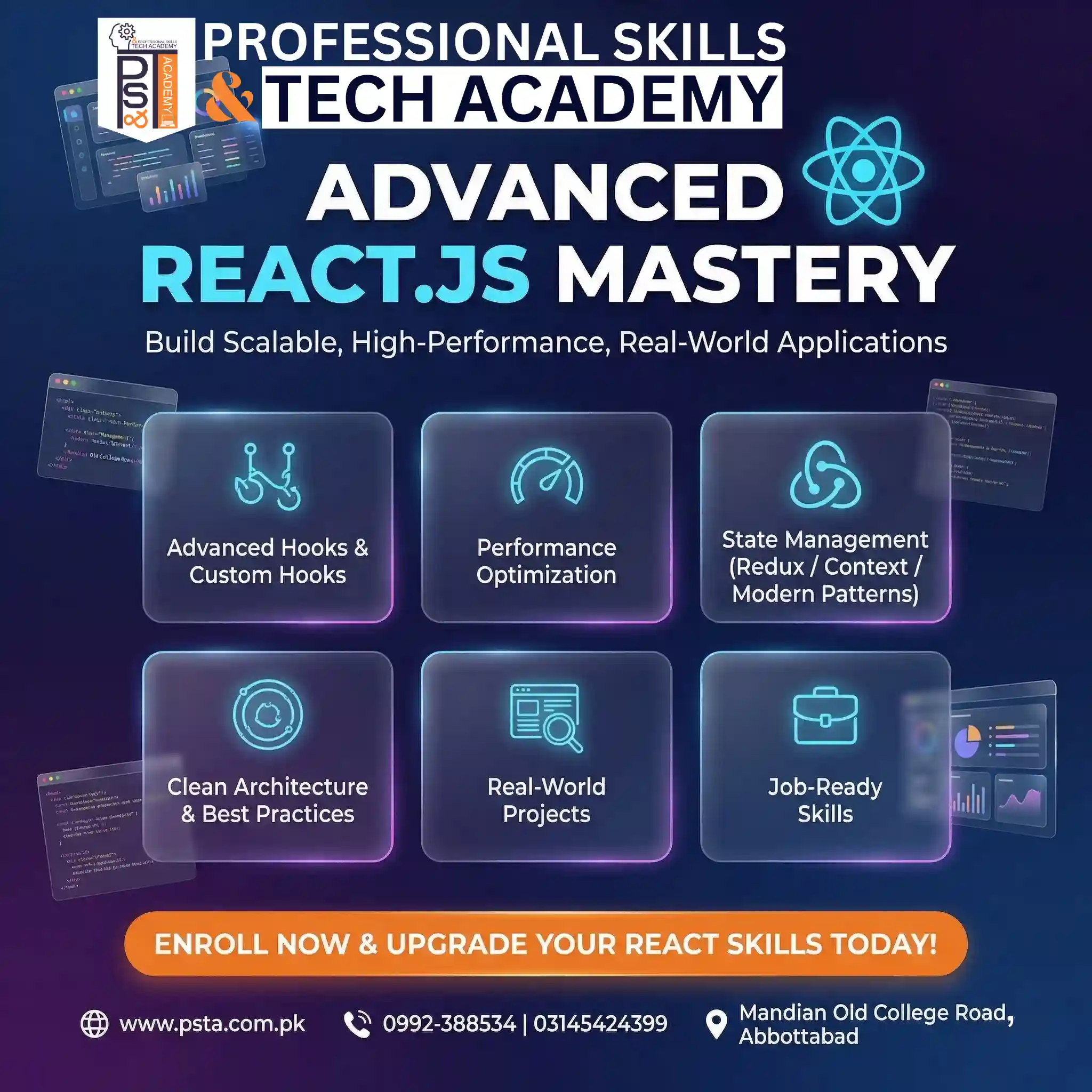
If you already know JavaScript, the Advanced React.js Mastery course is a 12-week, intermediate-level program at Rs. 30,000. Its modules cover hooks, Context API and Redux Toolkit, React Router, API work, performance, testing, authentication and a final e-commerce project. The course page also names developers moving from Angular or Vue as part of its audience.
Want the back end as well? The Full-Stack Web Development course covers the MERN stack over six months. Classes are offered on campus in Abbottabad, live online or hybrid. See every option on the courses page, or apply through the admission form.
Open Two Job Boards Before You Decide
You don't need to settle React vs Angular by reading more opinions. Do the five-step search above tonight for your city. If React shows up more often, or you can't tell, start with React. If your target companies clearly ask for Angular, choose Angular without second-guessing. Either way, commit for two months and build something real. Questions about which course fits you? Message PSTA on WhatsApp at +92 314 5424399.
Frequently asked questions
Is React easier than Angular for beginners?
For most beginners, yes. A React component is a JavaScript function, so you can show something on screen on the first day. Angular asks you to learn TypeScript, decorators, services and dependency injection before your first screen works. That early effort pays off later in big projects, but it slows down someone who has only just finished JavaScript basics.
Which pays more in Pakistan, React or Angular?
There is no reliable public dataset that compares React and Angular salaries in Pakistan, so be careful with any single figure you read online. Pay depends more on your projects, English communication, experience and the company than on the framework name. Compare real listings on Rozee.pk and LinkedIn for your city to see current ranges.
Can I learn Angular after React?
Yes, and it is usually quicker than learning it first. Components, props-style inputs, routing, forms and API calls are ideas both tools share. Once you are comfortable with React and TypeScript, expect roughly three to four weeks of focused practice to become productive in Angular, mostly spent on its CLI, services and dependency injection.
Do I need TypeScript for React?
No, React works with plain JavaScript. Most companies now use TypeScript in React projects, though, so it is worth adding after you understand components and state. Angular is different: projects are written in TypeScript by default, so you need at least the basics of types, interfaces and classes before you start.
Is Angular dying in 2026?
No. Angular v22 shipped in June 2026 with Signal Forms and Angular Aria marked stable, and Google publishes a release schedule that runs into 2027. Its usage share is lower than React in the 2025 Stack Overflow survey, but it remains a common choice for large company applications, especially where teams want one fixed structure.
Does PSTA teach Angular?
PSTA does not currently list a separate Angular course. The Advanced React.js Mastery course is 12 weeks at Rs. 30,000, and the JavaScript Programming Course takes beginners up to React. Both are offered on campus in Abbottabad, live online or hybrid. Developers coming from Angular are welcome in the React course.
Sources & references
- Stack Overflow Developer Survey 2025: Technology survey.stackoverflow.co
- React Docs: Creating a React App react.dev
- React Blog: The React Foundation react.dev
- React Blog: React 19.3 react.dev
- Angular: Overview angular.dev
- Angular: v22 Release angular.dev
- Angular: Versioning and Releases angular.dev
Last reviewed & updated on by Umar Qureshi. Written by the PSTA team in Abbottabad, Pakistan.

Umar Qureshi
Advanced React.js Mastery: Build Scalable Real-World Applications
Turn this guide into a career: hands-on training with real projects, online across Pakistan or on-campus in Abbottabad · 12 Weeks.

Comments
No comments yet — ask a question or share your experience.