
Quick answer
To write a resignation letter, check the notice period in your contract, tell your manager in person, then hand in a short letter with the date, a subject line, your decision, your exact last working day, a brief thank-you and a handover offer. Sign it, keep a copy, and ask HR about final settlement.
Key takeaways
- • Check your appointment letter for the notice period before you write.
- • Tell your manager in person first, then confirm in writing.
- • State your decision in the first sentence and give an exact last working day.
- • Keep complaints out of the letter; reasons are optional.
- • Keep a signed or stamped copy, or the email thread.
- • Ask HR in writing about final settlement and your experience letter.
Table of contents 12 sections
- What Is a Resignation Letter, and Why Does It Still Matter?
- Before You Write: Check Your Notice Period
- How to Write a Resignation Letter in 7 Steps
- The Standard Resignation Letter Format
- Sample 1: A Standard Resignation Letter Sample
- Sample 2: Asking for an Early Release
- Sample 3: A Short Resignation Email
- Should You Explain Why You Are Leaving?
- Mistakes That Can Delay Your Final Settlement
- What Happens After You Hand In the Letter?
- Writing Office English With Confidence at PSTA
- Draft Yours Before You Talk to Your Manager
Here is a realistic example. Sana has worked at a Rawalpindi software house for 14 months, and she has just accepted an offer from a company in Islamabad. The new office wants her to join in four weeks. Tonight she needs to write a resignation letter that leaves on good terms, gives the right notice, and does not create trouble with her final salary or experience letter. If you are in a similar spot, this guide shows you how to write one in seven steps, with three samples you can adapt. It comes from the career team at PSTA (Professional Skills & Tech Academy), where business English and office documents are part of everyday teaching.
By the end of this guide, you will know:
- What to check in your appointment letter before you write anything
- The standard resignation letter format, line by line
- How the notice period in Pakistan usually works, in plain language
- Three ready-to-edit samples, including a resignation email
- What to do between handing in the letter and your last day
What Is a Resignation Letter, and Why Does It Still Matter?
A resignation letter is a short, formal note telling your employer that you are leaving, from which date, and when your last working day will be. It turns a conversation into a written record. That record protects you if there is ever a question about your notice, your dues or your leaving date.
In many Pakistani offices, HR also uses the letter to start the clearance process: returning equipment, settling advances and preparing your experience letter. A clear, polite letter makes all of that faster. A vague or angry one can slow it down for weeks.
Keep in mind that the letter is not the place to argue, complain or negotiate. Its job is to confirm a decision you have already made.
Before You Write: Check Your Notice Period
Open your appointment letter or contract first. Most employers in Pakistan state a notice period there, often one month for permanent staff, and some ask for more for senior roles. Your company handbook may add rules about leave during notice or who must approve an early release.
The law sets a baseline for many workers. WageIndicator's summary of employment termination in Pakistan explains that under Standing Order 12 of the 1968 Standing Orders Ordinance, either party may end the contract with one month's notice, or one month's wages in place of notice. The same page says this applies to permanent workers, while temporary workers and probationers are not required to serve notice before leaving.
WageIndicator's notice and severance page adds that Khyber Pakhtunkhwa and Sindh have their own standing orders laws with similar provisions. A Dawn column on termination limits notes one regional difference for employers: three months' notice applies in Balochistan.
This is general information, not legal advice. If your contract and the law seem to disagree, or your employer refuses to release you, speak to HR in writing or get advice from a labour lawyer.
How to Write a Resignation Letter in 7 Steps
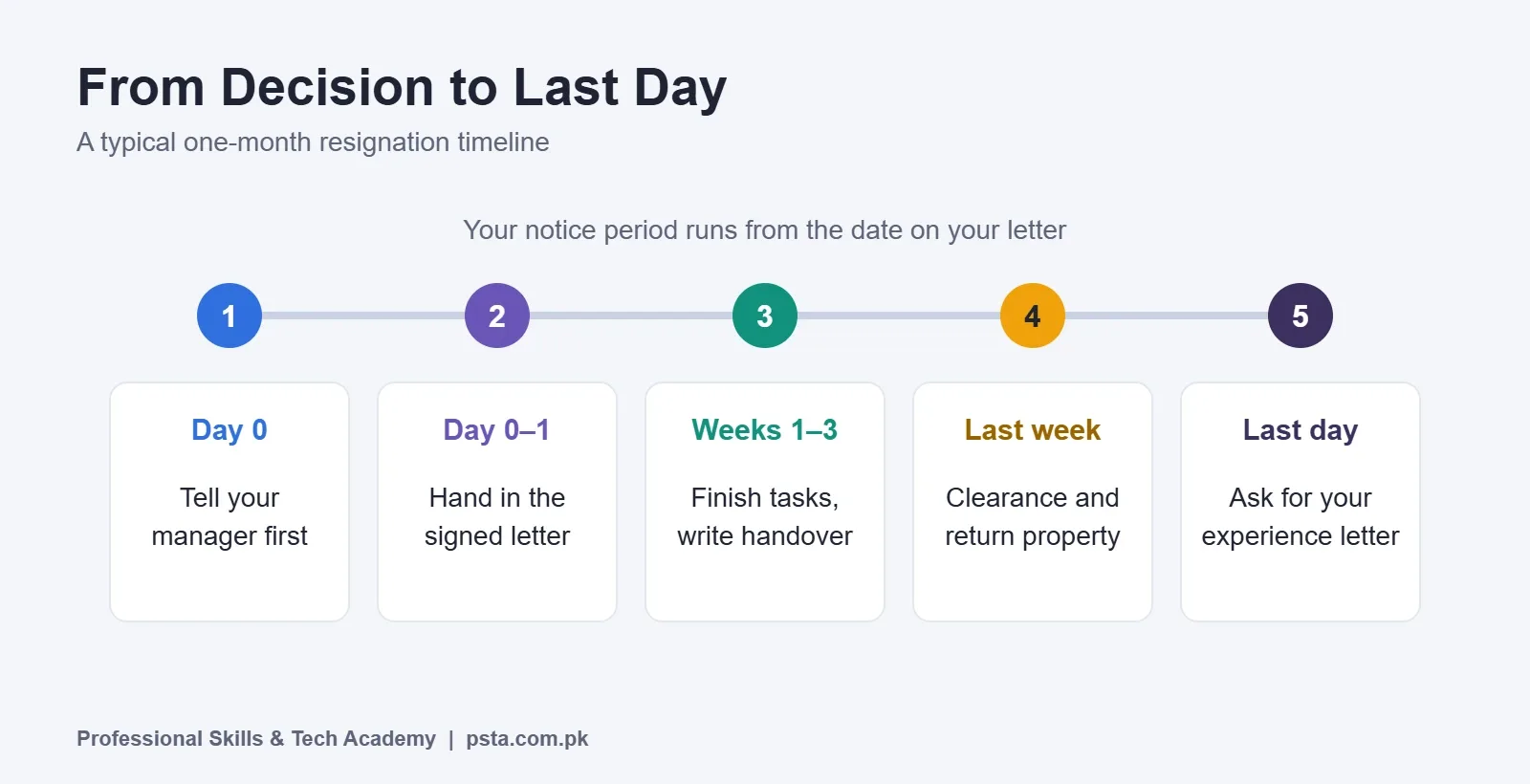
Once you know your notice period, the letter itself takes about 15 minutes. Follow these steps in order.
- Tell your manager in person first. Michael Page's resignation guidance advises speaking to your manager before telling colleagues, in a proper meeting or video call rather than over WhatsApp. The letter then confirms what you have already said.
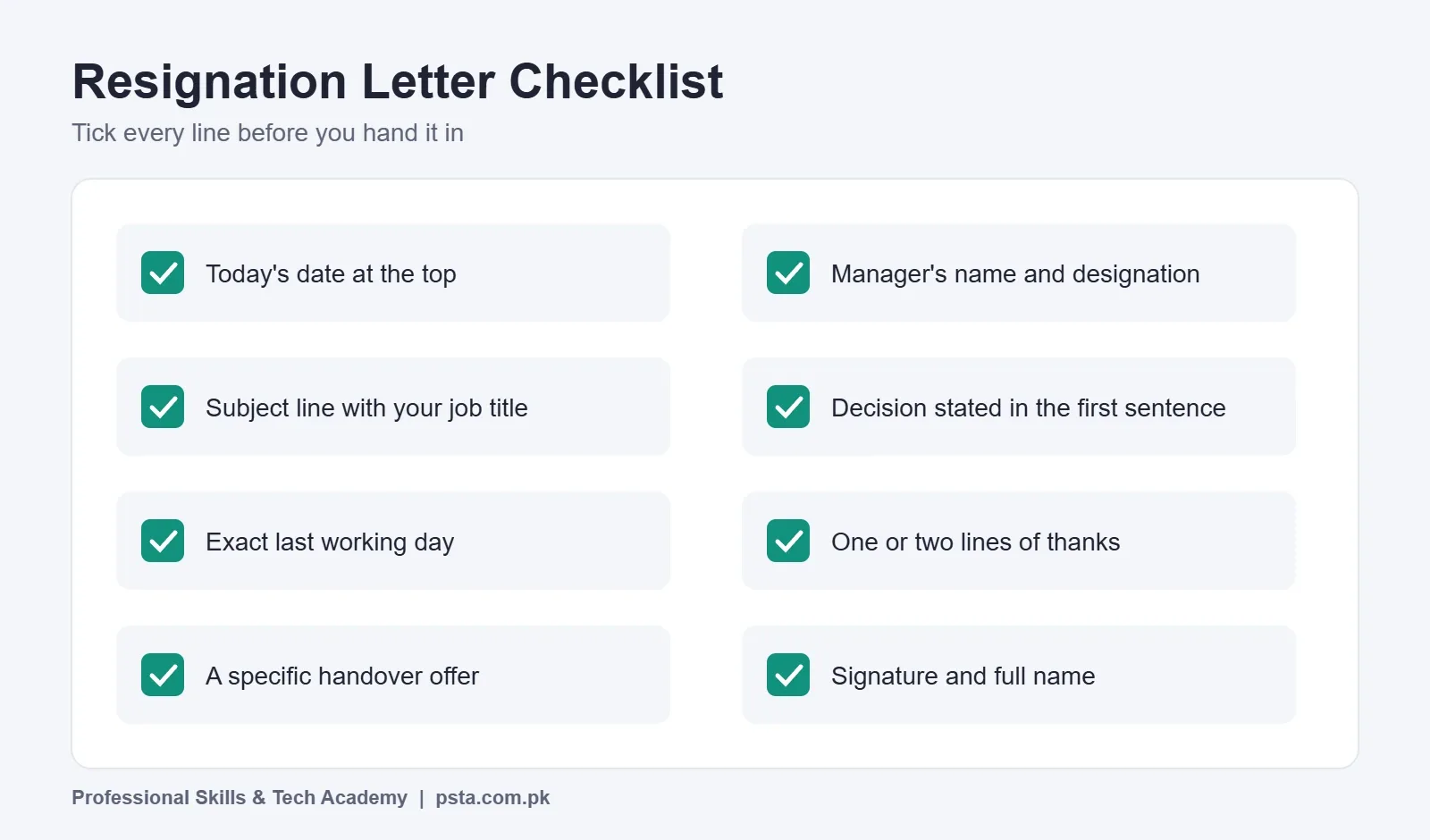
- Write the date and address it correctly. Put today's date at the top, then your manager's name and designation, the department and the company name.
- Use a clear subject line. "Subject: Resignation from the Position of Junior Accountant" tells HR exactly what the letter is.
- State your decision in the first sentence. Name your role and say you are resigning. Do not bury it in the second paragraph.
- Give your last working day. Count your notice period from the date of the letter and write the exact date. Robert Half's resignation letter checklist lists the contracted notice period and your final day as standard parts of the letter.
- Thank them and offer a handover. One or two sincere lines about what you learned, plus an offer to train a replacement or document your work.
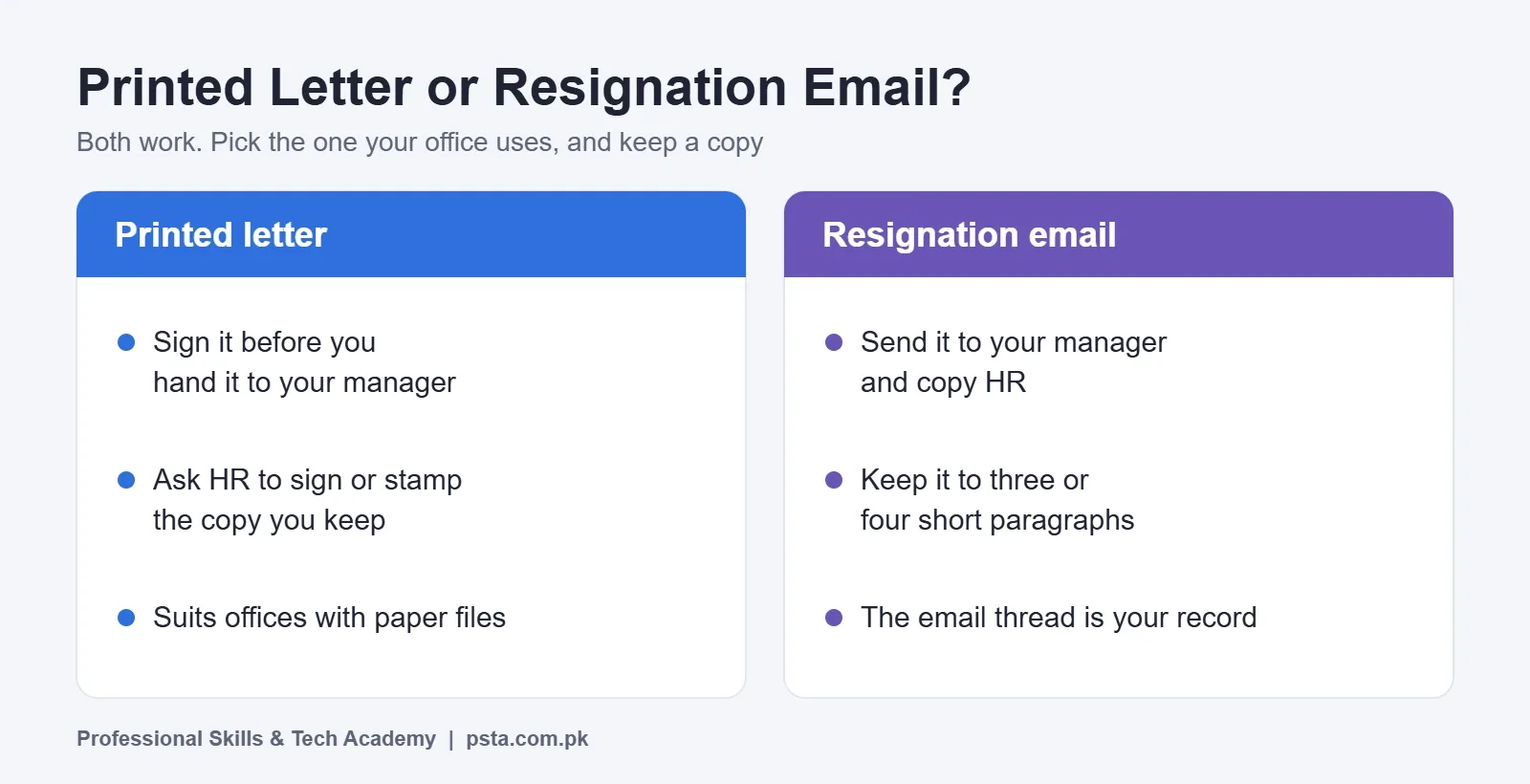
- Sign it and keep a copy. Sign a printed copy, or type your full name under an email. Ask HR to receive it with a signature or stamp, or keep the email thread.
The Standard Resignation Letter Format
Every good resignation letter format has the same parts. The table shows what goes where, with a short example of each line.
| Part | What to Write | Example |
|---|---|---|
| Date | The day you hand it in | 21 November 2026 |
| Recipient | Manager's name, designation, company | Mr. Imran Khan, Finance Manager, XYZ Traders |
| Subject | Resignation plus your job title | Resignation from the Position of Sales Officer |
| Opening line | Your decision, in one sentence | Please accept this letter as my formal resignation. |
| Last working day | An exact date, matching your notice | My last working day will be 20 December 2026. |
| Thanks | One or two genuine lines | I am grateful for the training in client reporting. |
| Handover | A specific offer of help | I will prepare handover notes for my accounts. |
| Closing | Polite sign-off and full name | Sincerely, Ayesha Malik |
Keep the whole letter under one page. Michael Page suggests three or four paragraphs for an email version, and the same length works on paper.
Sample 1: A Standard Resignation Letter Sample
Use this resignation letter sample when you are giving your full notice. Replace the bracketed parts.
[Date]
[Manager's Name]
[Designation]
[Company Name]Subject: Resignation from the Position of [Your Job Title]
Dear [Manager's Name],
Please accept this letter as my formal resignation from the position of [Job Title]. As per my contract, I am serving one month's notice, so my last working day will be [Date].
Thank you for the support and guidance I have received during my time here. Working on [a project or responsibility] taught me a great deal, and I value the experience.
Over the coming weeks I will complete my pending tasks and prepare handover notes. I am happy to help train whoever takes over my work.
Sincerely,
[Your Full Name]
[Employee ID, if any]
Sample 2: Asking for an Early Release
Sometimes a new employer wants you sooner than your notice allows. You can ask, but the decision is your employer's. Keep the tone respectful and offer something in return.
Dear [Manager's Name],
Please accept this letter as my resignation from the position of [Job Title]. My contract requires one month's notice, which would make [Date] my last working day.
I would like to request an early release on [Earlier Date], if the team's work allows it. I understand this depends on your approval. If it is possible, I can adjust the remaining days against my leave balance, or as the company policy allows.
Whatever you decide, I will finish my current tasks and hand them over properly before I leave.
Thank you for your understanding.
[Your Full Name]
Never just stop coming to work. Leaving without serving or settling your notice can mean deductions from your final pay, and it can damage the reference you need later.
Sample 3: A Short Resignation Email
Many companies now accept a resignation email, especially for remote roles and small offices. Send it to your manager and copy HR.
Subject: Resignation – [Your Name], [Job Title]
Dear [Manager's Name],
Following our conversation today, I am writing to confirm my resignation from my role as [Job Title]. My last working day will be [Date], in line with my notice period.
Thank you for the opportunities over the past [period]. I will share a handover document by [Date] and stay available for any questions until I leave.
Best regards,
[Full Name]
[Phone Number]
For help with formal email tone, the subject lines and sign-offs in our job application email walkthrough carry over well to resignations.
Should You Explain Why You Are Leaving?
No, you do not have to explain why you are resigning. Michael Page's guidance says reasons are optional, and if you share one, keep it short and professional. "I have accepted a role that matches my long-term goals" is enough.
Robert Half suggests a tactful reason, such as a new job, a move or personal reasons. What both firms agree on is what to leave out. If you are leaving because of problems at work, do not put complaints in the letter. Your letter may sit in your personnel file for years, and future reference checks can lead back to it.
If the company holds an exit interview, that is a better place for honest feedback. Even then, be specific and calm rather than personal.
Mistakes That Can Delay Your Final Settlement
These errors cause most of the trouble after a resignation:
- No last working day. Without a date, HR has to guess, and your notice may be counted from a later point.
- Resigning over WhatsApp only. A chat message is easy to dispute. Follow it with a proper letter or email.
- Taking all your leave during notice without approval. Check the policy first.
- Not returning company property. Laptops, SIM cards, ID cards and files usually have to be cleared before final dues.
- Posting about it on social media first. Your manager should hear it from you, not from LinkedIn.
- Forgetting to ask for documents. Request your experience letter and salary details for your records before your last day.
What Happens After You Hand In the Letter?
After you hand in the letter, your notice period runs. Use it well. Finish what you can, write simple handover notes, and introduce your replacement to clients or colleagues they will work with.
In the last week, complete the clearance form if your company uses one. Ask HR when your final settlement will be paid and what it will include, such as your last salary and any unused leave the policy covers. WageIndicator describes severance of 30 days' wages for each completed year of service when employment ends for reasons other than misconduct, but it does not spell out how this applies when a worker resigns, so confirm your entitlements with HR in writing.
Finally, ask for an experience letter that states your designation and dates of service. Your next employer, or a visa office later, may ask for it. Then update your CV and LinkedIn profile with the new role once you have joined.
Writing Office English With Confidence at PSTA
A resignation letter is one of many formal documents you will write in your career, along with applications, emails and meeting notes. PSTA's English Spoken and Grammar Course is a 12-week, beginner-level program whose course page lists writing basic emails, messages and job-related documents, and understanding formal versus informal English, among its outcomes. The listed fee is Rs. 12,000.
If you also need to format letters and reports neatly in Microsoft Word, the 12-week Office Automation course covers letters, applications and CVs in Word, plus Excel and PowerPoint. Both run on campus in Abbottabad, live online across Pakistan, or as a hybrid. You can see all programs on the course list at psta.com.pk.
Draft Yours Before You Talk to Your Manager
Pick the sample that matches your situation, fill in your dates, and read it aloud once to check the tone. Then book a short meeting with your manager, tell them first, and hand over the signed letter or send the email the same day. If you want structured practice in professional writing and speaking, you can apply for admission or ask the PSTA team a question on WhatsApp at +92 314 5424399.
Frequently asked questions
How many days' notice should I give when I resign in Pakistan?
Check your appointment letter first, because most contracts set the notice period. For many permanent workers, the Standing Orders allow either side to end employment with one month's notice or one month's wages instead. Probationers and temporary workers are generally not required to serve notice. Senior roles often have longer notice in the contract.
Can I resign by email instead of a printed letter?
Yes, many employers accept a resignation email, especially software houses and remote teams. Send it to your manager, copy HR, and use a clear subject line with your name and job title. Keep the sent email and any reply as your record. If your company requires a signed letter, provide one as well.
Do I have to give a reason in my resignation letter?
No. A reason is optional. If you give one, keep it to a short, neutral line such as a new opportunity, further studies or relocation. Leave complaints out of the letter, because it stays in your file. You can share honest feedback in an exit interview if one is offered.
Can my employer refuse to accept my resignation?
An employer can ask you to complete your notice period or follow the process in your contract, but you are generally free to leave once you have served or settled your notice. If you face a dispute, keep everything in writing and speak to HR. For serious problems, get advice from a labour lawyer.
What should I do if I need to leave before my notice ends?
Ask for an early release in writing and explain the date you need. Offer to finish key tasks, prepare handover notes, or adjust remaining days against leave if the policy allows. The decision is your employer's. Leaving without approval can lead to deductions from your final pay and a weaker reference.
When should I ask for my experience letter?
Ask during your last week, once your clearance is moving. Request a letter that states your designation and your dates of service. Many new employers ask for it during onboarding, and it can also help later with visa or further-study applications. Keep both a scanned copy and the original.
Should I tell my colleagues before my manager?
No. Tell your manager first, ideally in a short meeting or video call, and then hand in the letter. Colleagues and clients can hear the news afterward in the way your manager prefers. Hearing it secondhand can damage the relationship and make your notice period harder.
Sources & references
- WageIndicator: Employment termination in Pakistan wageindicator.org
- WageIndicator: Notice and severance in Pakistan wageindicator.org
- Dawn: Termination limits dawn.com
- Robert Half: How to write a resignation letter roberthalf.com
- Michael Page: Resignation letter templates and tips michaelpage.ae
Last reviewed & updated on by Umar Qureshi. Written by the PSTA team in Abbottabad, Pakistan.

Umar Qureshi

English Spoken & Grammar Course in Pakistan – Build Confidence, Speak Fluently (Online & Campus)
Turn this guide into a career: hands-on training with real projects, online across Pakistan or on-campus in Abbottabad · 12 Weeks.


Comments
No comments yet — ask a question or share your experience.