Quick answer
Yes, you still need to file. The 0.25% your bank deducts on PSEB-registered IT export receipts counts as final tax only when you file your return. Filing on time also keeps you on the Active Taxpayers List; late filers who want back on it now pay a Rs. 25,000 surcharge.
Key takeaways
- • The 0.25% rate for PSEB-registered IT exporters now runs to Tax Year 2029; unregistered exporters pay 1%.
- • Final-tax treatment under section 154A depends on filing your income tax return.
- • Gather a tax deduction certificate from every bank that received foreign payments.
- • Declare export receipts under final tax, local income separately, and balance your wealth statement.
- • Late filers were dropped from the 2026 ATL; rejoining costs individuals Rs. 25,000 under section 182A.
- • PSEB renewal needs last year's return, so file first and renew second.
Table of contents 22 sections
- Why Do Freelancers Need a Tax Return if the Bank Already Deducted Tax?
- What Did the 2026-27 Budget Change for Freelancers?
- Part 1: Paperwork to Gather Before You File (Checks 1 to 4)
- Check 1: Your NTN and IRIS Login Work
- Check 2: A Tax Deduction Certificate for Every Bank Account
- Check 3: Your Platform Earnings Summary
- Check 4: Your PSEB Certificate, if You Have One
- Part 2: Filing the Return Itself (Checks 5 to 8)
- Check 5: Declare Export Receipts Under Final Tax
- Check 6: Declare Local Income Separately
- Check 7: Complete the Wealth Statement
- Check 8: Save the Acknowledgement and a PDF Copy
- Part 3: Staying on the Active Taxpayers List (Checks 9 to 12)
- Check 9: Confirm Your ATL Status Online
- Check 10: Put the Deadline in Your Calendar for Next Year
- Check 11: Renew PSEB Before It Expires
- Check 12: Keep a Simple Income Log All Year
- Missed the 31 October Deadline? What Late Filers Can Do Now
- Freelancer, Content Creator or Local Contractor: Which Rule Applies?
- Tax Return for Freelancers: Six Common Mistakes
- The Skills Side: What PSTA Teaches Freelancers
- Put Every Bank Certificate in One Folder Tonight
Students who start earning on Upwork or Fiverr often ask the same thing in class: if the bank already cuts tax from every foreign payment, do I still need to file a tax return? Yes. A tax return for freelancers in Pakistan is what turns that small bank deduction into your final tax, and it is also what keeps your name on the Active Taxpayers List (ATL).
The question matters more this month than usual. The deadline for Tax Year 2026 closed on 31 October 2026, and late filers have already been dropped from the ATL. This checklist covers the full cycle, whether you filed on time, filed late or haven't filed at all.
Work through this checklist and you will know:
- Why the 0.25% bank deduction doesn't replace your annual return
- What the 2026-27 budget kept, and what it changed, for freelancers
- The 12 checks to complete before, during and after you file
- What late filers can do now that the 31 October deadline has passed
- Which rule applies if you also earn from YouTube or local clients
A note before you start: I teach freelancing and digital skills, not tax law. Read this as general information and check details about your own income with a registered tax practitioner.
Why Do Freelancers Need a Tax Return if the Bank Already Deducted Tax?
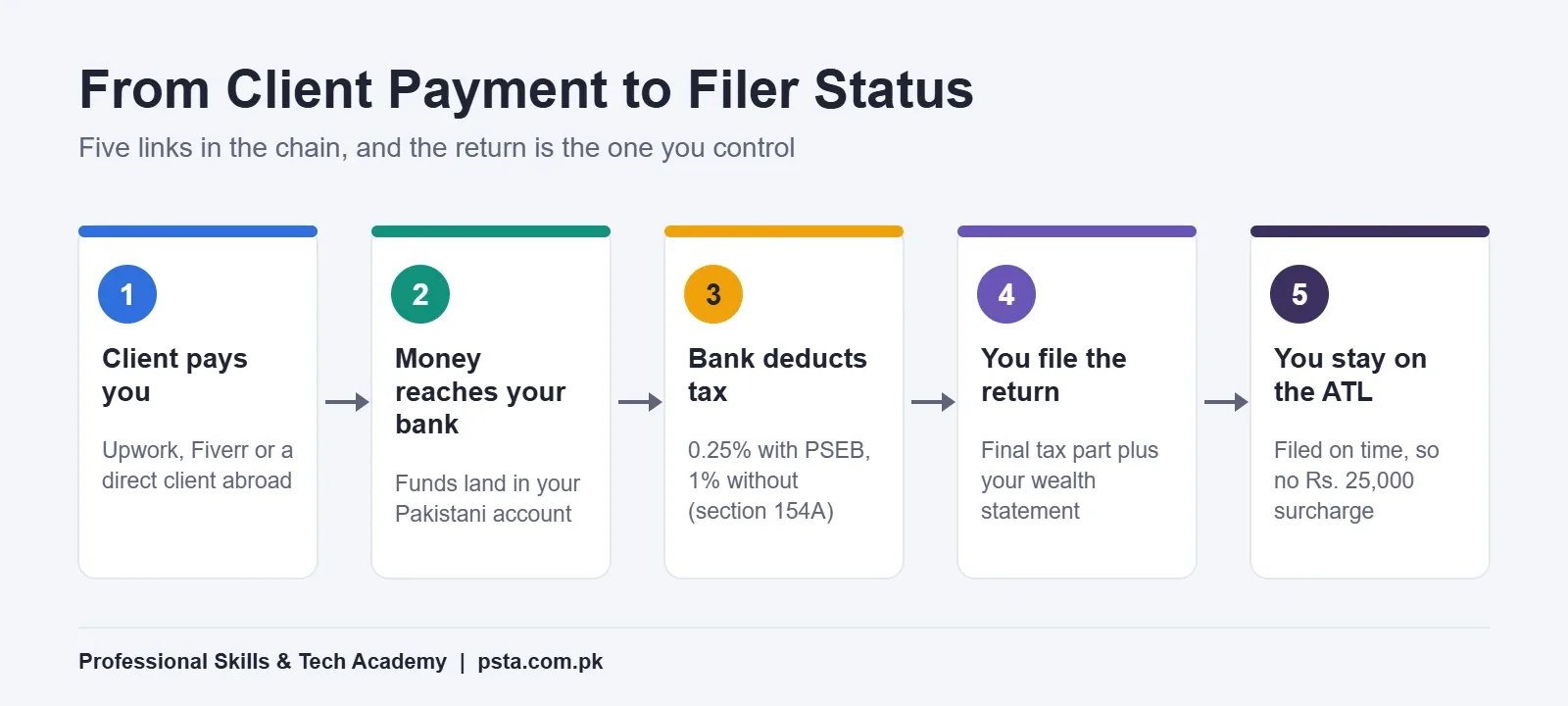
Section 154A of the Income Tax Ordinance requires your bank to deduct tax when foreign payment for exported services reaches your account. For IT and IT-enabled services, the FBR treats this deduction as a final tax, so in most cases you owe nothing more on that income.
The catch is that the final-tax treatment comes with conditions. According to the HS Advocate guide to section 154A, one of those conditions is that you file your income tax return. Skip the return, and the deduction loses its protection. You also fall off the ATL, which raises the tax you pay on many other everyday transactions.
Think of the bank deduction as paying the bill and the tax return for freelancers as getting the receipt. You need both.
What Did the 2026-27 Budget Change for Freelancers?
The headline news was good. Business Recorder reported on 12 June 2026 that the 0.25% regime for IT exporters and freelancers would continue, with a three-year extension to 2029. KPMG's brief of the Finance Act 2026 confirms the reduced rate applies to PSEB-registered exporters from Tax Year 2026 to Tax Year 2029.
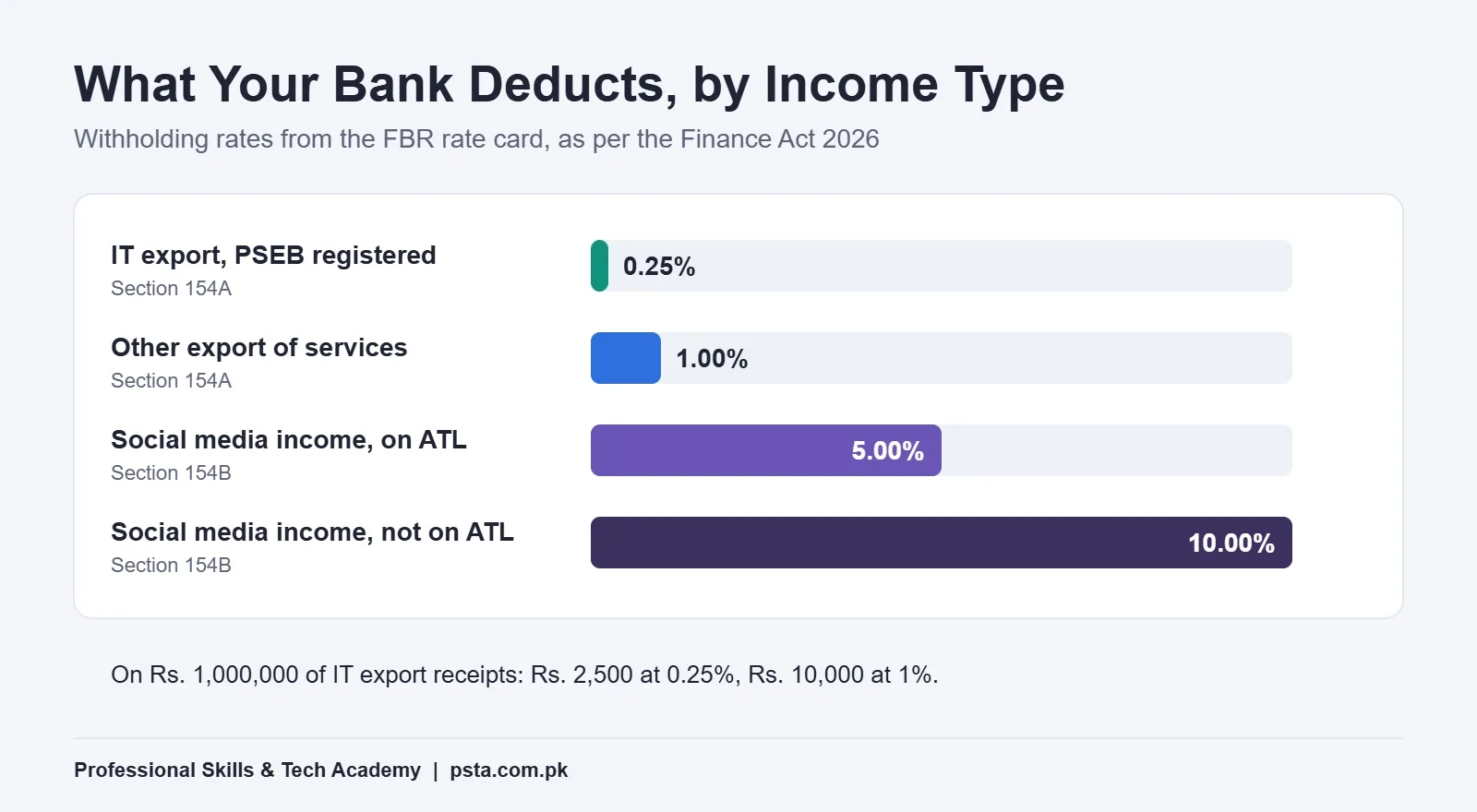
The FBR's own withholding tax rate card, updated as per the Finance Act 2026, lists these rates:
| Income Type | Section | Rate in the FBR Card |
|---|---|---|
| IT or IT-enabled services, exporter registered with PSEB | 154A | 0.25% |
| Other export of services (including unregistered exporters) | 154A | 1.00% |
| Social media platform revenue, person on the ATL | 154B | 5.00% |
| Social media platform revenue, person not on the ATL | 154B | 10.00% |
The less welcome change hit late filers. The surcharge under section 182A for an individual who wants back on the ATL after missing the deadline rose from Rs. 1,000 to Rs. 25,000 from 1 July 2026, as Filer.pk explains. That one change makes filing on time worth far more than it used to be.
On a simple example, the gap between registered and unregistered is easy to see. If Rs. 1,000,000 of IT export payments reaches your account in a year, 0.25% is Rs. 2,500. At 1%, it's Rs. 10,000.
Part 1: Paperwork to Gather Before You File (Checks 1 to 4)
Most problems with a tax return for freelancers start with missing papers, not with the form itself. Collect these first and the return takes an evening, not a week.
Check 1: Your NTN and IRIS Login Work
For individuals, your CNIC number serves as your NTN once you register on the FBR's IRIS portal. Log in a few days before you plan to file. Password resets go to your registered mobile number and email, so make sure both are still yours.
Check 2: A Tax Deduction Certificate for Every Bank Account
Ask each bank that received your foreign payments for a certificate of tax deducted for the tax year. Tax Year 2026 ran from 1 July 2025 to 30 June 2026. If you used two banks, you need two certificates.
Check 3: Your Platform Earnings Summary
Download a yearly earnings report from Upwork, Fiverr, Payoneer or Wise. It lets you match what clients paid against what reached your bank. Gaps usually come from fees, currency conversion or money still parked in a wallet abroad.
Check 4: Your PSEB Certificate, if You Have One
Keep a copy of your registration certificate and its expiry date. If it lapsed partway through the year, payments after the expiry date may have been taxed at 1% instead of 0.25%. If you haven't registered yet, the portal steps are in our walkthrough of PSEB registration for freelancers.
Part 2: Filing the Return Itself (Checks 5 to 8)
With your papers in one folder, the tax return for freelancers is mostly careful data entry on the FBR's IRIS portal. Here is the order that saves the most back-and-forth.
Check 5: Declare Export Receipts Under Final Tax
Your foreign IT receipts and the tax the bank deducted belong in the final tax part of the return, not with normal business income. Enter the gross amount and the deduction exactly as your bank certificates show them.
Check 6: Declare Local Income Separately
If a Pakistani business also paid you, that income isn't covered by section 154A. It's taxed under the normal rules, so keep it separate from your export receipts. This is the part where most people benefit from a practitioner's help. Freelancer tax in Pakistan gets complicated mainly at this mixing point.
Check 7: Complete the Wealth Statement
Resident individuals filing a return also submit a wealth statement under section 116. List bank balances, a motorbike or car, property, gold and cash in hand at the end of the tax year. Your opening and closing wealth must reconcile with your income and expenses, and the portal won't accept a statement that doesn't balance.
Check 8: Save the Acknowledgement and a PDF Copy
After you submit, download the acknowledgement slip and the full return. You'll need the return when you renew your PSEB certificate, since the PSEB freelancer registration page lists the preceding year's tax return among the renewal documents.
Part 3: Staying on the Active Taxpayers List (Checks 9 to 12)
Filing one tax return for freelancers' income is half the job. These four habits keep you a filer year after year.
Check 9: Confirm Your ATL Status Online
A few days after filing, check your status on the FBR's online ATL lookup. Don't assume it updated. Keep a screenshot with the date for your records.
Check 10: Put the Deadline in Your Calendar for Next Year
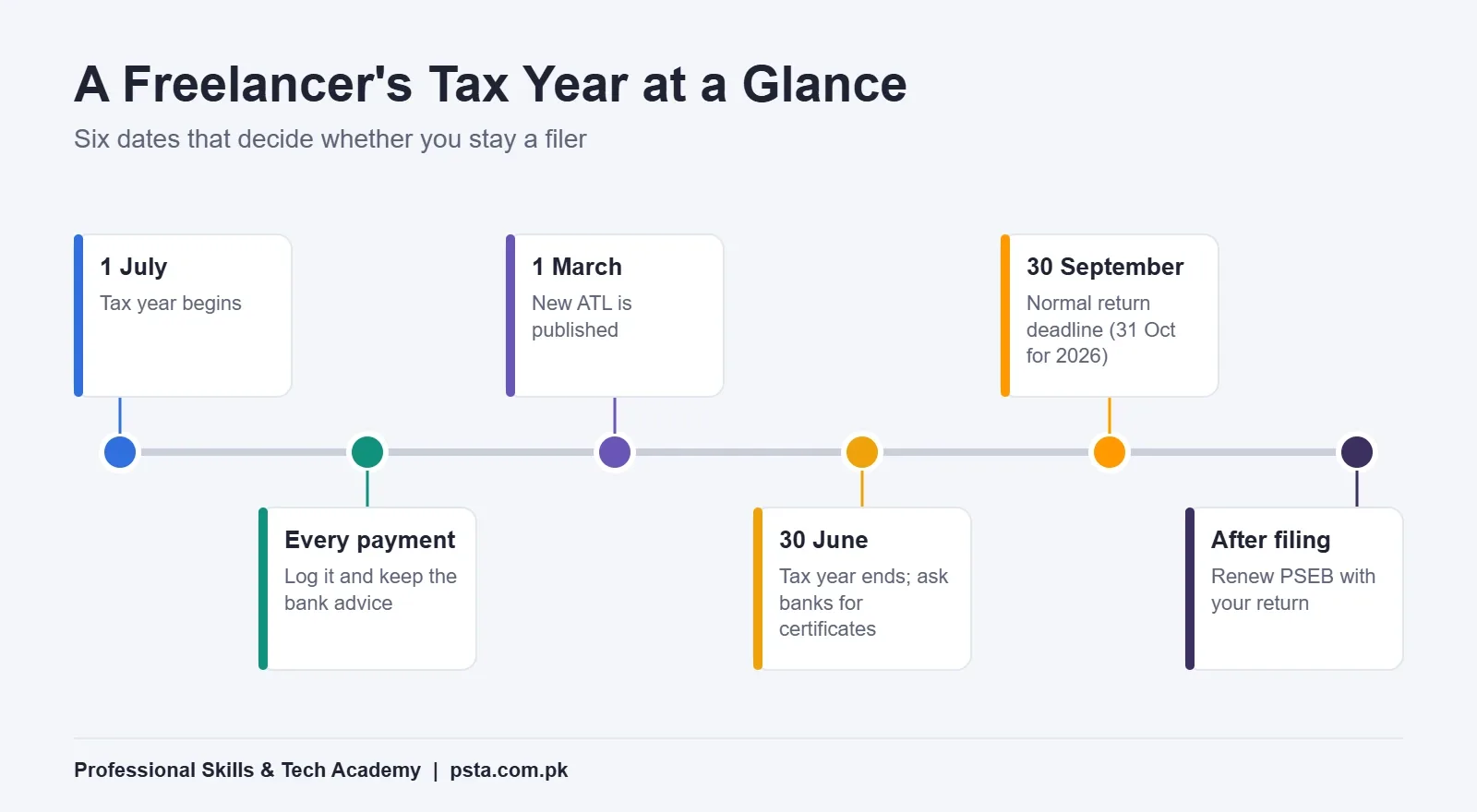
The normal deadline for individuals is 30 September. For Tax Year 2026, Profit reported that the FBR moved it to 15 October and then to 31 October. Don't plan around an extension, though. Set a reminder for 1 September and file early.
Check 11: Renew PSEB Before It Expires
According to PSEB's registration page, a first-time freelancer certificate costs Rs. 1,000 a year, while renewing costs Rs. 2,000. Since renewal needs last year's return, file first and renew second.
Check 12: Keep a Simple Income Log All Year
A spreadsheet with five columns is enough: date, client, platform, amount in dollars, and amount credited in rupees. Add each payment the day it lands. At filing time, you total the columns instead of searching old emails.
Missed the 31 October Deadline? What Late Filers Can Do Now
If you didn't file in time, you're not alone, but the rules have changed. Samaa reported on 2 November 2026 that the FBR updated its 2026 ATL and dropped those who hadn't filed by 31 October. Filing late doesn't put you back on the list by itself.
- File the return anyway. A late return still matters for the final-tax conditions and for your PSEB renewal.
- Decide about the surcharge. Getting back on the ATL now means paying the Rs. 25,000 section 182A surcharge for individuals, as both Samaa and Filer.pk report.
- Expect a possible penalty. Filer.pk notes that a separate late-filing penalty under section 182 can apply on top of the surcharge. Ask a practitioner to estimate it for your case.
- Weigh the cost honestly. If you rarely buy property, vehicles or make large bank transactions, waiting for the next annual ATL may cost you less than Rs. 25,000. If you do, rejoining sooner may pay for itself.
- Keep every receipt. Save the filing acknowledgement and any surcharge payment proof in the same folder as your bank certificates.
According to Filer.pk, a new ATL is published on 1 March each year. If you file late and skip the surcharge, that is the date to watch.
Freelancer, Content Creator or Local Contractor: Which Rule Applies?
Many students earn from more than one source, and each is taxed differently. Mixing them up leads to the wrong figures in the wrong part of the return.
| How You Earn | Who Deducts Tax | How It Works |
|---|---|---|
| Upwork, Fiverr or direct foreign clients for IT or design work | Your bank, under section 154A | 0.25% with PSEB registration, 1% without, treated as final tax when conditions are met |
| YouTube, TikTok or other social media payouts | Your bank, under section 154B | 5% if you're on the ATL, 10% if not; KPMG's brief describes it as a minimum tax for residents |
| A Pakistani company or shop that pays you | Depends on the payer | Declared as normal income in your return, not under section 154A |
If you run a channel alongside client work, the platform rules are covered in our post on YouTube monetization requirements in Pakistan.
Tax Return for Freelancers: Six Common Mistakes
- Declaring gross platform earnings instead of bank receipts. The bank certificate is your anchor. Platform fees never reached you.
- Leaving money in a foreign wallet for months. The 154A deduction happens when funds arrive in Pakistan through a bank. Money still abroad isn't in this picture yet.
- Forgetting a second bank account. Every account that received foreign money needs its own certificate.
- Treating family transfers as income, or income as family transfers. Client payments should arrive as export proceeds. Ask your bank how each payment was recorded.
- Letting the wealth statement drift. A new phone or laptop bought from freelance earnings is an asset. Leave it out and the numbers stop matching.
- Filing in the last 48 hours. The portal slows down near every deadline, and a single error can push you past midnight.
The Skills Side: What PSTA Teaches Freelancers
PSTA doesn't prepare tax returns. What we do is help you build the skills clients abroad pay for, and the habits that keep your records clean.
The record-keeping part is where our Office Automation course fits. It's a 12-week beginner course with Excel tables, formulas and charts, and one of its projects is a monthly expense or sales sheet, the same skill behind Check 12. The current fee is Rs. 12,000 (Rs. 15,000 is the usual price), which you can pay in two parts. You can attend at the Abbottabad campus, join live from home, or combine both.
For the earning side, students usually pair it with one exportable skill. Popular choices are Full-Stack Web Development with AI, Advanced Digital Marketing and Graphic Designing. All programs, side by side, are listed on our courses page. To apply, fill in the short online admission form, or you can message us on WhatsApp at +92 314 5424399 to ask about the next batch. Visitors are welcome at Mandian, Old College Road, opposite FIMS College.
If you're still setting up your payment route, our walkthrough of Fiverr withdrawal in Pakistan pairs well with this checklist.
Put Every Bank Certificate in One Folder Tonight
You don't have to finish your tax return today. Start with the step that blocks everything else: email each bank for its tax deduction certificate for 1 July 2025 to 30 June 2026, and create one folder for the replies. Once those certificates arrive, the other 11 checks move quickly.
Frequently asked questions
Do I need to file a tax return if I only earn from Fiverr or Upwork?
Yes. Your bank deducts tax when foreign payments arrive, but final-tax treatment under section 154A depends on filing your income tax return. Filing also keeps you on the Active Taxpayers List, which affects the tax you pay on bank profit, property and other transactions. A return with only export receipts is usually short once your bank certificates are ready.
Is the 0.25% bank deduction my full income tax on freelance earnings?
For IT and IT-enabled services exported by a PSEB-registered person, the 0.25% deduction is treated as final tax on that income when the conditions are met, and filing the return is one of them. Income from Pakistani clients is separate and taxed under normal rules. Confirm your own mix of income with a tax practitioner.
What can I do if I missed the 31 October 2026 deadline?
File your return anyway, since it still matters for final-tax treatment and PSEB renewal. Late filers were dropped from the 2026 Active Taxpayers List, and returning to it requires the section 182A surcharge. A separate late-filing penalty under section 182 may also apply, so ask a practitioner to estimate your total cost before deciding.
How much is the ATL surcharge for an individual late filer?
From 1 July 2026, the section 182A surcharge for an individual who wants to rejoin the Active Taxpayers List after filing late is Rs. 25,000, up from Rs. 1,000. Associations of persons pay Rs. 50,000 and companies Rs. 100,000. Paying it is your choice, and some people simply wait for the next annual list instead.
Do YouTube and TikTok earnings get the 0.25% rate?
No. Revenue from social media platforms falls under section 154B, not 154A. The FBR rate card lists 5% for people on the Active Taxpayers List and 10% for those who are not. If you also do client work, keep the two income streams separate in your records and in your return.
Which documents should a freelancer collect before filing?
Collect a tax deduction certificate from every bank that received foreign payments, a yearly earnings report from each platform, your PSEB certificate with its expiry date, and the details for your wealth statement: bank balances, vehicles, property, gold and cash. Having your IRIS login working before you start saves a lot of time.
When is the next tax return deadline for freelancers?
Tax Year 2027 runs from 1 July 2026 to 30 June 2027. The normal deadline for individuals is 30 September after the tax year ends, so plan for 30 September 2027. The FBR extended the 2026 deadline twice, but you should never count on an extension when planning.
Sources & references
- FBR Withholding Income Tax Rate Card (Finance Act 2026) download1.fbr.gov.pk
- KPMG: A Brief of Finance Act 2026 assets.kpmg.com
- Business Recorder: IT exporters, freelancers laud decision to maintain Final Tax Regime at 0.25% brecorder.com
- PSEB: Freelancer Registration techdestination.com
- Profit: FBR extends income tax return filing deadline to October 31 profit.pakistantoday.com.pk
- Samaa: FBR removes late filers from Active Taxpayers List 2026 samaa.tv
- Filer.pk: Late filers now pay far more to join the ATL filer.pk
- HS Advocate: IT Export Tax Pakistan, Section 154A and PSEB Registration hsadvocate.com
Last reviewed & updated on by Umar Qureshi. Written by the PSTA team in Abbottabad, Pakistan.

Umar Qureshi

Certified Office Automation Course: Master MS Office & Computer Basics
Turn this guide into a career: hands-on training with real projects, online across Pakistan or on-campus in Abbottabad · 12 Weeks.


Comments
No comments yet — ask a question or share your experience.