Quick answer
In July 2024, attackers took about $230 million to $235 million from a WazirX multisig wallet. Signers approved a transaction that differed from what their screen showed, which handed over control of the wallet. The US and South Korea blame North Korea. WazirX restarted in October 2025 under a Singapore court-approved repayment plan.
Key takeaways
- • WazirX lost about $235 million on July 18, 2024, from one six-signer multisig wallet.
- • Signers approved data that did not match their approval screen, according to WazirX.
- • WazirX and Liminal each point to the other, and neither full forensic report is public.
- • The US and South Korea attribute the theft to North Korea, based on industry analysis.
- • WazirX restarted in October 2025 and returned about 85% of rebalanced assets, plus recovery tokens.
- • The core lesson: verify what you sign on an independent device, not just what a screen shows.
Table of contents 12 sections
- What Was the WazirX Hack?
- WazirX Hack Timeline: From One Signed Transaction to a Court-Approved Restart
- WazirX Hack Explained: How Four Approvals Still Failed
- Where Did the Mismatch Come From?
- How Much Did the WazirX Hack Cost, and Who Felt It?
- Who Was Behind It, and How Sure Is Anyone?
- What Happened Afterwards?
- Seven Lessons From the WazirX Hack
- What Does This Mean for Exchanges and Users in Pakistan?
- How Does WazirX Compare With Other Series Cases?
- How PSTA Students Work Through a Case Like WazirX
- Make Your Next Approval a Slow One
How did the WazirX hack drain about $235 million when every transfer from the wallet needed four separate approvals? That question still comes up whenever Indian or Pakistani traders talk about exchange safety. The short answer: the approvers signed something different from what their screen showed. That is why the WazirX hack is now a lesson in checking what you sign.
This post is written as a lessons-learned report. It covers the confirmed facts first. Then it turns each failure into a habit you can use, whether you run a company wallet or just hold coins on an app.
- What happened on July 18, 2024, and what each source actually confirms
- How a four-signature wallet was still emptied, explained without exploit detail
- Why WazirX and its custody partner Liminal blamed each other
- How strong the North Korea attribution really is
- Seven lessons for exchanges, companies and everyday users in Pakistan
What Was the WazirX Hack?
WazirX was one of India's best-known crypto exchanges, run from Mumbai. On July 18, 2024, it paused all withdrawals after one of its multisig wallets was emptied. TechCrunch reported that the company put the loss at about $230 million, close to half of its reserves.
A multisig wallet is one that needs several keys to approve a payment. This one had six possible signers. Five worked for WazirX and one belonged to Liminal, the custody firm whose tools the exchange used. According to WazirX's preliminary report, as summarized by Business Today, any outgoing transaction needed three WazirX approvals plus the Liminal approval. Payments could also go only to pre-approved addresses.
On paper, that is a careful setup. In practice, it fell in a single afternoon. Blockchain analytics firm Elliptic counted roughly $235 million in stolen assets spread across more than 200 tokens. You will see both $230 million and $235 million in the news. The gap comes from token prices at the moment each party counted.
WazirX Hack Timeline: From One Signed Transaction to a Court-Approved Restart
The table below lists only dates that appear in the linked sources. Where a source gives a month but not a day, the table says so.
| Date | Event | Source |
|---|---|---|
| February 2023 | The affected wallet starts using Liminal's custody and wallet infrastructure | Cointelegraph |
| June 2024 | WazirX's proof-of-reserves shows holdings of about $500 million | TechCrunch |
| July 18, 2024 | Multisig wallet drained; withdrawals paused; Elliptic links the theft to North Korea the same day | TechCrunch, Elliptic |
| July 19, 2024 | WazirX publishes preliminary findings; Liminal says its platform was not breached | Cointelegraph |
| August 14, 2024 | WazirX ends its relationship with Liminal and moves funds to new multisig wallets | Inc42 |
| September 2 to 19, 2024 | Attacker pushes more than 42,500 ETH (about $100 million) through Tornado Cash, per Arkham | The Block |
| September 2024 | Grant Thornton review, hired by Liminal, finds no evidence the attack started in Liminal's web app | Inc42 |
| November 2024 | Delhi Police arrest a man from West Bengal over an account allegedly linked to the attack | The Record |
| January 14, 2025 | US, Japan and South Korea issue a joint warning; the US and South Korea attribute the theft to North Korea | Joint statement |
| 2025 (first half) | Creditors back a first restructuring plan, but the Singapore court rejects it over a disclosure gap | Business Standard |
| August 2025 | Revote: about 95.7% of voting creditors approve the revised scheme | Business Standard |
| October 13, 2025 | Singapore High Court sanctions the scheme | Business Standard |
| October 24, 2025 | WazirX restarts and begins returning about 85% of rebalanced assets | Outlook Money |
WazirX Hack Explained: How Four Approvals Still Failed
Here is the WazirX hack explained at the level a defender needs. No exploit steps are included, and none are needed to learn from it.
When a signer approves a multisig payment, two things happen. A web screen shows a summary, such as "send this amount to this address." Then the signer confirms on a device that holds their key. The key signs a block of data, often called the payload. The signer trusts that the summary and the payload match.
WazirX said that during the attack there was a mismatch between what Liminal's interface displayed and what was actually signed. The company suspected the payload had been swapped. The new version handed control of the wallet to the attacker, as TechCrunch reported. Once the attacker controlled the wallet itself, the address whitelist no longer mattered. A rule that blocks payments to unknown addresses does nothing if the thief can rewrite the rules.
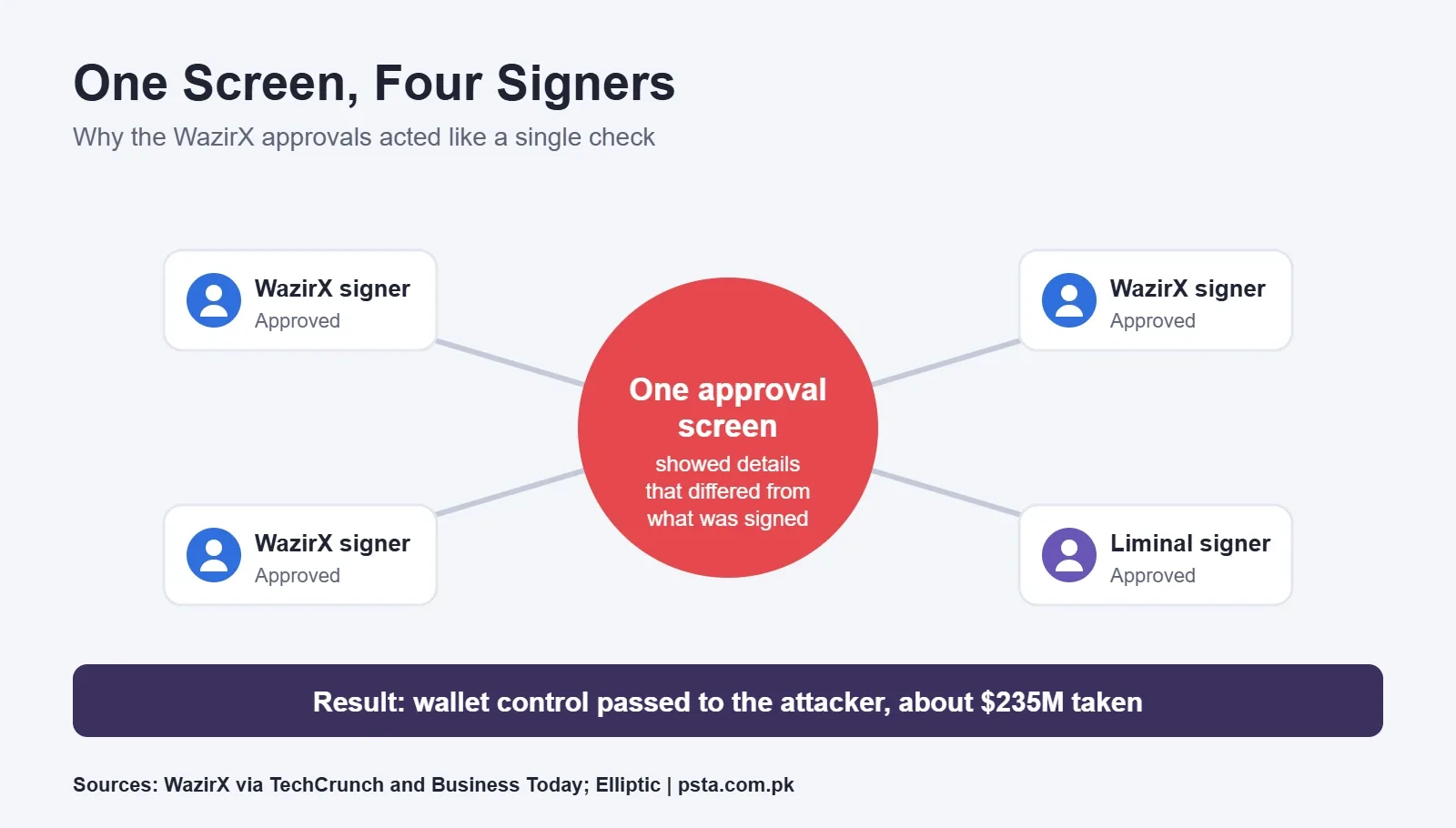
The key point is simple. Every signer did their part, yet the extra signatures added little protection because all of them trusted the same screen. Four people approving the same false picture is still one point of failure.
Where Did the Mismatch Come From?
This is the part nobody has settled in public. WazirX said its investigators at Mandiant found its laptops and systems clean. In its view, the evidence pointed toward Liminal. Liminal hired Grant Thornton, whose review found "no evidence" that the attack came from Liminal's web application, as Inc42 reported. Liminal also said the wallet involved was created outside its own ecosystem.
Each review was paid for by one side and looked at that side's systems. Neither full report has been made public. So the root cause of the mismatch is still disputed. You should treat any article that names a single culprit with care.
How Much Did the WazirX Hack Cost, and Who Felt It?
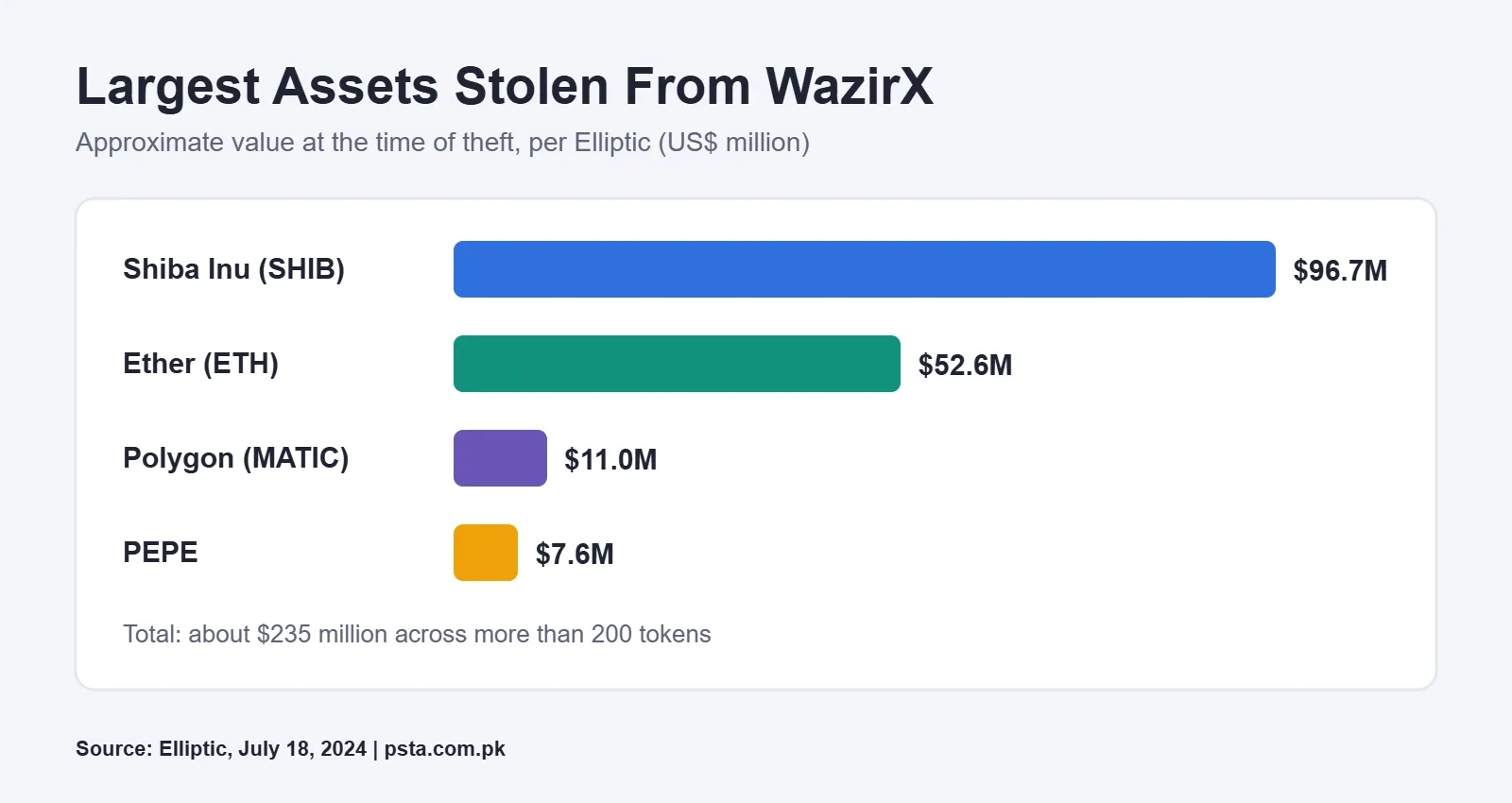
Elliptic's breakdown shows that a few tokens made up most of the loss. Shiba Inu tokens made up about $96.7 million and ether about $52.6 million. Polygon's MATIC came to about $11 million and PEPE to about $7.6 million. The rest was scattered across more than 200 smaller holdings.
For customers, the hit was large. Inc42 reported that the theft drained about 45% of user funds. Withdrawals stayed frozen for over a year. In 2025, Business Standard reported that the platform had about 4.3 million creditors. In the rerun vote, around 149,000 of them took part, holding $206.9 million in claims.
The loss was spread across all users, not only those whose coins sat in the drained wallet. That is how the court-approved scheme handled it. On a custodial exchange, your balance is really a claim on a shared pool.
Who Was Behind It, and How Sure Is Anyone?
There are two layers of blame here, and they carry different weight.
The first came from industry. On the day of the theft, Elliptic said on-chain analysis and other information pointed to hackers affiliated with North Korea. That is an expert finding, not a court ruling.
The second came from governments. On January 14, 2025, the United States, Japan and South Korea issued a joint statement on North Korean cyber theft. Read the wording closely. In it, the United States and South Korea "additionally attribute" the $235 million WazirX theft to North Korea. They cite industry analysis. Japan co-signed the overall warning but is not named in that specific attribution. The statement does name the Lazarus Group as a North Korean actor. But it does not tie that group by name to WazirX.
So the North Korea crypto theft label is backed by two governments and several analysts. It is a strong attribution. Still, it rests on intelligence and blockchain tracing, not on charges against named people for this attack.
In India, The Record reported that Delhi Police arrested Masud Alam of West Bengal in November 2024. Police alleged he opened a WazirX account under a false name and sold it on Telegram. They said the account was later used in the breach. How that account fits with the multisig story has not been explained publicly. Treat it as an allegation, not a finding of guilt.
What Happened Afterwards?
The stolen funds moved fast. Elliptic noted that the thief swapped many tokens for ether soon after the theft, a common first laundering step. By mid-September 2024, more than 42,500 ETH had gone through the Tornado Cash mixer. That was worth about $100 million then, as The Block reported using Arkham data.
WazirX's parent company, Zettai, turned to a Singapore court process called a scheme of arrangement. A first version won creditor votes but was rejected because the company had not disclosed incorporation details of a Panama entity. A revised scheme passed in August 2025 and was sanctioned on October 13, 2025.
The exchange restarted on October 24, 2025. According to Outlook Money, it distributed about 85% of rebalanced net liquid platform assets within 10 business days. The remaining claim is represented by WazirX recovery tokens. These are allocated in proportion to each approved claim. Every three months, if at least $10 million has been recovered in that cycle, part of it buys back tokens. They were not tradable at the time of that report.
Seven Lessons From the WazirX Hack
This section is the heart of the report. Each lesson from the WazirX hack ties back to a fact above.
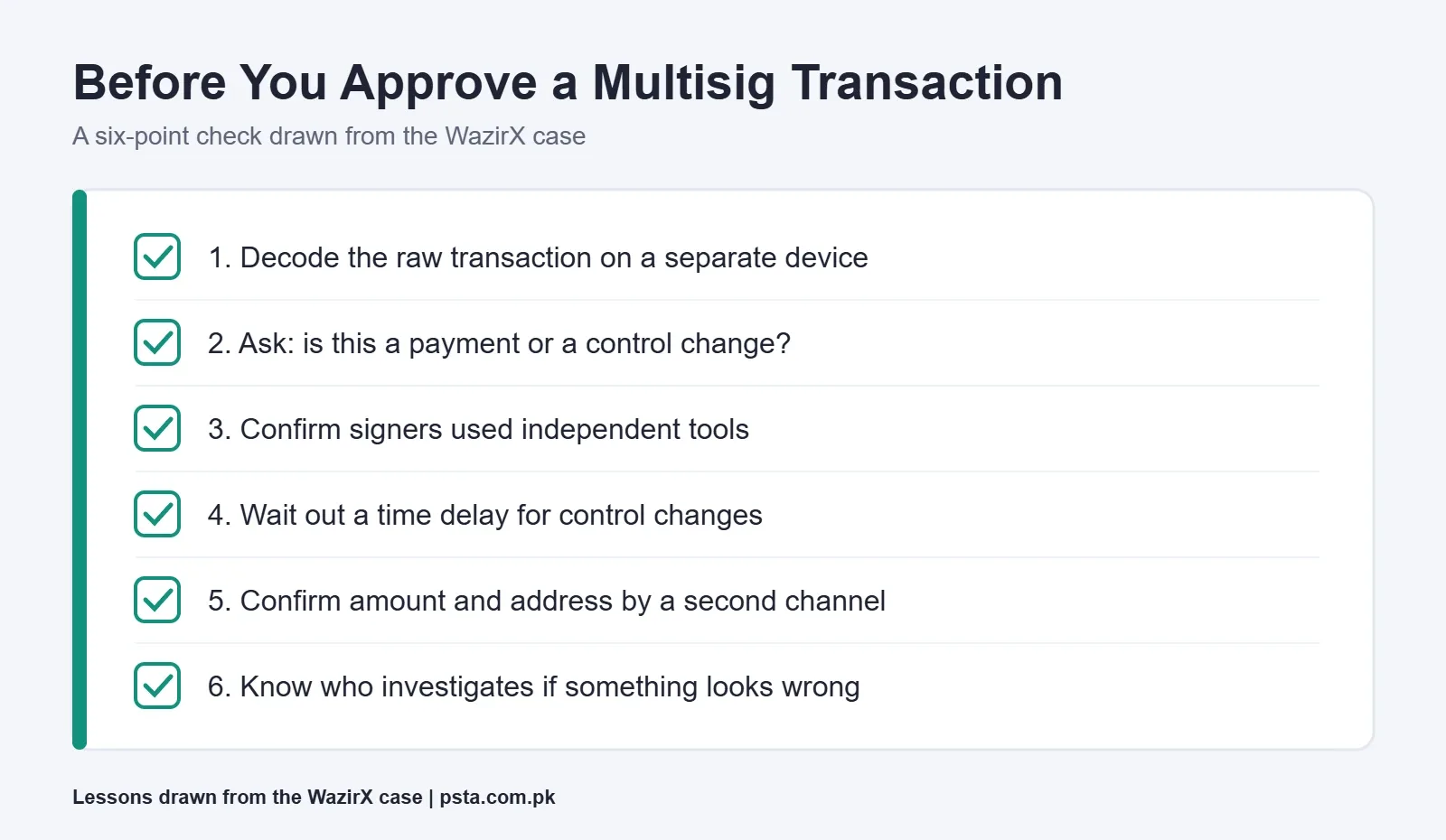
- Verify the payload, not the picture. Multisig wallet security depends on each signer seeing the real transaction. Signers should check the raw details on a separate trusted device, or with an independent decoder, before approving.
- Make signers truly independent. Four approvals through one shared interface act like one approval. Use different tools, networks or teams so a single bad screen cannot fool everyone.
- Treat control changes as the highest risk. Whitelists protect payments, not the wallet's own rules. Any transaction that changes ownership, code or signer lists deserves a separate, slower approval path with a time delay.
- Keep less in one wallet. Close to half of WazirX's reserves sat where one signing session could reach them. Splitting funds limits the damage of any single failure.
- Agree on incident roles before you need them. WazirX and Liminal spent months blaming each other. Contracts with custody firms should say who investigates, who shares logs, and how findings go public.
- Know Your Customer is a security control too. The Delhi arrest centered on an account allegedly opened under a false name and resold. Weak identity checks give attackers ready-made cover.
- Plan for recovery, not only prevention. Users waited over a year for partial repayment. Insurance, cash reserves and a tested recovery plan decide how long customers wait.
What Does This Mean for Exchanges and Users in Pakistan?
Pakistan is now writing its own rules for crypto. In July 2025, the President signed an ordinance creating the Pakistan Virtual Assets Regulatory Authority (PVARA). Dawn reported that anyone offering virtual asset services in or from Pakistan must get a PVARA license. License holders also face compliance and reporting duties in line with FATF standards.
That matters because a license usually comes with security rules. Maybe you work at a local fintech, a software house that builds wallets, or a bank testing digital assets. If so, the WazirX case is a ready-made test. Ask whether your signers would spot a mismatched payload, and whether your contracts settle who investigates after a breach.
If you are an individual trader, the takeaway is calmer. Any crypto exchange hack hits customers who did nothing wrong. Leave on an exchange only the coins you actively trade. Protect your account with an authenticator app. Be wary of anyone who offers to "recover" frozen funds for a fee. Our WhatsApp account recovery checklist covers the same scam patterns that follow big hacks.
How Does WazirX Compare With Other Series Cases?
Seven months later, the Bybit hack showed a similar pattern. Signers approved a transaction that looked routine on screen but did something else. The Ronin Network hack also beat a multi-signature design, there by gaining enough validator keys. The Coincheck hack showed what happens when a large balance sits in a single hot wallet. Read together with the Binance hack case study, these cases share one theme. The weak spot is usually the approval process around the keys, not the math behind them.
How PSTA Students Work Through a Case Like WazirX
At PSTA, we use real incidents as teaching material. They show how defenses fail in practice. PSTA's beginner course in cyber security and ethical hacking lasts 12 weeks. It starts with core ideas such as the CIA triad and risk. Later modules cover typical attacks, beginner-level ethical hacking and network security. You also study malware, how threats are detected, cyber law and digital forensics.
In the labs, you work through a mock incident: you keep the evidence intact and build a dated record of events, much like the table above. Your final piece of work is a case-study project with a written report. Classes run online for learners anywhere in Pakistan, or on campus at Mandian, Old College Road, Abbottabad.
Already know the basics? Our advanced penetration testing course teaches authorized testing of real systems from an attacker's point of view. Message our team on WhatsApp about the next batch. They can tell you which track fits your level.
Make Your Next Approval a Slow One
The single habit that would have helped most here is cheap. Next time you approve any payment, from a company wallet or a bank app, pause first. Confirm the details through a second channel, then sign. A two-minute check is far less costly than a year of frozen withdrawals.
Frequently asked questions
Did WazirX users get their money back?
Partly. WazirX restarted on October 24, 2025, after a Singapore court approved its restructuring scheme. Outlook Money reported that it returned about 85% of rebalanced net liquid platform assets within 10 business days. The rest of each approved claim is tracked through recovery tokens, which pay out only if more funds are recovered later.
What are WazirX recovery tokens?
They are a record of the part of your claim that was not repaid at restart. Tokens are allocated in proportion to each approved claim. Every three months, if at least $10 million has been recovered in that cycle, part of it is used to buy tokens back. At the time of reporting, the tokens could not be traded.
Was Liminal responsible for the WazirX hack?
That is disputed. WazirX said Mandiant found its own laptops and systems clean and that the evidence pointed toward Liminal. Liminal said its platform was not breached, and a Grant Thornton review it commissioned found no evidence that the attack began in its web application. Neither full report has been made public.
Why did the address whitelist not stop the theft?
A whitelist limits where payments can go. In this case, WazirX said the signed transaction handed control of the wallet itself to the attacker. Once someone controls the wallet's rules, a payment whitelist no longer protects it. That is why changes to wallet ownership or code need their own slower approval path.
Has anyone been arrested over the WazirX hack?
Delhi Police arrested Masud Alam of West Bengal in November 2024, according to The Record. Police alleged he opened a WazirX account under a false name and sold it on Telegram, and that the account was later used in the breach. These are allegations, and no court finding on them has been reported in the sources used here.
Could a similar attack hit a company in Pakistan?
Yes, any organization that approves payments through a shared screen faces the same risk, whether it holds crypto or uses online banking. The defense is the same: check transaction details on an independent device, keep signers and tools separate, and add a delay for high-risk changes. Pakistan's new PVARA licensing rules are also likely to bring security duties.
How is a multisig wallet different from a normal wallet?
A normal wallet needs one private key to move funds. A multisig wallet needs several keys, such as three out of five, so no single person can send money alone. WazirX's wallet needed four approvals. The case shows that multisig only helps when each signer checks the real transaction independently.
Sources & references
- TechCrunch: India's WazirX confirms security breach after $230 million suspicious transfer techcrunch.com
- Elliptic: $235 million lost by WazirX in North Korea-linked breach elliptic.co
- Joint Statement by the United States, Japan and the Republic of Korea, January 14, 2025 worldjpn.net
- Inc42: Grant Thornton review of Liminal after the WazirX hack inc42.com
- The Record: WazirX hack suspect arrested in India therecord.media
- Business Standard: Singapore court approves WazirX scheme of arrangement business-standard.com
- Outlook Money: WazirX completes recovery token allocation outlookmoney.com
- Dawn: Authority to regulate crypto and digital assets formed dawn.com
Last reviewed & updated on by Umar Qureshi. Written by the PSTA team in Abbottabad, Pakistan.

Umar Qureshi
Cyber Security & Ethical Hacking Course in Abbottabad - PSTA
Turn this guide into a career: hands-on training with real projects, online across Pakistan or on-campus in Abbottabad · 12 Weeks.
Comments
No comments yet — ask a question or share your experience.