Quick answer
AI Overviews cut clicks on many informational searches, but they don't replace SEO. Google says no special files, schema or markup are needed; pages must be indexed and snippet-eligible. Protect short, action-led searches with strong pages and a Business Profile, and aim to be cited on long questions with specific, first-hand content.
Key takeaways
- • Pew found people clicked a regular result in 8% of searches with an AI summary, vs 15% without.
- • Google needs no llms.txt, special schema or chunked content for AI Overviews.
- • AI features traffic is counted in Search Console's Performance report under Web.
- • Short, action-led searches trigger fewer AI summaries, so protect those pages first.
- • Long questions are where citations matter, and first-hand detail is what gets cited.
- • Urdu is a supported AI Overviews language, so test Urdu queries too.
Table of contents 21 sections
- What Are AI Overviews, and Do They Appear in Pakistan?
- How Many Clicks Do AI Overviews Actually Take?
- Myths About What Google Needs From Your Website
- Myth 1: You Need an llms.txt File to Be Cited
- Myth 2: AI Overviews Need Special Schema Markup
- Myth 3: You Should Chop Your Content Into Small Chunks for AI
- Myths About Traffic, Rankings and Measurement
- Myth 4: SEO Is Dead Because Google Answers Everything
- Myth 5: Only Big International Sites Get Cited
- Myth 6: You Can't Measure AI Overviews Traffic at All
- Myths About Controlling How You Appear
- Myth 7: Blocking Google-Extended Removes You From AI Overviews
- Myth 8: Adding nosnippet Protects Your Traffic
- Myth 9: AI Overviews Only Matter for English Searches
- AI Overviews SEO Myths and Facts at a Glance
- Which Searches Still Send Clicks?
- What Makes a Page Worth Citing?
- A Four-Week AI Overviews SEO Plan for a Business Website
- Is Generative Engine Optimization a Separate Skill?
- Studying SEO for AI Search With PSTA
- Today: Search Your Own Five Best Questions
AI Overviews SEO still works, but the click you used to get from ranking first is smaller when Google shows its own summary. In a Pew Research Center study of real browsing data, people clicked a regular result in 8% of searches that showed an AI summary, against 15% of searches that didn't. Your goal now is to be the page the summary cites, and the page people still need to open.
A lot of confused AI Overviews SEO advice has grown around this change, and most of it comes from tool sellers rather than from Google itself. This guide takes the common myths one at a time and checks each against Google's own documentation and three independent click studies.
Here's what you'll come away with:
- What AI Overviews are, and whether they appear for searches made in Pakistan and in Urdu
- What the best available studies say about lost clicks, and what they don't say
- Nine myths about AI search, each paired with the fact that replaces it
- A simple way to sort your keywords by how likely they are to still send visits
- A four-week plan you can run on a real business website
What Are AI Overviews, and Do They Appear in Pakistan?
An AI Overview is the generated summary that sits above or between the normal blue links. It answers the query in a few sentences and shows a small set of linked sources. AI Mode is the separate, chat-style tab where you can ask follow-up questions.
Both are live here. When Google AI Overviews expanded in May 2025, the company's announcement said the feature was available in more than 200 countries and territories and in more than 40 languages, and it named Urdu among the newly supported ones. The same post said that in the U.S. and India, AI Overviews brought an increase of over 10% in usage for the types of queries that show them.
So a student in Abbottabad searching "digital marketing course fee" and a shopper in Karachi asking a long question in Urdu can both see an AI answer before they see your page.
Google also explains how these answers are built. According to its page on AI features and your website, both AI Overviews and AI Mode may use "query fan-out". The system runs several related searches across subtopics, then pulls supporting links from all of them. That's why a page can be cited for a question it never targeted word for word.
How Many Clicks Do AI Overviews Actually Take?
There's no public click study for Pakistan yet. The three most useful studies all use U.S. data, so treat them as a direction, not a local measurement. They agree on the direction, but the size of the drop varies with method.
| Study | Method | Main finding |
|---|---|---|
| Pew Research Center (July 2025) | Browsing data from 900 U.S. adults in March 2025 | 8% clicked a regular result when an AI summary appeared, vs 15% without one. Only 1% clicked a link inside the summary. |
| Ahrefs (February 2026 update) | Search Console data for 300,000 keywords, December 2023 vs December 2025 | Position 1 click-through rate was 58% lower when an AI Overview appeared. Its April 2025 version had found 34.5%. |
| Randomized field study reported by Search Engine Journal (April 2026) | 1,065 U.S. users, some with AI Overviews hidden, January to February 2026 | AI Overviews appeared on 42% of queries. Organic clicks on those queries fell 38%. |
Read the fine print before you quote any of these to a client. Ahrefs says its data is observational. The field study, run by researchers at the Indian School of Business and Carnegie Mellon University, is a working paper that hasn't been peer reviewed. Pew also found that people ended their browsing session on 26% of pages with an AI summary, compared with 16% without one.
One more detail from the field study is worth remembering. More than 95% of users who had AI Overviews hidden didn't notice anything was missing, and their satisfaction scores were almost the same as the control group's.
Myths About What Google Needs From Your Website
This is where most wasted AI Overviews SEO effort happens. Freelancers sell "AI-ready" packages, and business owners pay for files and markup that Google says it doesn't use.
Myth 1: You Need an llms.txt File to Be Cited
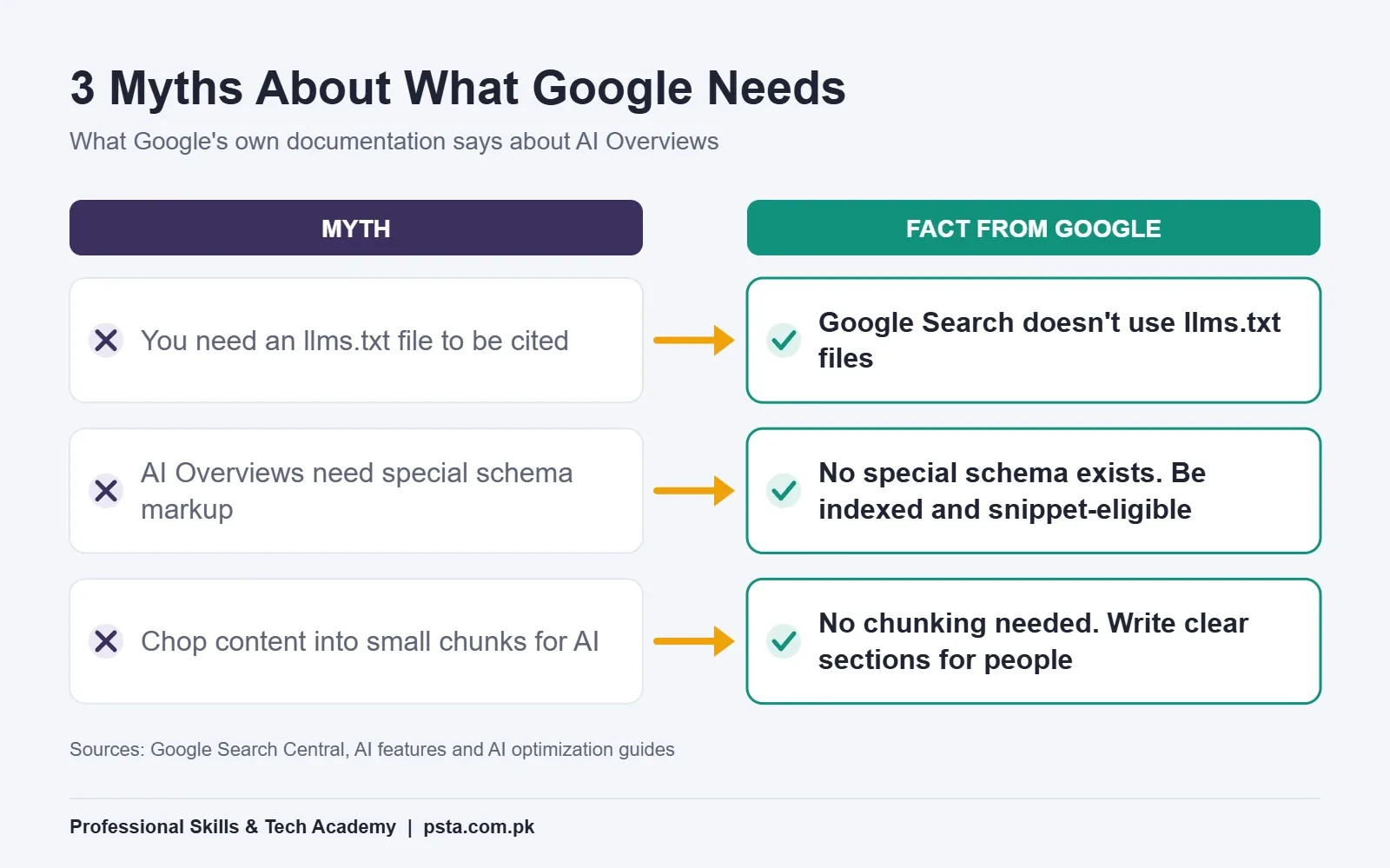
Fact: Google's guide to optimizing for generative AI features says Google Search doesn't use llms.txt files. Adding one for other services is fine, but it won't help or hurt you on Google.
Myth 2: AI Overviews Need Special Schema Markup
Fact: Google states that there's no special schema.org structured data to add, and no extra technical requirement beyond normal Search. Your page needs to be indexed and eligible to show with a snippet. Structured data is still useful for rich results, as long as it matches the visible text on the page.
Myth 3: You Should Chop Your Content Into Small Chunks for AI
Fact: The same guide says there's no need to "chunk" content. Write for the reader. Clear headings, short paragraphs and a direct answer near the top help people first, and that's the standard Google says it rewards.
Myths About Traffic, Rankings and Measurement
Myth 4: SEO Is Dead Because Google Answers Everything
Fact: In Pew's data, only about 18% of searches produced an AI summary at all. For one- or two-word searches it was 8%. The other searches still showed regular results, and the cited sources in every AI Overview must come from pages Google has indexed and can show with a snippet. Classic SEO is the entry ticket.
Myth 5: Only Big International Sites Get Cited
Fact: Pew found that Wikipedia, YouTube and Reddit together made up 15% of the sources in AI summaries, slightly less than their 17% share of standard results. Government sites did better inside summaries, at 6% versus 2%. That leaves the large majority of citations going to other sites, so a smaller site with a clear, specific answer still has room.
Myth 6: You Can't Measure AI Overviews Traffic at All
Fact: Google says clicks and impressions from AI features are counted in the Search Console Performance report, under the "Web" search type. Use that report to spot pages where impressions stay steady while clicks fall. That comparison is the first check in any AI Overviews SEO review. If you haven't verified your site yet, follow our Google Search Console setup guide first.
Myths About Controlling How You Appear
Myth 7: Blocking Google-Extended Removes You From AI Overviews
Fact: Google points to Google-Extended for limiting how content is used for training and grounding in its other AI systems. To limit what appears in Search, including AI features, it lists the usual tools: nosnippet, data-nosnippet, max-snippet and noindex.
Myth 8: Adding nosnippet Protects Your Traffic
Fact: Those controls also limit your normal snippet, which can make your regular listing less attractive. Use data-nosnippet only on a specific block you don't want quoted, such as a fee table you update often, rather than on the whole page.
Myth 9: AI Overviews Only Matter for English Searches
Fact: Urdu was named in Google's 2025 language expansion. If your customers search in Urdu or Roman Urdu, check those queries by hand on your phone. Don't assume an English-only strategy covers them.
AI Overviews SEO Myths and Facts at a Glance
Keep this AI Overviews SEO table handy for client calls. Each row links back to a source above.
| Myth | What the evidence says | What to do instead |
|---|---|---|
| You need llms.txt | Google Search doesn't use it | Spend the time on page quality |
| Special schema is required | No special structured data exists for AI features | Keep normal schema accurate |
| Chunk content for AI | Google says chunking isn't needed | Write clear sections for people |
| SEO is dead | About 18% of searches showed a summary in Pew's data | Keep ranking work going |
| Only big sites get cited | Wikipedia, YouTube and Reddit were 15% of sources | Answer niche questions well |
| AI traffic can't be measured | It's counted in Search Console's Web report | Track clicks vs impressions per page |
| Google-Extended hides you | Search uses snippet controls instead | Use data-nosnippet sparingly |
| English is enough | Urdu is a supported language | Test Urdu queries yourself |
Which Searches Still Send Clicks?
Pew's numbers give you a practical sorting rule for AI Overviews SEO. AI summaries appeared on 53% of searches with 10 or more words, and on 60% of searches that started with a question word such as "what" or "how". Short searches triggered them far less often.
Now add the second question: does the searcher need to do something, like call, visit, buy or book? A summary can explain "what is GEO", but it can't take a student's admission form or deliver a shalwar kameez to Quetta. That gives you four groups:
- Short and action-led ("dress shop Abbottabad", "Power BI course fee"). Fewer summaries. Protect these with strong pages, a complete Google Business Profile and fast load times.
- Long and action-led ("which laptop under Rs. 150,000 is good for video editing"). Summaries are likely, but buyers still click to compare. Give exact prices, stock and a comparison table.
- Short and informational ("what is CTR"). Expect fewer clicks. Answer in two lines, then offer something deeper that a summary can't, such as a template or a worked example.
- Long and informational ("how do I find which keywords bring sales to my Shopify store"). Summaries are most likely here. Aim to be cited, with first-hand steps, screenshots and your own data.

If you've never grouped keywords before, our keyword research guide for beginners walks through collecting them before you sort.
What Makes a Page Worth Citing?
Google's guidance uses the phrase "non-commodity content". In plain terms, it means a page that says something a hundred other pages don't. For AI Overviews SEO in a Pakistani business, that usually comes from things only you know:
- Real local prices, delivery times and stock that you update when they change
- Photos and short videos of your actual products, shop or classroom
- Steps you have tested yourself, with the mistakes you made along the way
- Answers to the exact questions your customers send on WhatsApp
Google's AI features page also lists the technical basics: allow crawling in robots.txt and at your host or CDN, link your pages internally, keep important content in text rather than only in images, give a good page experience, and keep your Merchant Center and Business Profile details current. If your on-page basics need work, run through our on-page SEO checklist. For local businesses, a well-kept Google Business Profile matters just as much.
One warning from the same guide: don't build separate thin pages for every related query the fan-out might run. Google says doing that to manipulate AI answers can fall under its scaled content abuse policy.
A Four-Week AI Overviews SEO Plan for a Business Website
This AI Overviews SEO plan fits a small business site with 10 to 50 pages. It assumes Search Console is already verified.
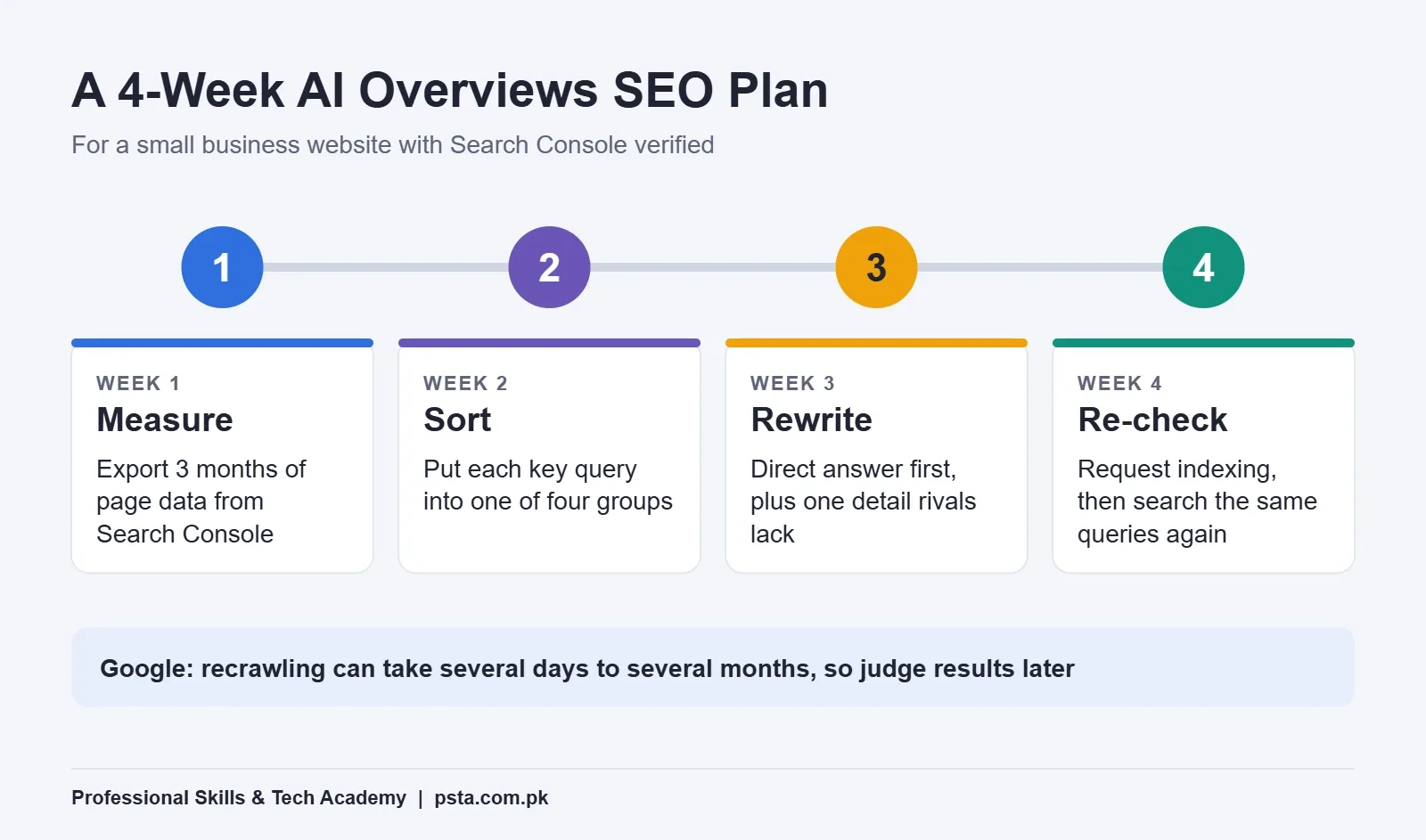
- Week 1: Measure. In Search Console, export 3 months of page data. Mark pages where impressions held steady but clicks dropped. Search your top 20 queries on a phone and note which show an AI Overview and who it cites.
- Week 2: Sort. Put every important query into one of the four groups above. Decide which pages should protect clicks and which should aim to be cited.
- Week 3: Rewrite. Open each priority page with a direct, two-sentence answer. Add one thing competitors don't have, such as a current price table, a real photo or a tested step. Check that schema matches what's visible.
- Week 4: Check and repeat. Request indexing for the changed pages. Search the same queries again, then compare clicks per page after a few weeks. Google notes that recrawling can take from several days to several months, so be patient.
Is Generative Engine Optimization a Separate Skill?
You'll see "GEO" and "AEO" used for optimizing toward AI answers, in Google and in tools like ChatGPT and Gemini. Some of it is useful thinking, such as asking which sources an answer engine trusts. But for Google, the documentation is clear that the same SEO basics apply, and its guide advises caution with tools claiming to show internal Google metrics.
So treat GEO as an extension of SEO, not a replacement. If you can research keywords, write a clear page, fix technical problems and build a local profile, you already have most of what AI Overviews SEO rewards.
Studying SEO for AI Search With PSTA
Our Advanced Digital Marketing Course runs for 12 weeks across 26 modules. Week 4 covers SEO and AI search together, and you finish it with an SEO audit and five fixes done on a live site. Later weeks cover Google Business Profile, Meta Ads, Google Ads, WhatsApp, email and GA4 reporting.
On fees, the course page shows Rs. 30,000 against the usual Rs. 35,000, with an option to pay in 2 parts. Attend in person at the Mandian campus in Abbottabad, follow the live online classes from your own city, or mix the two. If you also want to automate reporting, the AI Automation course pairs well with it. Compare options on the courses page, or see how to enrol on the admission page. If you'd like to know which slot suits your work hours, send a message to +92 314 5424399 on WhatsApp.
Today: Search Your Own Five Best Questions
Pick the five questions your customers ask most. Search each one on your phone, in English and in Urdu if that's how people ask. Write down whether an AI Overview appears, which sites it cites, and whether your page is one of them. That one list will tell you more about your AI Overviews SEO priorities than any tool report.
Frequently asked questions
Do Google AI Overviews appear in Pakistan?
Yes. In its May 2025 update, Google said AI Overviews were available in more than 200 countries and territories and in more than 40 languages, and it named Urdu among the newly supported languages. You can check your own keywords by searching them on your phone. Results vary by query, so test both English and Urdu versions of the questions your customers ask.
Do I need an llms.txt file to appear in AI Overviews?
No. Google's guide to generative AI features says Google Search doesn't use llms.txt files, and that you don't need new machine-readable files or special markup. Your page must be indexed and eligible to show with a snippet. An llms.txt file won't hurt your Google rankings, but time spent on page quality will do far more.
How can I tell if AI Overviews are reducing my website traffic?
Open the Performance report in Google Search Console, where Google counts AI feature traffic under the Web search type. Compare clicks and impressions for each page over several months. If impressions hold steady while clicks fall, search those queries yourself and see whether an AI Overview now sits above your result.
Can I stop Google from using my content in AI Overviews?
Google lists the standard snippet controls for Search: nosnippet, data-nosnippet, max-snippet and noindex. Be careful, because these also limit how your page appears in normal results. A softer option is data-nosnippet on one specific block, such as a frequently changing price table. Google-Extended relates to Google's other AI systems, not Search features.
Is GEO different from SEO?
GEO, or generative engine optimization, describes efforts to get cited in AI answers. For Google, the documentation says the same SEO basics apply: crawlable pages, clear text, helpful original content, good page experience and accurate business details. Treat GEO as an extension of SEO. Be cautious with tools that claim to show internal Google metrics, as Google itself advises.
Which searches still send the most clicks?
In Pew's 2025 data, AI summaries appeared on only 8% of one- or two-word searches but on 53% of searches with 10 or more words. Short searches where people want to buy, call or visit are the safest. Protect those pages with accurate details, a complete Google Business Profile and fast loading, then target long questions for citations.
Where can I learn SEO for AI search in Abbottabad?
PSTA's Advanced Digital Marketing Course covers SEO and AI search together in week 4, with an SEO audit and five live fixes as the deliverable. The course runs 12 weeks, on campus in Abbottabad, live online or hybrid. Check the course page for the current fee and batch timing, or message PSTA on WhatsApp.
Sources & references
- AI features and your website (Google Search Central) developers.google.com
- Optimizing your website for generative AI features on Google Search developers.google.com
- AI Overviews expansion, May 2025 (Google) blog.google
- Google users are less likely to click on links when an AI summary appears (Pew Research Center) pewresearch.org
- Update: AI Overviews Reduce Clicks by 58% (Ahrefs) ahrefs.com
- AI Overviews cut organic clicks 38%, field study finds (Search Engine Journal) searchenginejournal.com
Last reviewed & updated on by Umar Qureshi. Written by the PSTA team in Abbottabad, Pakistan.

Umar Qureshi

Advanced Digital Marketing Course in Pakistan and Abbottabad
Turn this guide into a career: hands-on training with real projects, online across Pakistan or on-campus in Abbottabad · 12 Weeks.
Comments
No comments yet — ask a question or share your experience.