
Quick answer
A JIT found that data of about 2.7 million Pakistanis was taken from NADRA between 2019 and 2023, reportedly through staff at three regional offices. NADRA later dismissed six officials. The route, buyers and exact data fields come from unnamed sources, so protect your SIM and OTPs.
Key takeaways
- • About 2.7 million citizens' records were compromised from 2019 to 2023, as later acknowledged by NADRA's chairman.
- • Reports trace the leak to staff in Multan, Karachi and Peshawar, with data moving through Dubai.
- • Claims about biometrics and a router entry point remain unverified.
- • Eight officers were reported suspended in March 2024, and six officials were dismissed by November 2024.
- • Check SIMs on your CNIC by sending your CNIC number to 668.
Table of contents 11 sections
- What Was the NADRA Data Breach?
- NADRA Data Breach Timeline: 2021 to 2024
- Confirmed, Reported or Disputed? Sorting the Claims
- How Did the Data Leave NADRA?
- What Data Was Taken, and Were Biometrics Included?
- Who Was Blamed, and How Sure Are Investigators?
- What Happened After the Report?
- What Does the NADRA Data Leak Mean for You in Pakistan?
- Seven Defensive Lessons for Offices That Hold CNIC Data
- Where PSTA Students Practice Insider Investigations
- Tonight: Send One SMS to 668
Try a quick self-test before you read on. Do you know how many SIMs are registered on your CNIC today, and would you notice a new one? That question matters more since the NADRA data breach, in which investigators reported that personal details of about 2.7 million Pakistanis were taken from the national ID database between 2019 and 2023.
This case study sorts what is confirmed from what is only reported. Inside, you'll find:
- Key dates in order, from the first warning in 2021 to the dismissals in 2024
- A clear split between official statements, reports based on unnamed sources and unverified claims
- A plain-language view of how insider access let the records leave
- What the leak means for SIM fraud and scam calls in Pakistan
- Seven numbered lessons for any office that stores CNIC data
What Was the NADRA Data Breach?
The National Database and Registration Authority (NADRA) issues the CNIC and holds identity records for almost every adult in Pakistan. Banks, mobile operators and government offices check those records every day. That makes the database one of the most valuable data sets in the country.
In March 2024, Dawn reported that a joint investigation team (JIT) had told the Interior Ministry that particulars of 2.7 million citizens were compromised from 2019 to 2023. The JIT was formed after a cyber security incident in March 2023. Dawn said it was headed by a senior Federal Investigation Agency (FIA) officer and included representatives of intelligence agencies.
The JIT report itself has not been published. Almost everything the public knows comes from news reports that cite people who saw it, plus later statements from NADRA. Keep that in mind as you read: the core numbers are consistent across outlets, but many details rest on unnamed sources.
NADRA Data Breach Timeline: 2021 to 2024
The NADRA data breach story unfolded over three years. Dates below are as reported in Pakistan, so they are already in Pakistan time.
| Date | What happened | Source |
|---|---|---|
| November 2021 | An FIA cybercrime official told a National Assembly committee that NADRA data had been hacked, then narrowed it to the biometric system used for SIM checks | Dawn |
| Dec 2022 to Mar 2023 | NADRA ordered inquiries into staff who opened records of the army chief's family (a separate case) | Dawn |
| March 2023 | A cyber security incident prompts the probe that later becomes the JIT inquiry | Dawn, Geo News |
| May 2023 | Dawn reports six employees terminated in the army chief family case | Dawn |
| March 27, 2024 | News reports reveal the JIT findings, now with the Interior Ministry, including the 2.7 million figure | Dawn, Geo News |
| March 28, 2024 | NADRA confirms disciplinary action; eight officers reported suspended | Geo News |
| November 2024 | NADRA's chairman tells the National Assembly interior committee that six officials, one in Grade 19, were dismissed | Dawn, The News |
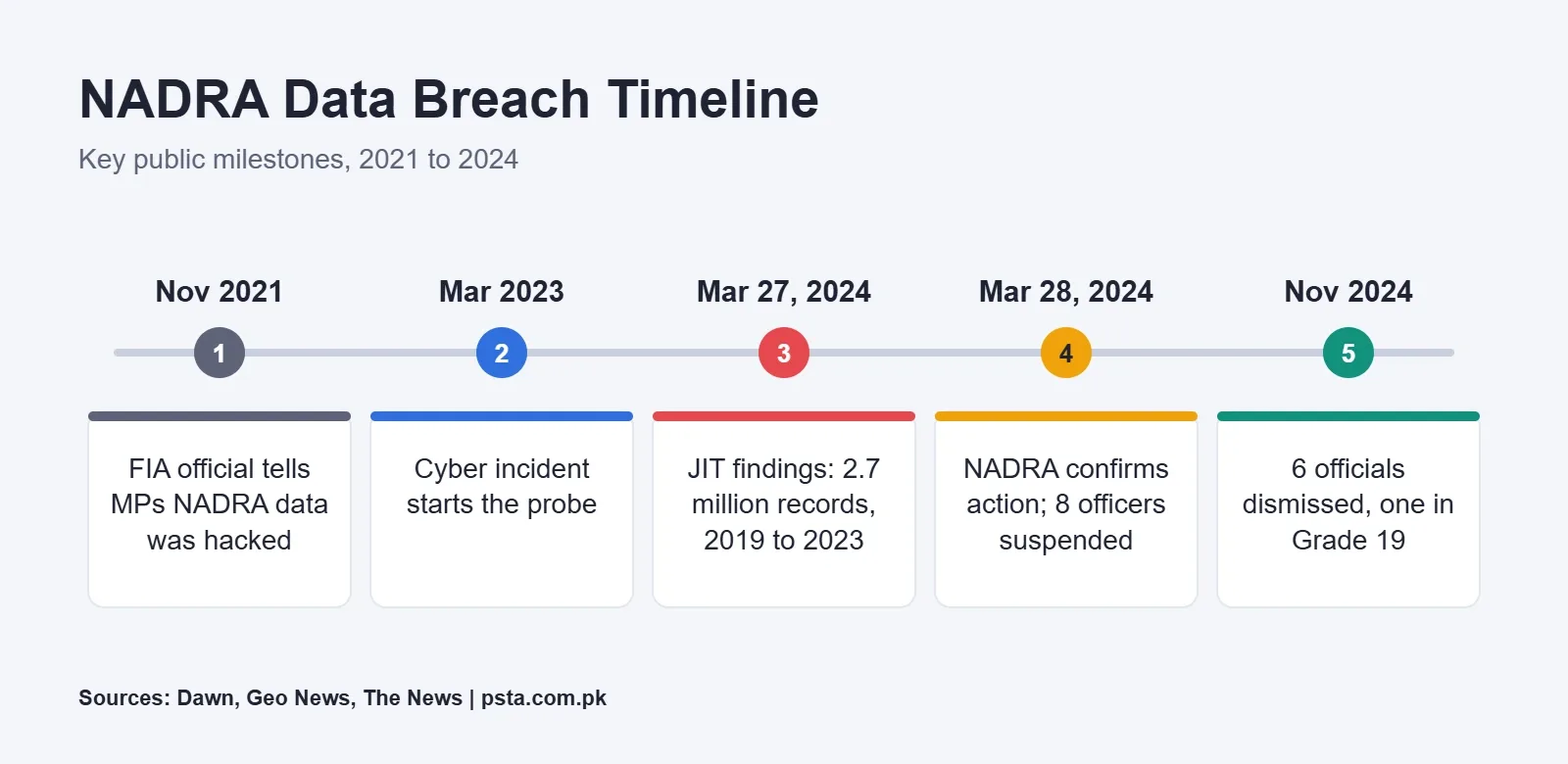
Two of these rows are easy to confuse with the main case. The 2021 claim concerned the SIM verification system, and the army chief family case involved staff who looked up specific records without permission. Both show the same weak point, though: people with legitimate system access using it for the wrong purpose.
Confirmed, Reported or Disputed? Sorting the Claims
Headlines about the NADRA data breach in March 2024 used words like "confirmed" and "stolen." The real picture is more layered. Sorting each claim by its evidence helps you judge how much weight to give it.
| Claim | Status | Why |
|---|---|---|
| About 2.7 million people affected, 2019 to 2023 | Confirmed in substance | Reported from the JIT, then acknowledged by NADRA's chairman before parliament in November 2024 |
| Disciplinary action followed the JIT's findings | Confirmed | A NADRA spokesperson said so on record |
| Six officials dismissed, one in Grade 19 | Confirmed | Stated by the chairman in a committee briefing |
| Staff at Multan, Karachi and Peshawar offices involved | Reported | From unnamed sources describing the JIT report |
| Data moved Multan to Peshawar to Dubai | Reported | From unnamed sources; the JIT text is not public |
| Data sold in Argentina and Romania | Reported | Sources say the report contains proof; no buyer has been named |
| No biometric data taken | Unverified | One anonymous source; the outlet said it could not confirm it |
| Entry through a telecom router in Multan, starting in 2016 | Unverified | One anonymous source; it conflicts with the 2019 start date |
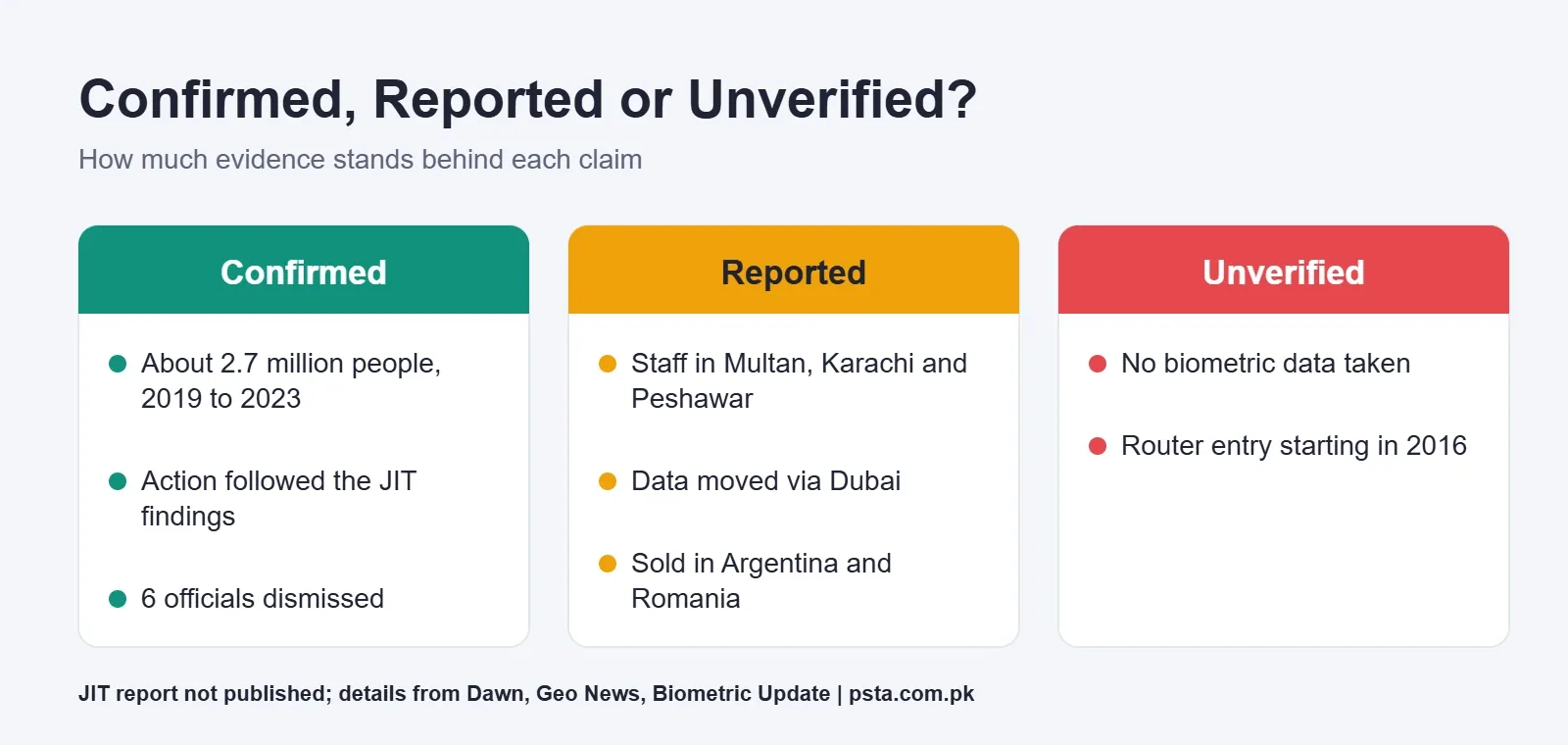
The headline facts hold up. The route, the buyers and the exact data fields are where you should stay cautious, because only people who have read the sealed report can check them.
How Did the Data Leave NADRA?
According to Geo News, the JIT traced the records from Multan to Peshawar and then to Dubai, after which they were sold in Argentina and Romania. The report blamed negligence by senior NADRA officials for allowing the theft. Geo said the JIT was led by FIA official Syed Waqaruddin and included NADRA nominees alongside officers from what it called sensitive agencies.
In plain terms, the NADRA data breach looks like an insider threat rather than an outside hacker breaking through a firewall. Staff in regional offices have accounts that can search citizen records. If those accounts are shared, poorly watched or allowed to pull large volumes, records can be copied out bit by bit over years. No alarm sounds, because each query looks like normal work.
A different theory came from an anonymous source quoted by Biometric Update. That person claimed the breach began in 2016 through a telecom router at a NADRA site in Multan. The outlet said it could not confirm the claim. Treat it as one possibility, not a finding.
Either way, the lesson for defenders is similar. You need to know who touched which record, from which device, and whether that pattern makes sense.
What Data Was Taken, and Were Biometrics Included?
None of the reports on the NADRA data breach lists the exact fields the JIT found in the leaked files. Dawn and Geo use broad words like "particulars" and "personal data."
The biometrics question has a confusing history. In November 2021, Dawn reported that an FIA official told lawmakers NADRA's data had been hacked. He later clarified that only the biometric system used for SIM verification was compromised, not the whole record. Biometric Update notes that NADRA's leadership at the time denied that its database had been breached.
For the 2024 case, the anonymous source quoted by Biometric Update said only text data such as names, mobile numbers and addresses was taken, with no fingerprints or face images. Again, that has not been confirmed on record. The safest reading for you is this: assume your name, CNIC number, address and family details could be in criminal hands, and protect the accounts those details can open.
Who Was Blamed, and How Sure Are Investigators?
Unlike the Binance hack or many crypto thefts, no foreign state or named hacking group has been publicly blamed here. The JIT's finger, as reported, points at NADRA's own people: staff in three regional offices and senior officials whose negligence let it happen.
How confident is that attribution? The disciplinary record gives it weight. On March 28, 2024, Geo News reported that eight officers had been suspended and charged, citing The News. Senior managers facing action reportedly included the director general (technical) and the director general (network) in Karachi. A NADRA spokesperson confirmed the action followed the JIT's recommendations but declined to name anyone, pointing to privacy and ongoing court proceedings.
What remains unknown is who bought the data, who paid the insiders, and whether any criminal case has reached a verdict. No public report so far names a conviction.
What Happened After the Report?
In November 2024, NADRA chairman Lt Gen Munir Afsar briefed the National Assembly Standing Committee on Interior, and the NADRA data breach came up. Dawn reported that six officials involved in the breach had been dismissed, one of them a Grade 19 officer. NADRA also said it monitors 300 to 400 people every day to catch data leaks and unauthorized ID card issuance, and that 60 officers had been dismissed or removed over five years.
Not every lawmaker was satisfied. According to The News, committee member Agha Rafiullah alleged that people responsible were still at NADRA and had been moved to better posts. The chairman said those implicated had been dismissed. The two accounts have not been reconciled publicly.
Some controls predate the JIT report. In May 2023, Dawn described how NADRA used logs, user IDs and IP addresses to identify 10 suspects in the army chief family case. The same report said NADRA had launched "Ijazat Aap Ki," which asks a citizen for a one-time code before their data is accessed remotely, and AI-based reviews of staff activity. A chairman's letter quoted there warned that unauthorized access could bring up to five years in prison, a fine of up to Rs. 1 million, or both.
What Does the NADRA Data Leak Mean for You in Pakistan?
The NADRA data leak is unlikely to empty a bank account by itself. Its danger is that it makes other frauds believable. With your name, father's name, CNIC number and address, a criminal can:
- Try to register a SIM in your name, which then supports SIM fraud and fake accounts
- Call you pretending to be a bank, NADRA or a courier and recite your details to win trust
- Attempt identity theft in Pakistan through loan apps or wallet sign-ups that check only basic details
- Target relatives, because family tree information links people together
The fix is to protect the things CNIC data cannot replace: your OTPs, your PINs and your SIM. Our guide to fraud calls in Pakistan covers the scripts callers use, and if a messaging account is taken over, follow the WhatsApp recovery checklist.
You can also check your SIM count. A PTA notice from November 2023 says you can send your CNIC number, without dashes, by SMS to 668 to see the SIMs issued against it; charges apply. The same notice says the disowning charge of up to Rs. 200 is waived once where a SIM was issued illegally without your consent. Disown any number you do not recognize at your operator's service centre.
The NADRA data breach also echoes earlier Pakistani cases. The 2018 bank card dumps and the FBR cyber attack showed how public trust drops when institutions share little about what went wrong.
Seven Defensive Lessons for Offices That Hold CNIC Data
Banks, telecom franchises, hospitals and HR departments all store CNIC data. You do not need NADRA's scale to learn from the NADRA data breach. These controls address the insider threat directly.
- Give each person the least access they need. A counter clerk should see one record at a time, not run broad searches.
- Ban shared logins. NADRA's own 2023 letter barred staff from using a colleague's account. Shared accounts erase accountability.
- Log every lookup and review the logs. Logs and IP addresses identified suspects in the army chief family case. Logs nobody reads catch nothing.
- Alert on volume and timing. Thousands of lookups from one office, or queries at 2 AM, should reach a supervisor the same day.
- Ask the citizen first. A consent code, like the one NADRA describes, turns each person into a check on remote access to their record.
- Audit network devices and vendors. Routers and contractor links sit inside your walls. Whether or not the router theory is true, an unmanaged device is a blind spot.
- Tell people what happened. Good data protection includes disclosure. A clear notice to affected citizens helps them defend themselves sooner.
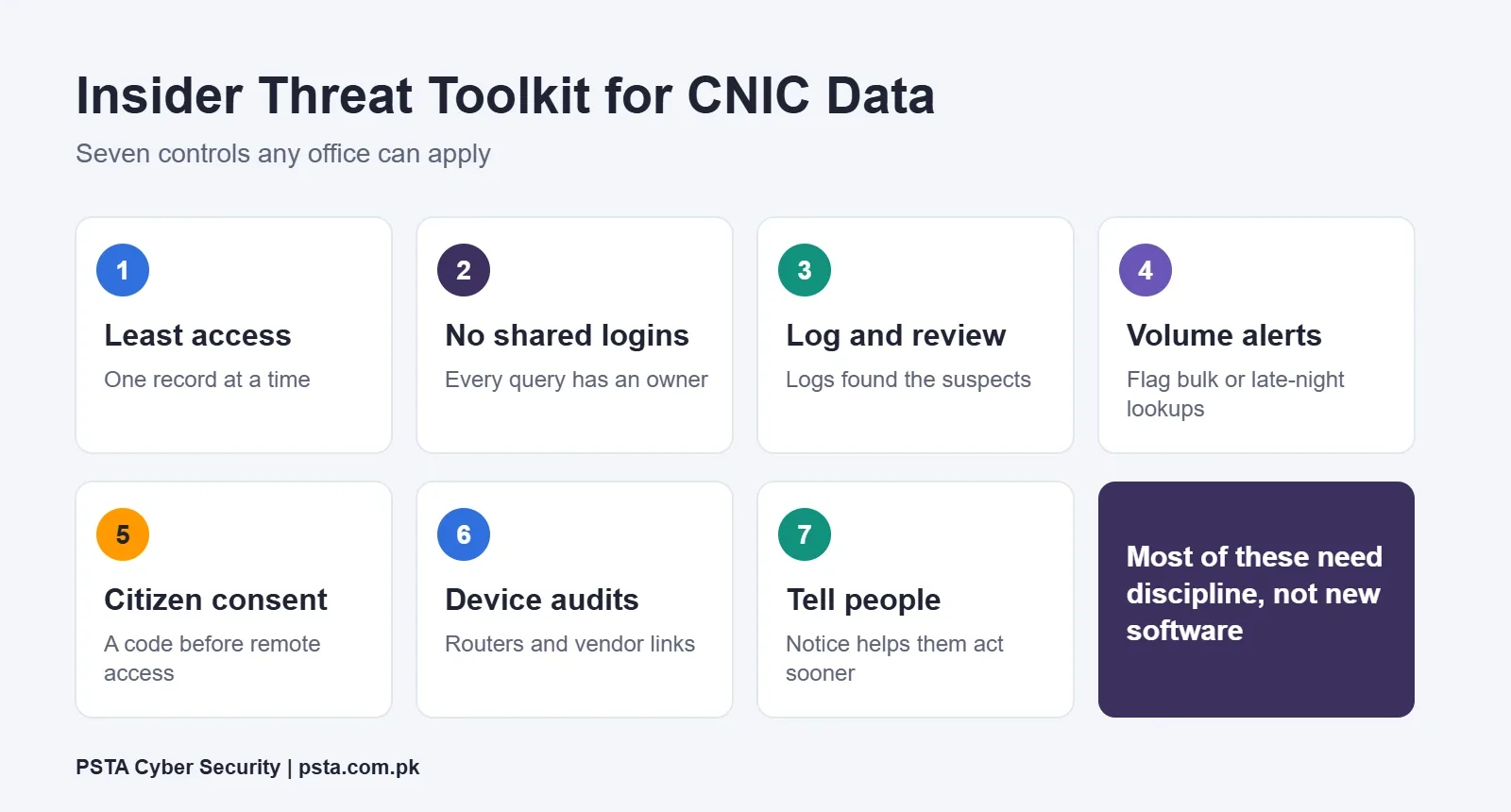
Notice that none of these needs expensive software. Most depend on discipline: someone owns the logs, someone reviews alerts, and managers face consequences when they ignore both.
Where PSTA Students Practice Insider Investigations
Cases like the NADRA data breach are why PSTA's Cyber Security and Ethical Hacking course spends time on the defender's side. It runs for 12 weeks at beginner level, on campus in Abbottabad or live online across Pakistan, with a new batch each month and sessions held from Monday to Saturday, any time from 9:00 AM until 9:30 PM.
The outline starts with basics like risk and the CIA triad, then moves through common attacks, defending networks, spotting malware and threats, cyber law and basic digital forensics. Lab work includes looking into a simulated incident, keeping evidence intact and writing up a dated timeline, much like the one above. A final case-study project asks you to present a security report. No prior security background is required.
If you later want to test systems the way attackers do, with permission, PSTA's advanced penetration testing course is the next step. You can ask questions about either course on WhatsApp or visit the campus before deciding.
Tonight: Send One SMS to 668
The NADRA data breach is a reminder that your identity details may already be out of your control. What stays in your control is the layer on top. Tonight, text your CNIC number to 668, compare the SIM count with the numbers you actually use, and disown any you do not recognize. It takes five minutes and closes one of the easiest doors a criminal could use.
Frequently asked questions
Was my CNIC part of the NADRA data breach?
NADRA has not published a list of affected people, and no public tool lets you check one. Since about 2.7 million records were reportedly taken, the practical approach is to assume your basic details could be exposed. Watch for unknown SIMs on your CNIC, refuse to share OTPs, and treat callers who recite your details with extra suspicion.
Did the NADRA data leak include fingerprints?
No official statement has settled this. An anonymous source told Biometric Update that only text data such as names, phone numbers and addresses was taken, but the outlet could not confirm it. In 2021 an FIA official told lawmakers the biometric system used for SIM checks was compromised, then narrowed that claim. Treat the question as open.
Who investigated the NADRA data breach?
A joint investigation team led by an FIA officer investigated it. Geo News named him as Syed Waqaruddin and said the team included NADRA nominees and officers from intelligence agencies. The team was formed after a cyber security incident in March 2023 and sent its report to the Interior Ministry in March 2024.
Has anyone been punished for the leak?
NADRA confirmed disciplinary action in March 2024, when eight officers were reported suspended and charged. In November 2024 its chairman told a National Assembly committee that six officials, including one Grade 19 officer, had been dismissed. One committee member disputed that the people responsible had left. No criminal conviction has been publicly reported.
How can criminals misuse stolen CNIC data?
Stolen CNIC data helps criminals sound believable. They can try to register SIMs in your name, open accounts that only check basic details, or call you pretending to be a bank or NADRA while reading out your own information. The data alone rarely empties an account, which is why guarding OTPs and PINs matters most.
What should an office that stores CNIC copies do differently?
Limit who can see records, ban shared logins and keep a log of every lookup that someone actually reviews. Set alerts for bulk or late-night searches, check routers and vendor connections, and plan how you would tell customers if data leaked. These steps cost little and target the insider risk this case exposed.
Sources & references
- Dawn: 2.7m citizens' data compromised over five years dawn.com
- Geo News: Personal data of 2.7m Pakistanis stolen from Nadra record geo.tv
- Geo News: Nadra initiates action, suspends 8 officers geo.tv
- Biometric Update: Alleged NADRA breach does not include biometrics biometricupdate.com
- Dawn: Nadra briefing to NA interior committee (Nov 2024) dawn.com
- The News: Several officers fired for data breach thenews.com.pk
- Dawn: Nadra takes action over access to army chief's family data dawn.com
- PTA: SIM disowning charge notice pta.gov.pk
Last reviewed & updated on by Umar Qureshi. Written by the PSTA team in Abbottabad, Pakistan.

Umar Qureshi

Cyber Security & Ethical Hacking Course in Abbottabad - PSTA
Turn this guide into a career: hands-on training with real projects, online across Pakistan or on-campus in Abbottabad · 12 Weeks.
Comments
No comments yet — ask a question or share your experience.