Quick answer
In late 2014, attackers stole Sony Pictures data, wiped thousands of its computers and leaked films and emails while threatening cinemas over "The Interview." The FBI blamed North Korea, and US prosecutors later charged three North Korean hackers. Sony reported $35 million in expected repair costs for the year.
Key takeaways
- • The attack began with malware sent to Sony staff, then weeks of hidden access before the wiper ran.
- • Sony expected $35 million in investigation and repair costs for the year to March 2015.
- • The FBI and the US Justice Department attribute the attack to North Korea; the charges remain untested in court.
- • The same group is linked by prosecutors to the Bangladesh Bank theft and WannaCry.
- • Offline backups, network segmentation and phishing-resistant logins blunt this kind of attack.
Table of contents 17 sections
- What Was the Sony Pictures Hack?
- Sony Hack 2014 Timeline: From Hacked Screens to Sanctions
- How the Attack Worked, in Plain Language
- Step 1: A Way In Through Email
- Step 2: Quiet Movement and Data Theft
- Step 3: The Wiper
- Step 4: Leaks and Threats
- What Sony Lost: Money, Data and Films
- Who Did It, and How Sure Are Investigators?
- The FBI's Public Finding (December 2014)
- The Criminal Case (2018 and 2021)
- Independent Research (2016)
- What Happened Next: Sanctions, a Settlement and a Film Release
- Why Does a Hollywood Hack Matter in Pakistan?
- Eight Defensive Habits From the Sony Case
- Rebuilding the Sony Timeline as a PSTA Lab Exercise
- Check Who Can Reach Your Backups Before Friday
On 24 November 2014, staff at Sony Pictures Entertainment in Los Angeles found an image reading "Hacked by #GOP" on their computer screens, along with a claim that the attackers held all of the studio's internal data, according to a Global News timeline. That message was the public start of the Sony Pictures hack. Within a month, unreleased films and private emails were online, cinemas faced threats, and the US government had named a foreign state as the attacker.
This explainer walks you through the case the way a security instructor would. In it you will find:
- A dated timeline of the attack and the leaks that followed
- How the intruders got in and why the damage was so heavy
- What the FBI and the US Justice Department said, and how strong that attribution is
- What the case means for offices, media houses and banks in Pakistan
- Eight defensive habits you can apply at work this month
What Was the Sony Pictures Hack?
The Sony Pictures hack was a destructive intrusion into the network of Sony Pictures Entertainment (SPE), the Hollywood studio owned by Japan's Sony. The attackers did two things at once. They stole a large amount of confidential data, and they ran wiper malware that made company computers unusable.
A group calling itself the "Guardians of Peace" (GOP) took credit. Over the following weeks it released Sony files almost daily, AP reported in a story carried by PBS NewsHour. The group later linked its demands to "The Interview," a Sony comedy that, according to US prosecutors, the attack was meant to punish.
Most data breaches are quiet. Criminals copy records and sell them. This case was loud on purpose. In its formal statement, the FBI said the attack stood out because it was both destructive and coercive, PBS reported. That mix of theft, sabotage and public pressure is why security teams still study the Sony hack 2014 case more than a decade later.
Sony Hack 2014 Timeline: From Hacked Screens to Sanctions
The dates below are US dates, drawn from the Global News timeline unless another source is named. In November and December, Los Angeles runs 13 hours behind Pakistan Standard Time, so a morning event in California happened late in the evening in Pakistan.
| Date (US) | What happened | Source |
|---|---|---|
| 24 Nov 2014 | Sony systems are hit and the "#GOP" image appears on staff screens. Sony calls it an IT matter. | Global News |
| 27 Nov 2014 | Five Sony films appear on file-sharing sites. | Global News |
| 1 Dec 2014 | The FBI opens an investigation. | Global News |
| 8 to 9 Dec 2014 | The attackers demand that "The Interview" be pulled. Full mailboxes of senior executives leak. | Global News |
| 16 Dec 2014 | The attackers threaten cinemas that show the film. The New York premiere is cancelled. | Global News |
| 17 Dec 2014 | Sony cancels the Christmas Day release after major cinema chains drop the film. | Global News, PBS |
| 19 Dec 2014 | The FBI formally blames the North Korean government. | PBS |
| 24 to 25 Dec 2014 | Sony reverses course: a limited cinema release plus online rental and sale. | Global News |
| 2 Jan 2015 | The US announces new sanctions on North Korean bodies and officials. | Al Jazeera |
| 6 Sep 2018 | US prosecutors make public a criminal complaint against North Korean programmer Park Jin Hyok. | US DOJ |
| 17 Feb 2021 | An indictment adds two more alleged North Korean military hackers to the case. | US DOJ |
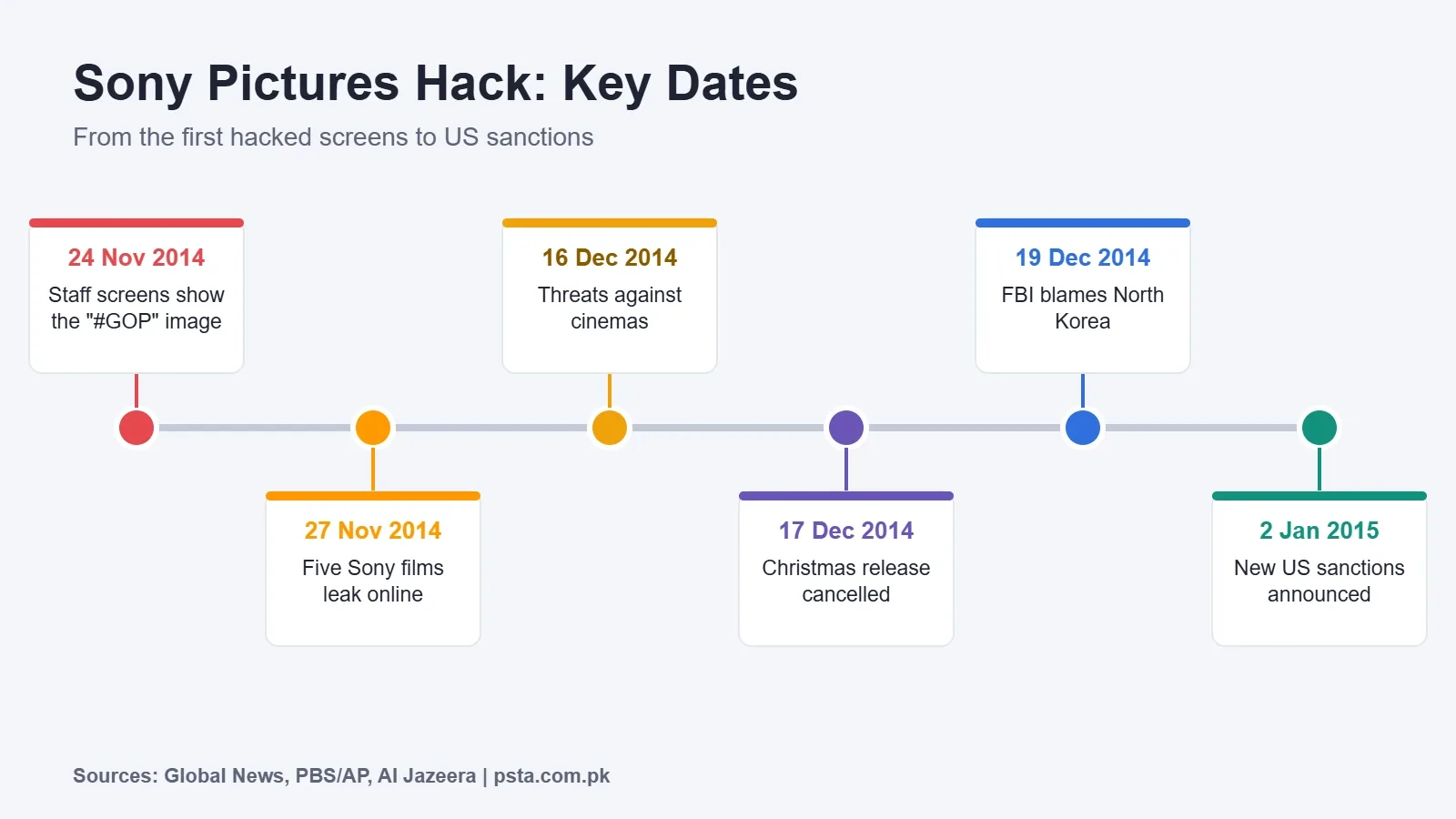
Notice the gap at the top of the table. In the Sony Pictures hack, the hacked screens on 24 November were the end of the intrusion, not the start. By the time staff saw the image, the attackers had already copied the data they later leaked.
How the Attack Worked, in Plain Language
Public records describe the Sony Pictures hack in broad steps. They do not give a full technical playbook, and you don't need one to learn from it.
Step 1: A Way In Through Email
The 2018 US criminal complaint alleges the attackers got into the network by sending malware to Sony employees, the Justice Department said. This is spear phishing: messages built for specific people, so they look like normal work email. Prosecutors also say the same group sent similar emails to a cinema chain and a British production company around the same time.
Step 2: Quiet Movement and Data Theft
Once inside, the intruders had time to explore. They reached file servers and mailboxes and copied films, salary sheets, contracts and personal records. None of this was visible to staff until the attackers chose to reveal it.
Step 3: The Wiper
The final stage used wiper malware, software that deletes or overwrites data so machines can't start or work. Prosecutors say the attack "damaged thousands of computers." Researchers later named the Sony wiper Destover, SecurityWeek reported.
Step 4: Leaks and Threats
Stolen data then became a weapon. The group released it in batches, wrote to journalists and threatened cinemas. Each new leak kept the story in the news and kept pressure on Sony's leaders.
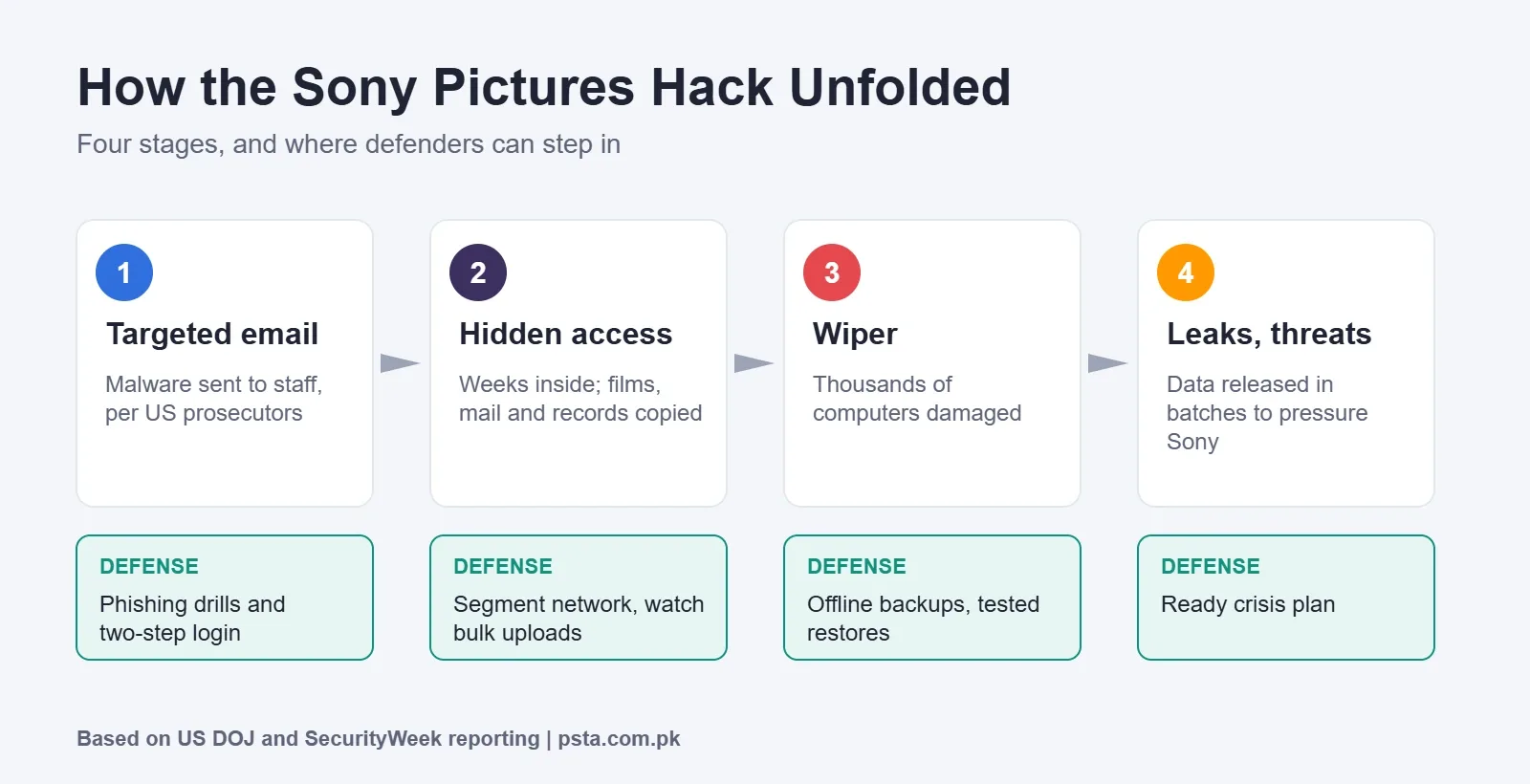
The lesson for defenders sits in the middle steps. A phishing email is hard to stop every time. Weeks of unnoticed movement and bulk copying inside a network is the failure that turned a breach into a disaster.
What Sony Lost: Money, Data and Films
Sony reported direct costs of the Sony Pictures hack rather than a single "loss" figure. In its February 2015 earnings, it put investigation and remediation costs at $15 million for the quarter that ended 31 December 2014, and expected $35 million for the full year to March 2015, CSO Online reported. A Sony spokesman said most of that went to restoring financial and IT systems. Sony also said the hack would not materially change its group results.
The data losses were wider than money:
- Films: five Sony titles leaked online on 27 November, and one of them, "Fury," passed 1.2 million downloads within days, Global News reported.
- Staff records: personal data on thousands of employees was exposed, CNN Money reported.
- Salaries: pay details of 17 top executives were published, according to Global News.
- Email: entire mailboxes of senior executives leaked on 9 December, exposing private remarks about stars and partners.
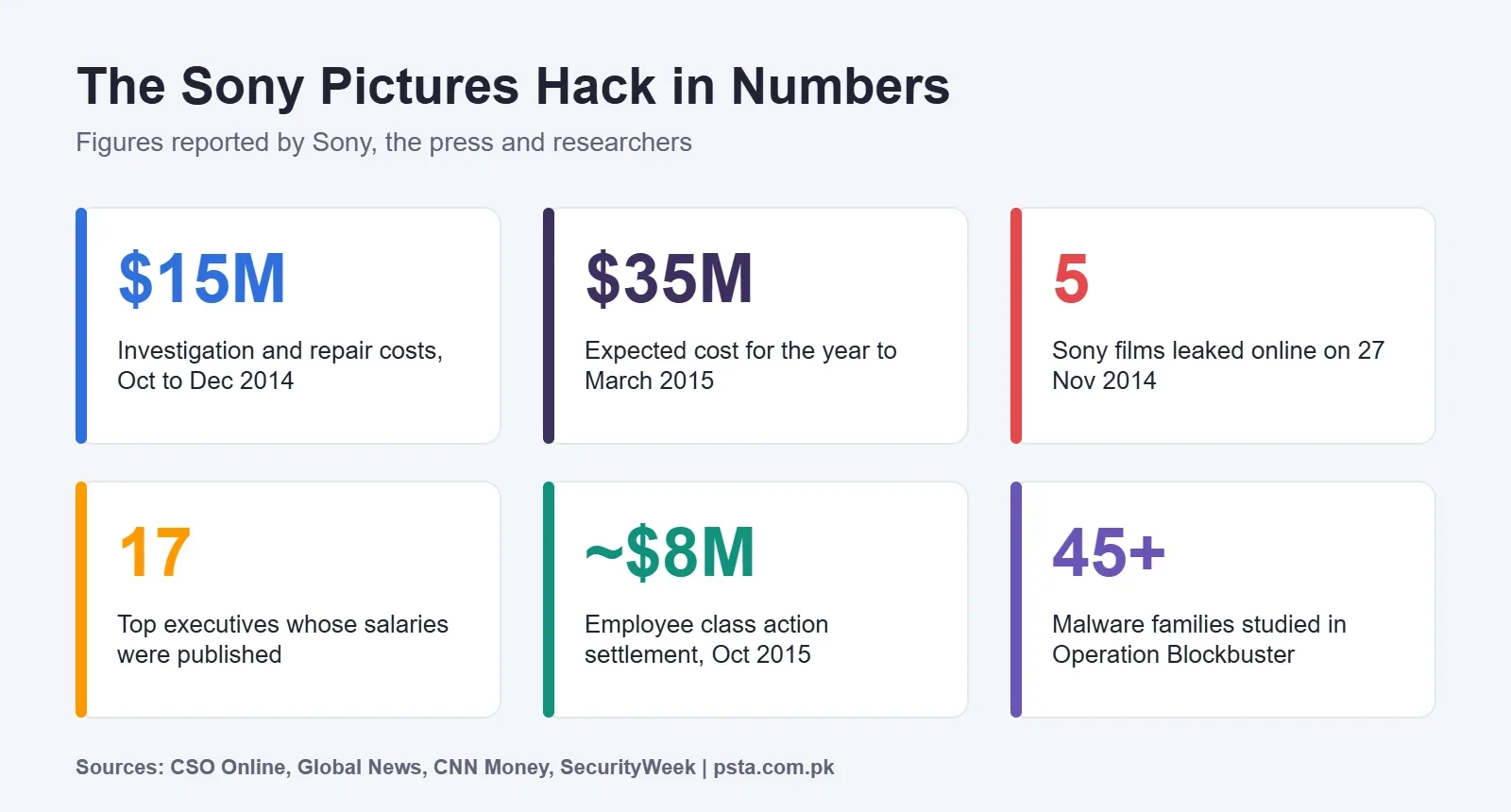
Some costs never appear in an earnings report. Leaked emails strained business relationships, and staff spent months worried about identity theft. That second cost turned into a lawsuit, covered below.
Who Did It, and How Sure Are Investigators?
Attribution is the part of the Sony Pictures hack that people argue about most, so it helps to separate three layers.
The FBI's Public Finding (December 2014)
On 19 December 2014, the FBI said the North Korean government was responsible. According to PBS, the bureau pointed to links between internet addresses operated by North Korea and the attack tools, and to code, encryption and data-deletion methods that matched earlier North Korean tools. The FBI said it kept details limited to protect its sources and methods. North Korea denied involvement while praising the hack as a "righteous deed," PBS reported.
The Criminal Case (2018 and 2021)
In September 2018, the Justice Department charged Park Jin Hyok, a North Korean programmer, with conspiracy to commit computer fraud and wire fraud. The complaint ties him to a North Korean front company and says the same team carried out the Sony attack, the $81 million theft from Bangladesh Bank and the WannaCry ransomware outbreak. In February 2021, an expanded indictment added two more defendants and described them as members of North Korea's Reconnaissance General Bureau, a military intelligence agency, the DOJ said. Both releases stress that the charges are only allegations, and neither release says any defendant is in US custody.
Independent Research (2016)
In February 2016, Novetta, Kaspersky, AlienVault and Symantec published joint research called Operation Blockbuster on the actor they named the Lazarus Group. They studied more than 45 malware families and linked the Sony attack to earlier campaigns in South Korea, SecurityWeek reported. Novetta concluded the Sony attack was unlikely to be the work of hacktivists or insiders, an idea some commentators had raised in 2014. The vendors did not directly name North Korea, though their evidence pointed that way.
So how confident should you be? The government attribution comes with formal charges and has been repeated over years, and private researchers reached a matching technical picture on their own. That makes this North Korea cyber attack attribution one of the better-supported in public records. It still rests partly on evidence the public has not seen, and no court has tested it.
What Happened Next: Sanctions, a Settlement and a Film Release
The aftermath played out on three fronts.
- Government response. On 2 January 2015, President Obama signed an executive order that led to sanctions on three North Korean organizations, including the Reconnaissance General Bureau, and 10 officials, Al Jazeera reported. Officials said it was the first US sanctions action over a threat to a private company.
- The film. After cancelling the Christmas release, Sony allowed a limited cinema release and put the film online for rental and sale. "The Interview" earned more than $15 million in online rentals and purchases in its first four days, Global News reported. President Obama had said Sony "made a mistake" in pulling it, PBS reported.
- Employees. Former staff sued over the exposure of their personal data. In October 2015, Sony agreed to pay up to about $8 million to settle the class action and to extend credit and fraud monitoring by two years, according to CNN Money.
The same group did not stop. Prosecutors link it to later bank thefts and to crypto heists, a thread you can follow in our Bangladesh Bank heist case study and the Bybit hack breakdown.
Why Does a Hollywood Hack Matter in Pakistan?
It is easy to treat the Sony Pictures hack as a story about celebrities. For a Pakistani IT manager, it is closer to home than it looks.
First, the actor behind it, according to US prosecutors, also hit South Asia. The 2016 Bangladesh Bank theft and the 2017 WannaCry outbreak are both in the same US case file. Our WannaCry ransomware myths and facts post covers how that worm spread across unpatched Windows machines worldwide.
Second, the pattern fits local targets. TV channels, production houses, software exporters and banks in Pakistan run large Windows networks, store staff CNIC copies and salary files, and depend on email. A wiper doesn't need a ransom note to stop a newsroom or a branch network for days.
Third, leaked staff data hurts people for years. Once CNIC numbers, phone numbers and salary details are public, they feed SIM fraud and scam calls. The NADRA data breach showed how far exposed identity data can travel inside Pakistan.
Finally, the Sony case shows that motive changes the playbook. A criminal wants money and stays hidden. A state-backed actor with a political goal may prefer maximum noise and damage, so a backup plan built only for ransomware may not be enough.
Eight Defensive Habits From the Sony Case
None of these steps needs a Hollywood budget. Each one targets a stage of the Sony Pictures hack described above.
- Train for targeted phishing, not generic spam. Show staff real examples aimed at their role, such as fake invoices for finance or fake script files for producers.
- Turn on strong sign-in protection. Use app-based or key-based two-step login for email and VPN. Our guide to two-factor authentication ranks the methods.
- Limit admin rights. Normal accounts should not be able to install software or reach every server. Fewer powerful accounts means slower movement for an intruder.
- Split the network. Keep finance, HR and production systems in separate zones, so one infected laptop cannot reach everything.
- Watch for bulk data leaving. Alert on unusual uploads or large archive files moving to outside addresses, especially at night.
- Keep offline backups and test restores. A wiper destroys whatever it can reach. Backups that are disconnected or immutable, and restore drills that are timed, decide how fast you recover.
- Treat email as a record. Set retention rules, delete what you no longer need and remind leaders that anything written may one day be public.
- Prepare a crisis plan. Decide in advance who talks to staff, police, regulators and the media, and how teams work if every PC is down.
Rebuilding the Sony Timeline as a PSTA Lab Exercise
Reading about a breach is the first step. Being able to explain it to a manager, with a timeline and a list of fixes, is the skill employers pay for.
PSTA's Cyber Security and Ethical Hacking Course is a 12-week, beginner-level program. Classes are live online for learners anywhere in Pakistan, with a campus option in Abbottabad. Its published outline moves from attack types and network defense to malware detection, then into cyber law and forensics. In the labs you work through an incident, keep the evidence intact and put events in date order, much like the table above. The last weeks go into a final case study that you present as a security report. Spear phishing, network segmentation and incident response, the main themes of the Sony Pictures hack, all fit that structure.
Already comfortable with the fundamentals? Our advanced penetration testing course teaches authorized testing of networks from an attacker's point of view. For a wider view of the series, start with the Binance hack explainer, which opened these case studies.
Want to ask which course fits your background? Send us a message on WhatsApp and a trainer will reply with an honest suggestion.
Check Who Can Reach Your Backups Before Friday
The Sony Pictures hack turned a phishing foothold into weeks of hidden access and then a wiper. If you look after any office network, pick one thing this week: list which accounts can delete or change your backups, and remove every one that doesn't need that power. It takes an hour and closes the door that matters most when a wiper arrives.
Frequently asked questions
When did the Sony Pictures hack happen?
The visible attack began on 24 November 2014, when Sony staff saw a "#GOP" image on their screens. The attackers had been inside the network before that and had already copied data. Leaks continued through December 2014, and the FBI named North Korea on 19 December.
Who were the Guardians of Peace?
Guardians of Peace was the name the attackers used when they claimed the Sony attack and leaked files. US investigators later said the people behind it worked for North Korea. Security researchers track the same actor as the Lazarus Group, which has been linked to many attacks since about 2009.
Was any money stolen from Sony?
Public reports describe data theft and destruction, not a theft of funds. Sony instead reported costs: $15 million for investigation and repair in the quarter to December 2014 and an expected $35 million for the full year. It also agreed to an employee settlement of up to about $8 million.
Has anyone been convicted for the Sony hack?
No. In 2018 and 2021, US prosecutors charged three North Korean men in connection with the attack and other schemes. The Justice Department stresses that these charges are allegations, and neither of its releases reports an arrest. That means the evidence has not been tested in a US court.
What is wiper malware?
Wiper malware is software built to destroy data rather than steal it or hold it for ransom. It deletes or overwrites files and key disk areas so computers cannot start or work. Recovery depends on clean, offline backups and a tested plan for rebuilding machines.
Could a similar attack hit a company in Pakistan?
Yes. Any office that relies on email and Windows networks can face targeted phishing followed by a destructive payload. The same actor is linked to attacks in South Asia, such as the Bangladesh Bank theft. Segmentation, strong logins and offline backups reduce the damage a lot.
Sources & references
- US DOJ: North Korean Regime-Backed Programmer Charged (2018) justice.gov
- US DOJ: 3 North Korean Military Hackers Indicted (2021) justice.gov
- PBS NewsHour (AP): FBI links North Korea to Sony hack pbs.org
- CSO Online: Hack to cost Sony $35 million in IT repairs csoonline.com
- Global News: Timeline of the Sony Pictures hacking scandal globalnews.ca
- SecurityWeek: Sony Hackers Linked to Many Espionage, Destruction Campaigns securityweek.com
- Al Jazeera: US sanctions North Korea over Sony hacking aljazeera.com
- CNN Money: Sony pays price for hack attack money.cnn.com
Last reviewed & updated on by Umar Qureshi. Written by the PSTA team in Abbottabad, Pakistan.

Umar Qureshi
Cyber Security & Ethical Hacking Course in Abbottabad - PSTA
Turn this guide into a career: hands-on training with real projects, online across Pakistan or on-campus in Abbottabad · 12 Weeks.

Comments
No comments yet — ask a question or share your experience.