Quick answer
The FBR cyber attack began before 2:00 am on August 14, 2021, when intruders reached the tax agency's main data centre in Islamabad. Official websites stayed down for more than 72 hours. The finance minister confirmed the hack but denied any data sale, and the FBR said it restored the full taxpayer database by August 25.
Key takeaways
- • The FBR first called the outage a migration; the finance minister later confirmed a hack.
- • Sources said about 360 virtual machines, roughly half the total, were taken over or shut down.
- • Reported entry routes include compromised admin logins, the Hyper-V layer and spear phishing emails.
- • Access was offered on a crime forum, but no sale of taxpayer data was ever proven.
- • No attacker has been publicly named, and no final investigation report has been published.
Table of contents 18 sections
- What Was the FBR Cyber Attack?
- FBR Cyber Attack Timeline in Pakistan Time
- Seven Myths vs Facts About the FBR Cyber Attack
- Myth 1: It Was Only a Failed Data Migration
- Myth 2: Hackers Broke In Through the Website
- Myth 3: Everything Was Lost for Good
- Myth 4: FBR Data Was Proven to Be Sold on the Dark Web
- Myth 5: A Named Foreign Group Has Been Blamed
- Myth 6: The Problem Was Pirated Software, Full Stop
- Myth 7: Nobody Could Have Seen It Coming
- How Did the FBR Data Centre Hack Work?
- What Went Offline, and What Did It Cost?
- Who Was Behind the FBR Cyber Attack, and How Sure Is Anyone?
- What Happened After the FBR Hacking of 2021?
- What Does the FBR Cyber Attack Mean for You in Pakistan?
- Seven Defensive Lessons From the FBR Cyber Attack
- How PSTA Students Work Through a Case Like This
- Test One Backup Restore This Month
Many people still remember the FBR cyber attack of August 2021 as a long website outage during a "migration." That was the first official story, but Finance Minister Shaukat Tarin later confirmed to The News that "the system was hacked." Sources told The Express Tribune that about 360 virtual machines, roughly half the total, were taken over or shut down.
This case study is built around the claims that spread at the time, checked against what reporters and officials actually said. You will find:
- Seven common myths about the 2021 attack, each set against the reported facts
- A timeline in Pakistan time, from early warnings to full data recovery
- How the intrusion reportedly worked, explained without exploit detail
- Where the sources disagree, and why you should read them carefully
- Seven defensive lessons for Pakistani offices, schools and businesses
What Was the FBR Cyber Attack?
The Federal Board of Revenue (FBR) collects federal taxes and customs duties. Its systems are run by Pakistan Revenue Automation Limited, known as PRAL, which supports the FBR and houses its data. That data includes income, wealth, transaction and withholding tax records for citizens and companies.
Shortly before 2:00 am on August 14, 2021, attackers struck the FBR House data centre in Islamabad, according to The Express Tribune's first report. The official website showed a maintenance notice. An internal FBR warning, quoted in the same report, said the agency had "experienced a severe cyberattack on our data centers" and that all applications were shut down.
The timing mattered. It was Independence Day, and one senior official quoted by the paper called it "cyber terrorism" on that day. For several days, taxpayers, customs agents and traders could not rely on the systems they use to file returns and clear goods.
FBR Cyber Attack Timeline in Pakistan Time
All times below are Pakistan Standard Time (PKT). Where a source gives only a weekday, the date has been worked out from the article's own date.
| Date (PKT) | What happened | Source |
|---|---|---|
| Early July 2021 | Threat intelligence about spoofed government emails carrying harmful attachments starts circulating, according to a security engineer quoted later | ProPakistani |
| Wed, Aug 11 | An intelligence agency reportedly warns the FBR of a possible attack; sources say the warning was ignored | Express Tribune |
| Evening, Aug 13 | Public-facing services go offline, by The Register's reading of FBR statements | The Register |
| Before 2:00 am, Aug 14 | Attackers hit the main data centre; websites and applications go down | Express Tribune |
| Aug 14 | FBR blames "unforeseen anomalies" in a migration and expects a fix within 48 hours | Express Tribune |
| Aug 15 | A listing offering access to more than 1,500 FBR systems is reported on a Russian-language crime forum | Hackread |
| Mon, Aug 16 | FBR says public-facing applications such as IRIS and Tax Asaan are working again | Express Tribune, The Register |
| Aug 17 | Tarin says he will review the report and seek a third-party view before acting | Express Tribune |
| Days later | Tarin confirms the hack and says no damage was done to the data | The News |
| Wed night, Aug 25 | FBR completes recovery of the taxpayer database; an Irish IT firm is lined up to review security | ProPakistani |
Notice the first two rows of August. One source puts the outage on the evening of August 13, while another says the attack came before 2:00 am on August 14. Both could be true if early disruption came before the main strike, but no public report settles it.
Seven Myths vs Facts About the FBR Cyber Attack
Each myth below is a claim that circulated in 2021 or that people still repeat. The facts come from named reports, and the confidence level is stated where it is low.
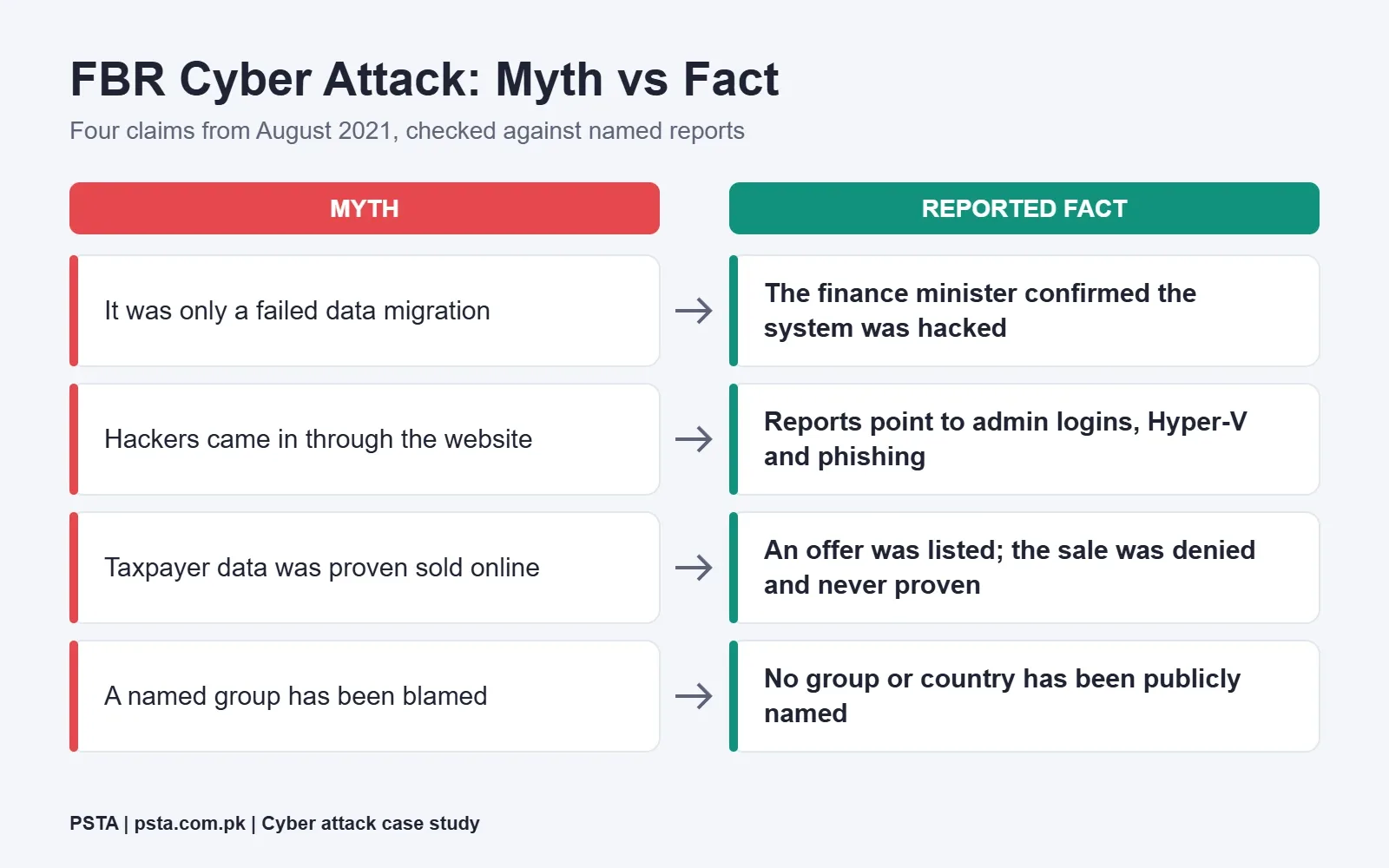
Myth 1: It Was Only a Failed Data Migration
Fact: The FBR's first press release spoke of "service optimisation" and a migration. Later, Tarin told The News plainly, "Yes the system was hacked." A Business Recorder column also pointed out that NADRA's chairman had tweeted that his team was helping restore FBR operations, which sat oddly with a routine migration story.
Myth 2: Hackers Broke In Through the Website
Fact: The website was a casualty, not the reported entry point. The FBR's technical wing first suspected a path through Microsoft's Hyper-V virtualisation layer, where administrator logins were compromised, according to The Express Tribune. A separate expert account pointed to spear phishing emails. Neither version has been confirmed in a public final report.
Myth 3: Everything Was Lost for Good
Fact: The record is mixed. Sources told The Express Tribune that data held on the affected machines at the time of the attack was lost. The FBR, however, said it recovered 90% of the data by one Tuesday and 100% by the next day, as reported by The News. ProPakistani reported the full taxpayer database restored on August 25.
Myth 4: FBR Data Was Proven to Be Sold on the Dark Web
Fact: What was reported is an offer, not a confirmed sale. Hackread saw a forum listing asking $26,000 for network access and $30,000 as an extortion demand. Tarin denied that hacked FBR data was being sold. No buyer, leak sample or later misuse has been publicly verified.
Myth 5: A Named Foreign Group Has Been Blamed
Fact: No group or country was publicly named by the government in the reports reviewed here. A listing on a Russian-language forum shows where the access was advertised. It does not show who carried out the attack or where they live.
Myth 6: The Problem Was Pirated Software, Full Stop
Fact: This one is disputed. Media reports cited a preliminary internal probe saying a pirated copy of Hyper-V was in use, according to ProPakistani. The FBR said PRAL mostly used licensed Hyper-V and called claims of pirated VMware software "simply not true." Licensing alone also would not explain a breach. Patching, account control and network design matter far more.
Myth 7: Nobody Could Have Seen It Coming
Fact: Several warnings came first, according to sources. The Express Tribune reported that an intelligence agency warned the FBR days before, and that PRAL's chief information officer had flagged weaknesses months earlier. A World Bank appraisal in May 2019 had already described FBR hardware as end-of-life, the paper's August 22 report said.
How Did the FBR Data Centre Hack Work?
Think of a modern data centre as a few powerful physical servers. Software called a hypervisor, such as Hyper-V, splits each one into many virtual machines. Each virtual machine runs its own system, such as a tax portal or a customs database.
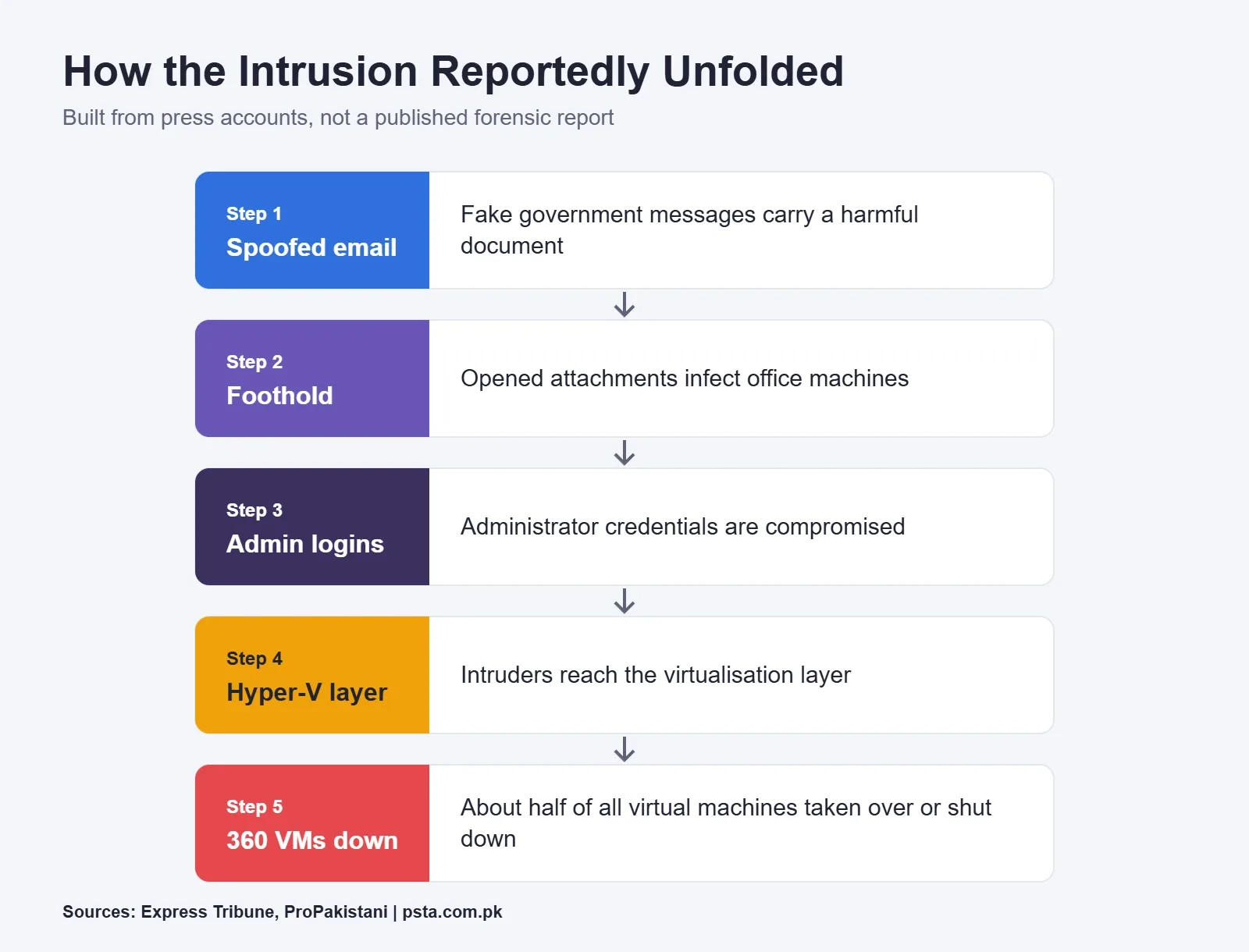
This setup saves money, but it also concentrates risk. Whoever controls the hypervisor layer can switch off or damage every virtual machine on top of it. That is why the FBR cyber attack's reported figure of about 360 affected machines, roughly half the total, is so telling. It points to an attacker who reached the management layer, not just one server.
Two accounts of the entry route were published:
- Stolen administrator logins. The FBR's technical wing reportedly believed the intruders used administrator credentials and the Hyper-V link.
- Spear phishing. Umair Ali Zafar, a principal security engineer at Ebryx, told ProPakistani that spoofed emails posing as government and IT ministry messages carried harmful document attachments. One subject line reported by The Express Tribune was "National Cyber Security Policy Draft."
The two accounts can fit together. A phishing email often gives the first foothold, and stolen admin logins let the intruder climb from there. The Register also noted that a Hyper-V flaw able to crash hosts had been patched in May 2021, making a missed update plausible. That is an analyst's suggestion, not a confirmed finding.
What Went Offline, and What Did It Cost?
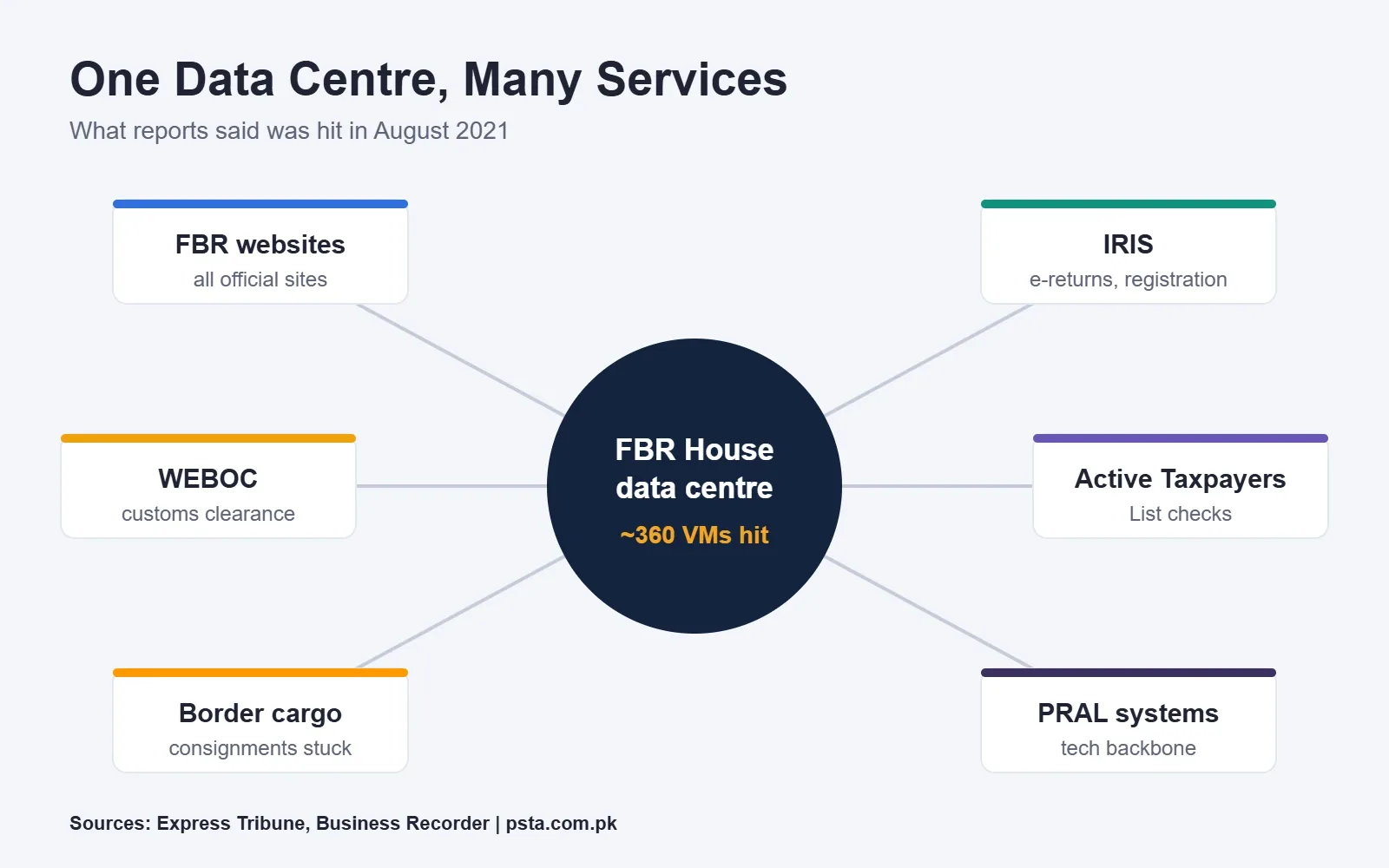
The Express Tribune said official websites stayed down for more than 72 hours. A Business Recorder column listed the affected services as the FBR website, the IRIS system for e-returns and registration, and WEBOC, used for customs clearance.
PRAL, the company that runs the FBR's technology, was reported down as well. The damage reached the border too. The first Express Tribune report described consignments stuck at border stations, including fresh vegetables and courier parcels. The Active Taxpayers List could not be checked because its data source was cut off.
The FBR pushed back on parts of this. It told The News that export goods declarations in WEBOC kept working, and that only an Active Taxpayers List glitch hit import filing for a while. It even shared figures: 1,901 goods declarations filed on August 14, 2021, against 1,148 a year earlier.
No official figure for the financial cost of the FBR cyber attack has been published. The bigger cost may be trust. Every taxpayer in Pakistan hands the FBR detailed income and wealth records, so even a disputed data risk weighs heavily.
Who Was Behind the FBR Cyber Attack, and How Sure Is Anyone?
The honest answer is that nobody has been publicly identified. Officials told reporters at the time that the attackers were unknown, and later coverage named no suspect. Here is how the evidence breaks down:
| Claim | Status | Confidence |
|---|---|---|
| The FBR systems were hacked | Confirmed by the finance minister | High |
| About 360 virtual machines were affected | Unnamed sources to The Express Tribune | Medium |
| Entry came through Hyper-V and admin logins | Initial internal assessment, reported by sources | Medium |
| Phishing emails gave the first foothold | Security expert's account | Medium to low |
| Access to 1,500+ systems was offered for sale | Forum listing seen by Hackread | Medium |
| Taxpayer data was sold | Denied by the finance minister; no proof published | Low |
| A named group or state carried it out | No public attribution | None |
Sale prices also differ by source. Hackread reported $26,000 for access plus a $30,000 extortion demand, while ProPakistani described the data as listed for $30,000. The likely reason is that one outlet described the full listing and the other summarised it.
What Happened After the FBR Hacking of 2021?
Recovery from the FBR cyber attack came in stages. The FBR said all public-facing services were back by August 16, according to The Register. The data centre itself was then shut down so every system and record could be checked, and ProPakistani reported full recovery of the taxpayer database on the night of August 25.
The government also moved to bring in outside help. The News reported that an Irish company would review the damage and safety protocols. Tarin said he would allow only registered software during his tenure. The FBR's initial recommendations, per The Express Tribune, included a review of software licensing and its relationship with Microsoft.
The paper also raised a funding question. A $400 million World Bank programme approved in June 2019 included an $80 million part for IT upgrades. A June 2021 status report said that upgrade work was delayed and its procurement had not started.
No arrests, fines or court cases linked to the attack appear in the reports reviewed for this post. If a final investigation report exists, it has not been published.
What Does the FBR Cyber Attack Mean for You in Pakistan?
If you are a taxpayer, your records sit with the FBR whether you like it or not. You can't control its servers, but you can watch for misuse. Scam calls and messages that quote your NTN, CNIC or income details are a warning sign, and our guide to fraud calls in Pakistan explains how to report them.
If you run a business, the lesson of the FBR cyber attack is closer to home. Many Pakistani firms run virtual servers, use shared admin passwords and delay updates to save time. The FBR case shows that one compromised management layer can take down every service at once.
This was not the only cyber attack in Pakistan to expose weak basics. Our case study on the 2018 Pakistan bank data breach shows a similar pattern of slow detection and unclear public communication.
Seven Defensive Lessons From the FBR Cyber Attack
- Treat the hypervisor as your crown jewel. Put management interfaces on a separate network that ordinary office PCs can't reach.
- Give every admin their own account with multi-factor login. Shared or reused admin passwords make stolen credentials far more dangerous.
- Patch virtualisation software on a schedule. Track vendor fixes monthly, and record when each one is applied. The WannaCry case shows what a missed patch can cost.
- Train staff to check official-looking emails. A message about a "policy draft" from a government address deserves a phone call before anyone opens the attachment.
- Act on warnings and log what you did. When an alert arrives, assign an owner and a deadline. A warning that nobody owns is the same as no warning.
- Keep offline backups and a second site. The World Bank had recommended an active-active setup so one site's failure would not stop all operations. Test that you can restore, not just copy.
- Communicate early and accurately. Calling a breach a migration costs trust once the truth comes out. Our Colonial Pipeline case study shows how a ransomware shutdown played out in public.
How PSTA Students Work Through a Case Like This
Reading about the FBR cyber attack is useful. Rebuilding its timeline, sorting confirmed facts from rumours and writing the defensive fixes is how you learn incident response. That is the kind of work done in PSTA's Cyber Security and Ethical Hacking Course.
According to the course page, the program runs for 12 weeks at beginner level, with no earlier security experience needed. The seven modules start with the CIA triad and attack types like phishing and social engineering. Later weeks add firewalls, VPNs and intrusion detection, then malware analysis with incident response, then forensics alongside PECA, ending in a case-study project. You can join online from anywhere in Pakistan or attend in Abbottabad.
If you already have the basics and want to test systems the way an attacker would, with permission, PSTA's advanced penetration testing track is the next step. For a wider view of credentials, see cyber security certifications for beginners, and read the Binance hack case study for a very different kind of attack.
Test One Backup Restore This Month
Pick one system your office can't work without, such as accounts or a customer database. Ask whoever manages it to restore last week's backup to a spare machine, and time how long it takes. If the answer is "we have never tried," you have found your most useful task for the month, and the FBR case shows why it matters.
Frequently asked questions
When did the FBR cyber attack happen?
Attackers struck the FBR's main data centre in Islamabad before 2:00 am on August 14, 2021, according to The Express Tribune. The Register's reading of FBR statements puts the first public outage on the evening of August 13. Public services were back by August 16, and the full taxpayer database was restored on August 25.
Was taxpayer data stolen in the 2021 FBR hack?
It has not been proven. A crime forum listing offered access to FBR systems, and some outlets said data was for sale. Finance Minister Shaukat Tarin denied that hacked FBR data was being sold and said no damage was done to the data. No leaked sample or later misuse has been publicly verified.
Who hacked the FBR in 2021?
No person, group or country has been publicly named. Officials said the attackers were unknown, and later reports named no suspect. The access was advertised on a Russian-language forum, but where something is advertised does not tell you who carried out the attack or where they are based.
What is Hyper-V, and why did it matter here?
Hyper-V is Microsoft's virtualisation software. It lets one physical server run many virtual machines. The FBR's technical wing reportedly suspected intruders came in through this layer using administrator logins. Control of a hypervisor can affect every virtual machine on it, which helps explain why so many systems went down at once.
Did the FBR use pirated software?
This claim is disputed. Media reports citing a preliminary probe said a pirated copy of Hyper-V was in use. The FBR said PRAL mostly used licensed Hyper-V and rejected claims about pirated VMware software. Either way, licensing alone does not cause a breach; patching, admin account control and network design matter more.
How can a small business avoid a similar outage?
Keep server management tools on a separate network, give every administrator a personal account with multi-factor login, and patch virtualisation software every month. Keep an offline backup and test a full restore at least once a quarter. Train staff to confirm unexpected official emails by phone before opening attachments.
Where can students practise incident response on a case like the FBR attack?
PSTA's Cyber Security and Ethical Hacking Course runs for 12 weeks and suits beginners. Its later modules cover incident response, digital forensics with PECA law and a final case-study project, so rebuilding an attack timeline fits the coursework. You can attend from any Pakistani city over the internet or come to the Abbottabad campus, and an advanced penetration testing track follows.
Sources & references
- FBR reels under a major cyberattack (The Express Tribune) tribune.com.pk
- Tarin mulls options on FBR hack (The Express Tribune) tribune.com.pk
- Neglect caused FBR cyber-attack (The Express Tribune) tribune.com.pk
- Cyber attack: FBR system now fully operational: Tarin (The News) thenews.com.pk
- FBR data hacking: Govt hires services of Irish company (The News) thenews.com.pk
- Pakistan's tax office outage (The Register) theregister.com
- Network access to FBR sold on Russian forum (Hackread) hackread.com
- Here's the real reason why FBR's system got hacked (ProPakistani) propakistani.pk
Last reviewed & updated on by Umar Qureshi. Written by the PSTA team in Abbottabad, Pakistan.

Umar Qureshi
Cyber Security & Ethical Hacking Course in Abbottabad - PSTA
Turn this guide into a career: hands-on training with real projects, online across Pakistan or on-campus in Abbottabad · 12 Weeks.
Comments
No comments yet — ask a question or share your experience.