Quick answer
Attackers entered Starwood's reservation network in July 2014 and stayed until September 2018, through Marriott's 2016 takeover. Roughly 339 to 383 million guest records were taken, including 5.25 million unencrypted passport numbers. The UK fined Marriott £18.4 million, and US states collected $52 million. US officials blamed China; no court has confirmed it.
Key takeaways
- • The intrusion began with a web shell in July 2014 and went undetected until a database alert on September 7, 2018.
- • Marriott inherited the compromised network when it bought Starwood in 2016.
- • Monitoring covered card fields only, so years of earlier database activity went unseen.
- • The UK ICO fined Marriott £18.4 million in 2020, down from a proposed £99.2 million.
- • The FTC order and a $52 million state settlement followed in 2024.
- • The China attribution comes from US officials and anonymous investigators, not a court ruling.
Table of contents 19 sections
- What Was the Marriott Data Breach?
- The Starwood Data Breach Timeline, Year by Year
- How Did the Marriott Hack Work?
- 1. A Foothold on a Web-Facing Server
- 2. Staying In Quietly
- 3. Collecting Passwords
- 4. Packaging the Data
- 5. Getting Caught by a Narrow Alarm
- What Did the Breach Expose, and Why Did the Numbers Change?
- Who Was Blamed for the Marriott Hack, and How Sure Is It?
- What Happened After the Marriott Data Breach?
- The Marriott ICO Fine
- The Marriott FTC Settlement
- Fixes Inside the Company
- Why a Hotel Data Breach Matters in Pakistan
- Seven Defensive Lessons From the Marriott Data Breach
- How Does This Compare With Other Cases in the Series?
- Reconstructing Breach Timelines in PSTA's Security Labs
- Ask One Vendor a Hard Question This Month
How could intruders sit inside a hotel booking system for four years before anyone raised an alarm? That is the central question of the Marriott data breach, which Marriott disclosed on November 30, 2018. The attackers had entered the Starwood network in 2014, two years before Marriott bought Starwood, and an alert finally fired in September 2018.
This case study walks through the incident in date order, because the gaps between the dates teach more than any single technical detail. This walkthrough covers:
- A dated timeline from the first foothold in July 2014 to the final FTC order in December 2024
- A plain-language account of how the Starwood data breach worked, without attack instructions
- Why the record counts changed from "up to 500 million" to about 339 million
- Who was blamed, and why that attribution still rests on officials and anonymous sources
- Seven numbered defensive lessons for companies and travelers in Pakistan
What Was the Marriott Data Breach?
The Marriott data breach was a long-running intrusion into the guest reservation database of Starwood Hotels and Resorts. Starwood ran brands such as Sheraton, Westin, W Hotels and Le Méridien. Marriott International completed its purchase of Starwood in 2016, so it inherited a network that was already compromised.
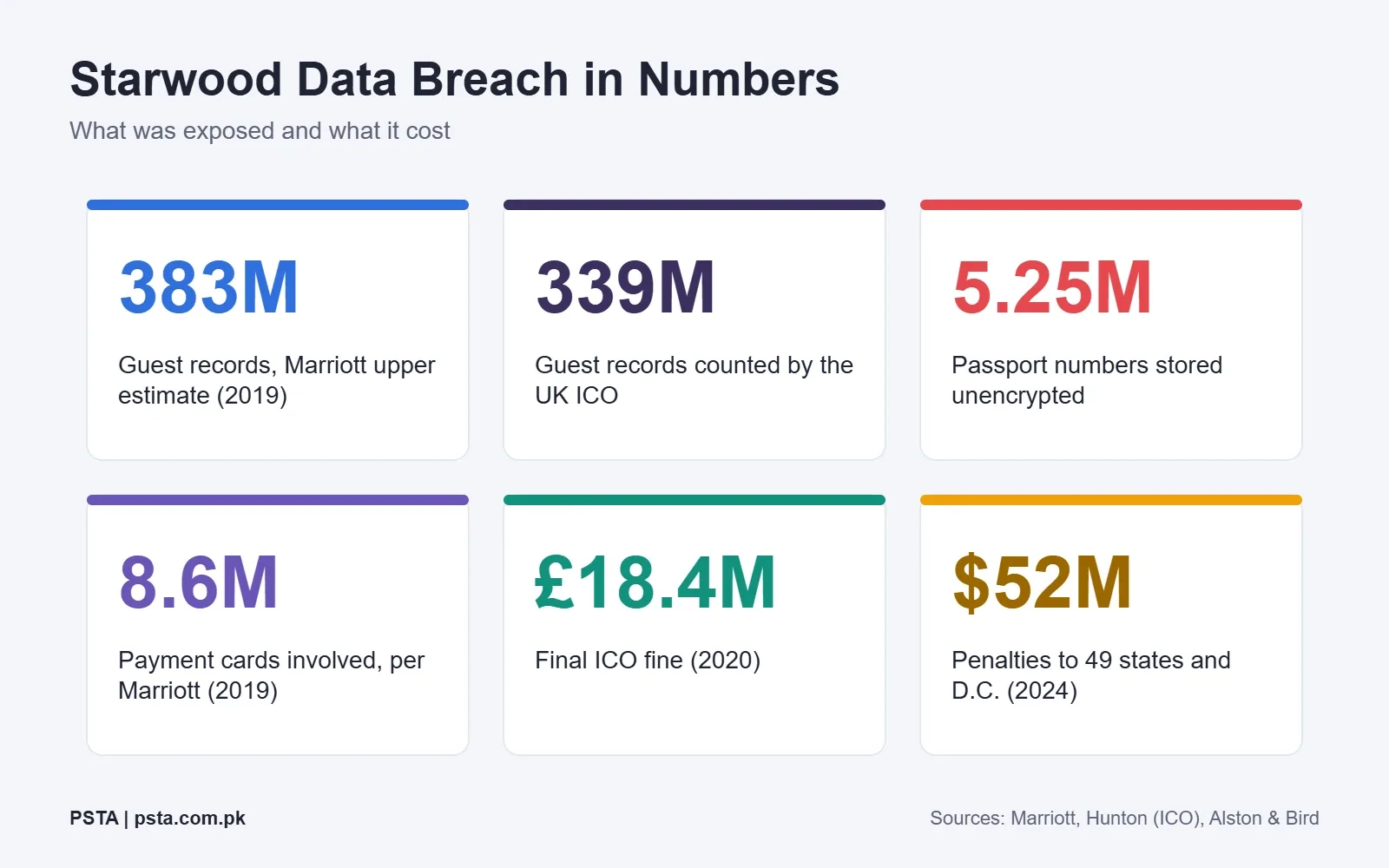
In its January 4, 2019 update, Marriott said the stolen data covered up to about 383 million guest records. It also said roughly 5.25 million passport numbers were stored unencrypted and about 20.3 million were encrypted. About 8.6 million payment cards were involved, which Marriott then described as encrypted, and only about 354,000 of those were still valid in September 2018.
The guest data itself was ordinary hotel information: names, email addresses, phone numbers, arrival and departure dates, and loyalty details. Put together with passport numbers, that is a rich profile of where a person travels and when.
The Starwood Data Breach Timeline, Year by Year
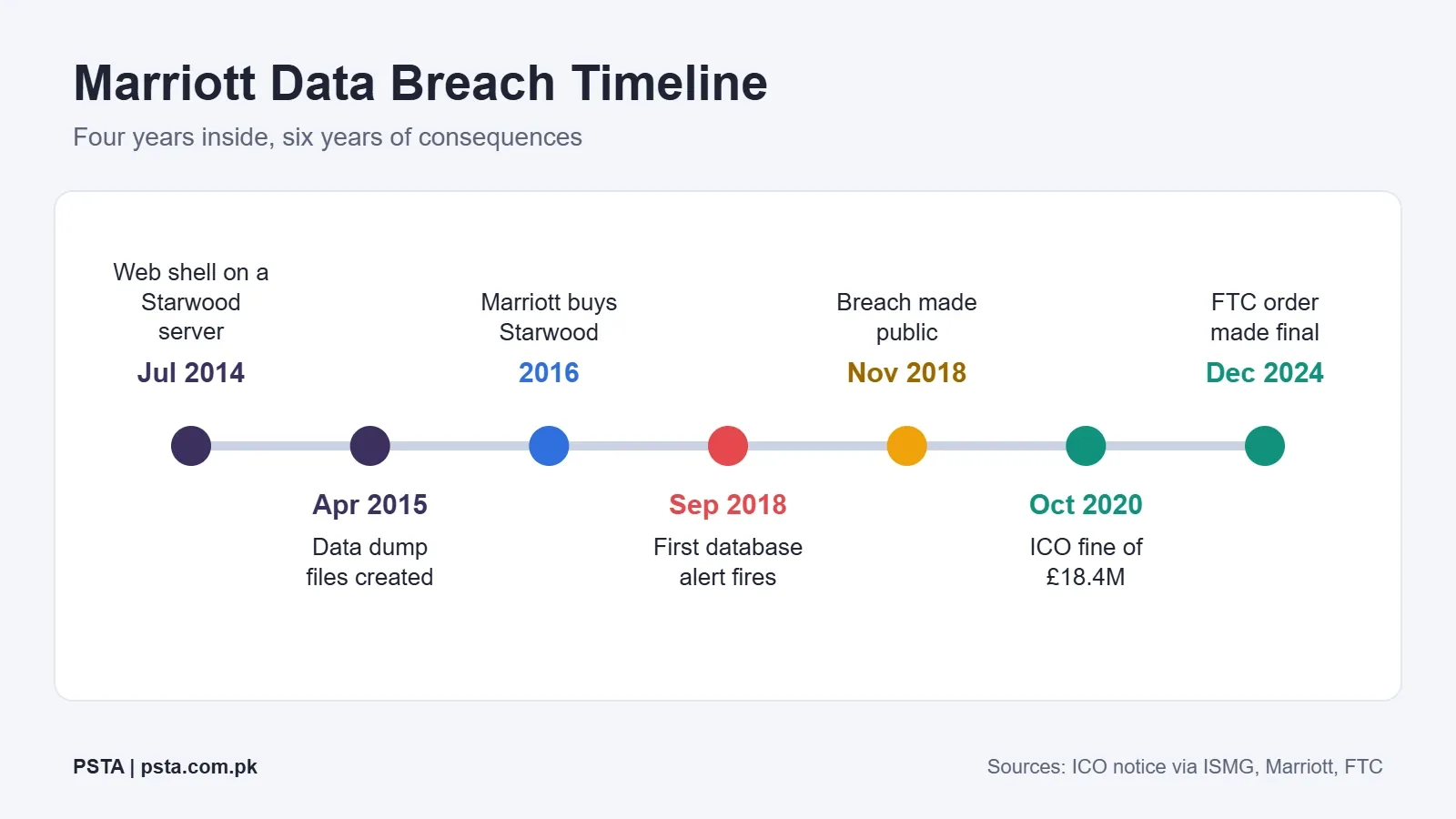
The table below uses dates from the UK Information Commissioner's Office (ICO) penalty notice, as summarized by Information Security Media Group (ISMG), plus Marriott and FTC statements.
| Date | What happened | Source |
|---|---|---|
| July 29, 2014 | A web shell is placed on a Starwood system linked to an application used to request website changes | ICO notice via ISMG |
| 2014 onward | A remote access Trojan keeps the foothold open; a password-stealing tool is used later to take over more accounts | ICO notice via ISMG |
| April 2015 | Attackers begin creating database dump files, apparently to move whole tables out at once | ICO notice via ISMG |
| 2016 | Marriott completes its acquisition of Starwood | Hunton summary of ICO findings |
| July 7, 2018 | Earliest unauthorized activity later traced to stolen credentials of staff at Accenture, which managed the database | ICO notice via ISMG |
| Sept. 7, 2018 | A "count" query on a guest profile table triggers the first database monitoring alert | ICO notice via ISMG |
| Sept. 17, 2018 | The remote access Trojan is identified and its control server blocked | ICO notice via ISMG |
| Nov. 19, 2018 | Marriott determines that guest reservation data was accessed | Marriott |
| Nov. 30, 2018 | Public disclosure; first estimate of up to 500 million guests | Marriott, Reuters via VOA |
| Jan. 4, 2019 | Estimate revised to about 383 million records at most | Marriott |
| Oct. 30, 2020 | ICO issues an £18.4 million fine | Hunton |
| Oct. 9, 2024 | FTC order and a $52 million settlement with 49 states and Washington, D.C. announced | Alston & Bird |
| Dec. 20, 2024 | FTC finalizes its order | FTC |
Notice the two long gaps. The attackers had about four years before the first alert, and the public waited almost three months after that alert for disclosure, while forensic teams worked out what had been taken.
How Did the Marriott Hack Work?
Think of the Marriott hack as five stages. None of them needed a rare or brilliant trick. Each stage succeeded because nobody was watching that part of the system closely.
1. A Foothold on a Web-Facing Server
According to the ICO notice as reported by ISMG, the first step was a web shell. A web shell is a small script on a web server that lets an outsider send it commands. It sat on a server connected to an internal tool Starwood staff used for website change requests.
2. Staying In Quietly
The attackers then installed a remote access Trojan. That gave them a lasting back door, so they did not need to break in again each time.
3. Collecting Passwords
ISMG reports that a well-known credential-dumping tool was used to pull passwords from memory. With those passwords, the attackers logged in as real users, including accounts with database rights. Logins by real accounts look normal unless someone reviews who did what.
4. Packaging the Data
From April 2015, the attackers created dump files of whole tables. In 2018, investigators found compressed and encrypted files holding large exports of customer data.
5. Getting Caught by a Narrow Alarm
The database monitoring tool, IBM Guardium, was set up to watch payment card fields only. When the attackers finally ran a query that touched one of those monitored tables, the alarm fired. Everything they had touched before that went unseen.
That last point matters most. The control existed. It simply covered the wrong scope.
What Did the Breach Expose, and Why Did the Numbers Change?
Marriott's first announcement said up to 500 million guests could be affected. In January 2019, it lowered the ceiling to about 383 million records and said the true number of unique guests was smaller, because one person can appear in many records.
Regulators later used a lower count again. The ICO, as summarized by Hunton Andrews Kurth, cited about 339 million guest records worldwide, including about 7 million linked to people in the UK. The difference reflects de-duplication and deeper forensic work, not a contradiction between honest sources.
Encryption claims also shifted. In an April 2024 note added to its update page, Marriott said the payment card numbers and some passport numbers had been protected with SHA-1 hashing, not the AES-128 encryption it first described. ISMG also reports that the ICO found a Starwood script able to decrypt certain encrypted entries.
Who Was Blamed for the Marriott Hack, and How Sure Is It?
Here you need to separate three levels of confidence.
- Anonymous investigators. On December 5, 2018, Reuters reported, as carried by VOA, that private investigators had found tools and methods previously linked to Chinese hacking groups. The same sources warned that some of those tools were public, so others could have used them.
- A senior official's statement. On December 12, 2018, US Secretary of State Mike Pompeo said in a television interview that China was behind it, Al Jazeera reported. The article noted no immediate comment from Beijing, which has denied other US hacking accusations.
- The company and the courts. Marriott did not name an attacker. As far as the sources used here show, no court has tied a named person to this intrusion.
So the China link is an official US government position backed by unnamed investigators, not a proven case in court. The same Al Jazeera report quoted a Recorded Future analyst saying nobody had released data showing state involvement. Hold both facts at once.
Investigators also suspected that more than one group had been inside Starwood. ISMG reports a separate attempt to install card-scraping malware around late 2016 that Marriott believed came from a different attacker.
What Happened After the Marriott Data Breach?
The Marriott ICO Fine
In July 2019, the ICO announced it intended to fine Marriott about £99.2 million. The final Marriott ICO fine, issued on October 30, 2020, was £18.4 million. Hunton's summary explains the drop: Marriott's representations, a 20% reduction for mitigation, and an allowance for the COVID-19 impact on the hotel business.
The ICO found four main failures: weak monitoring of privileged accounts, weak database monitoring, no server hardening such as allow-listing, and missing encryption for some passport numbers. It also rejected the argument that a skilled attacker reduced Marriott's responsibility.
The Marriott FTC Settlement
On October 9, 2024, the FTC announced action covering three breaches at Marriott and Starwood that together affected more than 344 million customers. The Marriott FTC settlement, finalized on December 20, 2024, requires a written security program, limits on how long personal data is kept, a deletion request link for US customers, and restoration of stolen loyalty points on request.
The FTC could not seek civil penalties in this case, so the money came from the states. Alston & Bird reports $52 million in penalties shared by 49 states and the District of Columbia. The same firm notes that the FTC order requires independent security assessments every two years for 20 years.
Fixes Inside the Company
Marriott said it retired the Starwood reservation database at the end of 2018 and moved all bookings to its own system. It offered a year of free web monitoring in eligible countries and set up a multilingual call center.
Why a Hotel Data Breach Matters in Pakistan
You may never have stayed at a Sheraton. The lessons still reach you, for three reasons.
First, travel data is personal data with a long shelf life. A hotel data breach exposes where you were and when, plus passport details that you cannot change as easily as a password. Pakistanis who travel for Umrah, business or study hand passport copies to hotels and agents regularly.
Second, Pakistani businesses collect similar data. Hotels, travel agencies, hospitals and banks here store CNIC and passport copies, often in shared folders or old databases. A passport data breach at a local agency would follow the same pattern: a forgotten server, reused admin passwords, and nobody reviewing logs.
Third, the law is still catching up. As of December 2025, The Friday Times described Pakistan's Personal Data Protection Bill as a draft. Without a GDPR-style regulator, the main pressure to protect customer data here comes from good practice, sector rules and reputation.
The same lesson ran through the Capital One data breach and the Equifax data breach: a known control was present but not applied to the data that mattered.
Seven Defensive Lessons From the Marriott Data Breach
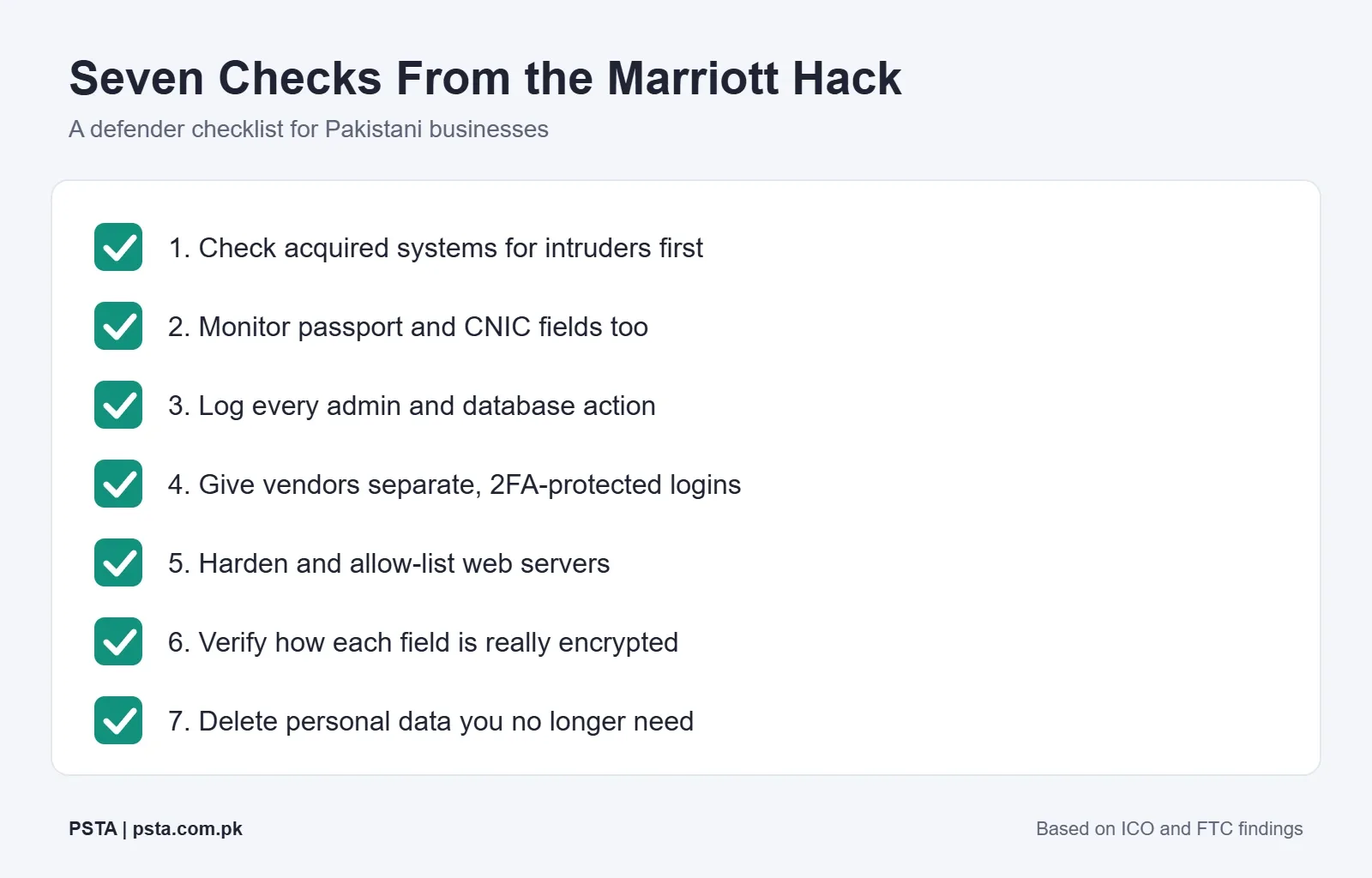
- Audit what you buy. When you acquire a company, merge a branch network or take over an old system, assume it may already be compromised. Run a compromise assessment before connecting it to your main network.
- Monitor by data sensitivity, not by habit. Marriott's alarm watched card fields only. List your most sensitive fields, such as passport and CNIC numbers, and make sure monitoring covers them.
- Watch privileged accounts closely. Log every action by admin and database accounts, keep those logs centrally, and review unusual exports.
- Treat vendor logins as your risk. Stolen credentials from a service provider were in use months before detection. Give vendors separate accounts, short-lived access and two-factor authentication.
- Harden servers that face the internet. Allow-listing and removing old software make it harder to plant a web shell or run unknown tools.
- Encrypt the right fields, and check the claim. Confirm which method actually protects each field. Marriott later corrected AES-128 to SHA-1 for some data.
- Keep less, for less time. The FTC order now limits how long Marriott can keep personal data. Data you deleted cannot be stolen.
If you are a traveler, the personal version is shorter. Watch for emails that mention a hotel stay you made, since breach news always brings phishing. Learn to check if a link is safe before you click, and never send passport scans over chat unless you know who stores them.
How Does This Compare With Other Cases in the Series?
The Yahoo data breach also involved years of undetected access and was also later linked by US officials to state-backed actors. The DMM Bitcoin hack began with a compromise of an outside supplier, much as Starwood's attackers later used a contractor's credentials. If you are new to the series, start with the Binance hack case study for the format we follow.
Reconstructing Breach Timelines in PSTA's Security Labs
Rebuilding a timeline like the one above is a core defender skill. The 12-week, beginner-level cyber security and ethical hacking program at PSTA needs no prior security experience. Its syllabus opens with the CIA triad and risk, then covers common attacks, network defenses, malware, threat detection, cyber law and forensics.
One of the listed lab tasks is to investigate a security incident, preserve evidence and document a timeline, which is exactly the work this case calls for. You can join live online from any city in Pakistan or attend in Abbottabad, with a new batch each month. Students who later want offensive testing skills can continue to PSTA's advanced penetration testing track.
Ask One Vendor a Hard Question This Month
Pick one outside company that can log in to your systems, such as an IT contractor, a software vendor or a hosting provider. Ask them which accounts they use, whether those accounts need a second factor, and when access was last reviewed. If nobody can answer within a week, you have found your first fix.
Frequently asked questions
When did the Marriott data breach start and end?
According to the UK ICO's penalty notice, as summarized by ISMG, an attacker placed a web shell on a Starwood server on July 29, 2014. The activity continued until September 2018, when a database monitoring alert fired. Marriott announced the incident publicly on November 30, 2018, after several weeks of forensic work to understand what data had been taken.
How many people were affected by the Starwood data breach?
Marriott first said up to 500 million guests. In January 2019 it lowered the upper limit to about 383 million records and said unique guests were fewer, since one person can appear in many records. The UK ICO later worked from about 339 million guest records, including roughly 7 million linked to people in the UK.
Were passport numbers stolen in the Marriott hack?
Yes. Marriott said about 5.25 million passport numbers were stored without encryption and about 20.3 million were protected. In April 2024 it added that some protected passport numbers and the card numbers used SHA-1 hashing rather than the AES-128 encryption it had first described. That correction is one reason to verify security claims rather than repeat them.
Why was the Marriott ICO fine cut from £99.2 million to £18.4 million?
The ICO proposed £99.2 million in July 2019. Its final notice in October 2020 reduced the amount after Marriott's representations, gave a 20% reduction for steps such as fast customer contact and new detection tools, and made a further allowance for the COVID-19 impact on the hotel business. Only conduct after GDPR took effect in May 2018 counted.
Did China carry out the Marriott data breach?
US Secretary of State Mike Pompeo said in December 2018 that China was responsible, and Reuters sources pointed to tools linked to Chinese groups. Marriott never named an attacker, and no court ruling on this intrusion appears in the sources reviewed. Treat it as an official US government attribution, not a proven fact, and note that some tools involved were publicly available.
What did the Marriott FTC settlement require?
The FTC order, finalized on December 20, 2024, requires Marriott and Starwood to run a written information security program, keep personal data only as long as needed, give US customers a deletion request link, and restore stolen loyalty points on request. Independent assessments run every two years for 20 years. Separately, 49 states and Washington, D.C. collected $52 million.
What should a Pakistani business learn from a hotel data breach like this?
Check any system you inherit or buy before trusting it, and monitor every field that holds passport or CNIC numbers, not just card data. Give vendors their own logins with two-factor authentication, review admin activity, and delete records you no longer need. These are low-cost habits that would have shortened Marriott's four-year blind spot.
Sources & references
- Marriott Provides Update on Starwood Database Security Incident marriott.gcs-web.com
- Probing Marriott's Mega-Breach: 9 Cybersecurity Takeaways (ISMG) govinfosecurity.com
- ICO Fines Marriott International £18.4 Million for Security Breach (Hunton) hunton.com
- FTC Finalizes Order With Marriott and Starwood ftc.gov
- FTC, State AGs Settle With Marriott Over Data Breaches (Alston & Bird) alston.com
- Sources: Clues in Marriott Hack Implicate China (VOA/Reuters) voanews.com
- US Accuses China for Massive Marriott Hotel Chain Data Theft (Al Jazeera) aljazeera.com
- Pakistan Approves First National AI Policy, but Data Protection Gaps Remain (The Friday Times) thefridaytimes.com
Last reviewed & updated on by Umar Qureshi. Written by the PSTA team in Abbottabad, Pakistan.

Umar Qureshi
Cyber Security & Ethical Hacking Course in Abbottabad - PSTA
Turn this guide into a career: hands-on training with real projects, online across Pakistan or on-campus in Abbottabad · 12 Weeks.
Comments
No comments yet — ask a question or share your experience.