Quick answer
In May 2024, attackers stole 4,502.9 BTC, about 48.2 billion yen, from Japan's DMM Bitcoin. The FBI and Japanese police blamed North Korea's TraderTraitor group, which first infected a wallet supplier's employee through a fake recruiter's coding test. DMM repaid customers with 55 billion yen in new funding, then closed and moved accounts to SBI VC Trade.
Key takeaways
- • The theft of 4,502.9 BTC began with a fake LinkedIn recruiter and a malicious coding test sent to a Ginco employee.
- • Stolen session cookies let attackers act as that employee and alter a real DMM transfer request.
- • Japan's regulator found single-person signing, weak audits and unreviewed external wallets at DMM.
- • DMM raised about 55 billion yen to repay customers, then announced its closure in December 2024.
- • The FBI, DC3 and Japan's police attributed the attack to North Korea's TraderTraitor group; no arrests have followed.
- • Run any stranger's code only in a virtual machine, and require more than one signer for large transfers.
Table of contents 16 sections
- What Was the DMM Bitcoin Hack?
- DMM Bitcoin Hack Timeline
- How Did a Fake Job Test Reach an Exchange Wallet?
- What Went Wrong: The Weak Points Japan's Regulator Found
- 1. Too Few People Held Too Much Power
- 2. Audits Were Not Independent
- 3. Outside Wallets Were Adopted Without a Proper Risk Review
- 4. One Person Could Sign, With Keys Managed in Bulk
- 5. Too Much Sat in One Place, and the Logs Ran Out
- The Money: Bitcoin Lost, Yen Raised, Customers Repaid
- Who Was Blamed, and How Strong Is the Attribution?
- What Happened After the Theft?
- Why the DMM Bitcoin Hack Matters in Pakistan
- Nine Defensive Lessons From the DMM Bitcoin Hack
- Tracing Supply-Chain Attacks in PSTA's Security Classes
- Before You Run Any Take-Home Test
Quick self-test before we open the DMM Bitcoin hack: a friendly recruiter offers you a remote role and sends a short coding task to run on your work laptop tonight. Do you run it? In 2024, one employee at a Japanese wallet software firm said yes, and the FBI says that single step opened the path to 4,502.9 stolen bitcoin.
If you hesitated, good. That pause is the main defense this case teaches. This post is a "what went wrong" analysis, built from Japanese government documents, the FBI's attribution and reporting by security outlets. Here is what you will get:
- A dated timeline from the first fake job contact to the exchange's closure
- A plain-language picture of how the attack moved from one laptop to an exchange wallet
- The specific control failures Japan's regulator listed in its official order
- What the theft cost, who paid customers back and why the dollar figures differ
- Nine defensive lessons for exchanges, software houses and freelancers in Pakistan
What Was the DMM Bitcoin Hack?
DMM Bitcoin was a licensed crypto exchange in Japan, part of the DMM group. On May 31, 2024, it reported "an unauthorized leak of Bitcoin (BTC) from our wallet," as TechCrunch reported that day. The amount was 4,502.9 BTC. Blockchain analytics firm Elliptic called it the eighth-largest crypto theft on record at the time.
The attackers did not break DMM's encryption or guess a password. They went around the exchange. They first compromised a supplier, the Ginco wallet software firm, and then used that access to tamper with a payment that a DMM employee had requested in the normal course of work.
That detail makes the DMM Bitcoin hack a supply-chain story and a social engineering attack at the same time. It also explains why Japan's regulator focused so hard on how DMM chose and supervised outside wallet providers.
DMM Bitcoin Hack Timeline
Japan runs four hours ahead of Pakistan, so a Tokyo morning is still night in Karachi. Exact hour-level times were not published, so the table sticks to dates.
| Date (Japan) | What happened | Source |
|---|---|---|
| Late March 2024 | A person posing as a LinkedIn recruiter targets a Ginco employee. A "pre-employment test" in Python infects the employee's computer. | FBI, via Security Affairs |
| Mid to late May 2024 | Attackers use stolen session cookies to act as the employee inside Ginco's systems and alter a legitimate DMM transaction request. | FBI, via The Record |
| May 31, 2024 | 4,502.9 BTC leaves DMM's wallet. DMM limits withdrawals and new trades and promises deposits are fully guaranteed. | TechCrunch |
| June 3 to June 10, 2024 | DMM raises about 55 billion yen through loans and a capital increase. | The Block |
| September 26, 2024 | The Kanto Regional Finance Bureau issues a business improvement order. | Ministry of Finance |
| December 2, 2024 | DMM announces it will close and move accounts to SBI VC Trade. | The Block |
| December 23 to 24, 2024 | The FBI, the US Defense Department's DC3 and Japan's National Police Agency name North Korea's TraderTraitor group. | NPA advisory, The Record |
| Around March 2025 | Planned completion of the account transfer to SBI VC Trade. | The Block |
How Did a Fake Job Test Reach an Exchange Wallet?
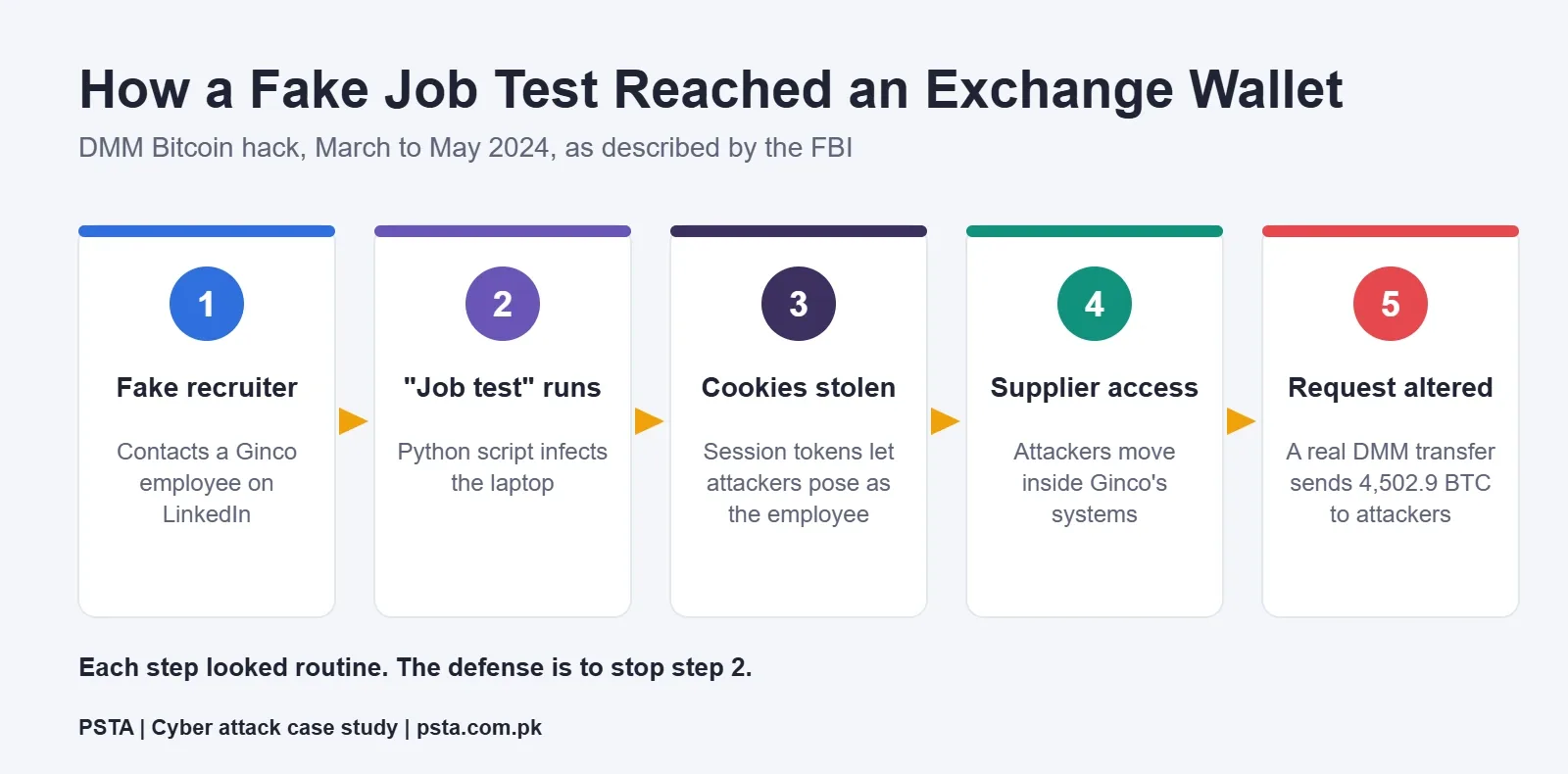
Think of the DMM Bitcoin hack as five links in a chain. Each one looked ordinary on its own, and that is why it worked.
- The approach. According to the FBI, as summarized by Security Affairs, the attacker posed as a recruiter on LinkedIn and built rapport with a Ginco employee.
- The "test." The employee received a Python script framed as a pre-employment exercise. Running it installed malware.
- The stolen session. The malware took session cookies. A session cookie is the token a website gives you after login, so whoever holds it can look like you without typing a password or passing a fresh MFA check.
- The pivot. Using that identity, the attackers reached Ginco's systems, which DMM relied on for its wallet operations.
- The swap. In late May, they altered a real transaction request raised by a DMM employee, so the outgoing bitcoin went to wallets they controlled.
Japan's joint advisory, issued by the National Police Agency, NISC and the Financial Services Agency, describes the same group's wider playbook. The attackers borrow the names and photos of real people, tailor their messages to each target's profile and move chats to apps where messages can be deleted. The code they ask targets to run is often presented as a bug fix for a simple API call, with the harmful part hidden inside.
We are keeping this at the level a defender needs. You do not need the malware's internals to stop it. You need to stop the first run.
What Went Wrong: The Weak Points Japan's Regulator Found
On September 26, 2024, the Kanto Regional Finance Bureau ordered DMM Bitcoin to fix its business under the Payment Services Act. The order is unusually blunt. It said the exact attack method was still unconfirmed, yet the control gaps were serious enough to need immediate correction. Here are the failures it listed, in plain words.
1. Too Few People Held Too Much Power
No executive was assigned to oversee systems. Authority for system risk, development, operations and information security sat with a small group, and those same people checked their own work.
2. Audits Were Not Independent
Departments were audited by their own staff, and the audit team lacked people with audit expertise. A weak audit function rarely finds the problem that later becomes a headline.
3. Outside Wallets Were Adopted Without a Proper Risk Review
DMM brought in external wallet arrangements without assessing the risk of funds flowing out, without judging whether the provider's security review was adequate, and without a plan for what to do if the wallet failed. This is the gap that let a supplier's laptop become an exchange-level problem.
4. One Person Could Sign, With Keys Managed in Bulk
According to the order, a single person carried out transaction signing without checks, and private keys were managed together. The bureau noted that DMM knew this conflicted with regulatory guidelines.
5. Too Much Sat in One Place, and the Logs Ran Out
Customer holdings had grown, but the exchange had not spread them across several wallets. It also had not thought about how long to keep the logs needed to investigate an outflow, which slowed the investigation once the money was gone.
Notice the pattern in the DMM Bitcoin hack. The phishing was clever, but the regulator's list is mostly about basic governance: separation of duties, independent review and knowing your vendors. Those are cheap compared with 48 billion yen.
The Money: Bitcoin Lost, Yen Raised, Customers Repaid
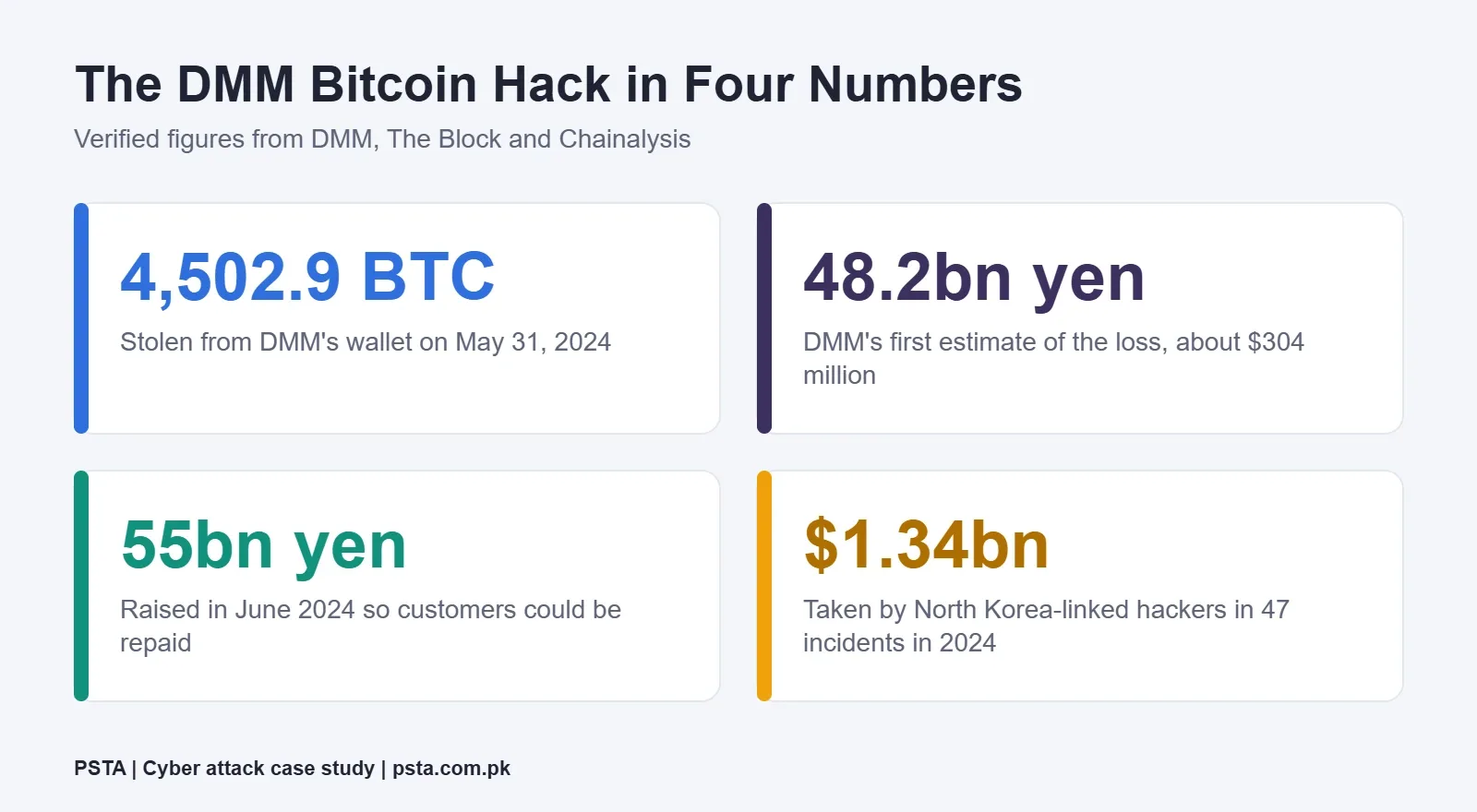
The stolen amount was always 4,502.9 BTC. The dollar figure changes with the source because bitcoin's price moved between reports. TechCrunch used about $305 million on the day. Security Affairs reports that DMM's first announcement put the loss near 48.2 billion yen, roughly $304 million. The FBI and Japan's police later used $308 million. By the time of the attribution, The Record noted the coins were worth over $440 million. None of these figures is wrong; each is a snapshot at a different date.
Customers did not absorb the cost of the DMM Bitcoin hack. DMM promised to fully guarantee customer bitcoin, buying replacement coins with group support. To fund that, it raised about 55 billion yen in June 2024, reported by The Block as three steps: 5 billion yen borrowed on June 3, 48 billion yen from a capital increase on June 7 and 2 billion yen in subordinated borrowing on June 10.
So customers were protected, but the company was not. Six months later, it announced it would shut down.
Who Was Blamed, and How Strong Is the Attribution?
In December 2024, the FBI, the Department of Defense Cyber Crime Center (DC3) and Japan's National Police Agency jointly attributed the DMM Bitcoin hack to TraderTraitor. The Record and Security Affairs both report this as a government finding, not an analyst guess. TraderTraitor is linked to North Korea's Lazarus Group, and security vendors track it under other names, including Jade Sleet, UNC4899 and Slow Pisces.
How confident should you be? Law enforcement agencies in two countries reached the same conclusion and published it jointly. That is strong. Still, no one has been arrested or tried for this theft, and the evidence has not been tested in court. The fair wording is "attributed by the FBI and Japanese police," not "proven."
The case also fits a wider pattern of North Korea crypto theft. Chainalysis estimated that North Korea-linked hackers took about $1.34 billion across 47 incidents in 2024, around 61% of all crypto stolen that year, as TechCrunch reported. The same actors were later blamed for the much larger Bybit hack in 2025, and earlier for the Ronin Network hack.
What Happened After the Theft?
- Service limits. DMM restricted withdrawals, spot buying and new leveraged positions while it investigated.
- Regulatory order. The September 2024 order required a root-cause analysis, full explanations to customers and a written improvement plan by October 28, 2024, followed by monthly progress reports.
- Closure. On December 2, 2024, DMM said it would wind down and move customer accounts and assets to SBI VC Trade, a unit of SBI Group, by around March 2025. Open leveraged positions had to be closed first.
- Laundering trail. The FBI says coins from the DMM Bitcoin hack moved into wallets controlled by TraderTraitor. None of the sources we reviewed reports that the bitcoin was recovered.
- A public warning. Japan's joint advisory turned the case into a checklist for other firms, which is where most of the lessons below come from.
Why the DMM Bitcoin Hack Matters in Pakistan
You may think a Japanese exchange is far from your daily work. The entry point says otherwise. Pakistan has a large pool of developers and freelancers who apply for remote roles through LinkedIn every week. A fake job offer scam that hands you "test code" is aimed at exactly that habit.
The second link is regulation. In July 2025, Pakistan created the Pakistan Virtual Assets Regulatory Authority (PVARA), a federal body that licenses and oversees firms offering crypto services, Dawn reported. Any local firm that wants that license will face questions about crypto exchange security much like the ones Japan asked DMM: who can sign, how keys are split and how vendors are vetted.
The third link is the supply chain. Pakistani software houses build wallets, payment apps and back-office tools for foreign clients. If you are the Ginco in someone else's story, your staff laptop is part of their attack surface. For two earlier crypto exchange cases, compare our breakdowns of the Binance hack and the WazirX hack.
Nine Defensive Lessons From the DMM Bitcoin Hack
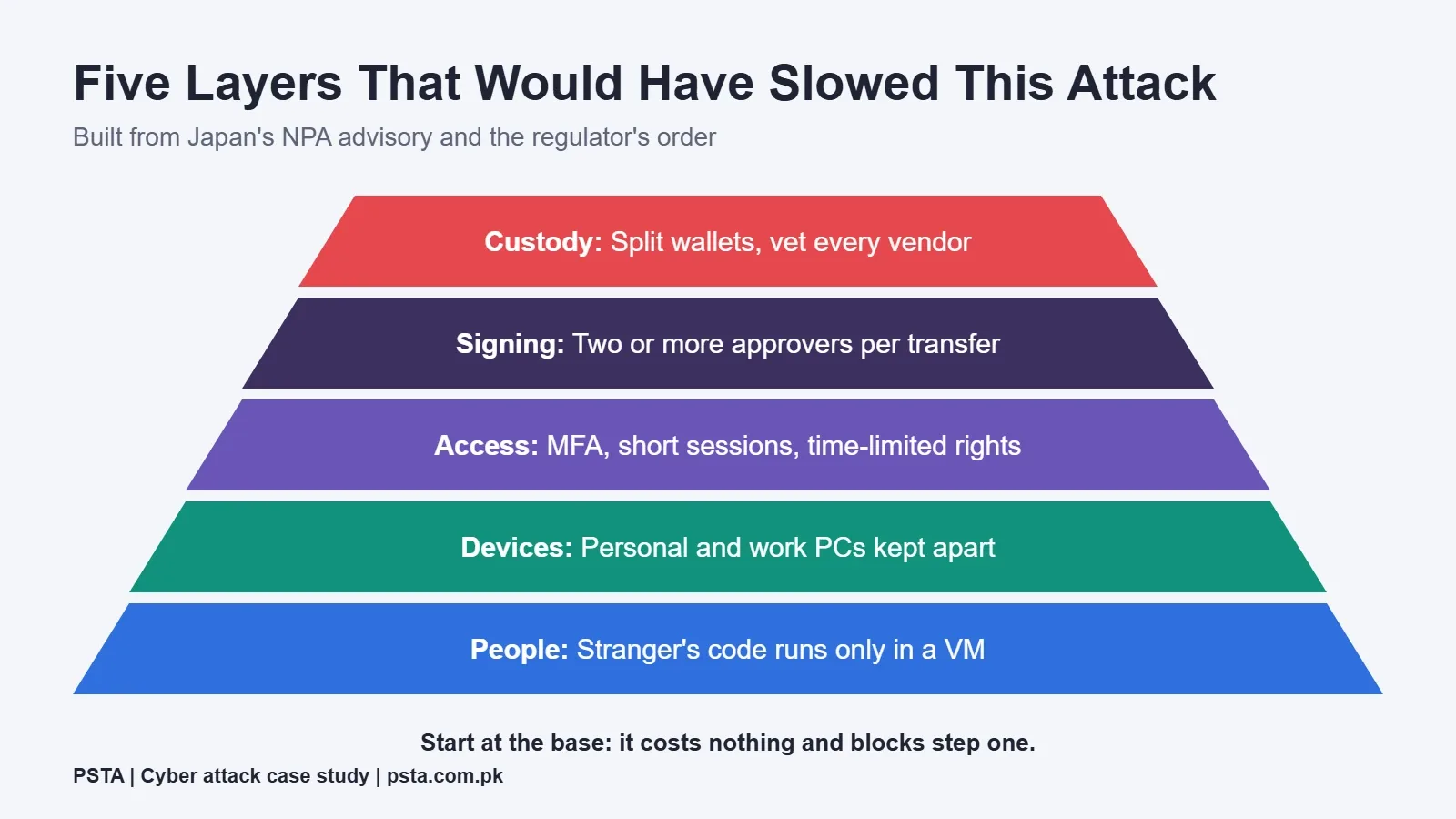
These come from the NPA advisory's countermeasures and the gaps the regulator listed. Start with the ones that cost nothing.
- Never run take-home code on a work machine. The advisory says to run unfamiliar code only on a virtual machine or a non-work PC. Our ethical hacking lab setup guide shows how to build one.
- Ask for a video call. If a recruiter keeps refusing to appear on camera, treat that as a warning sign. Screenshot the profile and the chat.
- Slow down when someone rushes you. Pressure to review or run code quickly is a red flag in itself.
- Keep personal and business devices apart. Do not reach sensitive systems from a personal PC unless that access was approved in advance.
- Treat sessions as keys. Use multi-factor authentication, keep sessions short and alert on logins at odd hours, from new locations or from unknown devices.
- Grant access for a purpose and a period. Give the minimum rights needed, then reduce or remove them when the task ends. Lock leavers' accounts at once.
- Require more than one signer. No single person should be able to approve and sign a large outgoing transfer.
- Spread holdings and review every wallet vendor. Split funds across wallets and assess an external provider's security before you depend on it.
- Keep logs centrally and long enough. Store logs away from endpoints so an intruder cannot erase them, and keep them long enough to rebuild a timeline.
If you think a work PC is infected, the advisory's advice is to keep it powered on, cut it off from the internet and company network, and preserve memory evidence first. For your own phone, our checklist on whether your phone is hacked covers the personal side.
Tracing Supply-Chain Attacks in PSTA's Security Classes
Cases like the DMM Bitcoin hack are why we teach attacks as chains rather than as single tricks. In PSTA's 12-week cyber security and ethical hacking classes for beginners, the modules move from common attacks such as social engineering to safe ethical hacking practice, then on to defending networks, spotting malware, the basics of cyber law and digital forensics. Each module ends in a lab, and the course closes with a case-study project.
In practice, that means you learn to build an isolated lab, read logs and write an incident timeline like the one above. You can join from Abbottabad or from anywhere in Pakistan through live online classes. Once the basics are solid, our advanced penetration testing course teaches you to test systems properly, and only with written permission.
Before You Run Any Take-Home Test
The DMM Bitcoin hack started with a job test and ended with an exchange closing its doors. You can break the first link yourself. This week, set up one virtual machine and make a rule: any code a stranger sends you runs there or nowhere. If you would like help building that habit properly, our team is happy to talk you through the course options.
Frequently asked questions
Was the DMM Bitcoin hack caused by a flaw in Bitcoin itself?
No. Bitcoin's network worked as designed. The attackers compromised an employee at Ginco, a wallet software supplier, through a fake recruiter's coding test. They then used stolen session cookies to alter a real DMM transfer request. The weakness was in people, vendor access and internal controls, not in the Bitcoin protocol.
Did DMM Bitcoin customers lose their money?
DMM promised to fully guarantee customer bitcoin and bought replacement coins with group support. It raised about 55 billion yen in June 2024 through loans and a capital increase to cover the gap. Customer accounts and assets were then moved to SBI VC Trade, which planned to complete the transfer around March 2025.
What is TraderTraitor?
TraderTraitor is the name US and Japanese agencies use for a North Korea-linked hacking group tied to the wider Lazarus Group. Security vendors also track it as Jade Sleet, UNC4899 and Slow Pisces. It typically targets crypto firms and their suppliers by approaching several employees with tailored messages and fake job or coding offers.
Why do reports give different dollar amounts for the theft?
The number of coins never changed: 4,502.9 BTC. The dollar value depends on the bitcoin price on the day of each report. Early reports said about $304 million to $305 million, the FBI and Japanese police used $308 million in December 2024, and by then the coins were worth over $440 million.
How can I spot a fake job offer scam on LinkedIn?
Watch for recruiters who refuse a video call, push you to move to another chat app, or hurry you to run code. Check that the person and company exist through official websites. Take screenshots of the profile and chat. Most important, run any test code only inside a virtual machine or a spare computer, never your work laptop.
Has anyone been arrested for the DMM Bitcoin hack?
Not according to the sources reviewed for this post. The FBI, the Defense Department's DC3 and Japan's National Police Agency publicly attributed the theft to TraderTraitor in December 2024, but no charges or arrests have been announced. None of the sources reports that the stolen bitcoin was recovered either.
Does Pakistan regulate crypto exchanges now?
In July 2025, Pakistan set up the Pakistan Virtual Assets Regulatory Authority (PVARA) under the Virtual Assets Ordinance, 2025, as Dawn reported. PVARA's job is to license and oversee companies that offer crypto services, so any firm serving customers in or from Pakistan needs its approval before it operates.
Sources & references
- Joint advisory on TraderTraitor (NPA, NISC, FSA, Japan) fsa.go.jp
- Business improvement order against DMM Bitcoin (Kanto Regional Finance Bureau) lfb.mof.go.jp
- FBI, Japan attribute DMM theft to TraderTraitor (The Record) therecord.media
- DMM Bitcoin $308M theft linked to North Korea (Security Affairs) securityaffairs.com
- DMM Bitcoin to shut down and transfer assets to SBI (The Block) theblock.co
- Hackers steal $305M from DMM Bitcoin (TechCrunch) techcrunch.com
- North Korea-linked hackers took 61% of crypto stolen in 2024 (TechCrunch) techcrunch.com
- Authority to regulate crypto and digital assets formed (Dawn) dawn.com
Last reviewed & updated on by Umar Qureshi. Written by the PSTA team in Abbottabad, Pakistan.

Umar Qureshi
Cyber Security & Ethical Hacking Course in Abbottabad - PSTA
Turn this guide into a career: hands-on training with real projects, online across Pakistan or on-campus in Abbottabad · 12 Weeks.
Comments
No comments yet — ask a question or share your experience.