Quick answer
YouTube SEO is mostly about matching a real search with a clear title, thumbnail and description, then keeping viewers watching. YouTube ranks search results on relevance, engagement and quality. Tags play a minimal role, more than 60 hashtags are all ignored, and half of channels have a CTR between 2% and 10%.
Key takeaways
- • YouTube ranks search results on relevance, engagement and quality, with weights that vary by search type.
- • Tags play a minimal role in discovery; they mainly help when your topic is often misspelled.
- • If a video has more than 60 hashtags, YouTube ignores every one of them.
- • Half of all channels and videos have an impressions CTR between 2% and 10%.
- • Manual chapters need a 00:00 start, at least three timestamps and chapters of 10 seconds or more.
- • YouTube Studio's Trends tab shows audience searches and content gaps at no cost.
Table of contents 21 sections
- What Does YouTube SEO Actually Mean?
- Why YouTube SEO Matters for Pakistani Creators
- 10 YouTube SEO Myths vs Facts at a Glance
- Myths About Tags, Hashtags and Descriptions
- Myth 1: Tags Are the Most Important Ranking Factor
- Myth 2: The More Hashtags You Add, the More Reach You Get
- Myth 3: A Long Keyword List in the Description Helps You Rank
- Myths About Rankings and the YouTube Algorithm
- Myth 4: You Can Pay YouTube to Rank Higher in Search
- Myth 5: Everyone Sees the Same Search Results
- Myth 6: View Count Decides Everything
- Myth 7: AI-Made Videos Are Automatically Pushed Down
- Is a Low Click-Through Rate a Sign Your Video Failed?
- Myth 8: Anything Under 10% CTR Means Your Video Failed
- Myths About Chapters and Keyword Research
- Myth 9: Chapters Appear on Every Video Automatically
- Myth 10: You Need a Paid Tool for Keyword Research
- How to Run a YouTube SEO Check Before You Upload
- Which Numbers Should You Watch After Publishing?
- Learning YouTube SEO in PSTA's Digital Marketing Course
- Rewrite One Old Title This Week
Here is a quick YouTube SEO self-test before you read any further. True or false: tags are the main thing that decides where your video shows up in search?
The answer is false. YouTube's own help page on tags says they play a minimal role in discovery, and search results are ranked on relevance, engagement and quality instead. A lot of advice in WhatsApp groups and short reels rests on old or invented rules. This guide checks 10 popular beliefs against what YouTube itself publishes.
After reading, you will be able to:
- Name the three factors YouTube uses to rank search results
- Spot which popular tactics do almost nothing and which ones can get a video removed
- Judge your click-through rate against the range YouTube calls normal
- Find real search terms with a free tab inside YouTube Studio
- Run a seven-step check on your next upload
What Does YouTube SEO Actually Mean?
YouTube SEO is the work of helping the right viewers find your video, mainly through YouTube search and partly through recommendations. These are two different systems, and mixing them up causes most of the confusion you see online.
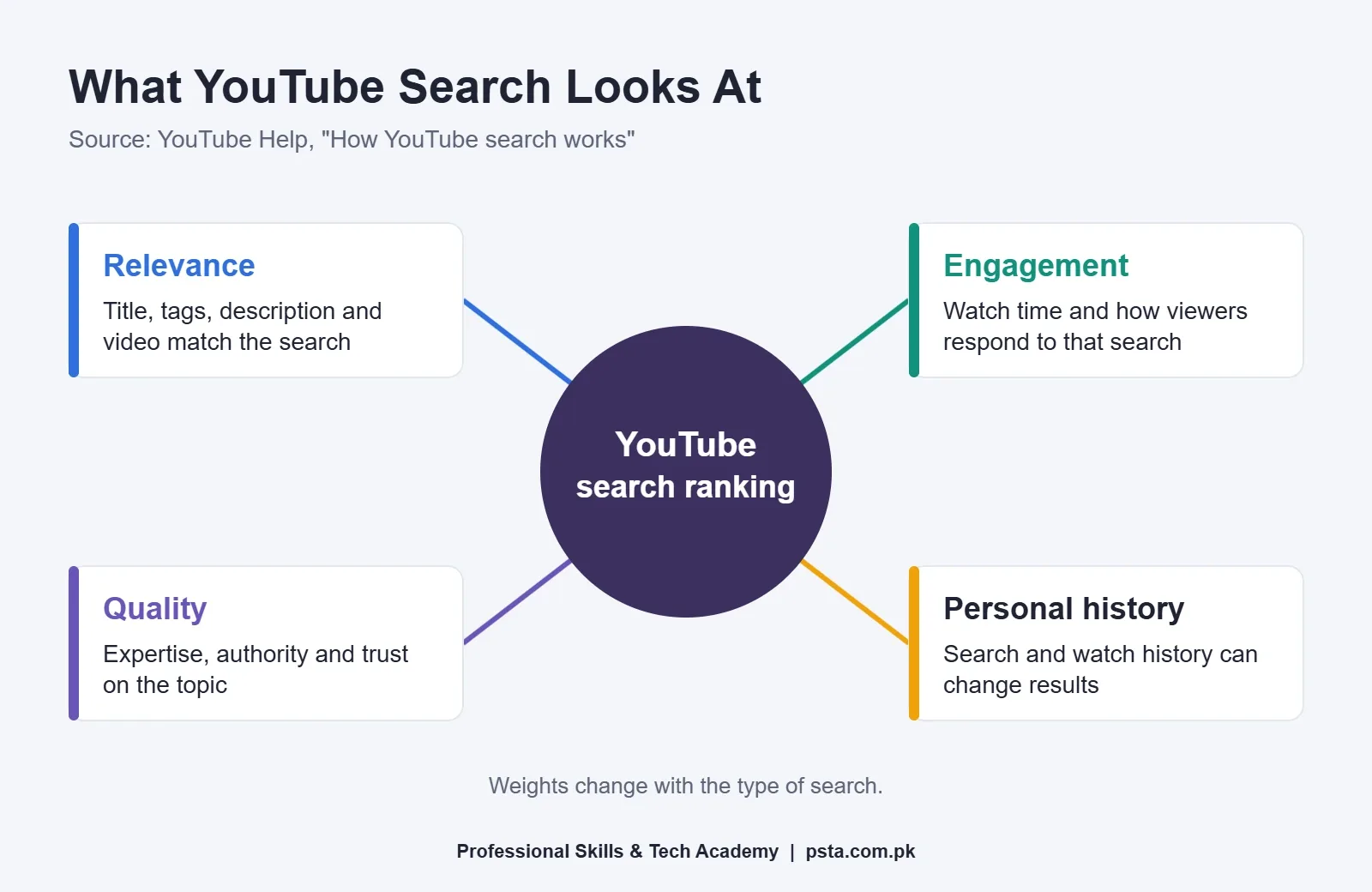
For search, YouTube's page on how YouTube search works names three elements:
- Relevance: how well your title, tags, description and the video itself match what the person typed.
- Engagement: how other viewers behave with your video for that same search, such as watch time.
- Quality: signals that your channel shows expertise, authority and trustworthiness on the topic.
The same page says the weight of each element changes with the type of search. It also says search and watch history, when they're turned on, can shape the results a person sees.
Recommendations follow different rules. YouTube explains that the homepage relies mostly on watch history, while the Up Next list uses the video you're currently watching as its main signal. Satisfaction surveys also feed in, so the system tries to learn whether people were happy with a video, not only how long they watched.
Why YouTube SEO Matters for Pakistani Creators
The competition at home is bigger than many beginners expect. In July 2026, Daily Pakistan reported YouTube's latest figures: more than 140,000 Pakistani channels have over 10,000 subscribers, and over 1,200 have passed one million.
The same report says nearly 60% of the watch time on Pakistani videos comes from viewers outside the country. That changes how you should write titles. Your viewer might be a Pakistani student in Dubai typing in English. It might be a family in Manchester searching in Roman Urdu. For YouTube SEO, that means writing for the words your real viewers type.
Here is a simple example. Say a maths tutor in Abbottabad uploads a lesson titled "Lecture 7." Nobody searches for that. A title such as "Class 9 Maths Chapter 3 Solved Exercise (Urdu)" uses the exact words a student types, so it has a fair chance of matching real searches.
10 YouTube SEO Myths vs Facts at a Glance
Use this table as a quick reference. Each row is explained in the sections that follow, with a link to the YouTube help page behind it.
| # | Myth | What YouTube says | What to do instead |
|---|---|---|---|
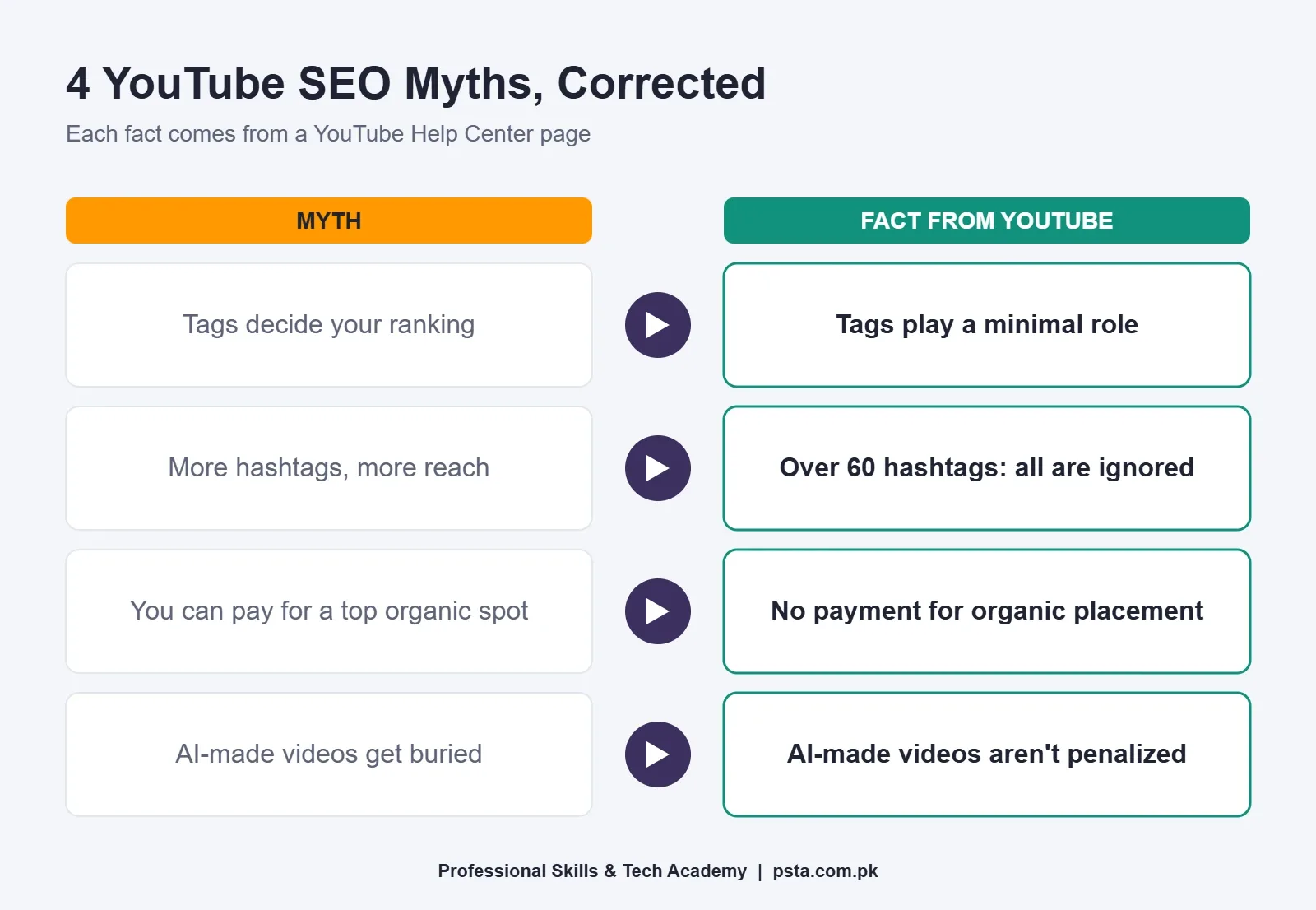
| 1 | Tags are the top ranking factor | Tags play a minimal role | Spend your time on the title, thumbnail and description |
| 2 | More hashtags bring more reach | Over 60 hashtags and all of them are ignored | Use two or three that fit the video |
| 3 | Keyword lists in the description help | Excessive tags in a description break spam rules | Write a plain two-line summary |
| 4 | You can pay for a top organic spot | YouTube doesn't accept payment for organic placement | Treat ads as a separate, paid channel |
| 5 | Everyone sees the same results | Search and watch history can change results | Don't judge rankings from your own feed |
| 6 | View count decides everything | Relevance, engagement and quality decide search | Answer one search well and keep viewers watching |
| 7 | AI-made videos get buried | AI videos can be recommended as broadly as others | Judge your video on whether viewers stay satisfied |
| 8 | Under 10% CTR means failure | Half of channels and videos sit between 2% and 10% | Compare your own videos by traffic source |
| 9 | Chapters appear on every video | Not every video gets automatic chapters | Add manual chapters starting at 00:00 |
| 10 | Keyword research needs a paid tool | Studio's Trends tab shows audience searches | Start with the free tab, add tools later |
Myths About Tags, Hashtags and Descriptions
Myth 1: Tags Are the Most Important Ranking Factor
This is the oldest YouTube SEO belief, and YouTube tags still get far more attention than they deserve. YouTube's tags page now says plainly that the title, thumbnail and description matter more. Tags are mainly useful when your topic is often misspelled.
That last point is handy in Pakistan, where Roman Urdu spellings vary so much. A cooking channel might tag "biryani" alongside "biriyani," or a local business might add "Abbotabad" as well as "Abbottabad." Add a handful of those variations, then move on.
Myth 2: The More Hashtags You Add, the More Reach You Get
Most advice on YouTube hashtags says to add as many as you can. YouTube's hashtag rules point the other way. Up to three hashtags that YouTube considers most engaging appear next to your title. If a video has more than 60 hashtags, YouTube ignores every one of them. The same page warns that over-tagging can get a video removed from your uploads or from search.
Two or three accurate hashtags are enough. Keep them directly related to the video, because unrelated hashtags can also lead to removal.
Myth 3: A Long Keyword List in the Description Helps You Rank
Many beginners paste 30 or 40 keywords at the bottom of every description. YouTube's tags page says that adding excessive tags to a description breaks its policies on spam, deceptive practices and scams. So the habit isn't just useless; it puts the video at risk.
A better description opens with two natural sentences that say what the viewer will learn, using your main search phrase once. After that, add chapters, links to related videos and any resources you mention.
Myths About Rankings and the YouTube Algorithm
Myth 4: You Can Pay YouTube to Rank Higher in Search
YouTube's search page states that it doesn't accept payment for better placement in organic search results. Running Google Ads on YouTube buys ad slots, which is a separate product. Be wary of anyone in Pakistan selling "guaranteed first-page ranking" for a fee, because YouTube offers no such service.
Myth 5: Everyone Sees the Same Search Results
Results can differ from person to person. When search and watch history are on, they may influence what appears. Your own account has probably watched your channel many times, so your video may look higher for you than for a stranger.
To get a fairer picture, check the YouTube search traffic report in Studio rather than searching from your own logged-in phone.
Myth 6: View Count Decides Everything
Big view counts make a video look popular, but YouTube's search page doesn't list views as a ranking element. It lists relevance, engagement for that search and quality signals about the channel.
In practice, I tell students to pick one clear topic per channel. A channel that posts tutorials on one subject builds a clearer track record than one that mixes cricket clips, recipes and tech reviews.
Myth 7: AI-Made Videos Are Automatically Pushed Down
YouTube's recommendations page says AI-made videos aren't penalized and can be recommended as broadly as videos made without AI. That doesn't mean low-effort videos will do well. The same system collects satisfaction surveys, so a video still needs to deliver what its title promises.
Is a Low Click-Through Rate a Sign Your Video Failed?
Myth 8: Anything Under 10% CTR Means Your Video Failed
Click-through rate (CTR) is the share of impressions that turn into views. YouTube's impressions and CTR FAQ says half of all channels and videos have an impressions CTR between 2% and 10%. So a 4% YouTube CTR is not a disaster.
The FAQ adds two warnings worth remembering:
- New videos or channels, such as those under a week old, and videos with fewer than 100 views can see an even wider range.
- Videos whose impressions come mostly from places like your channel page may show a higher rate, because those viewers already know you.
The fair test is to compare your own videos with each other over time, and to look at CTR by traffic source. A 3% CTR from browse features and a 9% CTR from your channel page tell two different stories.
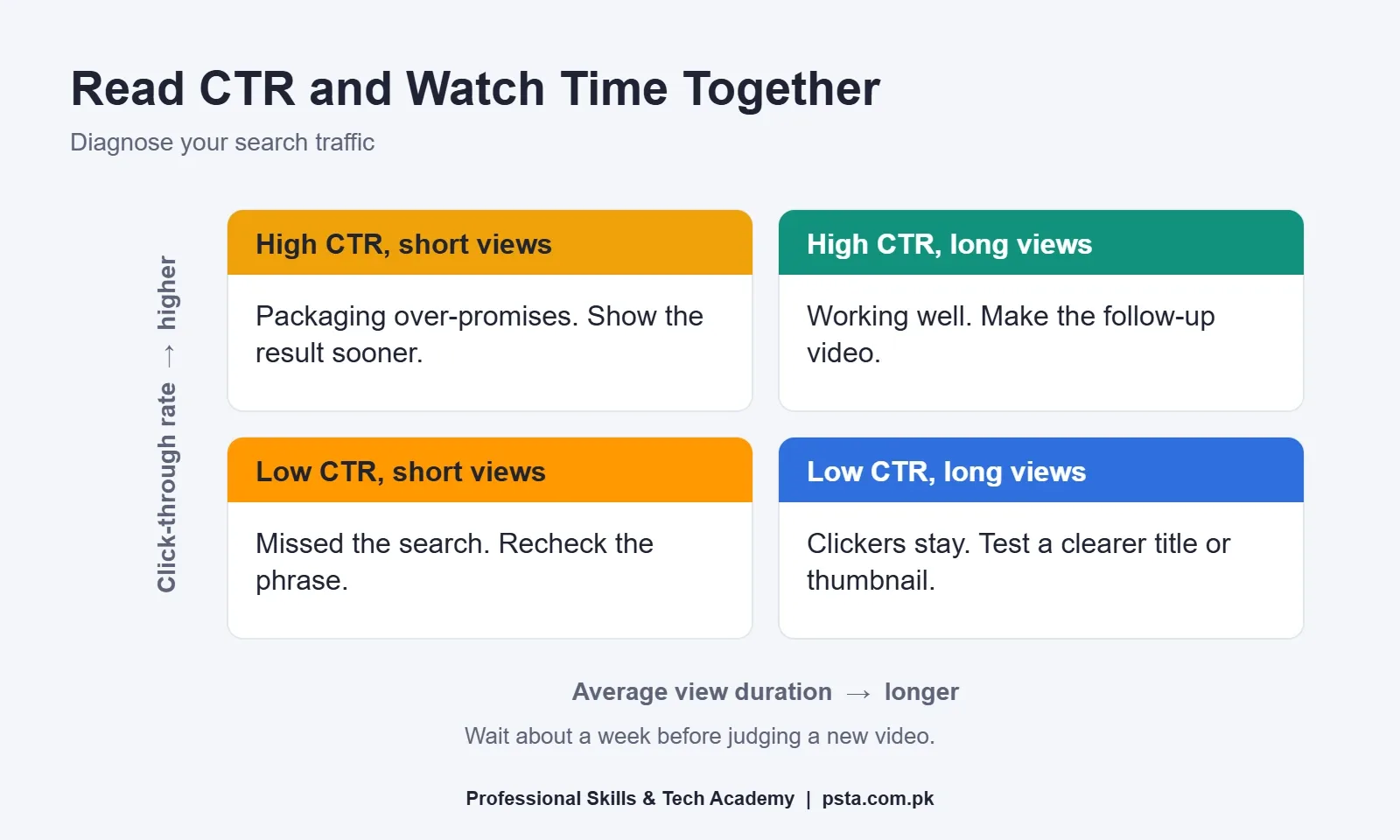
CTR also means little on its own. Pair it with average view duration, as the grid below shows.
Myths About Chapters and Keyword Research
Myth 9: Chapters Appear on Every Video Automatically
Automatic chapters are switched on by default for new uploads, but YouTube's video chapters page says not every video is eligible, and not every eligible video gets them. Chapters are also unavailable while a channel has an active strike.
Adding YouTube chapters yourself is quick. Type timestamps in the description with these rules:
- The first timestamp must be 00:00.
- List at least three timestamps in ascending order.
- Make each chapter at least 10 seconds long.
Manual chapters override automatic ones, so you stay in control of the labels. Clear chapter names also force you to plan the video in sections, which usually makes it easier to watch.
Myth 10: You Need a Paid Tool for Keyword Research
Paid browser extensions can help with YouTube keyword research, but they aren't the starting point. YouTube Studio's Trends tab shows top searches based on your audience over the last 28 days, recent videos on topics your audience watched, and content gaps for Shorts.
YouTube defines a content gap as a search where viewers can't find enough quality results. That is often a better video idea than the most crowded keyword. Keep in mind that some of these insights are limited to certain countries, languages and devices, and the Studio layout is being updated from July 2026, so the tab may look different on your account.
If you want to learn the general method first, our keyword research guide for beginners covers search intent and how to group phrases. The same thinking applies to video.
How to Run a YouTube SEO Check Before You Upload
Here is the routine I use with students before a video goes live. It takes about 15 minutes once you've done it a few times.
- Choose one search phrase. Type your topic into the YouTube search box, note the suggestions, then compare them with the Trends tab.
- Write a specific title. Put the phrase near the start and promise one clear result, such as a solved exercise or a working setup.
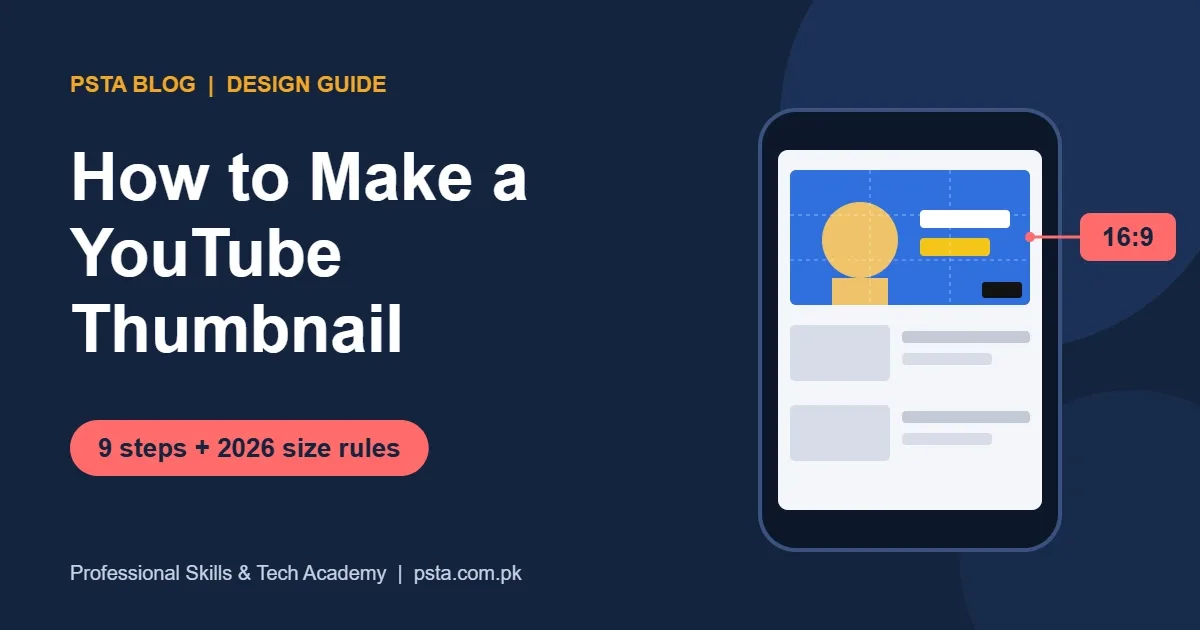
- Design a thumbnail that adds information. It should show something the title doesn't say. Our guide on how to make a YouTube thumbnail covers size and layout.
- Write the first two description lines. Say what the viewer will learn in plain language, then add manual chapters starting at 00:00.
- Add two or three hashtags. Add a few tags only for common misspellings of your topic.
- Deliver the promise early. Show the result or the first step within the opening moments, not after a long intro.
- Group related videos into a playlist. Viewers who finish one lesson can move straight to the next.
Which Numbers Should You Watch After Publishing?
Good YouTube SEO shows up in your analytics, not in your feed. Give a new video at least a week before drawing conclusions, since YouTube itself says early CTR swings widely. Then open the video's analytics and check:
- Impressions and CTR: how often your thumbnail was shown and how often it was clicked.
- Average view duration: whether people stayed once they clicked.
- Traffic sources: how much of your viewing came from YouTube search compared with browse or suggested videos.
- Search terms: the actual phrases that brought viewers, which often suggest your next video.
If you plan to earn from your channel, these same numbers feed into watch hours. Our checklist on YouTube monetization requirements in Pakistan walks through the current thresholds.
Learning YouTube SEO in PSTA's Digital Marketing Course
YouTube SEO is one module in our Advanced Digital Marketing course, which I teach in Abbottabad. The module, YouTube Marketing and YouTube SEO with TubeBuddy, sits alongside Google Analytics, Meta ads, Google Ads and portfolio building, so you learn to read results as well as publish videos.
The course lasts 12 weeks. You can attend at our Mandian campus on Old College Road, join live from any city in Pakistan, or mix both. The current fee is Rs. 30,000 (regular Rs. 35,000), payable in two installments, and a new batch starts every month.
If editing is your weaker side, the Video Editing and VFX course covers Premiere Pro, After Effects and export settings over 12 weeks for Rs. 22,000. You can compare every program on the courses page, apply through the admission form, or check batch timings by sending a WhatsApp message to +92 314 5424399.
Rewrite One Old Title This Week
Pick one older video that gets impressions but few clicks. Look at the search terms that brought its viewers, rewrite the title and the first description line around the clearest one, and add chapters if it has none. Write down the CTR today, then check it again in two weeks. One honest experiment on your own channel will teach you more about YouTube SEO than another hour of reels about secret tricks.
Frequently asked questions
Do YouTube tags still matter in 2026?
YouTube's help page says tags play a minimal role in discovery, and the title, thumbnail and description matter more. Tags are still worth adding when your topic is commonly misspelled, such as Roman Urdu words with several spellings. Add a few accurate variations, then spend the rest of your time on the title and the video itself.
How many hashtags should I use on a YouTube video?
Two or three relevant hashtags are usually enough. YouTube shows up to three of the most engaging hashtags next to your title. If a video has more than 60 hashtags, YouTube ignores all of them, and over-tagging can get a video removed from search. Every hashtag should relate directly to the content.
What is a good click-through rate on YouTube?
YouTube says half of all channels and videos have an impressions CTR between 2% and 10%. New videos, new channels and videos with fewer than 100 views can see a wider range. Rather than chasing one target number, compare your own videos over time and look at CTR separately for each traffic source.
Can I learn YouTube SEO for free?
Yes, you can start without paying anything. YouTube's Help Center explains how search and recommendations work, and the Trends tab in YouTube Studio shows top searches and content gaps based on your audience. Paid extensions add convenience, but the built-in tools are enough to practice on your own channel first.
How long does YouTube SEO take to show results?
There's no fixed timeline, and YouTube doesn't publish one. YouTube does say CTR on videos less than a week old can vary widely, so wait at least a week before judging a new upload. Track impressions, CTR, average view duration and search traffic over several weeks to see a reliable trend.
Does YouTube SEO work for Urdu and Roman Urdu videos?
Yes. YouTube matches searches to your title, description, tags and content, so use the language and spelling your viewers actually type. Many Pakistani viewers search in Roman Urdu or English. Check the search box suggestions and the search terms in your analytics, then write titles in the form people use most.
Is YouTube SEO part of PSTA's digital marketing course?
Yes. PSTA's 12-week Advanced Digital Marketing course includes a module on YouTube marketing and YouTube SEO with TubeBuddy, along with analytics, Meta ads and Google Ads. You can study on campus in Abbottabad, live online or in hybrid mode. The current fee is Rs. 30,000, payable in two installments.
Sources & references
- How YouTube search works - YouTube Help support.google.com
- Add tags to your videos - YouTube Help support.google.com
- Hashtag policies and how to use hashtags - YouTube Help support.google.com
- Video chapters - YouTube Help support.google.com
- How YouTube recommendations work - YouTube Help support.google.com
- Impressions and click-through rate FAQs - YouTube Help support.google.com
- Explore trends on YouTube - YouTube Help support.google.com
- Pakistani YouTubers win global audiences - Daily Pakistan en.dailypakistan.com.pk
Last reviewed & updated on by Umar Qureshi. Written by the PSTA team in Abbottabad, Pakistan.

Umar Qureshi

Advanced Digital Marketing Course in Pakistan and Abbottabad
Turn this guide into a career: hands-on training with real projects, online across Pakistan or on-campus in Abbottabad · 12 Weeks.
Comments
No comments yet — ask a question or share your experience.