Quick answer
In SQL vs NoSQL, SQL databases keep data in linked tables with a fixed schema and strong transactions, while NoSQL stores flexible documents, key-value pairs or graphs. Most beginners should learn SQL first, because relational databases fill four of the top six spots in Stack Overflow's 2025 survey, then add MongoDB.
Key takeaways
- • SQL databases use tables, keys and joins; NoSQL databases use documents, key-value pairs, wide columns or graphs.
- • In the Stack Overflow 2025 survey, PostgreSQL led at 55.6%, MongoDB was used by 24% and Oracle by 10.6% of 26,083 respondents.
- • Pick SQL for money, stock and reporting; pick NoSQL for changing shapes, caching and whole-object reads.
- • PostgreSQL jsonb and Oracle duality views mean relational databases now handle JSON well.
- • Learn SQL first, then rebuild one project in MongoDB to feel the trade-offs yourself.
Table of contents 16 sections
- What Is the Real Difference Between SQL and NoSQL?
- SQL vs NoSQL at a Glance
- SQL vs NoSQL in Practice: One Online Order
- The Relational Version
- The Document Version
- What Do Developers Actually Use in 2026?
- Where Relational Databases Still Win
- When to Use NoSQL
- NoSQL Database Examples and the Jobs They Do
- The Line Between Them Is Blurring
- Which Should Beginners Learn First?
- A 12-Week Study Order That Covers Both
- Free Ways to Practice Both Tonight
- Beginner Mix-Ups to Avoid
- Learning Databases Properly at PSTA
- Before You Close This Tab: Model One Order Two Ways
When students compare SQL vs NoSQL, the real question is usually simpler: which one should I learn first, and will the wrong pick cost me months? We hear it from first-semester BSCS students and self-taught web learners alike. Our answer: learn SQL first, then add one NoSQL database once you can design a clean table. This guide shows why, using real usage data and official documentation from Oracle, PostgreSQL and MongoDB.
In this comparison you will find:
- A plain-English definition of each model, with one shop order stored both ways
- A side-by-side table covering schema, joins, transactions and scaling
- What 26,083 developers reported using in the latest Stack Overflow survey
- When to use NoSQL and when a relational database is the safer pick
- A week-by-week study order and two free practice databases you can install tonight
What Is the Real Difference Between SQL and NoSQL?
SQL databases store data in tables with fixed columns and link those tables with keys. NoSQL databases store data in other shapes, most often JSON-like documents, key-value pairs, wide columns or graphs, and usually let each record carry its own set of fields. That is the whole split in two sentences.
The phrase "relational vs non-relational database" means the same thing. A relational database (Oracle, MySQL, PostgreSQL, SQL Server, SQLite) expects you to plan the structure first. You decide that a customer has a name, a phone number and a city, and every row follows that plan. You then ask questions with SQL, a query language that has been the standard for decades.
A non-relational database flips the order. You can save a record first and shape it later. MongoDB's own data modeling guide states that documents in one collection do not need the same fields or data types, and that you can add schema validation only where you need a fixed structure.
Neither approach is "newer and better." In SQL vs NoSQL, each side solves a different problem. A bank ledger and a product catalog with 40 kinds of attributes need different things from a database.
SQL vs NoSQL at a Glance
Use this SQL vs NoSQL table as a quick reference before we go deeper. It describes the typical behavior of each family; individual products have exceptions, which we cover later.
| Point | SQL (relational) | NoSQL (non-relational) |
|---|---|---|
| Data shape | Tables, rows and columns | Documents, key-value pairs, wide columns or graphs |
| Schema | Defined before you insert data | Flexible by default, validation optional |
| Relationships | Foreign keys and joins | Embedded data or references you resolve in code or queries |
| Transactions | Multi-row ACID transactions are standard | Single-document writes are atomic; multi-document transactions need extra setup |
| Query language | SQL, shared across vendors | Each product has its own API or query syntax |
| Growth pattern | Traditionally scaled up on a bigger server | Often designed to spread across many servers |
| Examples | Oracle, MySQL, PostgreSQL, SQL Server, SQLite | MongoDB, Redis, Cassandra, DynamoDB, Neo4j |
Notice the row on query language. Once you know SQL, you can move between Oracle, MySQL and PostgreSQL with small syntax changes. NoSQL skills transfer less cleanly, because MongoDB, Redis and Cassandra each work differently.
SQL vs NoSQL in Practice: One Online Order
Abstract comparisons only go so far. Picture a small Pakistani clothing store that sells on Instagram and takes cash on delivery. A customer in Mardan orders two shirts. Here is how each model might hold that order (an illustrative design, not taken from a real business).
The Relational Version
You would create at least three tables: customers, orders and order_items. The order row stores a customer_id that points to the customer. Each shirt becomes its own row in order_items with an order_id. To print a packing slip, you join the three tables in one query. If the customer changes her phone number, you update one row and every past order shows the new number.
This is the design approach our database normalization walkthrough teaches, and the join itself is covered step by step in SQL joins explained.
The Document Version
In MongoDB you might save the whole order as one document: the customer's name and phone, the delivery address and an array holding both shirts. Reading the packing slip is a single fetch with no join. The trade-off appears later. If that customer places 15 orders, her phone number is copied 15 times, so changing it means updating many documents.
MongoDB's guide on embedding vs references recommends embedding when your app reads the pieces together, and references when child data grows without limit or is hard to keep in sync when duplicated. Good document design is still design. It just happens in a different place.
| Task on this order | Relational | Document |
|---|---|---|
| Show one packing slip | Join 3 tables | Read 1 document |
| Change customer phone | Update 1 row | Update every order that copied it |
| Monthly sales by city | One GROUP BY query | An aggregation pipeline |
| Add a "gift wrap" field to new orders only | ALTER TABLE, then fill or allow NULL | Just start saving it |
What Do Developers Actually Use in 2026?
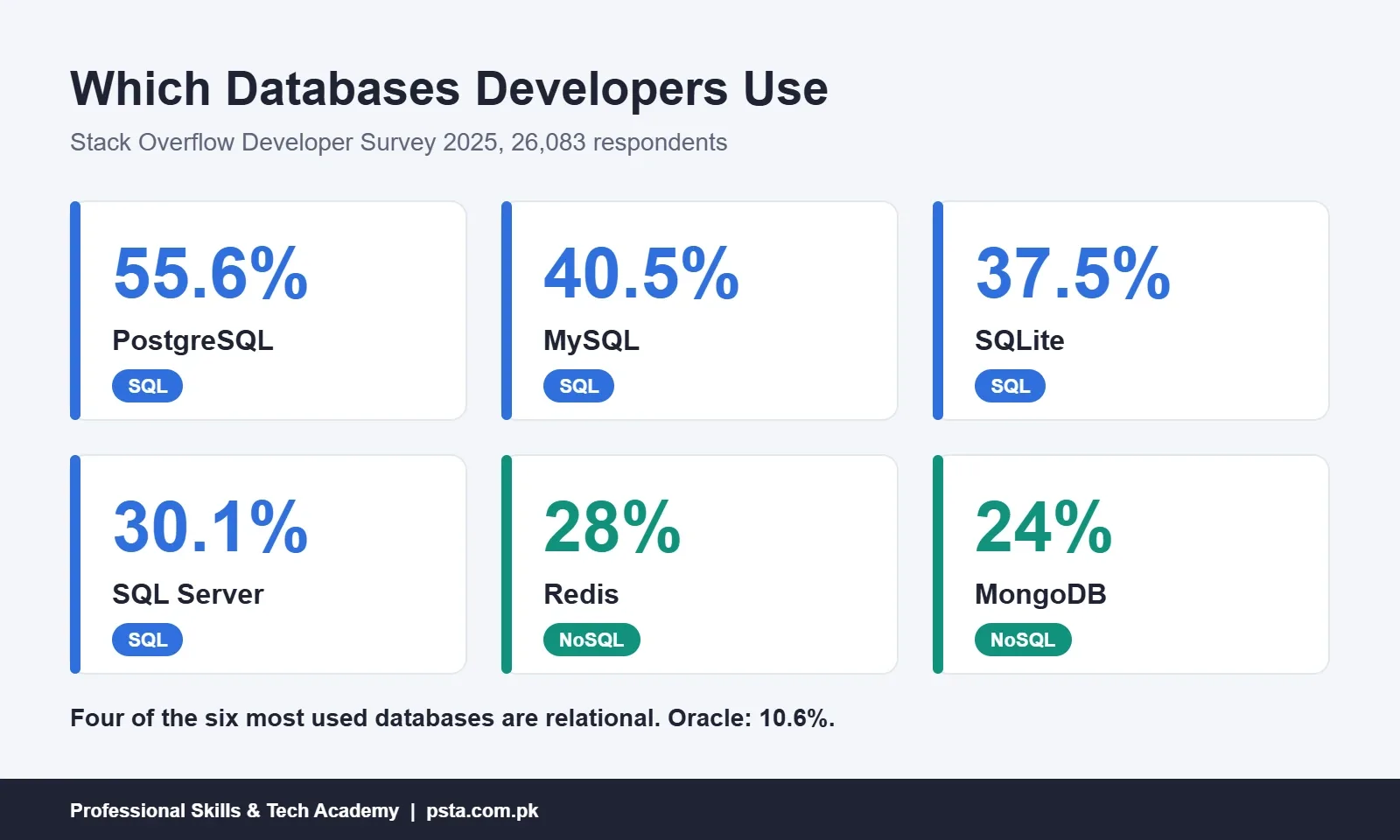
The clearest public numbers come from the Stack Overflow Developer Survey 2025, where 26,083 respondents answered the database question. PostgreSQL led at 55.6%, followed by MySQL at 40.5%, SQLite at 37.5% and Microsoft SQL Server at 30.1%. The top NoSQL entries were Redis at 28% and MongoDB at 24%. Oracle came in at 10.6% overall and 10.4% among professional developers.
Two SQL vs NoSQL lessons sit inside those figures. First, four of the six most used databases are relational, so SQL is the skill you will meet in most codebases and job descriptions. Second, Redis and MongoDB together show up in a large share of projects too, often running beside a relational database rather than replacing it. Many real systems use both.
Keep in mind that the survey leans toward web and software developers. Large enterprise teams running Oracle are a smaller slice of its respondents, so read the Oracle figure as a web-developer view, not a measure of the whole job market.
Where Relational Databases Still Win
Choose a SQL database when the correctness of every record matters more than how fast you can change its shape. Typical cases:
- Money and stock: fee records, payroll, invoices and inventory, where a half-saved transfer is unacceptable.
- Many related entities: students, courses, teachers and results that you combine in different ways for different reports.
- Reporting and analytics: SQL is the language Power BI, Excel's Power Query and most BI tools speak to when they pull data.
- Long-lived systems: a hospital or university system that new developers will maintain for a decade benefits from an enforced structure.
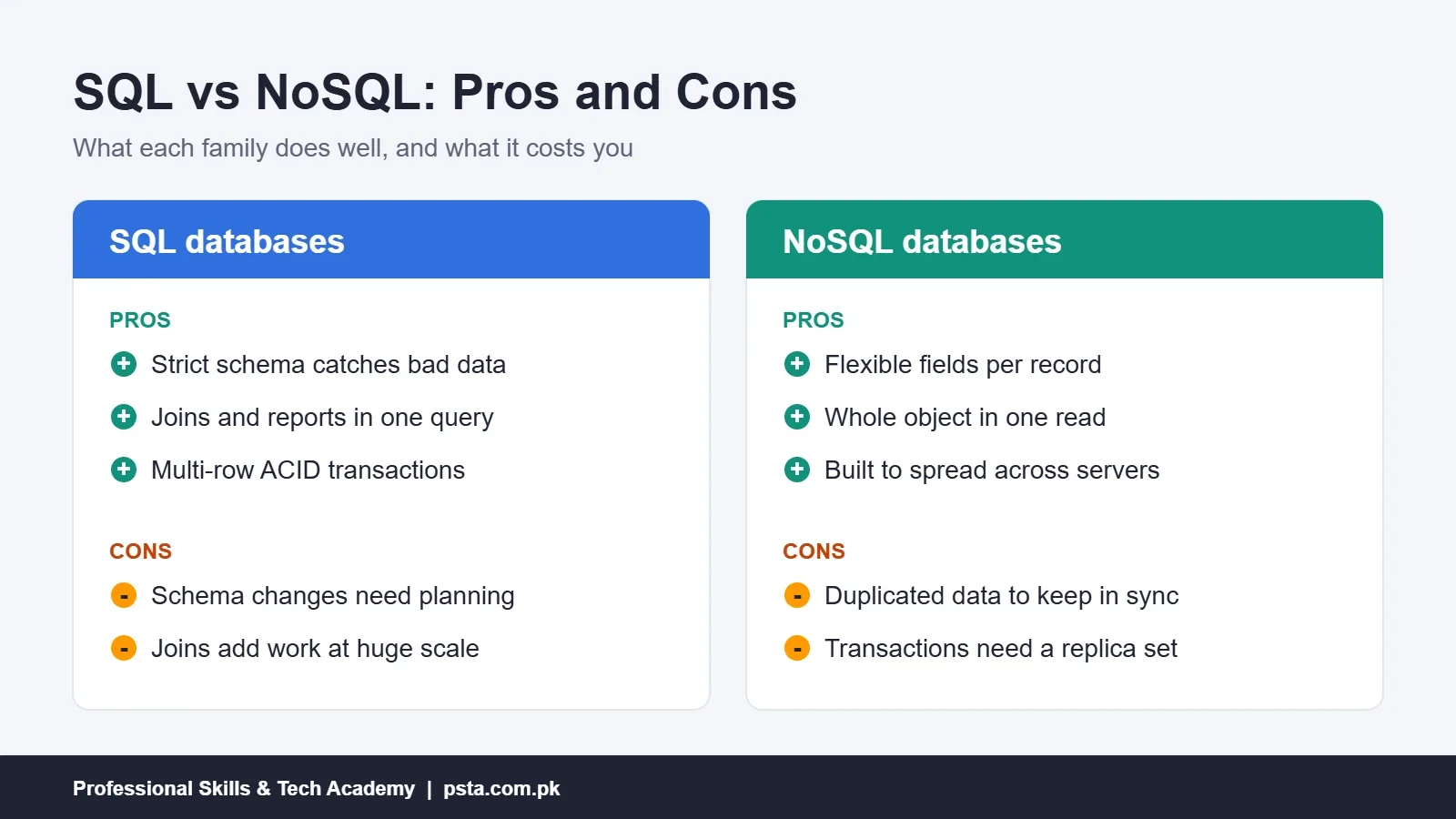
The schema that feels slow at the start is what protects you later. A column defined as a date will reject "next Tuesday." A foreign key will refuse an order for a customer who does not exist. Those checks catch bugs before they reach a report your manager reads. The price is planning: schema changes need care, and joins across very large tables take tuning work at huge scale.
When to Use NoSQL
Pick a NoSQL store when your data's shape changes often, when you read whole objects at once, or when you need a specialized job done very fast. Common, sensible uses include:
- Product catalogs: a phone, a lawn suit and a solar panel have completely different attributes.
- Content and user profiles: blog posts, settings and app preferences that are read as one unit.
- Caching and sessions: Redis keeps hot data in memory so pages load quickly.
- Event and log data: high write volume where each record stands alone.
- Prototypes: early app versions where the fields change weekly.
Be honest about the costs, too. MongoDB's transaction production notes say standalone deployments do not support transactions; you need a replica set. By default a transaction must finish in under one minute, or it is aborted. These limits are reasonable, but they show that multi-record consistency takes more care than in a relational system.
NoSQL Database Examples and the Jobs They Do
"NoSQL" covers four quite different families. Knowing which is which stops you from comparing Redis with MongoDB as if they were rivals.
| Family | Well-known product | Good at |
|---|---|---|
| Document | MongoDB | App data read as whole objects, such as profiles, catalogs and orders |
| Key-value | Redis | Caching, sessions, counters and queues in memory |
| Wide-column | Cassandra | Very high write volume spread across many servers |
| Graph | Neo4j | Relationships such as friends, routes and fraud rings |
For a beginner, the document family is the natural second step after SQL, because its records map closely to the JavaScript and Python objects you already write.
The Line Between Them Is Blurring
Older articles frame SQL vs NoSQL as two walled camps. That picture is out of date. Relational databases now store and index JSON well, and document databases now support transactions.
The PostgreSQL documentation on JSON types explains that the jsonb type is stored in a decomposed binary format, supports indexing, and is the type most applications should prefer. You can keep strict tables for orders and a flexible jsonb column for product attributes in the same database.
Oracle went further with JSON-relational duality views. According to Oracle's overview, a duality view exposes normal table data as JSON documents. The database builds documents when you read and splits them back into tables when you write, so a document-style app and a SQL report can work on the same rows at once.
For a learner, this convergence makes the SQL vs NoSQL choice less risky. Strong SQL plus a working knowledge of JSON covers a large part of both worlds.
Which Should Beginners Learn First?
Start with SQL. If you want one database for beginners that pays off in almost any IT role, a relational one is it. SQL transfers across vendors, it appears in most of the databases developers report using, and it teaches you to think about structure, keys and consistency. Those habits make you better at document design later, because you will know what you are giving up when you embed data.
There is one exception to this SQL vs NoSQL advice. If you are already deep in a JavaScript track and want to ship a MERN app this month, starting with MongoDB is fine. Just plan to come back for SQL before you apply for jobs. Our MERN stack roadmap shows where MongoDB fits in that path.
Students also search for MongoDB vs Oracle as if the two were direct rivals. They are not: one is a document store built for app data, the other a relational system built for consistency and enterprise workloads, and many companies run both. If you are torn between two relational databases rather than SQL and NoSQL, read Oracle vs MySQL for beginners first. This post sits one level above that choice.
A 12-Week Study Order That Covers Both
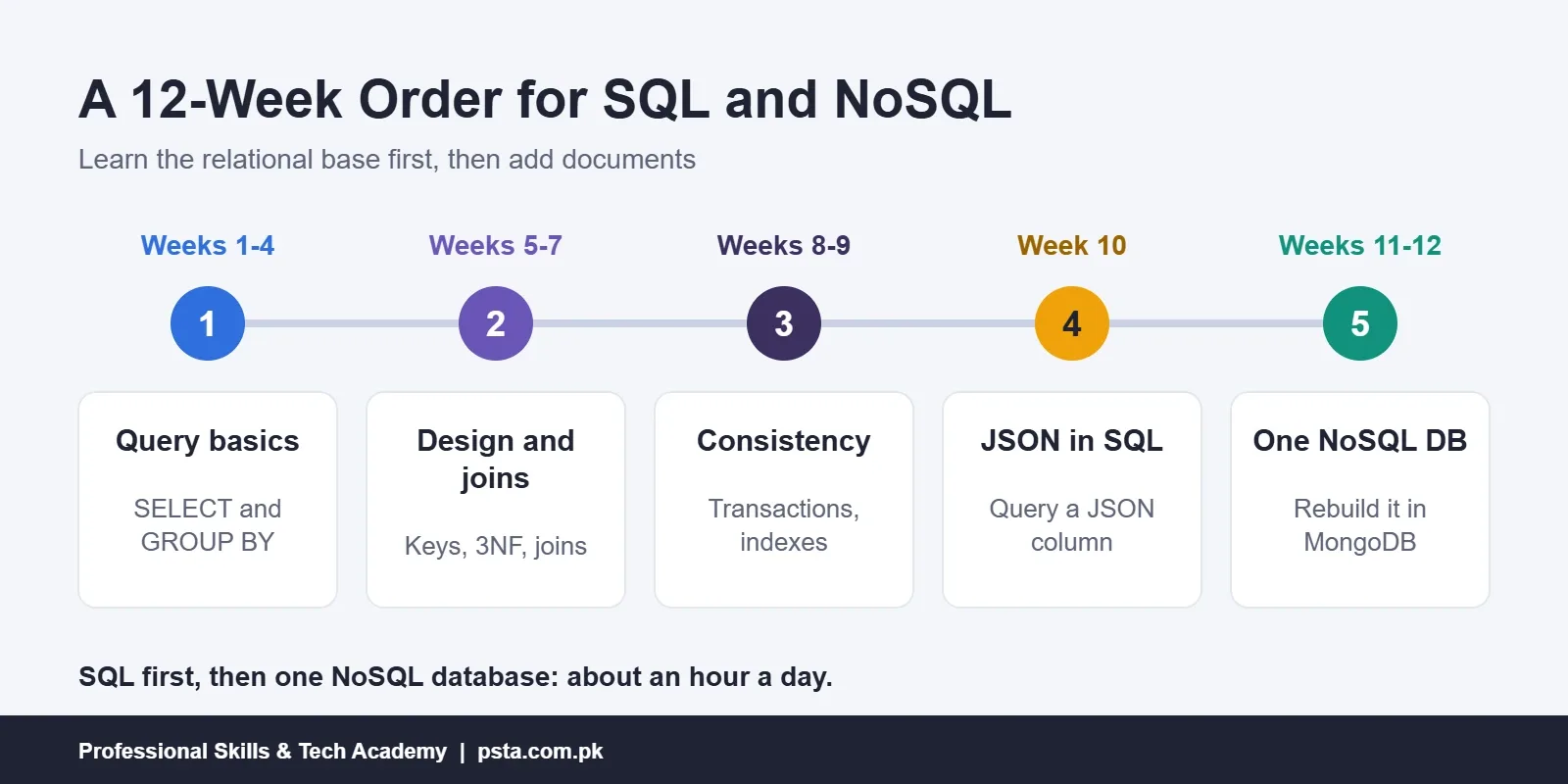
This plan covers both sides of SQL vs NoSQL and suits a student with about an hour a day. Adjust the pace, not the order.
- Weeks 1 to 4, query basics: SELECT, WHERE, ORDER BY, GROUP BY and single-row functions on one practice schema.
- Weeks 5 to 7, design and joins: primary and foreign keys, normalization to third normal form, inner and outer joins, subqueries.
- Weeks 8 and 9, consistency: transactions with COMMIT and ROLLBACK, constraints, indexes and reading an execution plan.
- Week 10, JSON inside SQL: store and query a JSON column so the document idea feels familiar.
- Weeks 11 and 12, one NoSQL database: rebuild the shop-order example in MongoDB, once embedded and once with references, and compare the queries.
By the end you will be able to explain SQL vs NoSQL trade-offs from your own code, which is exactly what interviewers probe for.
Free Ways to Practice Both Tonight
You do not need to pay anything to try both models on your own laptop or in the cloud.
- Oracle AI Database Free: Oracle's licensing restrictions page lists a limit of two CPU cores, 2 GB of RAM and 12 GB of user data. That is plenty for coursework and portfolio projects.
- MongoDB Atlas free cluster: the MongoDB pricing page lists the free tier at 512 MB of storage with shared RAM and CPU. Enough for the shop example and much more.
- PostgreSQL or SQLite: both are open source, and PostgreSQL lets you practice SQL and jsonb in one place.
Whichever you install first, load the same small shop dataset into it. Practicing on data you understand makes every query result easier to check.
Beginner Mix-Ups to Avoid
A few SQL vs NoSQL misunderstandings come up in almost every batch we teach.
- "NoSQL means no SQL at all." Many people read it as "not only SQL." Several NoSQL products offer SQL-like query languages.
- "NoSQL has no schema." The schema still exists; it lives in your application code or in optional validation rules.
- "NoSQL is always faster." It is faster for the access patterns it was designed for. A badly modeled collection can be slower than a well-indexed table.
- "SQL databases cannot scale." Large banks and telecoms run on relational systems. Scaling them takes planning, not a different product.
Learning Databases Properly at PSTA
PSTA (Professional Skills & Tech Academy) teaches the relational side in depth through the Oracle Database 19c Masterclass. According to the course page, it runs 12 weeks at beginner level and costs Rs. 33,000, discounted from Rs. 45,000. Its modules move from SQL fundamentals and data design through joins, subqueries and DDL, then PL/SQL with cursors, procedures and triggers, and on to architecture, security, RMAN backup and recovery, performance tuning and a capstone project.
If your goal is building web apps where a document database often appears, look at the Full-Stack Web Development Course with AI Tools, listed as a six-month beginner course at Rs. 45,000. You can compare every option on the courses page.
You can attend either course at the Abbottabad campus, join the same sessions live over the internet from your own city, or mix both modes. Fresh batches open monthly, and the timetable spans Monday to Saturday from 9:00 AM until 9:30 PM.
Before You Close This Tab: Model One Order Two Ways
Take a piece of paper and design the shop order from this guide twice. First draw three tables with their keys. Then write the same order as a single JSON object. Ask yourself one question: if the customer changes her phone number, how many places must change? That ten-minute exercise teaches more about SQL vs NoSQL than any comparison chart.
When you are ready for structured practice with a trainer who checks your queries, the admission page takes your application in a few minutes. Prefer to ask first? Our WhatsApp line, +92 314 5424399, answers questions about upcoming start dates.
Frequently asked questions
Is SQL harder to learn than NoSQL?
Not really. Basic SQL reads almost like English, and most students write useful SELECT queries within a week. NoSQL can feel easier on day one because you skip schema design, but that work returns later when you decide what to embed and what to reference. Over a full semester, both demand similar effort; SQL simply front-loads the thinking.
Can I get a job knowing only MongoDB?
Some startup and MERN roles focus on MongoDB, but most job descriptions for developers, data analysts and database administrators also list SQL. Relational databases filled four of the six most used spots in the Stack Overflow 2025 survey. Knowing only MongoDB narrows your options, so treat it as a second skill added on top of SQL.
Is MongoDB a replacement for Oracle?
No. They are built for different jobs. MongoDB stores flexible documents and suits app data read as whole objects. Oracle is a relational system built for strict consistency, complex reporting and enterprise workloads, and it can now expose tables as JSON through duality views. Many organizations run both side by side rather than choosing one.
Does NoSQL support transactions?
Many NoSQL databases do, with conditions. MongoDB treats a single-document write as atomic and supports multi-document transactions on replica sets and sharded clusters, but not on a standalone server. Its documentation also says a transaction must finish in under one minute by default. Relational databases handle multi-row transactions as a standard feature.
Which database is used for data analysis and Power BI?
Data analysis work leans heavily on SQL. Power BI, Excel's Power Query and most reporting tools pull data from relational sources with SQL queries, and analysts use GROUP BY, joins and window functions daily. NoSQL data is usually exported or flattened into tables before it reaches a dashboard, so SQL remains the core skill for analyst roles.
Do I need a powerful laptop to practice SQL and NoSQL?
No. Oracle AI Database Free is limited to two CPU cores, 2 GB of RAM and 12 GB of user data, so an ordinary student laptop handles it. MongoDB Atlas offers a free cloud cluster with 512 MB of storage, which needs only a browser and an internet connection. PostgreSQL and SQLite also run comfortably on modest machines.
Is it worth learning both SQL and NoSQL as a student?
Yes, in sequence. Spend most of your first months on SQL and relational design, since it carries across Oracle, MySQL and PostgreSQL. Then spend two or three weeks rebuilding one small project in MongoDB. That short second step lets you explain the trade-offs in interviews from your own experience rather than from memorized lists.
Sources & references
- Stack Overflow Developer Survey 2025: Technology survey.stackoverflow.co
- MongoDB Manual: Data Modeling mongodb.com
- MongoDB Manual: Embedding vs References mongodb.com
- MongoDB Manual: Transactions Production Considerations mongodb.com
- PostgreSQL Documentation: JSON Types postgresql.org
- Oracle: Overview of JSON-Relational Duality Views docs.oracle.com
- Oracle AI Database Free: Licensing Restrictions docs.oracle.com
- MongoDB Atlas Pricing mongodb.com
Last reviewed & updated on by Umar Qureshi. Written by the PSTA team in Abbottabad, Pakistan.

Umar Qureshi
Oracle Database 19c Masterclass: SQL, PL/SQL & Administration
Turn this guide into a career: hands-on training with real projects, online across Pakistan or on-campus in Abbottabad · 12 Weeks.
Comments
No comments yet — ask a question or share your experience.