Quick answer
In February 2022, an attacker exploited a signature check flaw in Wormhole's Solana bridge and minted 120,000 wrapped ETH, valued at roughly $320 million to $326 million. Jump Crypto refilled the bridge the next day. A UK court-ordered counter-exploit in 2023 clawed back about $140 million net. Nobody has been publicly charged.
Key takeaways
- • The Wormhole hack on February 2, 2022 minted 120,000 wETH on Solana with no ETH behind it.
- • A deprecated helper trusted a look-alike system account, so fake signatures passed as verified.
- • Jump Crypto replaced the 120,000 ETH within a day, so wETH holders kept their backing.
- • A UK High Court order in February 2023 led to a counter-exploit that recovered about $140 million net.
- • No attacker has been publicly named or charged in the sources reviewed.
- • Verify every input, remove deprecated code and cap large mints to avoid the same failure.
Table of contents 15 sections
- What Was the Wormhole Hack?
- Wormhole Hack Timeline: From Exploit to Clawback
- How Does a Solana Bridge Like Wormhole Work?
- How Did the Signature Verification Bug Let the Attacker In?
- Was the Fix Visible Before the Attack?
- How Much Did the Wormhole Hack Cost, and Why Do Figures Differ?
- Who Was Behind the Wormhole Hack?
- Who Paid for the Hole, and How Was Money Clawed Back?
- The Next-Day Bailout
- The 2023 Counter-Exploit
- Was the Counter-Exploit a Good Precedent?
- What Does This Mean for Crypto Users and Developers in Pakistan?
- Eight Defensive Lessons From the Wormhole Bridge Exploit
- Rebuilding the Wormhole Timeline in a PSTA Lab
- Spend Ten Minutes on Your Wrapped Tokens
Quick self-test before you read on. If you hold wrapped ETH on Solana, what stops someone from creating more of it out of thin air? The Wormhole hack on February 2, 2022 answered that question the hard way: a forged approval let an attacker mint 120,000 wrapped ETH that nothing backed. This timeline-led case study walks through each date, the flaw, the bailout and the unusual recovery a year later.
- A dated timeline from the exploit to the court-ordered clawback in February 2023
- How the bridge's signature verification bug worked, explained without code
- Why reported losses range from $320 million to $326 million
- Who covered the hole, and why the counter-exploit split the crypto community
- Eight defensive lessons for Pakistani users, developers and security students
What Was the Wormhole Hack?
Wormhole is a cross-chain bridge. It lets you move value between Solana, Ethereum and other blockchains. When you lock ETH on the Ethereum side, the bridge creates a matching wrapped token on Solana. That wrapped token is only worth something because real ETH sits behind it.
On February 2, 2022, someone broke that promise. According to TRM Labs, the attacker got around a signature check in Wormhole's contracts. That let them pose as an authorized party and mint at least 120,000 wETH on Solana. No ETH had been deposited to back those tokens.
The attacker then swapped and bridged much of the haul back to Ethereum, where it could be spent as real ETH. Blockchain analytics firm Elliptic, quoted by The Block, ranked it the fourth-largest crypto theft at the time.
Wormhole Hack Timeline: From Exploit to Clawback
Sources do not publish a single verified clock time for the mint, so this table sticks to dates that multiple outlets confirm. Each row links back to the article that reported it.
| Date | What happened | Reported by |
|---|---|---|
| August 2021 | Jump Trading buys Certus One, the firm that developed Wormhole | The Block, Fortune |
| February 2, 2022 | Attacker mints 120,000 wETH on Solana using a forged approval; Wormhole announces the exploit on Twitter | TRM Labs, The Register |
| February 2–3, 2022 | About 93,750 wETH moves back to Ethereum; Wormhole offers a $10 million bounty for the funds' return | The Block, Fortune |
| February 3, 2022 | Wormhole says all wETH is again backed 1:1 and the Portal token bridge is back up; Jump confirms it replaced the 120,000 ETH | The Block |
| February 3, 2022 | SOL falls 9% over 24 hours, per CoinMarketCap data | Fortune |
| February 21, 2023 | The High Court of England and Wales orders Oasis to retrieve assets tied to the attacker's vaults | Blockworks, DL News |
| February 24–25, 2023 | Oasis publishes its statement; reports put the recovered assets at about $225 million gross | Cointelegraph |
Notice how fast the first week moved. The theft, the bounty offer and the full refill all happened within roughly a day. The legal recovery took more than a year.
How Does a Solana Bridge Like Wormhole Work?
Think of a bridge as a bank with two branches in different cities. You deposit cash in Lahore, and the Karachi branch hands you a receipt you can spend. The receipt only works if the Lahore vault really holds your cash.
In Wormhole's design, a group of independent validators called guardians watched both chains. When they saw a deposit, they signed a message confirming it. The Solana side checked those signatures and then minted wrapped ETH.
So the whole Solana bridge rested on one question: did enough guardians really sign this message? If an attacker could fake a yes, the bridge would print tokens with nothing behind them. That is exactly what happened.
How Did the Signature Verification Bug Let the Attacker In?
Security researcher samczsun summarized the root cause in a widely cited thread: Wormhole did not properly validate all the accounts passed into its program. The Block reported that this let the attacker spoof guardian signatures.
Halborn's analysis fills in the concept. On Solana, programs often confirm that a signature check ran by reading a special system account that lists the transaction's instructions. Wormhole used an older, deprecated helper to read it. That helper never confirmed it was reading the genuine system account.
The attacker handed the program a look-alike account instead. The bridge read it, believed the signatures had been checked, and marked a fake signature set as verified. From there, the attacker posted a forged guardian approval and the bridge minted the tokens.
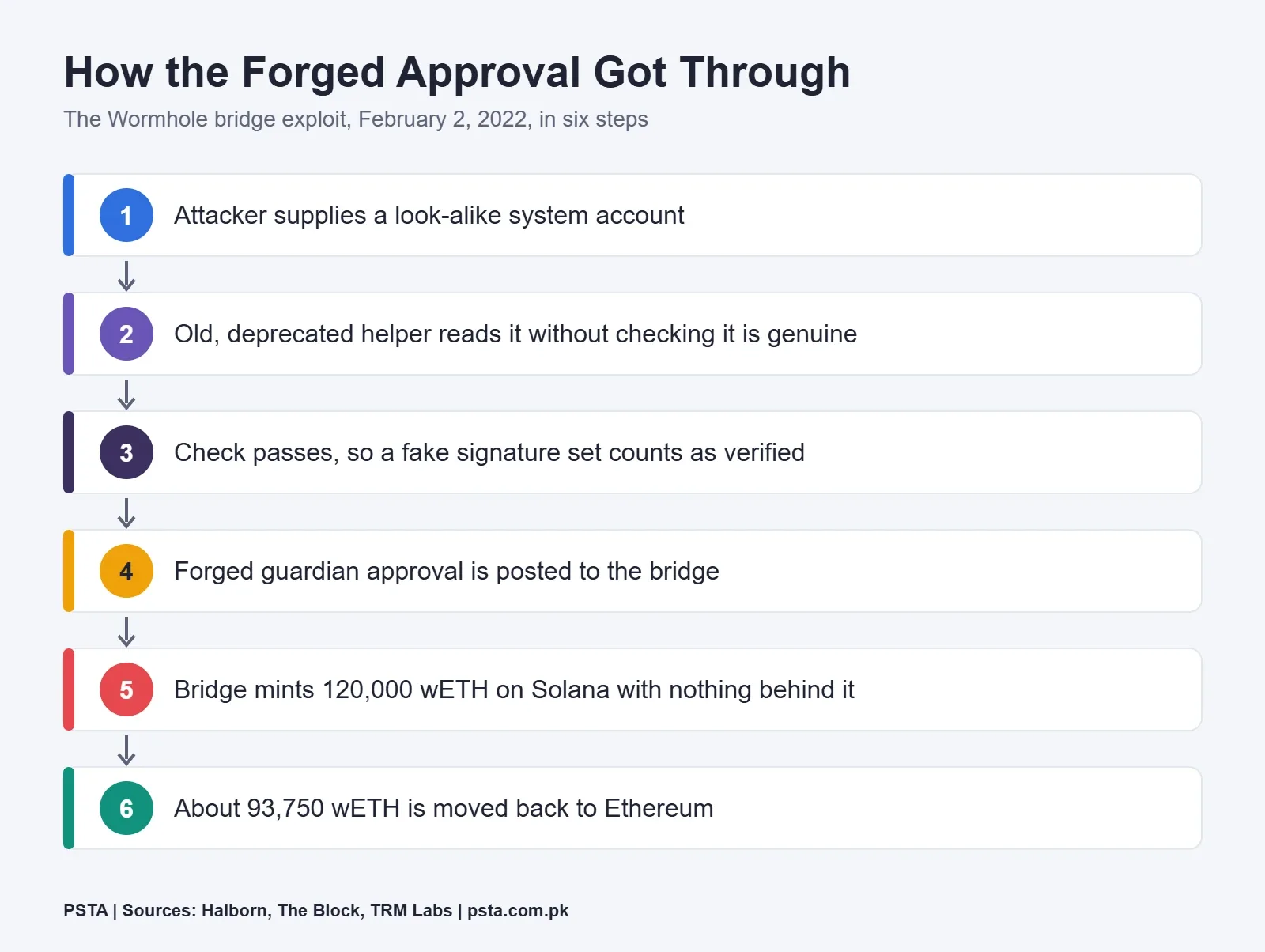
Put simply, the signature verification bug was not a broken cipher. The math was fine. The program simply trusted an input it should have identified first. That pattern, trusting data because it arrived in the expected slot, shows up in many web and API attacks too.
Was the Fix Visible Before the Attack?
Possibly, but this part is unconfirmed. The Register reported that researcher Matthew Garrett suspected a security fix had appeared in a public code change before it was deployed. In his view, an attacker may have spotted it and struck in that gap. The Register said Wormhole had not answered its question about that account, so treat it as informed speculation rather than fact.
How Much Did the Wormhole Hack Cost, and Why Do Figures Differ?
The token count is consistent: 120,000 wETH. The dollar figure is not, because ETH's price moved during the day and each outlet measured at a different moment.
- The Register put the loss at roughly $320 million.
- Elliptic, quoted by The Block, put it at about $325 million.
- TRM Labs said it was worth over $324 million.
- Halborn's write-up used about $326 million.
The amount moved back to Ethereum also varies slightly. The Block and The Register cite 93,750 ETH, based on samczsun's tracking. Fortune, citing TRM Labs, reported about 96,000 wETH. The gap likely reflects snapshots taken at different times.
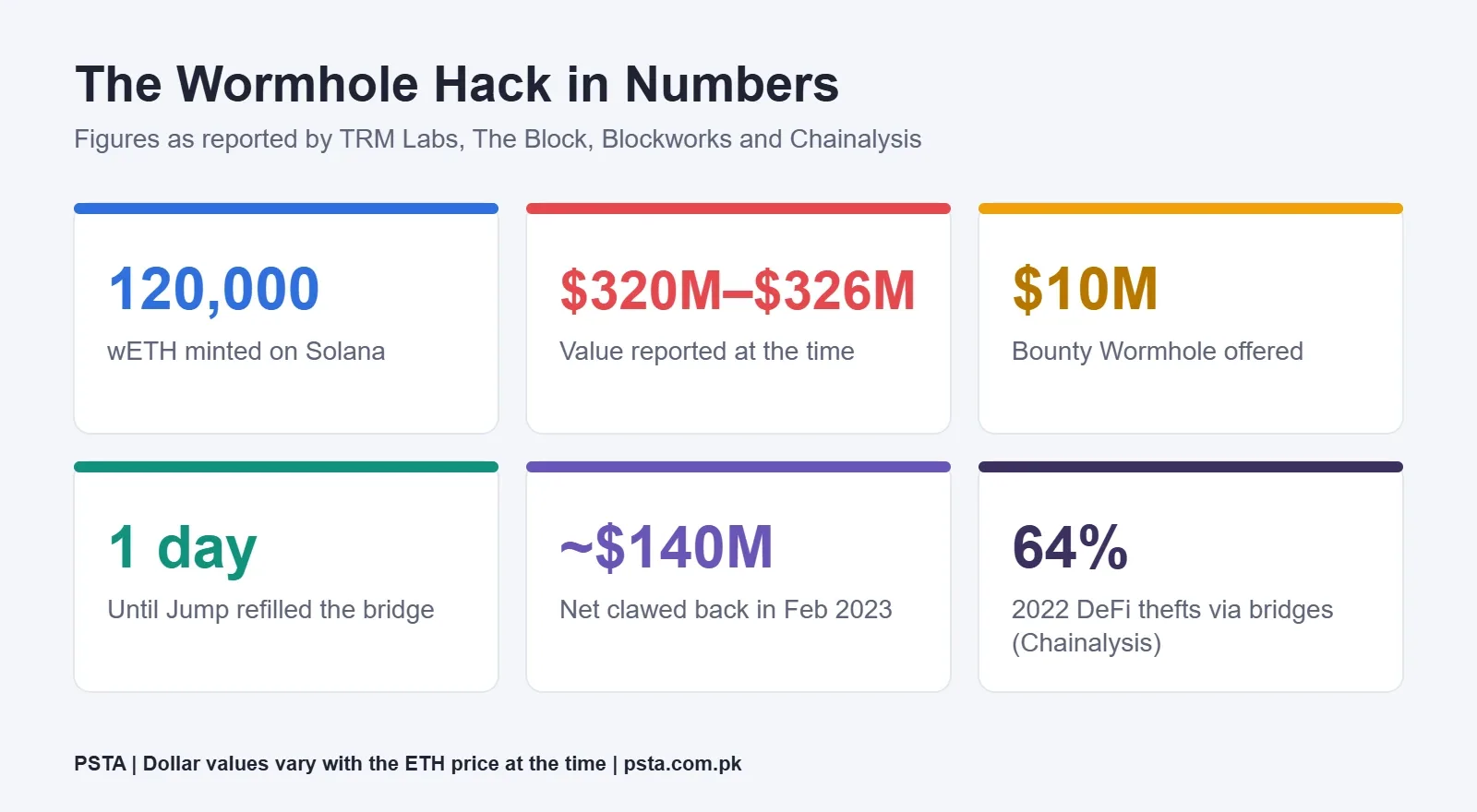
For wider context, Chainalysis counted about $3.8 billion stolen from crypto firms in 2022, as reported by Infosecurity Magazine. It said cross-chain bridge protocols made up 64% of DeFi protocol thefts that year. The Wormhole hack was one of the largest single cases inside that figure.
Who Was Behind the Wormhole Hack?
Nobody has been publicly named. None of the sources reviewed for this article report an arrest, a charge or a confirmed attribution. That sets this crypto bridge hack apart from the Ronin Network hack and the Bybit hack, where the FBI linked the thefts to North Korea.
What investigators did see was the money trail. TRM Labs reported that the attacker's starting ETH came from Tornado Cash, a mixing service. That is a common way to hide where funds came from. It tells you about operational care, not identity.
Be careful with one shortcut here. Chainalysis said North Korean hackers stole about $1.7 billion in 2022. That fact alone does not tie them to Wormhole, and no official body has made that link.
Who Paid for the Hole, and How Was Money Clawed Back?
The Next-Day Bailout
Within a day of the Wormhole hack, the project said its ETH contract had been refilled and all wETH was backed one-for-one again. Jump Crypto then confirmed it had replaced the 120,000 ETH to make the community whole. Users who held wETH did not lose their tokens' backing. Jump absorbed the loss, at least on paper.
Wormhole also offered the attacker a $10 million bounty to return the funds and explain the exploit. According to the reports, the attacker did not take it.
The 2023 Counter-Exploit
The attacker later parked part of the proceeds in vaults on Oasis, a front-end for the Maker lending protocol, to borrow against them. DL News said the goal was to increase their Ethereum holdings.
On February 21, 2023, the High Court of England and Wales ordered Oasis to retrieve those assets. Blockworks reported that Oasis used its 4-of-12 admin multisig and an upgradable contract to move the attacker's vault positions to a new wallet. Oasis said the assets went to a court-authorized third party and that it kept no access. Blockworks Research identified that party as Jump, though neither firm confirmed it.
The recovered amount depends on how you count. Cointelegraph reported 120,695 wstETH and 3,213 rETH, worth about $225 million. However, about $78 million in DAI debt had to be repaid to free that collateral. Blockworks therefore estimated the net recovery at about $140 million.
Was the Counter-Exploit a Good Precedent?
Getting money back sounds like a clear win. Many DeFi builders saw it differently. Oasis itself admitted the access was possible only because of a previously unknown weakness in its admin multisig design.
Wintermute's Igor Igamberdiev told DL News, "It sets a very dangerous precedent." His worry was that upgradable contracts with admin keys work like a backdoor. Adam Cochran of Cinneamhain Ventures warned that tools built to stop hackers can be turned against ordinary users. He also raised the risk of regulators pressuring known developers.
The other side is simple. A court approved the action, the target was a thief, and stolen funds came back. Both views can be true. As a defender, the takeaway is that any admin key that can move user funds is a power someone may one day ask you to use.
What Does This Mean for Crypto Users and Developers in Pakistan?
Many Pakistani freelancers and students who followed the Wormhole hack hold crypto through wallets that use bridges in the background. Others build smart contracts for foreign clients or take part in Web3 bug bounties. The Wormhole bridge exploit touches all three groups.
- If you hold wrapped tokens: a wrapped token is only as safe as the bridge behind it. Keep large balances in the native asset where you can.
- If you build on Solana or Ethereum: deprecated helpers and unchecked inputs are the kind of bug a reviewer can catch. Code review is part of the job, not an extra.
- If you study security: this is a clean example of broken input validation, the same family of flaw covered in the OWASP Top 10 2025.
Also watch for scams after big hacks. Fake "refund" and "bridge recovery" links often follow headlines. Use the steps in our guide to check if a link is safe before you connect a wallet anywhere.
Eight Defensive Lessons From the Wormhole Bridge Exploit
- Verify the identity of every input. Before trusting what an account, file or header says, confirm it is the genuine source.
- Remove deprecated helpers. Old functions often skip checks that newer ones enforce. Treat deprecation warnings as security tickets.
- Close the patch-to-deploy gap. When a fix is security-critical, plan its release so it reaches production before it gets public attention.
- Add limits to minting. Rate limits or caps on large mints give a team time to react before the full pool is lost.
- Monitor for unbacked supply. Compare wrapped tokens issued against assets locked on the other chain, and alert on any mismatch.
- Prepare a recovery playbook. Wormhole's bounty offer and refill came within a day. Speed like that needs a plan written in advance.
- Treat admin keys as risk. The same multisig power that recovered funds in 2023 was also an undisclosed weakness. Document it and guard it.
- Diversify where you hold value. Users should avoid keeping everything in one bridge, one exchange or one wallet.
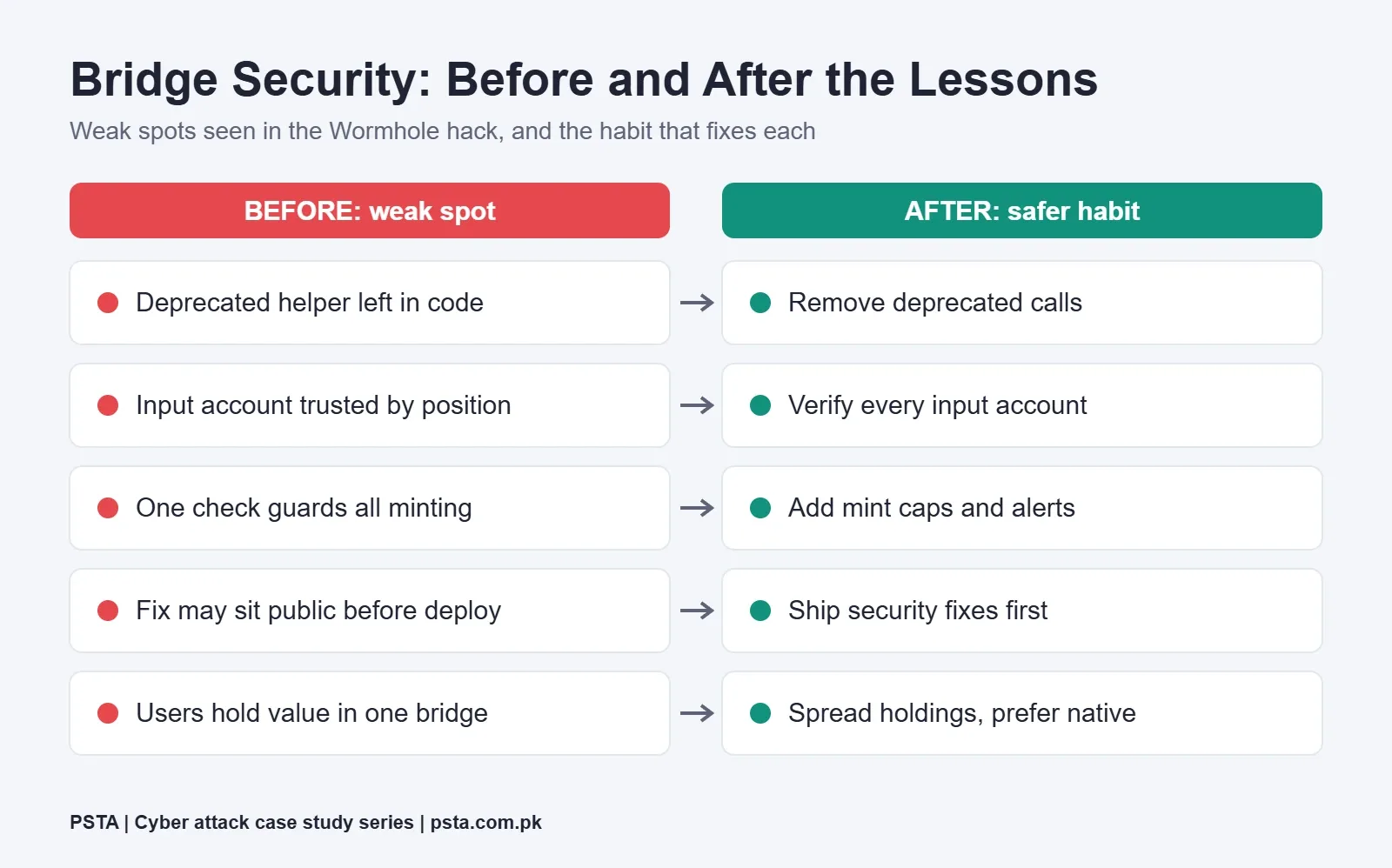
Several lessons from the Wormhole hack repeat across the series. Compare them with the Poly Network hack, another bridge failure, and the first case study on the Binance hack.
Rebuilding the Wormhole Timeline in a PSTA Lab
Reading about the Wormhole hack is useful. Rebuilding its timeline from public sources, then writing a short incident report, is where the skill really forms. That is how we use cases like this one at PSTA.
The PSTA cyber security course is a 12-week program pitched at beginners. Its modules cover security fundamentals, types of attacks, ethical hacking basics, network security, malware analysis and incident response, and digital forensics with Pakistan's PECA law. Module 7 is built around real-world case studies and a final security project.
You can join on campus in Abbottabad or through live online classes from any city. If you already work in IT and want deeper testing skills, move on to our advanced penetration testing program after it. Current fees and batch dates are listed on each course page.
Spend Ten Minutes on Your Wrapped Tokens
Open your wallet today and list every token with "wrapped" or a bridge name in it. For each one, note which bridge issued it and whether you need to hold it there. If not, move it back to the native asset the next time you transact. It is a small habit, and it removes one link from the chain that failed in the Wormhole hack.
Frequently asked questions
Did Wormhole users lose money in the 2022 hack?
Holders of Wormhole's wrapped ETH kept their backing because Jump Crypto replaced the 120,000 ETH within about a day, according to The Block. The loss fell on Jump rather than on users. Anyone who panic-sold or was caught by follow-up scams could still have lost money, which is why calm verification matters after any big hack.
Is Wormhole still running after the hack?
Yes. Wormhole said on February 3, 2022 that its Portal token bridge was back up and all wETH was backed one-for-one again. The specific flaw was patched. A bridge recovering, though, does not prove it is risk-free today, so check any bridge's current audits and incident history before moving large amounts.
What does wrapped ETH mean?
Wrapped ETH is a token on another blockchain, such as Solana, that represents real ETH locked by a bridge on Ethereum. It lets you use ETH's value on a different network. Its worth depends completely on the bridge keeping that locked ETH safe and only minting tokens when a genuine deposit exists.
Was North Korea behind the Wormhole hack?
No public evidence links North Korea to this case. Chainalysis said North Korean groups stole about $1.7 billion in 2022, but that general figure does not attribute Wormhole to them. No government agency or court has named the attacker, and none of the sources we reviewed report an arrest.
How was money recovered a year later?
The attacker had placed assets in vaults on Oasis, a front-end for Maker. After a High Court of England and Wales order on February 21, 2023, Oasis used its admin multisig to move those positions. Reports put the gross value at about $225 million and the net recovery at about $140 million after repaying debt.
Could a similar crypto bridge hack happen again?
Yes. Bridges hold large pools of locked assets and depend on complex checks across two chains, which makes them attractive targets. Chainalysis said bridges made up 64% of DeFi protocol thefts in 2022. Strong code review, removal of deprecated functions and limits on large mints all reduce the risk.
Can I learn to analyze attacks like this at PSTA?
Yes. PSTA's 12-week beginner Cyber Security and Ethical Hacking course ends with a module on real-world case studies and a final security project. You practice building incident timelines and writing findings, on campus in Abbottabad or through live online classes. No earlier security background is required to join.
Sources & references
- TRM Labs: Solana Wormhole Compromise, 120k Wrapped ETH Stolen trmlabs.com
- The Block: Wormhole replenishes its blockchain bridge after $325 million exploit theblock.co
- The Register: Wormhole currency theft theregister.com
- Halborn: Explained, the Wormhole Hack (February 2022) halborn.com
- Fortune: Hackers steal $320 million from Wormhole fortune.com
- Blockworks: Jump Crypto counter-exploited the Wormhole hacker blockworks.co
- Cointelegraph: Jump Crypto and Oasis counter-exploit Wormhole hacker cointelegraph.com
- DL News: Wormhole hack recovery sets a dangerous precedent for DeFi dlnews.com
Last reviewed & updated on by Umar Qureshi. Written by the PSTA team in Abbottabad, Pakistan.

Umar Qureshi

Cyber Security & Ethical Hacking Course in Abbottabad - PSTA
Turn this guide into a career: hands-on training with real projects, online across Pakistan or on-campus in Abbottabad · 12 Weeks.
Comments
No comments yet — ask a question or share your experience.