Quick answer
On August 10, 2021, an attacker took about $611 million from the Poly Network bridge by tricking a privileged contract into swapping the key that approved transfers. No signing key leaked. Almost all funds came back by August 23, except $33 million that Tether froze. Poly Network was attacked again in July 2023.
Key takeaways
- • The 2021 attack abused contract logic, not a leaked key, according to SlowMist.
- • One manager contract both ran user messages and controlled the keeper list.
- • About $611 million left three chains, and nearly all was returned by August 23, 2021.
- • Tether froze about $33 million in USDT within a day of the theft.
- • A separate July 2023 attack cashed out about $10.1 million, per Beosin.
Table of contents 16 sections
- What Was Poly Network, and What Did the Hack Take?
- Poly Network Hack Timeline in UTC and Pakistan Time
- How Did the Poly Network Hack Work?
- What Went Wrong: Five Design Mistakes
- 1. A Powerful Contract Ran Outsiders' Messages
- 2. Nobody Checked What a Message Meant
- 3. A Filter Was Treated as a Wall
- 4. Short Identifiers Guarded a Critical Function
- 5. Too Much Value Sat Behind One Check
- Who Was Behind It, and How Sure Is Anyone?
- After the Theft: Returns, a Bounty Offer and a Second Attack
- Three Myths About the Poly Network Hack
- What Does This Mean for Crypto Users and Builders in Pakistan?
- Seven Defensive Lessons for Cross-Chain Bridge Security
- Where PSTA Students Meet Cases Like Poly Network
- Read One Bridge's Security Page Before You Use It
The Poly Network hack drained about $611 million from a cross-chain bridge on August 10, 2021, by The Block's estimate reported by BleepingComputer. The thief did not guess a password or steal a signing key. One contract trusted a message it should have rejected, and that gap gave a stranger control of the bridge.
This post reads the case as a "what went wrong" report. You will see:
- What Poly Network did and how much left each blockchain
- A day-by-day timeline in UTC and Pakistan time
- The design mistakes behind the theft, explained without code
- Why the attacker returned the funds, and why you should never count on that
- Seven defensive lessons for builders and users in Pakistan
What Was Poly Network, and What Did the Hack Take?
Poly Network was a bridge. It let people move tokens between separate blockchains such as Ethereum, BNB Smart Chain and Polygon. According to BleepingComputer, it was built by the teams behind Neo, Ontology and Switcheo.
A bridge usually works by locking your tokens in a contract on one chain and releasing matching tokens on another. So each side of the bridge holds a large pool of real assets. That pool is the target. If someone can convince the bridge that a valid transfer request arrived, the pool pays out.
The figures differ slightly by source, mostly because token prices moved during the day. The table below shows both versions.
| Blockchain | The Block's estimate (via BleepingComputer) | Figures cited by Blockworks |
|---|---|---|
| Ethereum | $273 million | About $266 million |
| BNB Smart Chain | $253 million | $253 million |
| Polygon (USDC) | $85 million | $85 million |
| Total | About $611 million | About $604 million |
Poly Network itself later used the round figure of $610 million in its August 23 recovery update. The Block called it the largest DeFi hack on record at the time.
Poly Network Hack Timeline in UTC and Pakistan Time
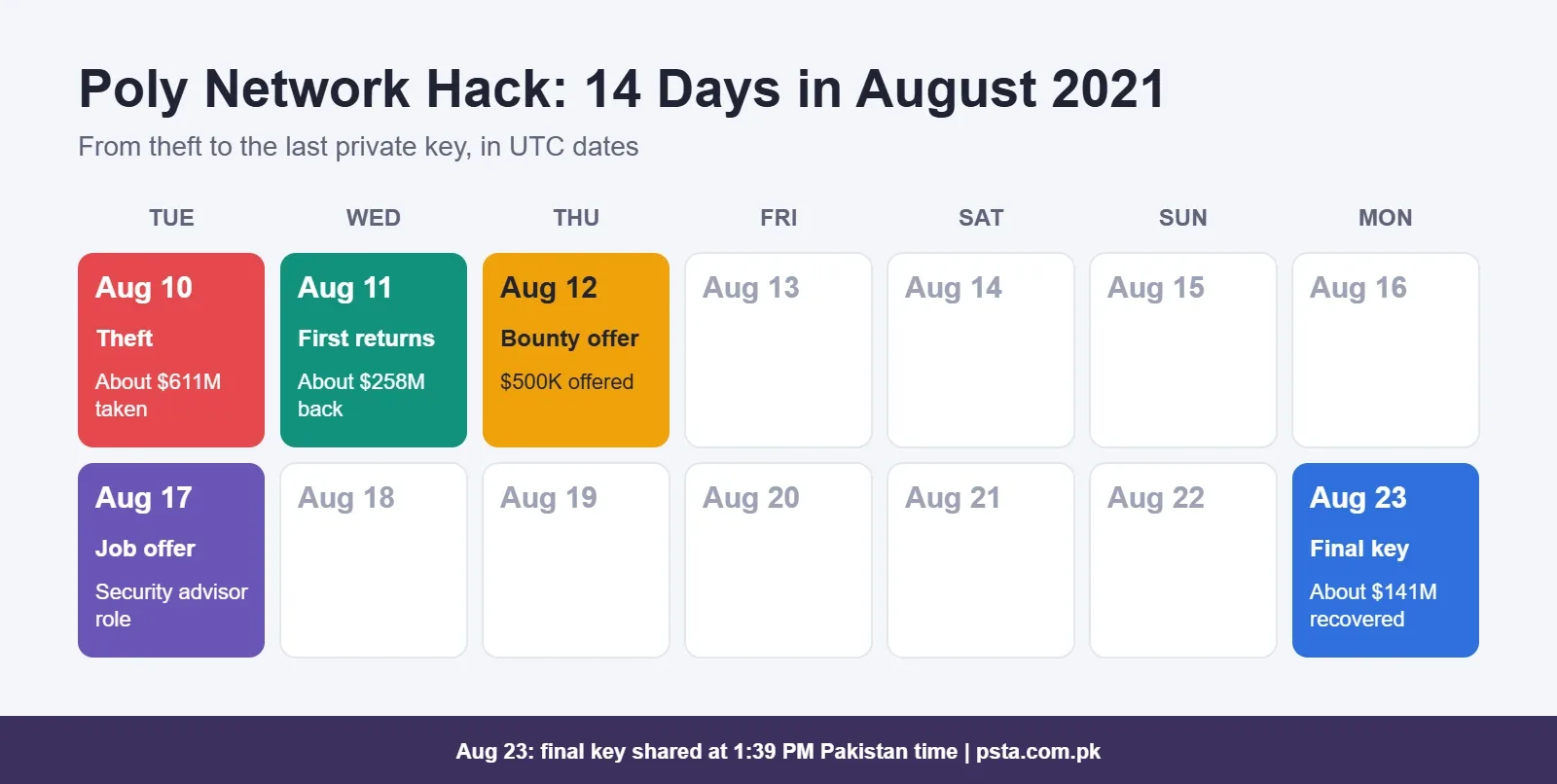
Most of the story played out in public, on the blockchain and on social media. Pakistan Standard Time is five hours ahead of UTC. Exact times are given only where a source states them.
| Date | Time | What happened |
|---|---|---|
| August 10, 2021 | During the day | Funds leave the bridge on three chains. Poly Network asks miners and exchanges to blacklist the attacker's tokens. |
| August 10 | Same day | Tether freezes about $33 million in USDT held by the attacker. SlowMist says it has traced the attacker's email, IP address and device fingerprint. |
| August 11 | Wednesday | The attacker starts sending money back. About $258 million is returned, per Cointelegraph. |
| August 12 | Thursday | Poly Network offers a $500,000 bounty. Nearly all remaining funds sit in a shared multisig wallet. |
| August 17 | Tuesday | Poly Network invites the attacker to become its chief security advisor. |
| August 23 | 08:39 UTC (1:39 PM PKT) | The attacker shares the last private key. Poly Network recovers 28,953 ETH and 1,032 WBTC, about $141 million. |
| July 2, 2023 | Sunday | A separate attack hits Poly Network. About $10.1 million is cashed out, per Beosin. |
How Did the Poly Network Hack Work?
You need three ideas to follow the attack. None of them requires reading code.
The keeper. Poly Network trusted a small set of public keys, called keepers, to approve cross-chain transfers. If a keeper signed a request, the bridge treated it as genuine.
The data contract. The list of keeper keys was stored in a separate data contract on each chain.
The manager contract. A manager contract received verified cross-chain messages and carried out whatever they asked. It also owned the data contract, so it had the right to change the keeper list.
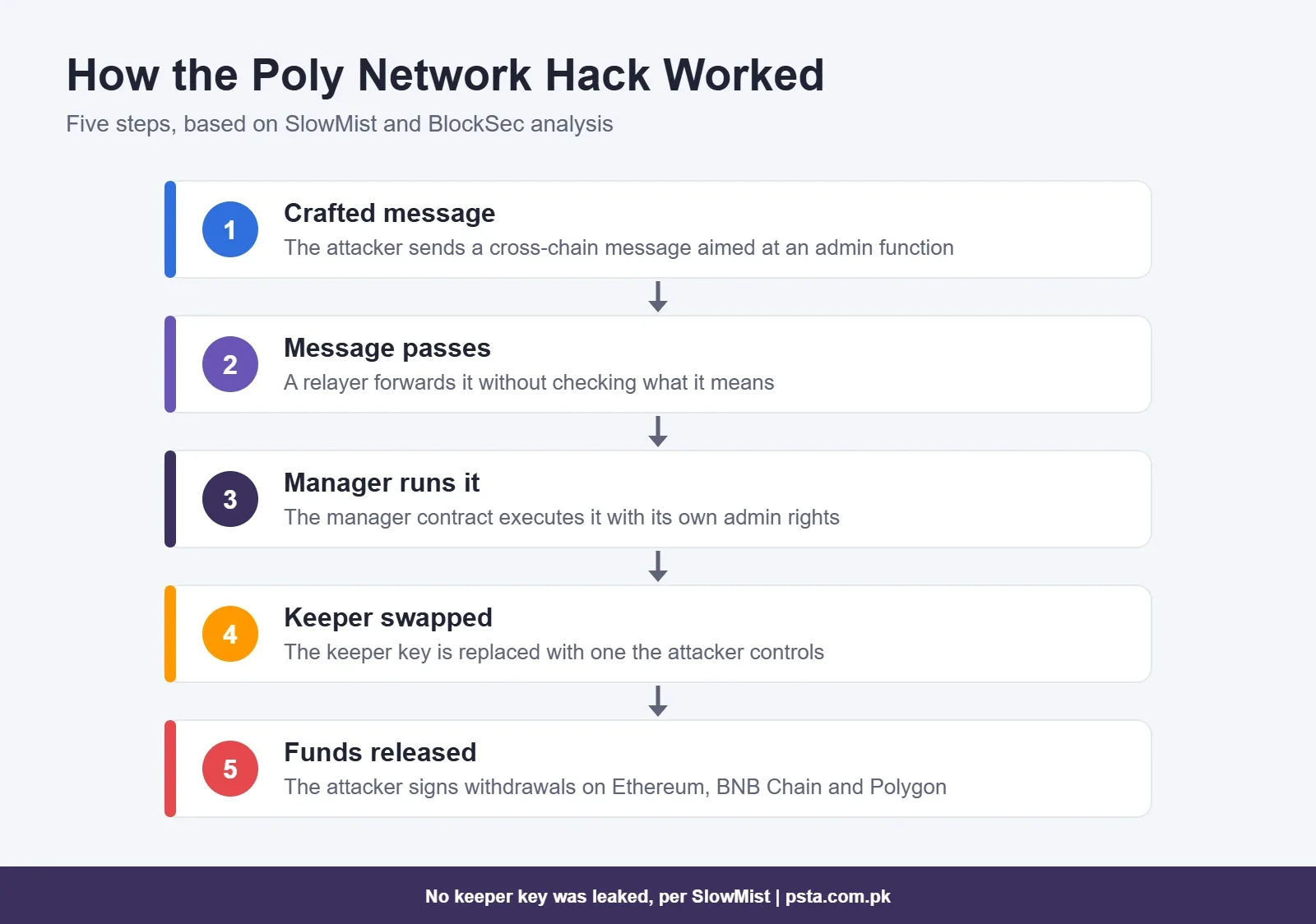
Security firm SlowMist explained the root cause this way. The attacker sent a crafted cross-chain message. The manager contract executed it and, because it owned the data contract, the message could tell it to replace the keeper with a key the attacker controlled. From then on, the attacker could sign their own withdrawal requests, and the bridge paid out. SlowMist stated plainly that a leaked keeper key was not the cause.
Researchers at BlockSec added one more detail in their follow-up analysis. Smart contracts pick which function to run using a short identifier made from the function's name. Because the identifier is short, two different names can produce the same one. BlockSec says the attacker chose a name whose identifier matched the privileged keeper-changing function. BlockSec also noted that part of the path was still not fully explained, so treat its account as strong analysis rather than a final ruling.
What Went Wrong: Five Design Mistakes
The Poly Network hack was not one bug. Each mistake below is drawn from the SlowMist and BlockSec write-ups. Together they turned a smart contract vulnerability into a $600 million loss.
1. A Powerful Contract Ran Outsiders' Messages
The manager contract did two jobs. It executed requests from users and it held admin rights over the keeper list. Mixing those roles meant any request it accepted could reach the most sensitive setting in the system.
2. Nobody Checked What a Message Meant
BlockSec found that a relayer on the Ontology side forwarded cross-chain transactions from anyone without asking whether the target contract and function made sense. The message was well formed, so it passed. Its purpose was never questioned.
3. A Filter Was Treated as a Wall
The Ethereum relayer did filter by target contract. But BlockSec showed the attacker could call the manager contract directly and skip that relayer. A filter that can be walked around is not a security control.
4. Short Identifiers Guarded a Critical Function
The privileged function could be reached by anything that produced the same short identifier. That made it possible to disguise a dangerous call as an ordinary one.
5. Too Much Value Sat Behind One Check
Three chains' worth of locked assets depended on one keeper list. Once that list changed, every pool was open. This is the core risk of cross-chain bridge security: one logic error can expose everything the bridge holds.
Who Was Behind It, and How Sure Is Anyone?
No one has been publicly named. Poly Network nicknamed the attacker "Mr. White Hat." SlowMist said it had found the attacker's email address, IP address and device fingerprint, as Cointelegraph reported. That is a claim by a private firm. It has not been tested in court, and none of the sources reviewed for this post report an arrest or charge.
No government has blamed a state group for this attack. Compare that with the Bybit hack, where the FBI publicly attributed the theft to North Korea. After the Poly Network hack, the honest answer is that the attacker's identity remains unknown to the public.
The attacker's own explanation came through short messages embedded in Ethereum transactions. Per Cointelegraph, the attacker said they never planned to keep the money and did the hack for fun, out of interest in cross-chain systems. You cannot verify a motive from a message, so read that as the attacker's account, nothing more.
After the Theft: Returns, a Bounty Offer and a Second Attack
The return happened in stages. Cointelegraph reported that about $258 million came back on August 11. By August 12, Poly Network said nearly all of the rest had moved into a multisig wallet controlled jointly by the project and the attacker. A multisig wallet needs several keys to approve a transfer, so neither side could move the funds alone.
Poly Network offered a $500,000 bounty and said it would not hold the attacker accountable. The attacker said they would not respond to the offer and would return everything instead. On August 17, according to Blockworks, Poly Network went further and offered the attacker a chief security advisor role.
The last step came on August 23. Poly Network said the attacker posted the final private key on-chain, and the team regained control of about $141 million. It said it now controlled the full $610 million, apart from the $33 million in USDT that Tether had frozen. Tether was still confirming the unfreezing process at that point.
The story did not end there. On July 2, 2023, Poly Network was attacked again. The Block reported that the attacker created 57 tokens across 10 blockchains, with a paper value above $34 billion. Low trading volume meant only about 5,196 ETH, around $10.1 million, could be cashed out, per Beosin. Beosin and Dedaub suggested that keys for three of the four admin wallets had been compromised. Poly Network had not responded to that claim at the time, so treat it as analyst opinion.
Three Myths About the Poly Network Hack
The Poly Network hack is often retold as a feel-good story. A few parts of that version do not hold up.
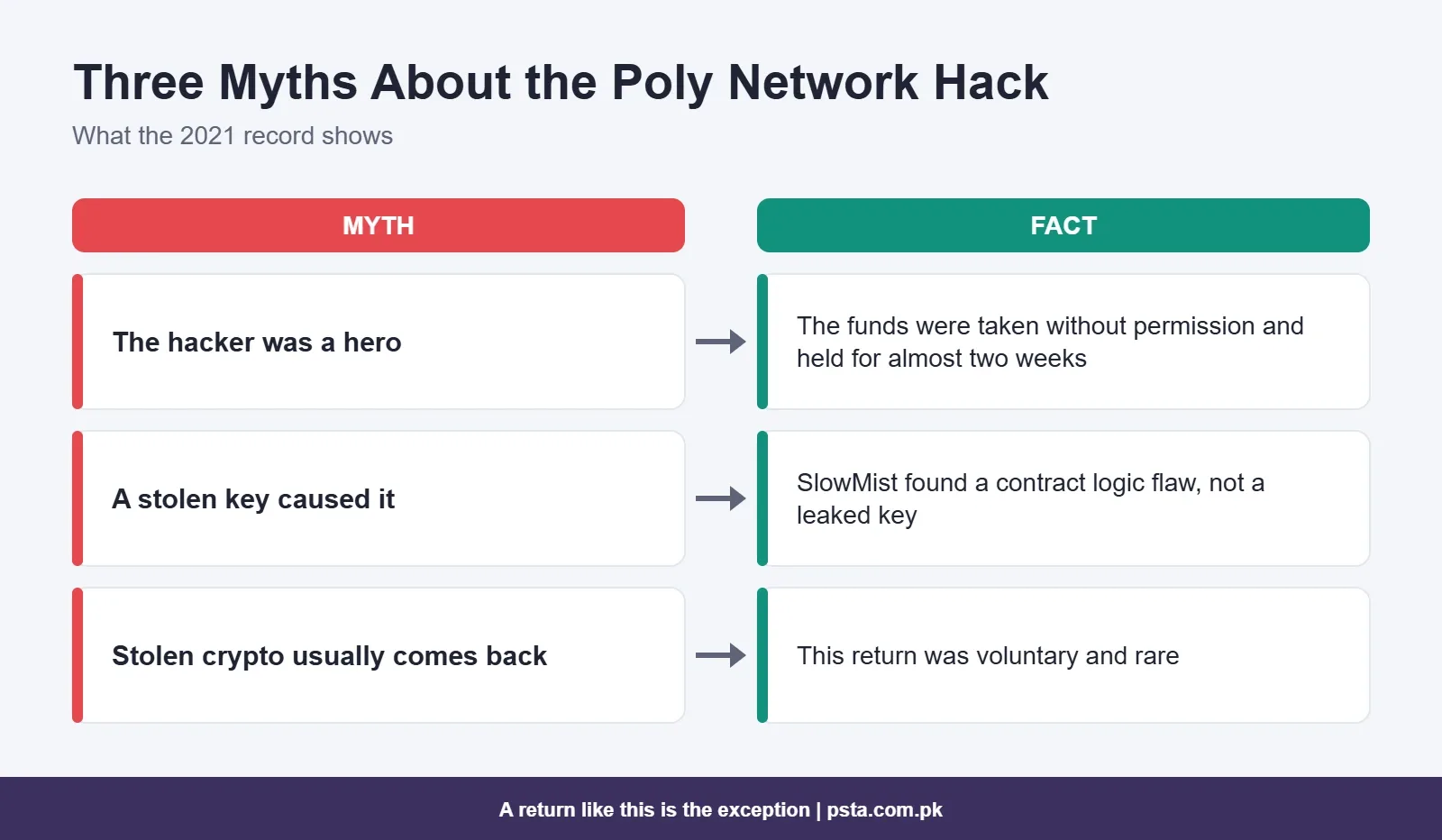
Myth: The hacker was a hero. The attacker took $611 million without permission and kept control of it for almost two weeks. Users could not move their assets during that time. A real white hat hacker reports a flaw first, through a program like the ones described in our bug bounty guide.
Myth: A stolen key caused it. SlowMist ruled that out for the 2021 attack. The problem was contract logic. The 2023 attack is a different story, where analysts did suspect compromised keys.
Myth: Stolen crypto usually comes back. It rarely does. This return was voluntary. The Ronin Network hack and the Mt. Gox hack show the more common outcome.
What Does This Mean for Crypto Users and Builders in Pakistan?
Pakistan now has a legal framework for this space. Dawn reports that the Virtual Assets Act 2026 makes the Pakistan Virtual Assets Regulatory Authority (PVARA) responsible for licensing and supervising virtual asset activity. In an advisory on April 27, 2026, PVARA said services such as issuing, transferring, holding or exchanging virtual assets for users in Pakistan fall under its oversight and need prior authorisation.
That matters in three practical ways.
- If you use crypto, a bridge or DeFi app is not the same as a licensed service. Ask who runs it, whether it has public audits, and what happens to your funds if it is paused.
- If you build smart contracts for freelance clients, Poly Network is a reminder that admin rights must be separated from user-facing logic. Clients increasingly expect an audit before launch.
- If your company plans a stablecoin or blockchain pilot, PVARA's advisory says to engage early through its sandbox, no-action relief or NOC process.
For a fresh comparison, our Binance hack explainer covers a centralized exchange failure. Poly Network shows the decentralized side of the same risk.
Seven Defensive Lessons for Cross-Chain Bridge Security
These blockchain security lessons apply to anyone who writes, audits or relies on smart contracts.
- Separate admin rights from user paths. A contract that runs user requests should not also own the keys to the system.
- Allowlist targets and functions. Accept cross-chain messages only for contracts and actions you expect, and reject the rest.
- Enforce checks inside the contract. Off-chain relayers and filters help, but the contract itself must refuse unsafe calls.
- Test the direct route. Ask whether someone can call your contract while skipping the front end, relayer or user interface.
- Watch for admin changes. A change to signers or keepers should trigger alerts and, ideally, a pause.
- Spread the risk. Limit how much value one signer set or one contract can release in a short window.
- Plan for key theft too. The 2023 attack suggests that guarding signing keys matters as much as clean code.
The DeFi hack pattern repeats because builders keep making the same trust mistakes. Crypto hack recovery is the exception, so prevention has to carry the load.
Where PSTA Students Meet Cases Like Poly Network
PSTA's Cyber Security Course for Beginners is a 12-week beginner program that you can join from any city through live online classes, or attend in person at the Abbottabad campus. The course page lists hands-on labs, case studies and a final security project, covering attack types, network defense, malware, threat detection, cyber law and digital forensics. One listed lab asks you to investigate an incident and document a timeline, which is exactly the skill this post practices.
Students with some security grounding can move on to PSTA's advanced penetration testing track, another 12-week course, pitched at advanced level. Its listed modules include reconnaissance, vulnerability assessment, web application security based on the OWASP Top 10, and bug bounty work. To plan your next certificate, see our guide to cyber security certifications for beginners. For batch timings, message our team on WhatsApp and we will share the current schedule.
Read One Bridge's Security Page Before You Use It
Pick one bridge or DeFi app you have used or plan to use. Find its audit reports, its bug bounty page and its admin key setup. If you cannot find any of the three in 10 minutes, keep your funds somewhere you understand better.
Frequently asked questions
What was the Poly Network hack?
The Poly Network hack was the theft of about $611 million from the Poly Network cross-chain bridge on August 10, 2021. An attacker abused a flaw in how its contracts trusted cross-chain messages, swapped the key that approved transfers, and withdrew funds on Ethereum, BNB Smart Chain and Polygon. Almost all of it was returned by August 23, 2021.
Did the Poly Network hacker get caught?
No arrest or charge appears in the sources reviewed for this post. SlowMist said it had traced the attacker's email, IP address and device fingerprint, but no name was ever released publicly. Poly Network also said it would not hold the attacker accountable once the funds came back, which is unusual and should not be read as a rule for other cases.
Why did the attacker return the stolen crypto?
Only the attacker knows for certain. In messages written into blockchain transactions, the attacker said the hack was done for fun and that keeping the money was never the plan. What is documented is that Tether froze about $33 million and SlowMist publicly claimed to hold identifying details. Treat any stated motive as the attacker's own account.
Was a private key stolen in the 2021 attack?
According to SlowMist, no. The 2021 attack used contract logic: a privileged contract executed a crafted message that replaced the keeper key with one the attacker held. A separate attack on July 2, 2023 was different. Analysts at Beosin and Dedaub suggested that keys for three of four admin wallets were compromised in that later incident.
What is a cross-chain bridge in simple words?
A cross-chain bridge lets you move value between two blockchains that cannot talk to each other directly. It usually locks your tokens in a contract on the first chain and releases matching tokens on the second. Because the locked pool can be very large, a single flaw in how the bridge approves requests can expose all of it at once.
Is it safe to use crypto bridges from Pakistan?
No bridge is risk-free, and this post is not financial advice. Under the Virtual Assets Act 2026, PVARA licenses and supervises virtual asset services offered to people in Pakistan. Before using any bridge or DeFi app, check who operates it, read its audit reports, look for a bug bounty program and only move amounts you can afford to lose.
How can I learn to analyze attacks like this?
Start with networking, common attack types and incident timelines, then move to web and application security. PSTA's 12-week Cyber Security Course for Beginners covers those foundations through labs and case studies, online or on campus in Abbottabad. Reading public post-mortems from firms like SlowMist and BlockSec is good weekly practice once you know the basics.
Sources & references
- Poly Network Commences Full Asset Restoration (Poly Network) medium.com
- The Root Cause of Poly Network Being Hacked (SlowMist) slowmist.medium.com
- The Further Analysis of the Poly Network Attack (BlockSec) blocksec.com
- Over $600 Million Reportedly Stolen in Cryptocurrency Hack (BleepingComputer) bleepingcomputer.com
- Poly Network Hacker Returns Nearly All Funds, Refuses $500K Bounty (Cointelegraph) cointelegraph.com
- Poly Network Offers Security Role to Hacker (Blockworks) blockworks.co
- Attacker Pockets $10 Million From Poly Network Security Attack (The Block) theblock.co
- PVARA Says Deals and Pilots Involving Virtual Assets Require Prior Authorisation (Dawn) dawn.com
Last reviewed & updated on by Umar Qureshi. Written by the PSTA team in Abbottabad, Pakistan.

Umar Qureshi

Cyber Security & Ethical Hacking Course in Abbottabad - PSTA
Turn this guide into a career: hands-on training with real projects, online across Pakistan or on-campus in Abbottabad · 12 Weeks.
Comments
No comments yet — ask a question or share your experience.