
Quick answer
To become a graphic designer in Pakistan, learn design basics first, then one photo tool and one vector tool. Finish six projects from written briefs, publish 8 to 12 pieces on Behance, then pick one income route: a job, Fiverr or Upwork, or local clients. Free Affinity works if Adobe's US$22.99 Photoshop plan is too costly.
Key takeaways
- • Train your eye on hierarchy, alignment, contrast, type and color before opening any software.
- • Learn one raster and one vector tool; Affinity is free, and Photoshop alone lists at US$22.99 a month on an annual plan.
- • Work from written briefs that copy real local orders, and keep drafts to show how you handle feedback.
- • A portfolio of 8 to 12 focused case studies beats a large gallery of mixed work.
- • Pakistani freelancers earned a record $1.76 billion in FY2025-26, according to SBP data reported by Profit.
Table of contents 15 sections
- What Does a Graphic Designer in Pakistan Actually Do?
- How to Become a Graphic Designer: The Roadmap at a Glance
- Stage 1: Learn to See Before You Learn Software
- Stage 2: Which Software Should You Learn First?
- Adobe Photoshop and Illustrator
- Free Graphic Design Software That Is Good Enough to Start
- CorelDRAW and InPage for Local Print Work
- Stage 3: Build Projects From Real Briefs
- Stage 4: Build a Graphic Design Portfolio That Gets Replies
- Stage 5: Where Will Your First Income Come From?
- What the Freelancing Numbers Show
- Is Graphic Design Still Worth Learning With AI Tools Around?
- Free Course or Paid Training: Which Should You Choose?
- Training for This Path at PSTA
- Your First Assignment: Redesign One Flyer From Your Street
If you want to become a graphic designer, start with a two-minute self-test rather than a software download. Answer these three questions honestly:
- Can you point to a poster in your bazaar and say exactly why it is hard to read?
- Have you finished a single design from a written brief, without a template?
- Has anyone outside your family ever paid for, printed or posted something you made?
Three "no" answers mean you start at Stage 1 below. One or two "yes" answers mean you can skip ahead, but only after you pass the exit test of each earlier stage. In my classes, the usual reason self-taught learners stall is learning tools in the wrong order, not a lack of talent.
This guide gives you:
- A five-stage roadmap where each stage ends with a clear test you can check yourself
- Which software to learn first, with current Adobe prices and the free options that work on a normal PC
- Project ideas based on work that Pakistani shops, schools and clinics actually order
- Three ways to earn your first income, with the trade-offs of each
- Free and paid ways to learn, and how to pick between them
What Does a Graphic Designer in Pakistan Actually Do?
The job title covers very different days depending on where you sit. Before you decide to become a graphic designer, picture the kind of work you would enjoy doing 40 hours a week.
- Print shop designer: wedding cards, panaflex banners, visiting cards, school result cards and election posters. Speed matters, and so does Urdu typing in InPage.
- Agency or in-house designer: social media posts, ad creatives, brochures and packaging for one brand or several clients. You'll work with a marketing team and a weekly content calendar.
- Freelancer: logos, brand kits, YouTube thumbnails and social media packs for clients in Pakistan or abroad, found through Fiverr, Upwork, Behance or referrals.
- Small business designer: the person a restaurant, pharmacy or clothing brand calls every month for menus, offers and Eid campaigns.
All four rely on the same core graphic designer skills: layout, type, color and the ability to follow a brief. The difference is the tools you lean on and how you find work. That is why the roadmap below keeps the foundation shared and splits only at the end.
How to Become a Graphic Designer: The Roadmap at a Glance
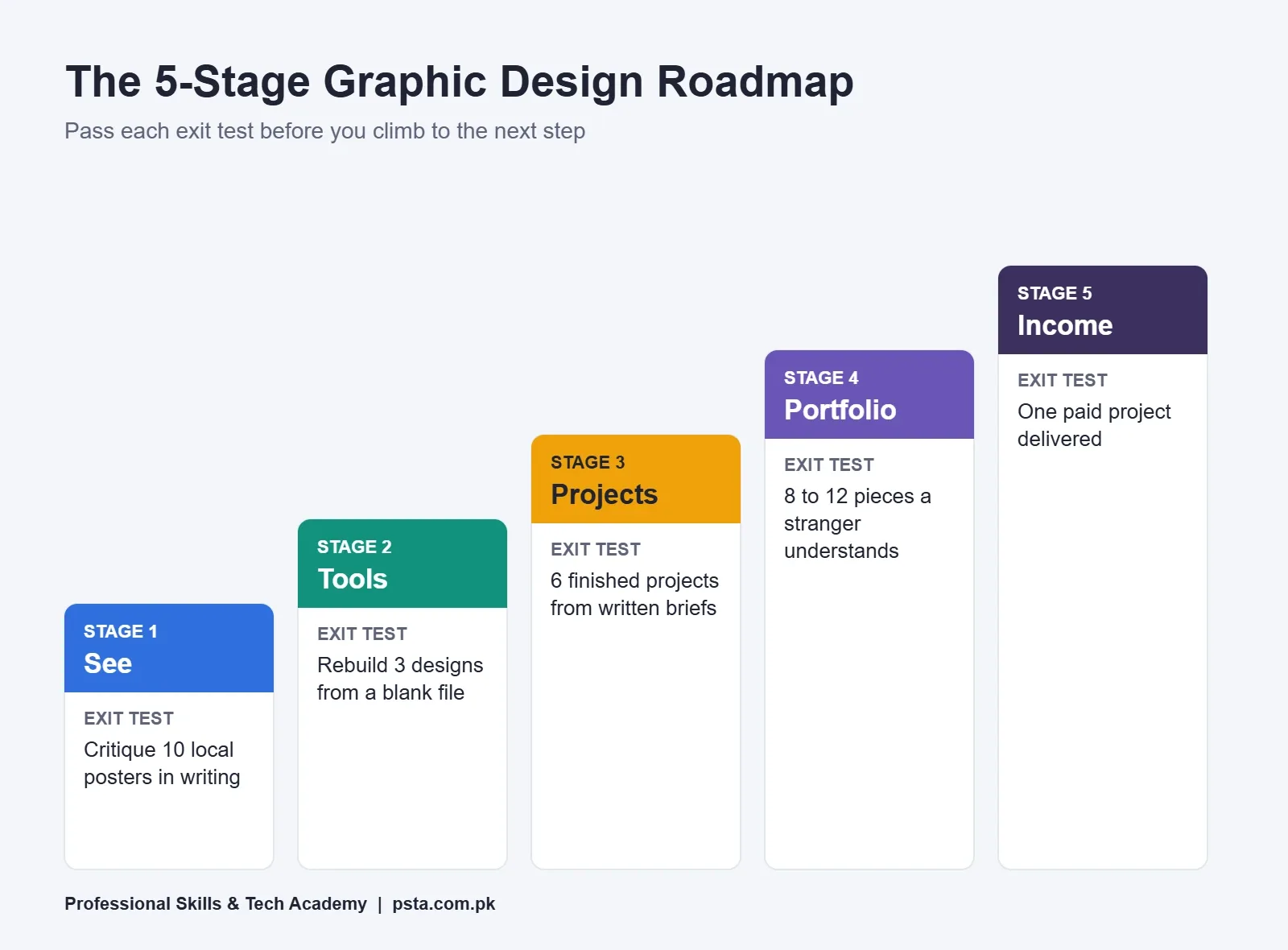
This graphic design roadmap has five stages, and each one has a single goal and exit test. Don't move on until you pass the test, even if a stage takes longer than you planned. The time ranges are a guide for someone practising one to two hours a day, not a promise.
| Stage | Main Goal | Core Tools | Exit Test | Typical Time |
|---|---|---|---|---|
| 1. See | Understand hierarchy, alignment, contrast, type and color | Paper, phone camera, any free editor | Critique 10 local posters in writing | 2 to 3 weeks |
| 2. Tools | Control one raster and one vector tool | Photoshop or Affinity, plus Illustrator or CorelDRAW | Rebuild 3 existing designs from scratch | 4 to 6 weeks |
| 3. Projects | Finish work from written briefs | Your chosen tools, plus InPage for Urdu | 6 finished projects with print-ready files | 4 to 6 weeks |
| 4. Portfolio | Present 8 to 12 pieces as short case studies | Behance, mockups, a PDF portfolio | A stranger can tell what you do in 10 seconds | 2 weeks |
| 5. Income | Get the first paid job, client or order | Fiverr, Upwork, LinkedIn, local shops | One paid project delivered and reviewed | Ongoing |
Stage 1: Learn to See Before You Learn Software
People who want to become a graphic designer usually open Photoshop on day one. The problem is that software only makes your choices faster. If the choices are weak, you just produce weak designs quickly.
Spend the first weeks training your eye. Focus on five ideas:
- Hierarchy: what should the viewer read first, second and third? On a sale banner, it's usually the offer, then the shop name, then the phone number.
- Alignment: every element should line up with something else. Random placement is the most common sign of an amateur design.
- Contrast: size, weight and color differences that make the important part stand out.
- Typography: two typefaces are enough for most jobs. Use the first for titles and the second for paragraphs.
- Color: start with one main color, one accent and neutral tones. Learn why screens use RGB and printers use CMYK; our RGB vs CMYK guide covers that in detail.
Exit test: photograph 10 posters, shop boards or social media ads around you. For each one, write two sentences: what works and what you would change. If you can explain your reasons using the five ideas above, you're ready for Stage 2.
Stage 2: Which Software Should You Learn First?
You need one raster tool for photos and one vector tool for logos and print layouts. Which pair you choose depends on your budget, your computer and the work you want.
Adobe Photoshop and Illustrator
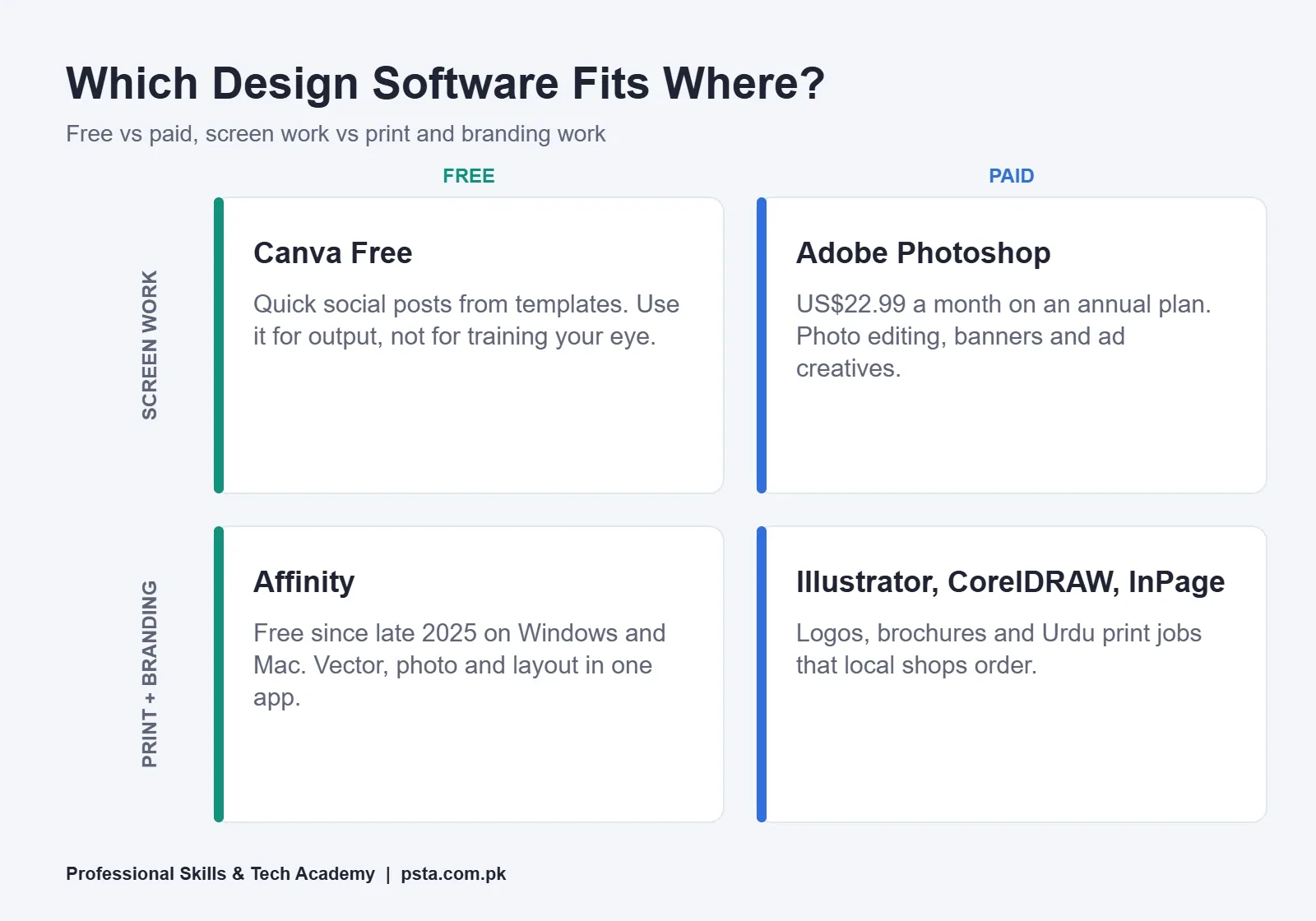
Agencies and studios commonly share Adobe files, so these are worth learning at some point. On Adobe's Creative Cloud plans page, the Adobe Photoshop price for the app on its own is US$22.99 per month when you commit to a year and pay monthly. Creative Cloud Standard, which covers more apps, lists at US$54.99 a month. These are US-dollar prices, so your bank will convert the charge to rupees, and the final amount on your statement can differ.
Check your computer before you subscribe. Adobe's Photoshop technical requirements list Windows 10 version 21H2 or later, 8 GB of RAM and 10 GB of free disk space as the minimum for the current version. A used office laptop with 8 GB of RAM can run it for learning, though large files will feel slow.
Free Graphic Design Software That Is Good Enough to Start
Money should not stop you from starting. In October 2025, Canva made Affinity, its professional design app, free to use. TechRadar's report explains that the relaunched app brings drawing, photo editing and page layout together. Thurrott notes that it runs on Windows and Mac, while its AI features need a paid Canva subscription.
Canva itself is fine for quick social media posts, but treat it as a production tool rather than your training ground. Templates hide the layout decisions you are supposed to be learning.
CorelDRAW and InPage for Local Print Work
If you plan to work with print shops in Abbottabad, Peshawar or Rawalpindi, expect to see CorelDRAW files and Urdu text set in InPage. Learning both early makes you useful to local clients from your first month.
Exit test: pick three designs you admire and rebuild each one from a blank file, without tracing. Matching the spacing and type sizes teaches you more than any tutorial.
Stage 3: Build Projects From Real Briefs
A brief is a short description of what the client needs: purpose, audience, size, text, deadline and where the design will appear. Working from a brief is the skill that separates people who become a graphic designer from people who only learn Photoshop.
If you don't have clients yet, write your own briefs based on real businesses near you. Here are six that mirror common local orders:
- An Urdu and English flyer for a pharmacy's home delivery service, A5 size, for print.
- A wedding card with a matching envelope design, set up with bleed for the printer.
- A one-page menu for a tea and paratha café, readable from an arm's length.
- A set of five Instagram posts for a clothing brand's Eid collection, in one consistent style.
- A logo and visiting card for a home tutor or a small tuition centre.
- A school admission banner for the gate, readable from across the road.
For each project, save three versions: your first draft, a revised draft after someone else's feedback, and the final file. Clients care about how you handle feedback, and those versions become material for your portfolio later.
Exit test: six finished projects, each with a print-ready or upload-ready export, correct size and a short note explaining your choices.
Stage 4: Build a Graphic Design Portfolio That Gets Replies
When you try to become a graphic designer for hire, your portfolio is the first thing a recruiter or client checks, often before your CV. A good one is small, focused and easy to scan on a phone.
- Pick 8 to 12 pieces. Fewer strong pieces beat 40 average ones.
- Show the problem, not just the poster. Two or three lines on the brief, your decisions and the result turn a picture into a case study.
- Use mockups with care. A logo on a shop board or a flyer in a hand helps clients picture the result. Keep mockups simple so they don't hide the design.
- Match the work you want. If you want packaging jobs, lead with packaging. If you want social media work, lead with post sets.
- Publish on Behance and keep a PDF copy under 10 MB that you can send on WhatsApp or email.
Before you share it widely, check our list of graphic design portfolio mistakes so you don't repeat the common ones.
Exit test: show the portfolio to someone outside design for 10 seconds, then ask what kind of work you do. If they can't answer, your selection or ordering needs work.
Stage 5: Where Will Your First Income Come From?
There are three common routes. You don't have to pick one forever, but focusing on one at a time gets results sooner.
| Route | Best For | Strength | Trade-Off |
|---|---|---|---|
| Job at an agency, print shop or company | Learners who want steady pay and mentoring | You learn fast from senior designers and real deadlines | Starting pay can be modest, and city jobs may mean relocating |
| Freelancing on Fiverr or Upwork | Learners with stable internet and patience | Clients from many countries, paid in dollars | Slow start while you build reviews; strong competition |
| Local businesses directly | Learners in smaller cities with a good network | Quick first orders and repeat work | Lower budgets and more back-and-forth on changes |
What the Freelancing Numbers Show
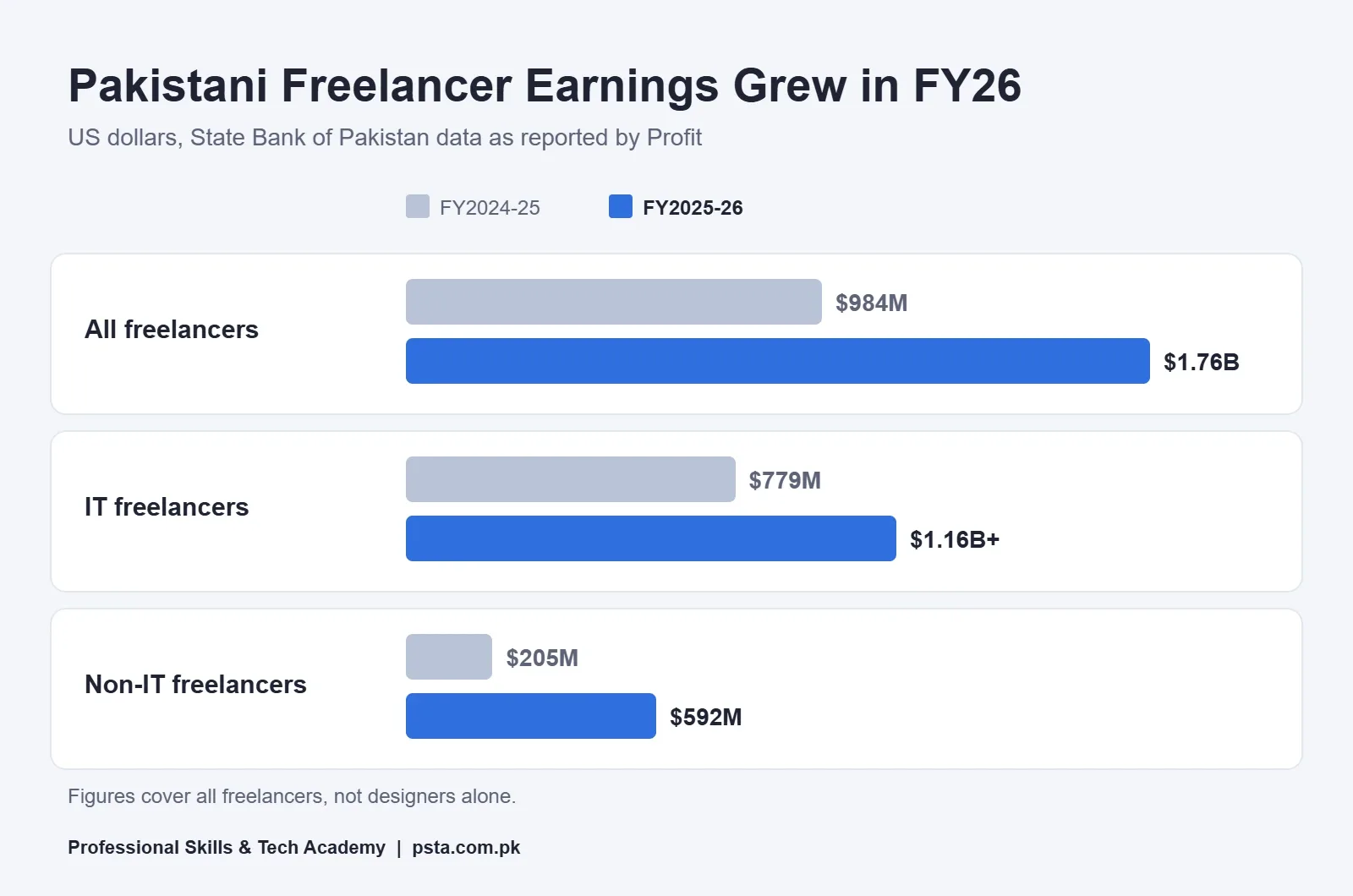
If you want to become a graphic designer who works remotely, the trend is in your favor. Profit reported, citing State Bank of Pakistan data, that freelance inflows reached a record $1.76 billion in the 2025-26 fiscal year, against $984 million a year earlier. IT freelancers earned more than $1.16 billion of that, while non-IT freelancers, a group that includes many creative services, earned $592 million, up from $205 million.
These figures cover all freelancers, not designers alone, so treat them as a sign that the route is open rather than as a forecast for your own earnings.
If you choose freelance graphic design in Pakistan, start with a narrow offer such as "Urdu and English social media posts for restaurants" rather than "all design work." Our guide to creating a Fiverr gig walks through the setup, and our graphic design interview questions help if you go for a job instead.
Is Graphic Design Still Worth Learning With AI Tools Around?
Yes, you can still become a graphic designer, but the beginner tasks are changing. AI tools now handle jobs like background removal, image extension and resizing a design for different platforms. Even free courses now teach these; the DigiSkills Graphic Design course page lists AI tools for automated background removal and smart image resizing in its outline.
What AI does not do well is understand a client. It can't tell that a Peshawar sweet shop wants Urdu text larger than English, that a school principal hates the color red, or that a banner must be readable from a moving rickshaw. Your value comes from judgment, clear communication and clean, print-ready files. Learn the AI features as helpers, and keep your design basics strong.
Free Course or Paid Training: Which Should You Choose?
Both can work. The right pick depends on how you learn and how much structure you need.
- Free government training: the DigiSkills Graphic Design course is free, runs as a 12-week batch with about 24 hours of video in Urdu and English, and focuses mainly on Affinity Designer, according to its course page. It suits disciplined self-learners.
- YouTube and practice: costs nothing but needs strong self-discipline. The usual risk is jumping between tutorials without finishing projects.
- Live training with an instructor: costs money, but you get feedback on each project, a fixed schedule and help with your portfolio. This suits learners who want someone to point out mistakes early.
A practical mix many students use: start free for a few weeks to confirm you enjoy the work, then join live training to speed up Stages 3 to 5.
Training for This Path at PSTA
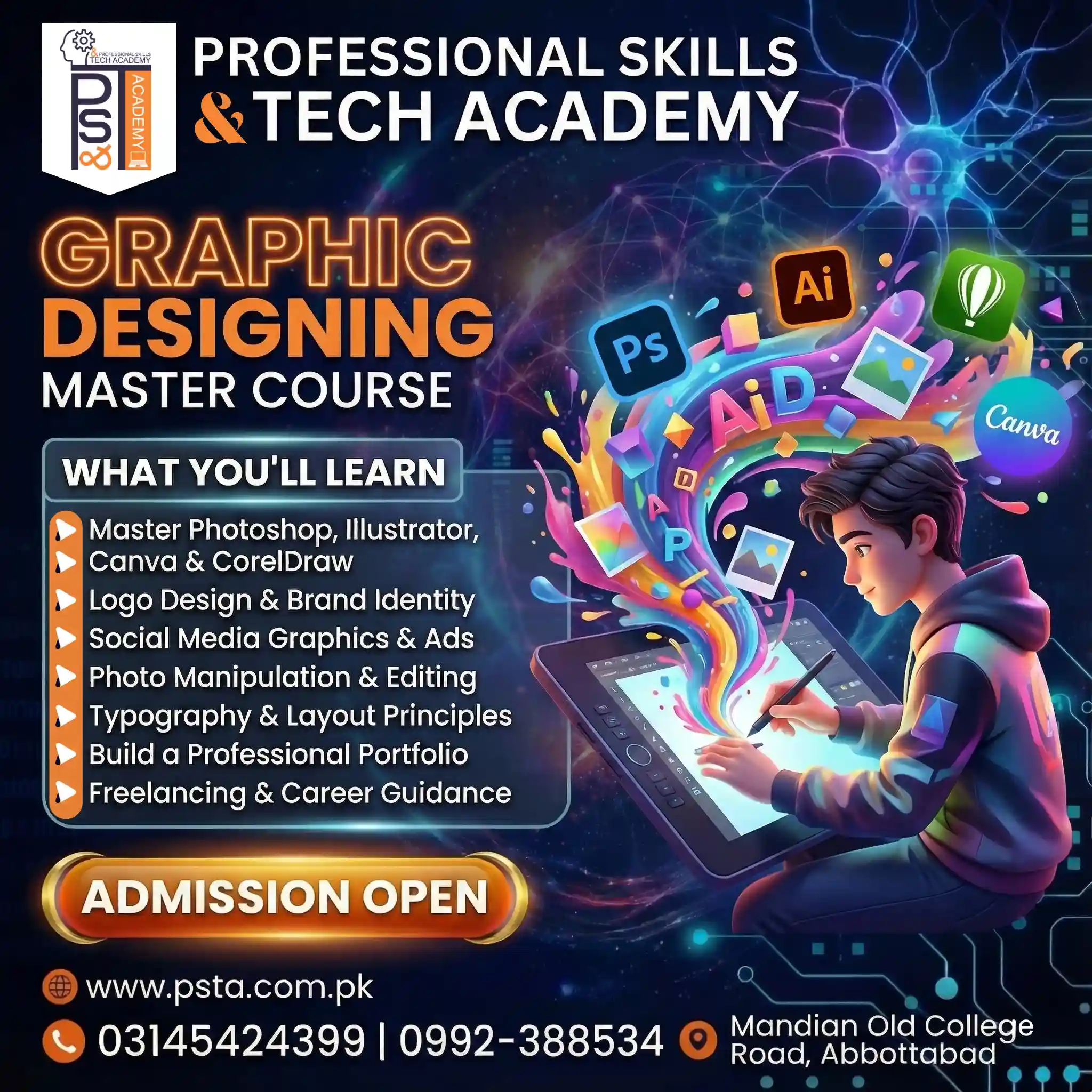
PSTA's Graphic Designing Course follows the same order as this roadmap. It is a 12-week, beginner-level program for people who want to become a graphic designer from scratch, with weekly blocks on Photoshop, Illustrator, CorelDRAW and Canva, a week of Urdu layouts in InPage, and a week on Canva AI, Adobe Firefly and mockup tools. The final weeks focus on branding projects, building a portfolio and freelancing on Fiverr and Behance.
According to the course page, the current fee is Rs. 18,000 instead of the regular Rs. 20,000. You can split it into 2 installments, and fresh batches open monthly. You can study at the Abbottabad campus in Mandian, join the same live classes online from your own city, or mix campus days with online ones. Along the way you produce work for your portfolio: an identity kit with logo and stationery, a tri-fold brochure, Urdu poster work in InPage, matching social posts and a front-and-back book cover.
Many designers later add video skills, since clients often want one person for both. If that interests you, look at the Video Editing and VFX course or the Digital Marketing course. You can compare all programs on the courses page or apply through the admission form. For questions about timings, message PSTA on WhatsApp at +92 314 5424399.
Your First Assignment: Redesign One Flyer From Your Street
Pick one printed flyer or shop poster near your home this week. Photograph it, list three problems using the Stage 1 ideas, then redesign it in any free tool you have. Keep the same text and size so the comparison is fair.
Put the before and after side by side. That single exercise shows you which stage you have really reached, and it often becomes the first piece in a beginner's portfolio.
Frequently asked questions
Can I become a graphic designer in Pakistan without a degree?
Yes. Most clients and many employers judge you by your portfolio, not your certificate. A degree can help for some corporate or teaching roles, but a focused portfolio of 8 to 12 strong pieces, clean print-ready files and the ability to follow a brief matter more in agencies, print shops and freelancing.
How long does it take to learn graphic design from zero?
With one to two hours of practice a day, many beginners can finish the first four stages of this roadmap in about three to four months. Getting the first paid project takes longer and varies a lot. Finishing real projects, not watching more tutorials, is what shortens the timeline.
What computer do I need to run Adobe Photoshop?
Adobe lists Windows 10 version 21H2 or later, 8 GB of RAM and 10 GB of free disk space as the minimum for the current Photoshop. A used office laptop that meets this can handle learning projects, though large print files and many layers will feel slow. More RAM helps once you take client work.
Is Canva enough to get a graphic design job?
Canva is useful for quick social posts, and many businesses use it. On its own, it rarely gets you a design job, because employers expect you to build layouts, logos and print files from scratch. Learn Photoshop or Affinity and a vector tool, then use Canva for speed.
Is Affinity really free to use?
Yes. In October 2025, Canva relaunched Affinity as a single free app for Windows and Mac that combines vector, photo and layout work. Its AI features, such as generative fill, need a paid Canva subscription, but the core design tools cost nothing, which makes it a strong option for students.
Do I need to be good at drawing to become a graphic designer?
No. Graphic design is mainly about arranging type, images and color so a message is clear. Drawing skill helps with illustration and some logo work, but most daily jobs, like posters, social posts and brochures, depend on layout and typography rather than sketching ability.
How do I find my first graphic design client in Pakistan?
Start close to home. Offer to redesign a flyer or menu for a local shop, school or clinic, and ask for honest feedback. At the same time, publish your best work on Behance and set up one narrow Fiverr or Upwork offer. One delivered project with a review makes the next one easier.
Sources & references
- Adobe Creative Cloud plans and pricing adobe.com
- Adobe Photoshop on desktop technical requirements helpx.adobe.com
- TechRadar: Affinity makes its software free for everyone techradar.com
- Thurrott: Affinity is back and now it's free thurrott.com
- Profit: Pakistan's freelancer earnings hit record $1.76 billion in FY26 profit.pakistantoday.com.pk
- DigiSkills Graphic Design course details digiskills.pk
Last reviewed & updated on by Umar Qureshi. Written by the PSTA team in Abbottabad, Pakistan.
Umar Qureshi
Ultimate Graphic Designing Course in Pakistan: Master Photoshop, Illustrator, CorelDRAW & AI Tools (Practical & Beginner Friendly)
Turn this guide into a career: hands-on training with real projects, online across Pakistan or on-campus in Abbottabad · 12 Weeks.
Comments
No comments yet — ask a question or share your experience.