Quick answer
In 2025, criminals bribed overseas support agents to leak details of 69,461 Coinbase customers, including ID images and balances but not passwords or private keys. Coinbase refused a $20 million ransom, offered a $20 million reward and estimated costs of $180 million to $400 million. Lawsuits against contractor TaskUs are still running.
Key takeaways
- • The breach came from bribed support agents, not from malware or a software flaw.
- • Coinbase's filing says names, ID images, balances and masked bank details leaked, but passwords and private keys did not.
- • Coinbase refused a $20 million ransom and offered a $20 million reward instead.
- • The company estimated costs of $180 million to $400 million, mostly cleanup and customer refunds.
- • A court let parts of a class action against TaskUs go ahead in July 2026.
- • Any unexpected call about your exchange account should be verified inside the official app.
Table of contents 15 sections
- What Happened in the Coinbase Data Breach?
- Coinbase Data Breach Timeline
- How Did Bribed Support Agents Leak the Data?
- What Data Was Exposed, and What Stayed Safe?
- The Money: A Ransom, a Bounty and a $400 Million Estimate
- Who Was Responsible, and How Solid Is the Evidence?
- Confirmed by Coinbase
- Confirmed by TaskUs
- Alleged, Not Proven
- What Happened Next: Lawsuits, Firings and a Court Ruling
- Why Does an Insider Breach in India Matter to Pakistan?
- How Can You Spot a Fake Exchange Support Call?
- Eight Defensive Lessons for Businesses and Support Teams
- Where PSTA Students Pick Apart Cases Like This
- Lock Down Your Exchange Contact Settings Today
The Coinbase data breach came to light on Sunday, May 11, 2025, when an unknown sender emailed the exchange claiming to hold customer records and internal documents. The sender wanted money to keep quiet. No server had been cracked. According to Coinbase's own SEC filing, the attacker had simply paid support staff outside the US to pass on what they could see on their screens.
This case study walks you through the Coinbase data breach step by step: what happened and what it teaches anyone who handles customer data. You will learn:
- How a handful of bribed support agents exposed 69,461 customers
- Which data leaked, and what stayed out of reach
- Why the cost estimate ran as high as $400 million
- How lawsuits against the outsourcing firm TaskUs have played out
- Practical steps for Pakistani crypto users, call centers and security students
What Happened in the Coinbase Data Breach?
Coinbase is one of the largest crypto exchanges in the US. Like many big platforms, it uses outside contractors to answer customer support tickets. Some of those contractors worked in India for TaskUs, a business process outsourcing (BPO) company.
Coinbase told the SEC that a criminal group paid people in support roles to pass on customer information from internal tools. The filing also promises refunds to customers who sent funds to the attacker, which tells you the data was used to trick people. Then came a demand for payment from the company itself.
The company said no. Chief executive Brian Armstrong said Coinbase would not pay the $20 million demand, CyberScoop reported, and instead offered a $20 million reward for information leading to the attackers' arrest and conviction.
So this was not a "Coinbase hack" in the usual sense of malware or a broken password. It was an insider threat: trusted people with legitimate access, turned by cash. That makes it a useful case to compare with the Binance hack that opened this series, where outsiders broke in, and with the Twitter hack of 2020, where staff were tricked rather than bribed.
Coinbase Data Breach Timeline
The Coinbase data breach unfolded over roughly two years if you count the court case. Dates below come from court papers, regulator filings and news reports. Where sources disagree, the table says so. Pakistan time (PKT) is US Eastern time plus nine hours in May.
| Date | Event | Source |
|---|---|---|
| September 2024 | A TaskUs worker in Indore allegedly starts selling photos of customer records (an allegation, not a finding) | Class-action complaint, via Fortune |
| December 26, 2024 | Breach date Coinbase gave to the Maine regulator | Maine Attorney General notice |
| January 2025 | Coinbase is told of a data problem involving TaskUs; TaskUs stops Coinbase work in Indore, affecting 226 staff | Reuters, via Decrypt |
| May 11, 2025 | Extortion email arrives demanding money not to publish the data | Coinbase 8-K |
| May 15, 2025, 3:52 PM PKT | Coinbase files its 8-K (report date May 14), refuses to pay and announces a $20 million reward | SEC EDGAR, CyberScoop |
| May 21, 2025 | Filing in Maine puts the number of affected people at 69,461 | Maine AG, TechCrunch |
| May 27, 2025 | Customers sue TaskUs in a proposed class action in New York | TaskUs 10-Q |
| May 30, 2025 | Written notices go out with one year of free credit monitoring | Maine AG |
| September 16, 2025 | Amended complaint names the alleged Indore insider and claims a wider scheme | Fortune, Infosecurity Magazine |
| July 28, 2026 | Court partly grants and partly denies TaskUs's motion to dismiss | TaskUs 10-Q |
Notice the gap between January and May 2025. Coinbase's 8-K says its own monitoring had "independently detected" the insider activity in earlier months. Reuters, as summarized by Decrypt, reported that Coinbase knew of a TaskUs-linked data issue in January. The public disclosure only came after the ransom email.
How Did Bribed Support Agents Leak the Data?
The Coinbase data breach needed no hacking tools, because you do not need them to steal data you are already allowed to see. That is the core lesson here. Support agents need customer details to do their jobs, such as verifying identity and answering balance questions.
Based on the court filings and company statements, the scheme worked in five broad stages:
- Recruit. Criminals approached support staff and offered cash for customer information.
- Copy. According to five former TaskUs employees quoted by Reuters, an agent photographed her work screen with a personal phone. That simple method can slip past tools that watch for downloads.
- Sell. The amended complaint, reported by Fortune, alleges payment of $200 per photo and up to 200 photos a day.
- Scam. With real names, balances and ID details, criminals could pose as Coinbase support and persuade customers to move funds.
- Extort. Finally, the group demanded $20 million from Coinbase not to release the data.
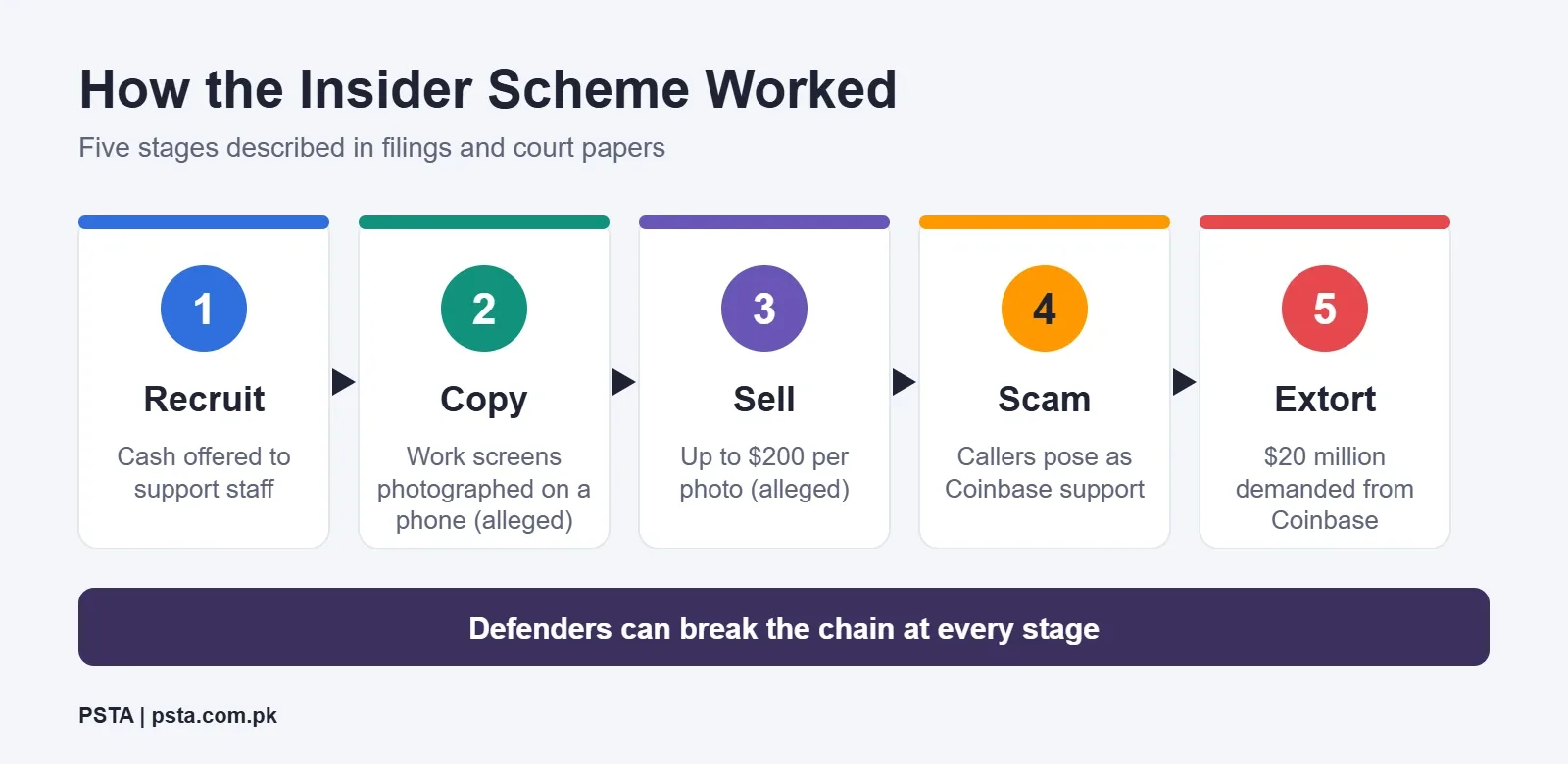
This is a conceptual outline, not a recipe. The point for defenders is that each stage leaves a chance to stop the chain. Strict device rules on the support floor, alerts on unusual record lookups and fast customer warnings all break different links.
What Data Was Exposed, and What Stayed Safe?
The 8-K lists the data types taken in the Coinbase data breach in detail. It also says what the attacker did not get.
| Exposed (per Coinbase 8-K) | Not exposed (per Coinbase 8-K) |
|---|---|
| Names, addresses, phone numbers and emails | Login passwords |
| Masked Social Security numbers (last four digits only) | Private keys |
| Masked bank account numbers and some bank identifiers | Direct access to customer funds |
| Images of government ID, such as driver's licenses and passports | |
| Balance snapshots and transaction history | |
| Limited corporate data, such as training material available to support agents |
There is one important disagreement. The customers' lawsuit alleges that full Social Security numbers were taken, while Coinbase's filing says only the last four digits were. Courts have not settled that point, so treat the complaint's version as an allegation.
Coinbase's blog, as quoted by CyberScoop, said fewer than 1% of monthly transacting users were affected. TechCrunch confirmed the 69,461 figure from the Maine Attorney General notice, which also lists about 217 Maine residents among them.
The Money: A Ransom, a Bounty and a $400 Million Estimate
Three dollar figures dominate the Coinbase data breach story, and they mean different things.
- $20 million demanded. The extortion amount, reported by CyberScoop and others. The 8-K itself does not give a figure.
- $20 million offered. Coinbase's reward for information leading to arrests and convictions.
- $180 million to $400 million. Coinbase's preliminary estimate in the 8-K for cleanup costs and voluntary refunds to customers who sent funds to the attacker as a direct result of the incident.
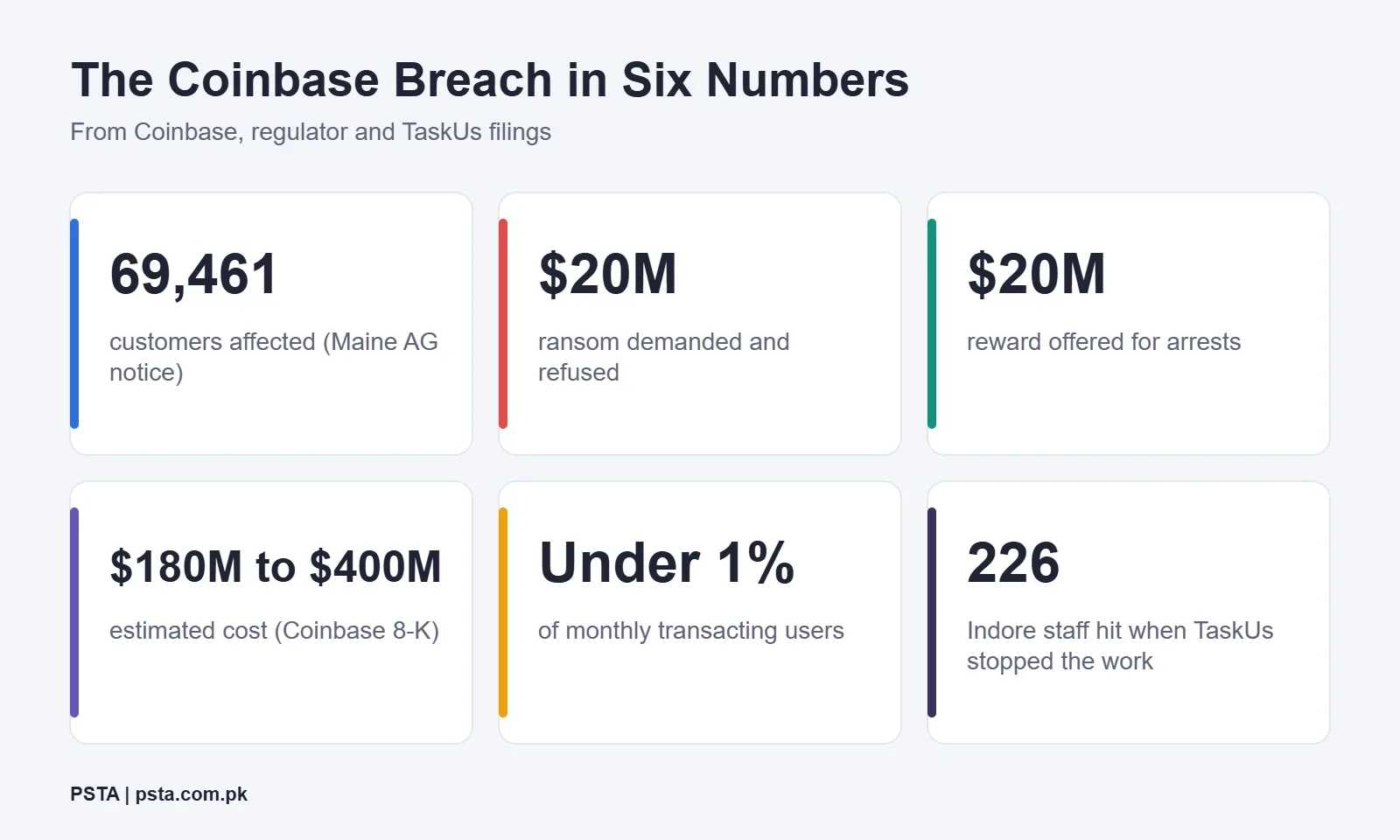
The wide range reflects uncertainty. In May 2025 Coinbase had not finished counting how many customers were tricked or how much they lost. Decrypt also reported that Coinbase shares fell 7% after the disclosure, and a shareholder lawsuit followed on May 22, 2025.
Compare this with crypto thefts earlier in this series, such as the WazirX hack. There, coins left company wallets directly. Here, the company's own funds were never touched, yet the bill could still rival a major theft.
Who Was Responsible, and How Solid Is the Evidence?
When you read about who caused the Coinbase data breach, separate three layers of claims.
Confirmed by Coinbase
The 8-K confirms that the attacker paid contractors or employees in support roles outside the US. It does not name TaskUs, India or any person. Coinbase said it fired the insiders involved and referred them to US and international law enforcement.
Confirmed by TaskUs
TaskUs has said it identified two employees who stole data, ended their contracts and is working with law enforcement. It told Decrypt it stopped all Coinbase work in Indore in January 2025, which affected 226 staff, and offered severance to the others.
Alleged, Not Proven
The class-action complaint names an Indore employee and claims team leaders and managers were also involved. TaskUs called those allegations "entirely without merit," according to Fortune. Infosecurity Magazine wrote that the worker was arrested in January 2025, but other sources we checked do not confirm an arrest. No public source identifies the group that sent the ransom email.
So your confidence should be high that bribed support staff were the entry point, moderate on how widely the scheme spread, and low on who was running it.
What Happened Next: Lawsuits, Firings and a Court Ruling
Coinbase's response to the data breach had four parts. It refused the ransom, posted the reward, promised reimbursement and, per the Maine notice, offered affected customers a year of identity monitoring with $1 million in insurance cover.
The legal fallout landed mostly on TaskUs. According to TaskUs's quarterly report for September 2026, the proposed class action filed on May 27, 2025 claims negligence, negligent hiring and supervision, fraud and breaches of state consumer laws. On July 28, 2026, the federal court in New York granted part of TaskUs's motion to dismiss and denied part of it. TaskUs has not disclosed an estimate of possible losses.
The Coinbase data breach case is still open. Watch for a settlement or trial date before drawing final conclusions about blame.
Why Does an Insider Breach in India Matter to Pakistan?
The Coinbase data breach happened in an Indian support center, but the lesson travels. Pakistan's IT and BPO sector sells customer support, data entry and back-office work to foreign clients. Many of those jobs give junior staff access to sensitive records. The Coinbase case shows how a foreign client can lose trust in a whole delivery center because of a few people.
For Pakistani firms, the risks are practical. A client could cancel a contract, demand an audit, or sue, as Coinbase customers have done with TaskUs. Pakistan's cybercrime law, PECA 2016, can also treat unauthorized access to data as an offense, so the employee carries personal legal risk too.
For ordinary users, the lesson is about Coinbase scam calls and their local copies. Pakistanis who use international exchanges, or local wallets and banking apps, get similar calls. The caller knows your name and maybe your balance, so you trust them. The NADRA data breach shows that leaked identity details already circulate here, which makes these calls more convincing.
How Can You Spot a Fake Exchange Support Call?
Any crypto exchange data breach feeds social engineering. A scammer who knows real details can sound exactly like a support agent. Use this simple test whenever someone contacts you about your account.
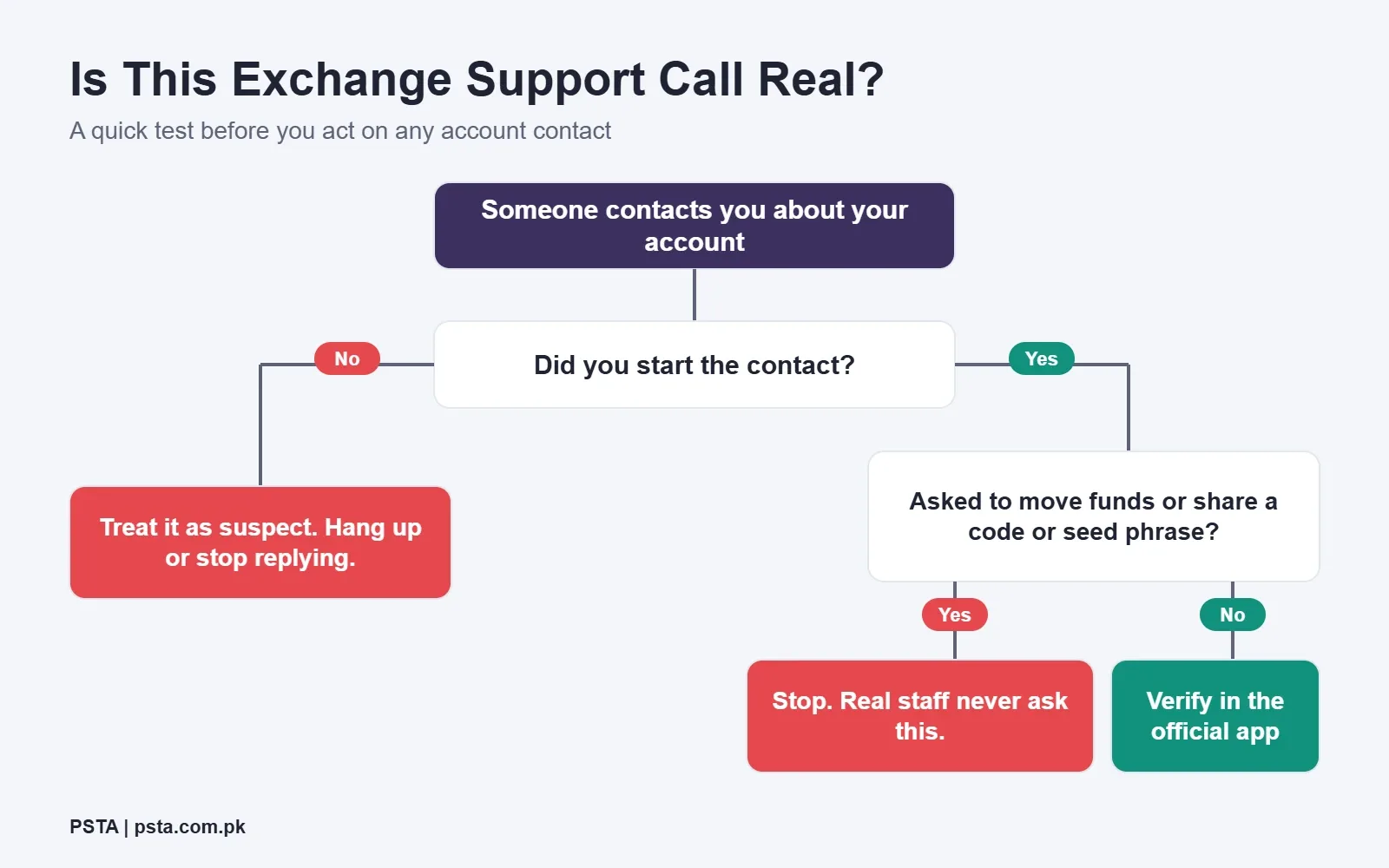
- Did you start the contact? If not, treat it as suspect. Hang up or stop replying.
- Are you being asked to move funds? Real exchanges do not ask you to send crypto to a "safe wallet."
- Are you asked for a code or seed phrase? Never share these with anyone, including real staff.
- Verify on your own. Open the official app yourself and check messages or open a ticket there.
If you clicked a link during the call, check it with our guide on how to check if a link is safe. If you already sent funds, contact the exchange through its app at once and report the loss to the cybercrime authorities.
Eight Defensive Lessons for Businesses and Support Teams
- Show agents only what a ticket needs. Mask ID images and balances by default, and reveal them only for a stated reason.
- Control phones on the support floor. Screen photos defeat many data loss tools, so physical rules matter.
- Watch lookup patterns. An agent opening hundreds of unrelated accounts a day should trigger a review.
- Treat contractors as part of your attack surface. Audit vendor controls and require breach reporting in contracts.
- Pay attention to early warning signs. When monitoring flags an insider, decide quickly whether customers need a warning.
- Warn customers before scammers call. Prompt notices reduce the window for impersonation fraud.
- Plan your extortion response in advance. Decide your ransom policy, legal contacts and disclosure steps before a crisis.
- Look after your staff. Fair pay, clear reporting channels and regular ethics training make bribes harder to land.
Where PSTA Students Pick Apart Cases Like This
Insider cases are hard to teach with tools alone, because the "exploit" is a person. Our beginner track, the Cyber Security and Ethical Hacking course, runs for 12 weeks and leans on labs and real case studies, which is where incidents like the Coinbase data breach fit. Its course page lists the CIA triad and risk, common attacks including social engineering, network security, malware and threat detection, plus digital forensics and cyber law.
During practical sessions, you investigate an incident, preserve evidence and write up a timeline, much like the table above. You can attend in Abbottabad or join live classes from any city in Pakistan. Once you have the basics, PSTA's advanced penetration testing track moves into offensive work.
Wondering which exam should come after that? Read about cyber security certifications for beginners before you pay for any voucher.
Lock Down Your Exchange Contact Settings Today
Pick one account you care about, such as an exchange, wallet or bank app. Open its security settings and switch on an authenticator app instead of SMS codes where possible. Then save the official support channel inside the app, so you never have to trust a caller again. It takes about 10 minutes, and it removes the scammer's easiest opening.
Frequently asked questions
Was Coinbase actually hacked in 2025?
Not in the usual sense. Coinbase's SEC filing says the attacker paid support contractors and employees outside the US to pass on customer data they could already see. No malware or software flaw was involved. That is why security teams describe it as an insider threat case, and why the fixes focus on access limits, monitoring and staff controls rather than patching.
How many people were affected by the Coinbase data breach?
Coinbase told the Maine Attorney General that 69,461 people were affected, including about 217 Maine residents. The company also said fewer than 1% of its monthly transacting users were involved. Affected customers received written notices from May 30, 2025, along with one year of free identity monitoring.
Did the attackers get passwords, private keys or crypto?
Coinbase's 8-K says login passwords and private keys were not exposed and customer funds were not directly accessible. The risk came from impersonation. Scammers with real names, balances and ID images could convince some customers to send funds themselves, which is why Coinbase promised to reimburse eligible customers who were tricked.
Did Coinbase pay the $20 million ransom?
No. Coinbase refused the $20 million demand and instead offered a $20 million reward for information leading to the arrest and conviction of the people behind the attack. It also said it fired the insiders involved and referred the matter to law enforcement in the US and abroad.
What role did TaskUs play in the breach?
TaskUs is an outsourcing company that ran Coinbase support work from Indore, India. TaskUs says two employees stole data and were removed. A class action in New York alleges a wider scheme, which TaskUs denies. In July 2026 the court allowed part of that lawsuit to continue.
Could a breach like this happen at a Pakistani company?
Yes. Any company that gives support or back-office staff access to customer records faces the same risk, whether it is a bank, telecom operator or BPO serving foreign clients. Limiting what each agent can see, controlling phones on the floor and watching for unusual record lookups all reduce the chance of a bribed insider succeeding.
What should I do if I get a call claiming to be my exchange?
Do not act during the call. Hang up, open the official app or website yourself, and check for messages or open a ticket there. Never share one-time codes or a seed phrase, and never move funds to a so-called safe wallet. If you lost money in Pakistan, report it to the cybercrime authorities quickly.
Sources & references
- Coinbase Form 8-K, May 2025 (SEC) sec.gov
- Maine Attorney General data breach notice: Coinbase maine.gov
- CyberScoop: Coinbase flips $20M extortion demand into bounty cyberscoop.com
- TechCrunch: Coinbase says its data breach affects at least 69,000 customers techcrunch.com
- Fortune: Suspect in Coinbase hack kept data on her phone, court filing alleges fortune.com
- Decrypt: Coinbase knew of its data breach months before disclosing (Reuters) decrypt.co
- Infosecurity Magazine: TaskUs employees behind Coinbase breach, court filing alleges infosecurity-magazine.com
- TaskUs Form 10-Q, quarter ended September 30, 2026 (SEC) sec.gov
Last reviewed & updated on by Umar Qureshi. Written by the PSTA team in Abbottabad, Pakistan.

Umar Qureshi

Cyber Security & Ethical Hacking Course in Abbottabad - PSTA
Turn this guide into a career: hands-on training with real projects, online across Pakistan or on-campus in Abbottabad · 12 Weeks.

Comments
No comments yet — ask a question or share your experience.