Quick answer
In January 2018, attackers moved about 523 million NEM, worth roughly ¥58 billion, out of Coincheck's internet-connected hot wallet, which needed only one key. Phishing malware reportedly gave them that key. Coincheck repaid about 260,000 customers in yen, was bought by Monex and won registration in 2019. The thieves remain unnamed.
Key takeaways
- • About 523 million NEM, worth roughly ¥58 billion ($532.6 million), left Coincheck at about 3 a.m. Japan time on January 26, 2018.
- • The coins sat in an online hot wallet without multi-signature protection, so one stolen key was enough.
- • Police-linked sources told Nikkei that phishing emails planted malware on staff computers weeks earlier.
- • Coincheck repaid about 260,000 customers ¥88.549 per NEM in yen, about ¥46.3 billion in total.
- • North Korea was suspected, but no direct evidence was made public and the thieves remain unidentified.
- • About 30 people in Japan were charged with trading the stolen coins on a dark web exchange.
Table of contents 18 sections
- What Was the Coincheck Hack?
- Coincheck Hack Timeline in Japan and Pakistan Time
- How Did the Attackers Get the Wallet Keys?
- What Went Wrong: Six Mistakes Behind the Coincheck Hack
- Mistake 1: Customer Coins Sat in a Hot Wallet
- Mistake 2: One Key Could Move Everything
- Mistake 3: No Cap on What One Wallet Could Hold
- Mistake 4: Security Standards Differed by Coin
- Mistake 5: The Theft Went Unnoticed for Hours
- Mistake 6: Known Gaps Stayed Open
- How Much Was Lost, and Who Paid It Back?
- Who Was Behind the Coincheck Hack, and How Sure Is Anyone?
- The People Who Were Charged
- What Happened to Coincheck Afterwards?
- Why Does a Japanese Exchange Hack Matter in Pakistan?
- Seven Defensive Lessons From the Coincheck Hack
- Where PSTA Students Rebuild an Exchange Breach
- Write Down Where Your Keys Live Today
Try a quick self-test before reading about the Coincheck hack. If one person on your team clicked a bad link this morning, could an outsider use that laptop to move most of your customers' money before lunch? At the Tokyo exchange Coincheck, the answer in January 2018 was yes. About 523 million NEM coins, worth roughly ¥58 billion ($532.6 million), left a single online wallet in the early hours of one morning, Reuters reported via Fortune.
We have written this case as a mistakes analysis. Each failure below was a choice made weeks or months before the theft, and each one has a cheap fix. Here is what you will find:
- A dated timeline of the theft, the refunds and the court cases, with Japan and Pakistan times.
- A plain-language account of how the attackers reached the wallet keys.
- Six specific mistakes, each tied to a reported fact rather than a guess.
- Who was blamed, and why the attribution is still weak.
- Seven defensive lessons for exchanges, fintech teams and ordinary users in Pakistan.
What Was the Coincheck Hack?
Coincheck was a Tokyo-based cryptocurrency exchange still waiting for full registration in early 2018. Customers bought and held coins in their exchange accounts, so the company controlled the private keys behind those coins. A private key is the secret that signs a transfer. Whoever holds it can move the funds.
On Friday, January 26, 2018, coins were sent out of Coincheck's NEM address at about 3 a.m. local time, Chief Operating Officer Yusuke Otsuka said, according to Reuters. The company noticed the falling balance more than eight hours later. By then the coins sat in addresses the attackers controlled.
The Coincheck NEM theft was not a hack of the NEM blockchain itself. The network worked as designed. It accepted a properly signed transfer, because the attacker had the key needed to sign it. That detail matters, because it puts the failure inside one company's walls.
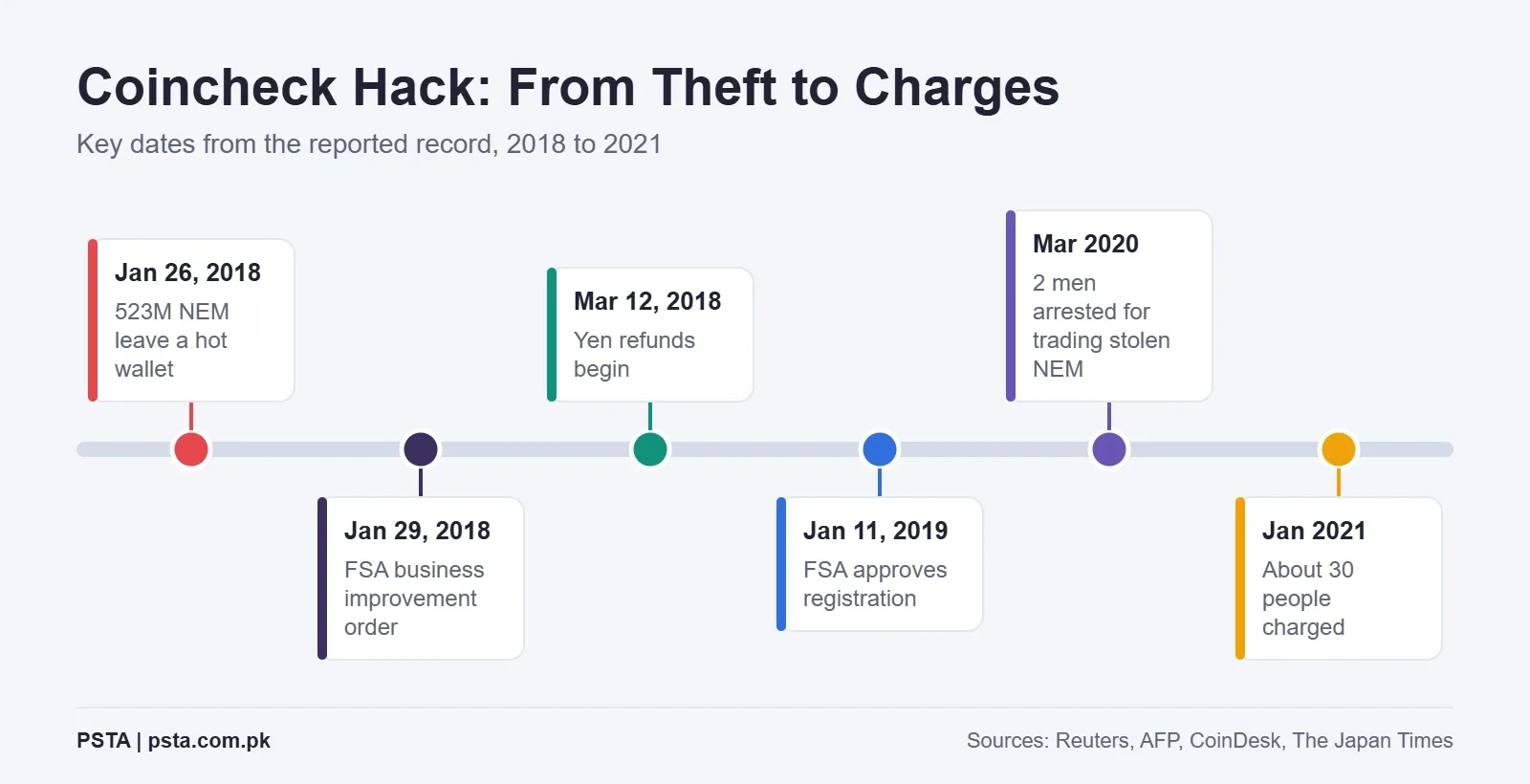
Coincheck Hack Timeline in Japan and Pakistan Time
Japan Standard Time (JST) is four hours ahead of Pakistan Standard Time (PKT). Times appear only where a source gave one.
| Date | JST / PKT | Event | Source |
|---|---|---|---|
| April 2017 | n/a | Japan requires exchanges to register with the Financial Services Agency (FSA). Coincheck keeps operating on a tentative basis while its application is pending. | Japan Times |
| Early January 2018 | n/a | Phishing emails reach Coincheck employees, according to police-linked sources cited by Nikkei. | CoinDesk |
| January 26, 2018 | About 3:00 a.m. JST / about 11:00 p.m. PKT on January 25 | About 523 million NEM (XEM) leave the exchange's NEM address. | Reuters |
| January 26, 2018 | More than 8 hours later | Staff notice the abnormal drop. Trading in every coin except bitcoin is suspended. The president apologizes at a press conference. | Reuters, AFP |
| By January 29, 2018 | n/a | Coincheck says it will repay about 260,000 customers in yen at ¥88.549 per NEM, from its own funds. | AFP |
| January 29, 2018 | n/a | The FSA issues a business improvement order. A report is due by February 13. | AFP |
| February 2, 2018 | 8:00 a.m. JST / 4:00 a.m. PKT | Ten FSA officials begin an on-site inspection. | Reuters |
| March 8, 2018 | n/a | A second administrative penalty requires a written system improvement plan by March 22. | CoinDesk |
| March 12, 2018 | n/a | Refunds begin, withdrawals restart, and trading resumes for six coins. | CoinDesk |
| April 2018 | n/a | Monex Group, an online brokerage, announces plans to acquire Coincheck. | Japan Times |
| January 11, 2019 | n/a | The FSA approves Coincheck's registration, about a year after the theft. | Japan Times |
| March 2020 | n/a | Tokyo police arrest two men accused of trading stolen NEM. | Japan Times |
| January 2021 | n/a | About 30 people have been charged for exchanging the stolen coins. | Japan Times |
The Coincheck hack timeline shows a pattern that repeats in most exchange cases. The theft takes minutes. The cleanup takes years, and the people who took the coins are often never named.
How Did the Attackers Get the Wallet Keys?
Coincheck has not published a full technical post-mortem of the Coincheck hack that we could find. The clearest account came from Nikkei, citing anonymous sources close to the police, as summarized by CoinDesk. Treat it as well-sourced reporting, not an official finding.
In that account, the chain had three links:
- A lure. Attackers sent phishing emails to employees in early January 2018.
- A foothold. When staff clicked the links, malware was installed on their computers.
- The keys. Over the following weeks, the attackers collected private keys, then used them to send the NEM out.
Nothing in that chain needs a rare technical trick. It needs an email someone trusts, a computer with access to secrets, and a wallet design where one key is enough. If you have read our guide to a hacked WhatsApp account, the first link will look familiar. Most account takeovers start with a message that feels routine.
What Went Wrong: Six Mistakes Behind the Coincheck Hack
Each mistake below is tied to something a company officer, regulator or reporter said in public. None of them alone caused the Coincheck hack. Together they made a theft of this size possible.
Mistake 1: Customer Coins Sat in a Hot Wallet
Coincheck said the NEM was kept in a "hot wallet," one connected to the internet, rather than a "cold wallet" kept offline, Reuters reported. President Koichiro Wada blamed technical difficulty and a shortage of staff. The hot wallet vs cold wallet choice is a trade-off. Hot wallets make withdrawals fast. Cold wallets make theft slow. Exchanges normally keep only a small working balance hot.
Mistake 2: One Key Could Move Everything
Coincheck was not using a multi-signature system, Reuters reported. A multi-signature wallet needs approval from two or more separate keys before funds move. With that setup, malware on one laptop would have produced one signature, not a completed transfer.
Mistake 3: No Cap on What One Wallet Could Hold
All 523 million coins left from one NEM address in a single early-morning window, according to Coincheck's own account to Reuters. Nothing limited how much value that one address carried. Splitting reserves across wallets, with small hot balances and large cold ones, limits what any one breach can take.
Mistake 4: Security Standards Differed by Coin
The same exchange kept customers' bitcoin in cold storage, and Coincheck admitted its security for NEM was "insufficient," Dark Reading reported. The NEM got weaker treatment. When each asset is handled separately, the newest or least-watched one tends to get the thinnest protection, and attackers look for exactly that gap.
Mistake 5: The Theft Went Unnoticed for Hours
The balance drop was noticed more than eight hours after the transfer. An alert on large or unusual outflows, sent to a person who is awake, costs very little. On a blockchain, a few minutes can decide whether a destination address gets flagged before coins move again.
Mistake 6: Known Gaps Stayed Open
The FSA had told Coincheck to fix flaws in its computer networks before the theft, and those gaps were among the reasons it lacked full registration, Reuters reported. Japan's finance minister, Taro Aso, told parliament the company had not stored important assets separately and seemed to lack basic knowledge, AFP reported. A warning on file does nothing until someone owns the fix and a deadline.
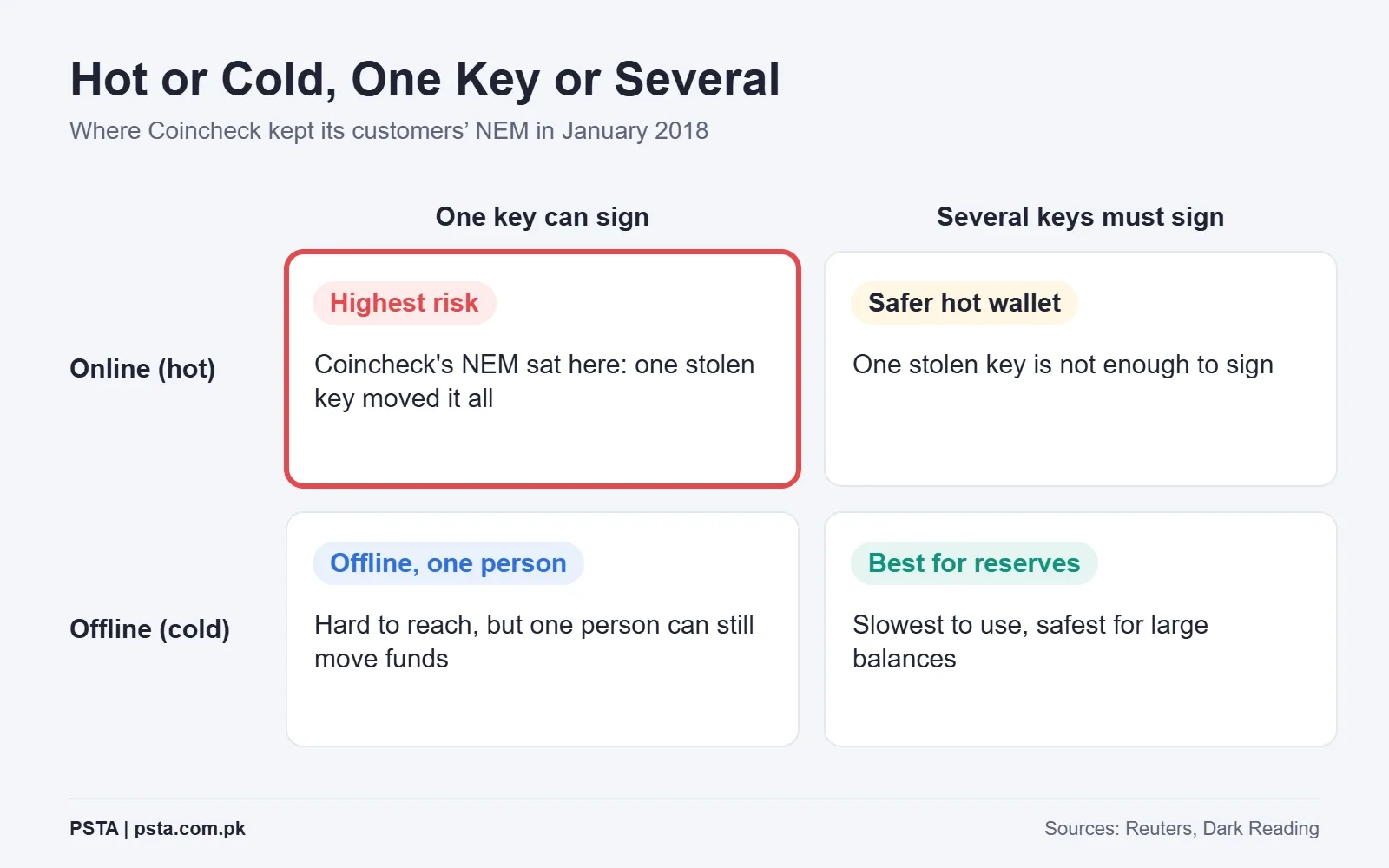
It helps to picture the first two mistakes as a grid. One axis asks whether a wallet is online. The other asks whether one key or several must sign. Coincheck's NEM sat in the riskiest corner: online, with a single key.
A hot wallet with multisig means one stolen key is not enough. A cold wallet with one key is offline, but one person can still move funds. Cold storage with multisig is the slowest to use and the safest place for reserves.
How Much Was Lost, and Who Paid It Back?
Reports converted the Coincheck hack loss in slightly different ways, which is normal for a coin whose price moved by the hour. Reuters gave ¥58 billion, about $532.6 million. AFP used $530 million at Friday's exchange rate and noted that it exceeded the roughly $480 million in bitcoin lost at Mt. Gox in 2014. Our Mt. Gox hack case study covers that earlier collapse.
The refund was smaller than the headline loss. Coincheck promised to repay about 260,000 customers ¥88.549 per NEM in yen, about ¥46.3 billion in total, from its own funds, AFP reported. AFP put that at about $430 million, while Reuters gave about $425 million. The gap comes from the per-coin price. ¥58 billion across 523 million coins works out to about ¥111 per coin, well above the refund rate.
Customers were also paid in yen, not NEM. Anyone who expected to get the coins themselves back did not. Payments began on March 12, 2018, for customers who held NEM at the close of January 26, Japan time, CoinDesk reported.
| Figure | Value | Source |
|---|---|---|
| NEM taken | About 523 million XEM | Reuters |
| Value at the time | About ¥58 billion ($530 million to $532.6 million) | Reuters, AFP |
| Customers repaid | About 260,000 | AFP |
| Refund rate | ¥88.549 per NEM, paid in yen | AFP, CoinDesk |
| Total refund | About ¥46.3 billion ($425 million to $430 million) | AFP, Reuters |
Who Was Behind the Coincheck Hack, and How Sure Is Anyone?
The short answer is that nobody has been publicly named for the Coincheck hack itself. In January 2021, The Japan Times reported that the identities of the thieves were still unknown and that Tokyo police would keep investigating.
North Korea was raised early as a suspect. In February 2018, South Korea's National Intelligence Service was reported to be looking into claims that North Korean hackers were responsible, partly because of similar past cases, Computing reported. The same report said the agency had found no evidence that directly implicated North Korea.
So keep the two claims apart. The theft is confirmed. The idea that a state group did it is a suspicion based on resemblance, not proof. Compare that with the Bybit hack, where the FBI publicly named North Korea, or our Ronin Network hack case study.
The People Who Were Charged
Japanese police did charge people for what happened next. A site appeared on the dark web where stolen NEM could be swapped for other coins.
About 30 Japan residents were charged with exchanging the coins while knowing they were stolen. Their trades were estimated at more than ¥10 billion at 2018 rates, The Japan Times reported. Two of them were arrested in March 2020. Buying stolen funds is a crime of its own, even if you did not steal them.
What Happened to Coincheck Afterwards?
After the Coincheck hack, the regulator moved fast. The FSA's order on January 29, 2018 told Coincheck to find the cause, deal properly with clients, strengthen risk management and prevent a repeat. The agency also warned it would raid the office if needed, AFP reported. On February 2, ten officials arrived for an early inspection, and the FSA asked every exchange in Japan for a report on system risk.
A second penalty followed on March 8. Coincheck had to submit a written improvement plan by March 22. Days later, refunds began and withdrawals reopened.
Then ownership changed. In April 2018, Monex Group, an online brokerage running since 1999, announced plans to acquire Coincheck and said it could share its security and internal management experience. The FSA approved Coincheck's registration on Friday, January 11, 2019, The Japan Times reported. Its new chief executive, Toshihiko Katsuya, said the firm had to keep working on security and internal controls.
The company survived because it could pay customers from its own money. Many exchanges in a similar position could not, which is why crypto exchange security matters before a breach, not after it.
Why Does a Japanese Exchange Hack Matter in Pakistan?
You may never have heard of NEM. The Coincheck hack still applies to you in three ways.
If you hold coins on an exchange, you depend on its key management, not your own. Coincheck customers did nothing wrong and still waited about six weeks for yen at a set rate. Before you leave a balance on any platform, look for a public statement on cold storage, multi-signature controls and a record of how past incidents were handled.
If you work at a fintech, bank or software house, replace "NEM wallet" with whatever single secret can move money or data at your firm. That might be a payment gateway API key, a cloud admin login or a code-signing certificate. Ask who can use it alone, from which computer, and who would see an unusual action at 3 a.m.
If you are studying security, this is a clean teaching case. Every cryptocurrency exchange hack in our series, from the Binance hack onward, comes back to the same few questions about keys, people and detection.
Seven Defensive Lessons From the Coincheck Hack
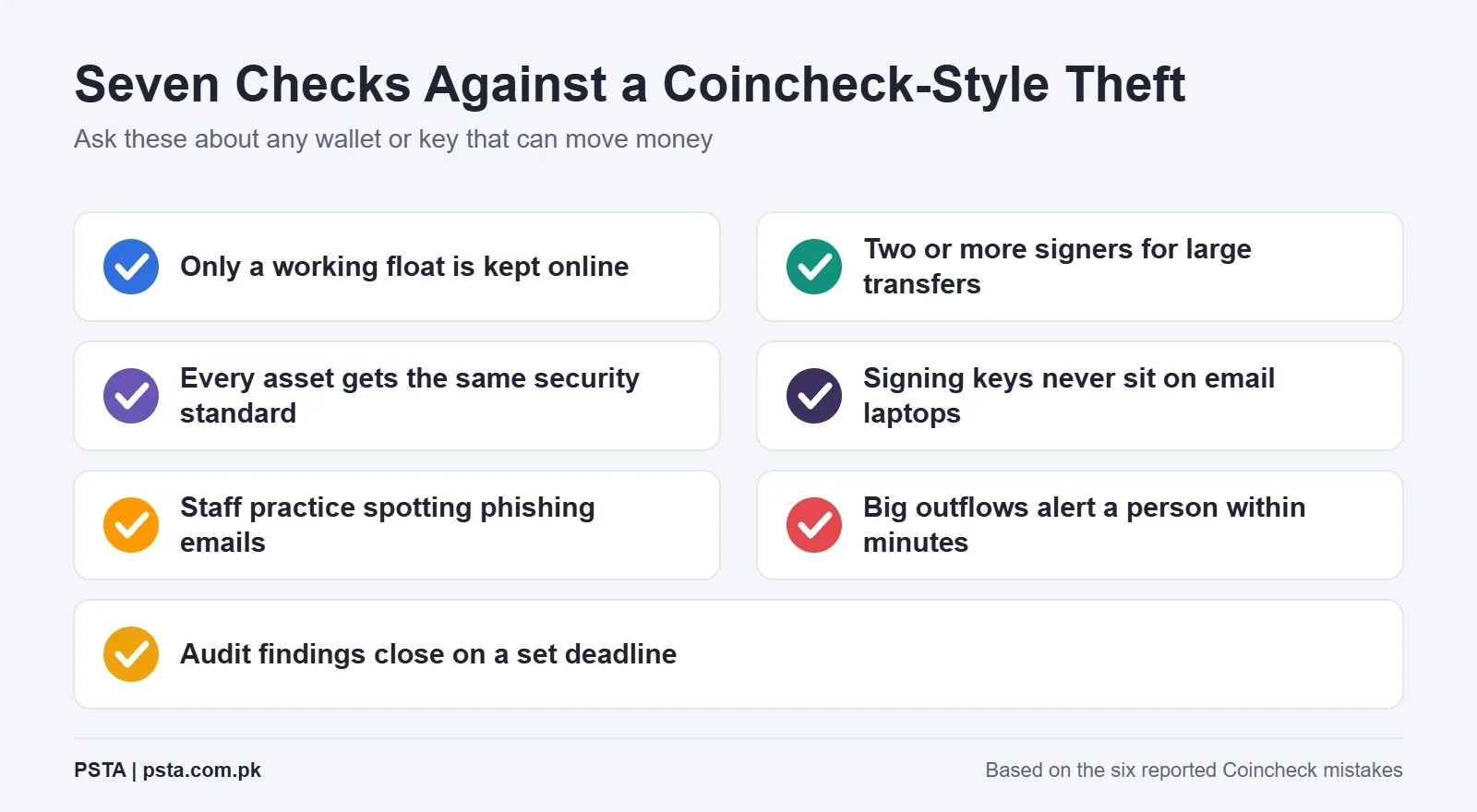
These lessons come straight from the six mistakes above. Most cost staff time, not new software.
- Keep only a working float online. Hold most reserves offline, and set a written limit for the hot balance.
- Require two or more signers for large transfers. Put the keys on separate devices held by separate people.
- Use one security standard for every asset. A new coin or product launch should not get weaker controls than the old ones.
- Keep secrets off everyday computers. The laptop that opens email should not be the one that holds signing keys.
- Train staff on phishing with real examples. Make reporting a strange email quick and free of blame.
- Alert on large outflows within minutes. Route alerts to an on-call person, including nights and weekends.
- Close regulator and audit findings on a deadline. Give each finding an owner, a date and a check that it was actually fixed.
Where PSTA Students Rebuild an Exchange Breach
At PSTA, cases like the Coincheck hack are used as lab material in the Cyber Security and Ethical Hacking course. It runs for 12 weeks at beginner level, on campus in Abbottabad or live online across Pakistan. The outline moves from the CIA triad and risk through common attacks, basic ethical hacking, network security, malware and threat detection, cyber law and digital forensics.
In a Coincheck-style exercise, you would build the timeline from sources, mark which facts are confirmed, and write the controls that would have broken each link. Students who want to go further into offensive testing can continue with the Advanced Ethical Hacking and Penetration Testing course. If you are weighing exams as well, our list of cyber security certifications for beginners explains where to start.
You are welcome to message us on WhatsApp with questions about batch dates before you decide.
Write Down Where Your Keys Live Today
Take ten minutes and list every secret that can move money or data in your work or personal life. For each one, note where it is stored, who can use it alone, and how you would learn that it had been used. If any line reads "online, one person, nobody would notice," you have found your own Coincheck risk, and that is the one to fix first.
Frequently asked questions
Was the NEM blockchain itself hacked in the Coincheck case?
No. The NEM network processed a transfer that was signed with a valid key, exactly as it was built to do. The failure was inside Coincheck, where the key for a large online wallet was reachable from compromised staff computers. That is why the case is studied as a company security failure rather than a flaw in the coin's own technology.
Did Coincheck customers get their money back?
Most were repaid in part. Coincheck paid about 260,000 affected customers ¥88.549 for each NEM they held at the close of January 26, 2018, in Japanese yen rather than coins. Payments began on March 12, 2018. Customers who wanted their NEM back, or who valued it at a higher price, did not get that.
Why was the refund total lower than the ¥58 billion loss?
The two figures used different prices per coin. The ¥58 billion estimate works out to about ¥111 for each of the 523 million NEM taken. The refund rate was ¥88.549 per coin, which adds up to about ¥46.3 billion. Both numbers describe the same coins, valued at different moments and by different methods.
Has anyone been convicted of stealing the Coincheck coins?
Not publicly. As of January 2021, The Japan Times reported that the thieves were still unidentified. Police did charge about 30 people in Japan for exchanging the stolen NEM through a dark web site while knowing where it came from. That shows buying or laundering stolen crypto can be prosecuted even when the original thief is never found.
What is a multi-signature wallet in simple terms?
It is a wallet that needs approval from more than one key before funds can move, for example two out of three. Each key is kept on a separate device by a separate person. If an attacker steals one key through malware or phishing, the transfer still cannot be completed without the others, which buys time to spot and stop the theft.
How long did Coincheck take to notice the theft?
More than eight hours, according to what the company's chief operating officer told reporters. The coins left at about 3 a.m. Japan time, which was about 11 p.m. the previous night in Pakistan. Automated alerts on unusually large withdrawals, routed to someone on call, are the usual way to close that kind of gap.
What should I check before keeping crypto on any exchange?
Look for public, specific information on how the platform stores customer funds, such as the share kept offline, whether large transfers need several approvals, and how it handled past incidents. Check whether it is registered with a regulator where it operates. This is security information, not investment advice, so make any money decisions with a qualified adviser.
Sources & references
- Reuters via Fortune: The Coincheck Cryptocurrency Hack fortune.com
- Reuters via Investing.com: Japan's regulator urged Coincheck to fix flaws before theft m.investing.com
- AFP via The Daily Star: Japan sanctions Coincheck after massive cryptocurrency heist thedailystar.net
- CoinDesk: Coincheck Starts Crypto Hack Refunds, Allows Limited Trading coindesk.com
- Dark Reading: Hack Costs Coincheck Cryptocurrency Exchange $530 Million darkreading.com
- The Japan Times: Coincheck wins approval a year after massive theft japantimes.co.jp
- The Japan Times: About 30 charged with exchanging stolen cryptocurrency japantimes.co.jp
- Computing: South Korea investigating claims North Korea was behind Coincheck hack computing.co.uk
Last reviewed & updated on by Umar Qureshi. Written by the PSTA team in Abbottabad, Pakistan.

Umar Qureshi

Cyber Security & Ethical Hacking Course in Abbottabad - PSTA
Turn this guide into a career: hands-on training with real projects, online across Pakistan or on-campus in Abbottabad · 12 Weeks.
Comments
No comments yet — ask a question or share your experience.