Quick answer
Most cyber security interview questions for freshers cover six areas: fundamentals such as the CIA triad, networking and ports, logs and SIEM, incident response, OWASP web risks, and ethics. Recent Pakistani job ads stress SIEM, Windows and Linux, and incident handling. Answer by defining the term, giving an example, explaining how you'd check it, and naming your next step.
Key takeaways
- • Recent SBP, Mobilink Bank and MoITT ads ask for SIEM, log analysis and incident response skills.
- • Shape answers in four steps: define, give an example, say how you'd check, then say what you'd do.
- • Know key ports, Windows event IDs 4624 and 4625, and the difference between IDS and IPS.
- • Learn the OWASP Top 10:2025 order and the six NIST CSF 2.0 functions.
- • Practise scenario answers out loud and bring a written lab report to the interview.
Table of contents 12 sections
- What Pakistani Employers Test in Security Interviews
- How Do Interviewers Grade Your Answers?
- Fundamentals: The Questions That Open Most Interviews
- Networking Questions You Will Almost Certainly Get
- SOC Analyst Interview Questions on Logs and SIEM
- Incident Response and Framework Questions
- Web Security and OWASP Top 10 Questions
- Scenario Questions: Thinking Out Loud
- Questions About Ethics, Law and Your Own Practice
- A 14-Day Plan to Prepare for Cyber Security Interview Questions
- Where PSTA's Cyber Security Course Fits Your Prep
- Record Five Answers Before Tomorrow
Cyber security interview questions for freshers in Pakistan come from a short list of skills, and recent job ads name them plainly. Line up three of them and the same words repeat: SIEM, incident response, log analysis, Windows and Linux. In September 2026, a SOC Analyst ad from Mobilink Bank on Rozee.pk asked for IBM QRadar or a similar SIEM, networking fundamentals and Active Directory, with PowerShell, Python or Bash as a plus.
So this guide skips trivia. It sticks to the cyber security interview questions that entry-level candidates actually get, with model answers you can say out loud in under a minute.
Here is what this guide covers:
- What banks, government projects and SOC teams in Pakistan say they want
- A simple four-part way to shape any technical answer
- 24 common questions with short sample answers, grouped by topic
- Scenario questions where you walk through a real alert
- A 14-day preparation plan you can start this week
What Pakistani Employers Test in Security Interviews
For cyber security jobs in Pakistan, job ads are the best study guide you have, because they list what the team needs on day one. Three recent examples show a clear pattern.
The State Bank of Pakistan's Cyber Security Department advertised OG-3 roles for a Senior Cyber Operations Analyst and a SOC Administrator in Karachi. Applications closed on November 16, 2026. The duties mention SIEM, SOAR and threat intelligence platforms, along with threat hunting, incident response and detection rule tuning.
The Ministry of IT and Telecommunications also invited applications for its "Cyber Security for Digital Pakistan, Phase-I" project, ProPakistani reported. The posts ranged from SOC Analyst L1, L2 and L3 to a SIEM Engineer and Incident Responders, with applications through the National Jobs Portal.
The Mobilink Bank ad asked for 1 to 3 years of SOC or security experience, preferably in banking. Its skill tags included MITRE ATT&CK, IOC analysis, threat hunting, EDR and log analysis.
Global data points the same way. In ISC2's 2025 Cybersecurity Workforce Study of more than 16,000 professionals, 59% reported critical or significant skills shortages, up from 44% a year earlier, according to Infosecurity Magazine. Teams want people who can do specific work, and interviews are how they check.
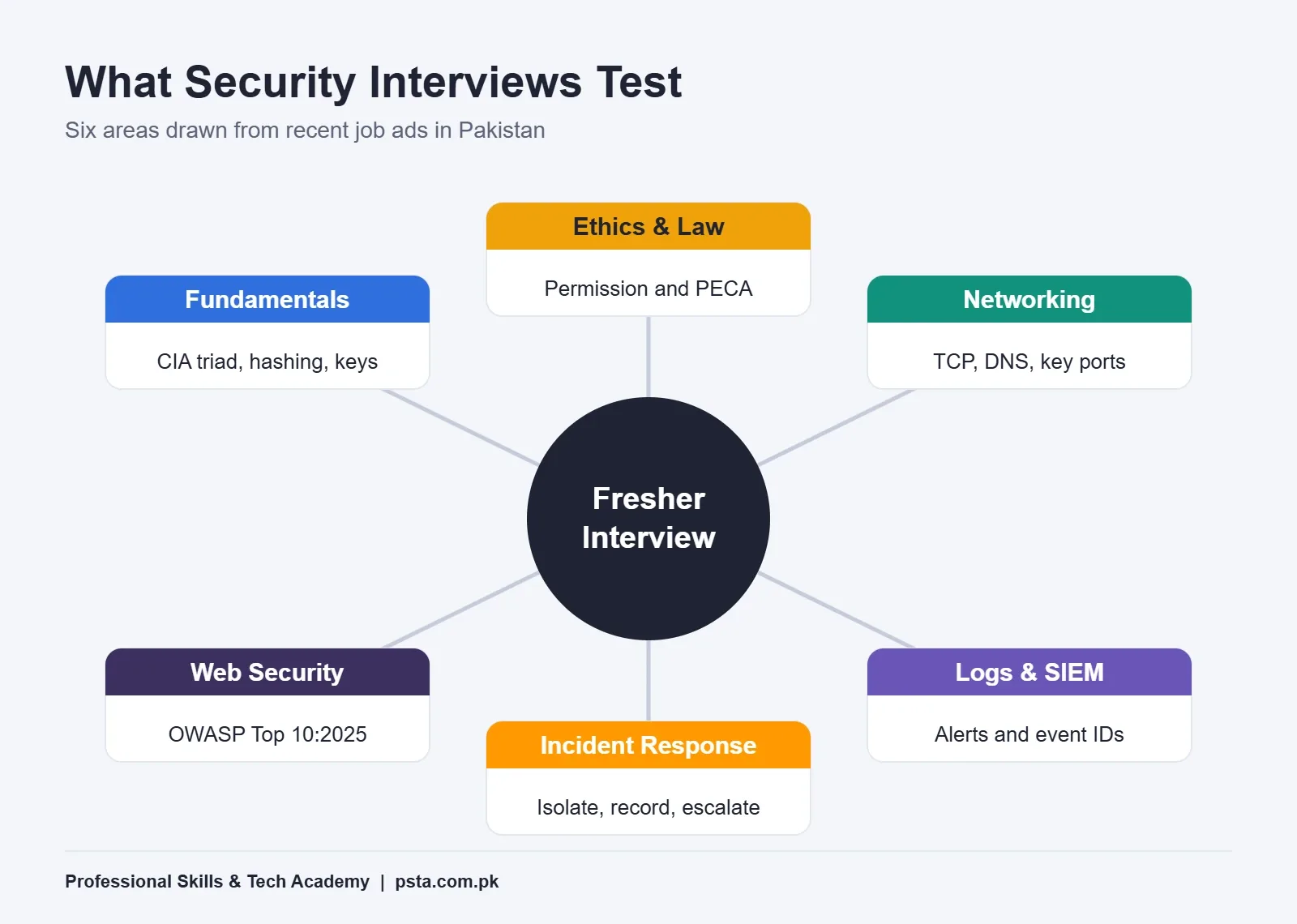
Put together, you can expect cyber security interview questions in six areas: fundamentals, networking, logs and SIEM, incident response, web security, and ethics.
How Do Interviewers Grade Your Answers?
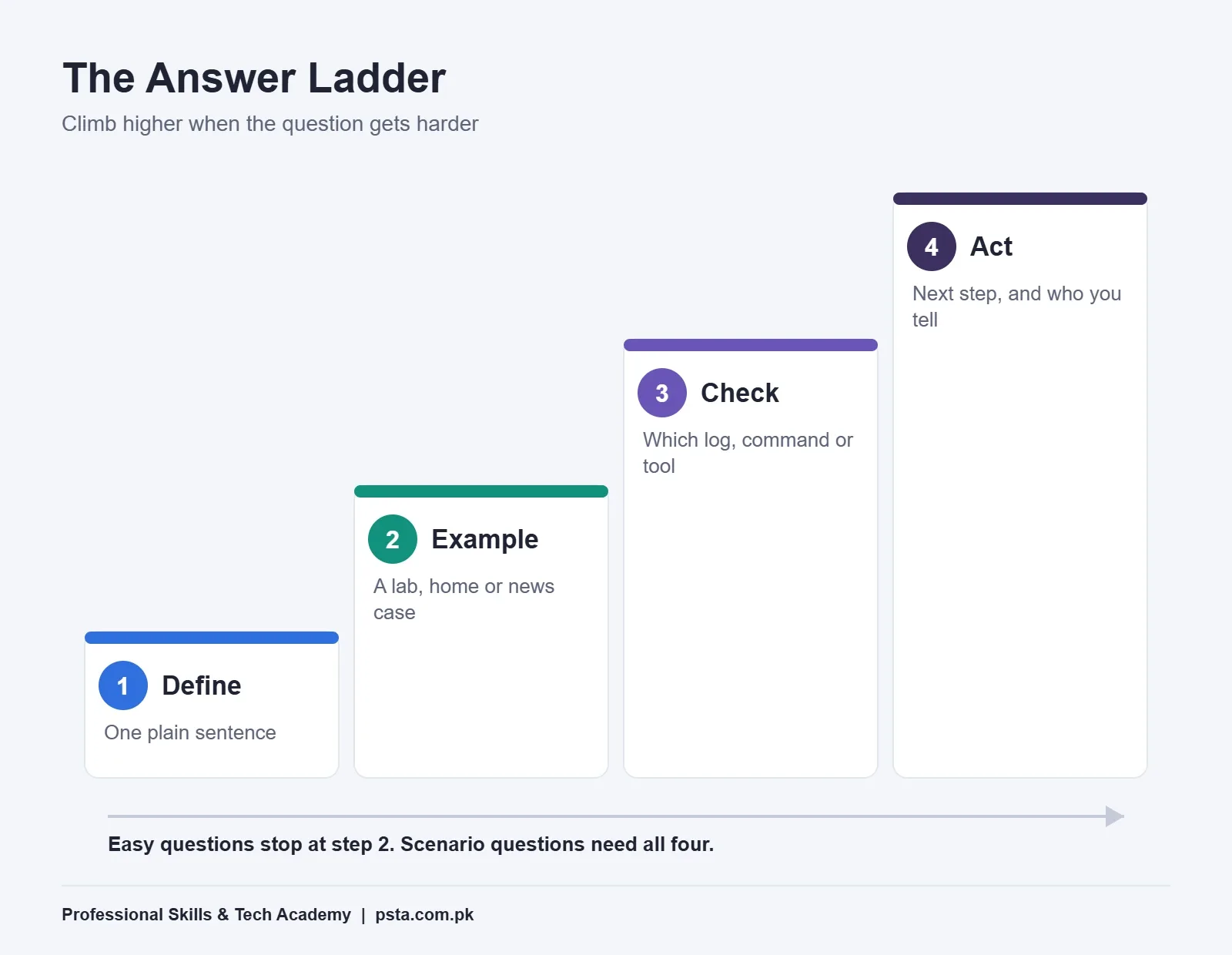
When panels mark cyber security interview questions, most aren't looking for a textbook definition. They want to see whether you understand the idea well enough to use it. A weak answer stops after one line. A strong answer climbs a little further.
Use this four-step shape for any technical question:
- Define it in one plain sentence.
- Give an example from a lab, a home network or a news case.
- Say how you would check it, such as which log, command or tool.
- Say what you would do next, including who you would tell.
You don't need all four steps every time. For "What is a firewall?", steps 1 and 2 are enough. For "You see 500 failed logins on one account, what now?", steps 3 and 4 are the whole answer.
Fundamentals: The Questions That Open Most Interviews
These come first because they're quick to ask and they show how clearly you think. Keep each answer short and concrete.
Q1. What is the CIA triad?
Confidentiality, integrity and availability. Confidentiality means only the right people can read data. Integrity means nobody changes it without permission. Availability means it's there when users need it. A ransomware attack hurts availability first, and often confidentiality too if files are copied out before encryption.
Q2. What's the difference between a threat, a vulnerability and a risk?
A vulnerability is a weakness, like an unpatched server. A threat is something that could use that weakness, like an attacker scanning the internet. Risk is the chance of harm multiplied by how bad the harm would be. You reduce risk by patching, adding controls or reducing exposure.
Q3. Authentication vs authorization?
Authentication proves who you are, for example with a password and an OTP. Authorization decides what you may do after that. A bank teller and a branch manager can both log in, but only one can approve a large transfer.
Q4. How is hashing different from encryption?
Encryption is two-way: with the right key you get the original data back. Hashing is one-way: it turns input into a fixed-length value you can't reverse. Systems store password hashes, ideally with a salt and a slow algorithm, so a leaked database doesn't reveal the actual passwords.
Q5. Symmetric vs asymmetric encryption?
Symmetric uses one shared key and is fast, so it's used for bulk data. Asymmetric uses a public and private key pair. HTTPS uses both: asymmetric methods to agree on a session key, then symmetric encryption for the actual traffic.
Networking Questions You Will Almost Certainly Get
Networking interview questions show up in nearly every security panel, because security work is mostly network work. If you can't explain how traffic moves, you can't explain how an attack moves either.
Q6. Explain the TCP three-way handshake.
The client sends SYN, the server replies SYN-ACK, and the client sends ACK. Only then does data flow. A SYN flood abuses this by sending many SYNs and never finishing, which ties up the server's resources.
Q7. TCP vs UDP?
TCP is connection-based and resends lost packets, so web pages and email use it. UDP skips the handshake and the delivery checks, which suits DNS lookups, voice calls and live video where speed matters more than a perfect copy.
Q8. What does DNS do, and how can attackers misuse it?
DNS turns names like psta.com.pk into IP addresses. Attackers misuse it through spoofed or poisoned responses, look-alike domains in phishing, and DNS tunneling to sneak data out. Analysts watch for odd query volumes and very long random-looking subdomains.
Q9. Firewall vs IDS vs IPS?
A firewall allows or blocks traffic based on rules. An IDS watches traffic and raises alerts but doesn't stop anything. An IPS sits inline and can block traffic it judges malicious. Many modern devices combine all three.
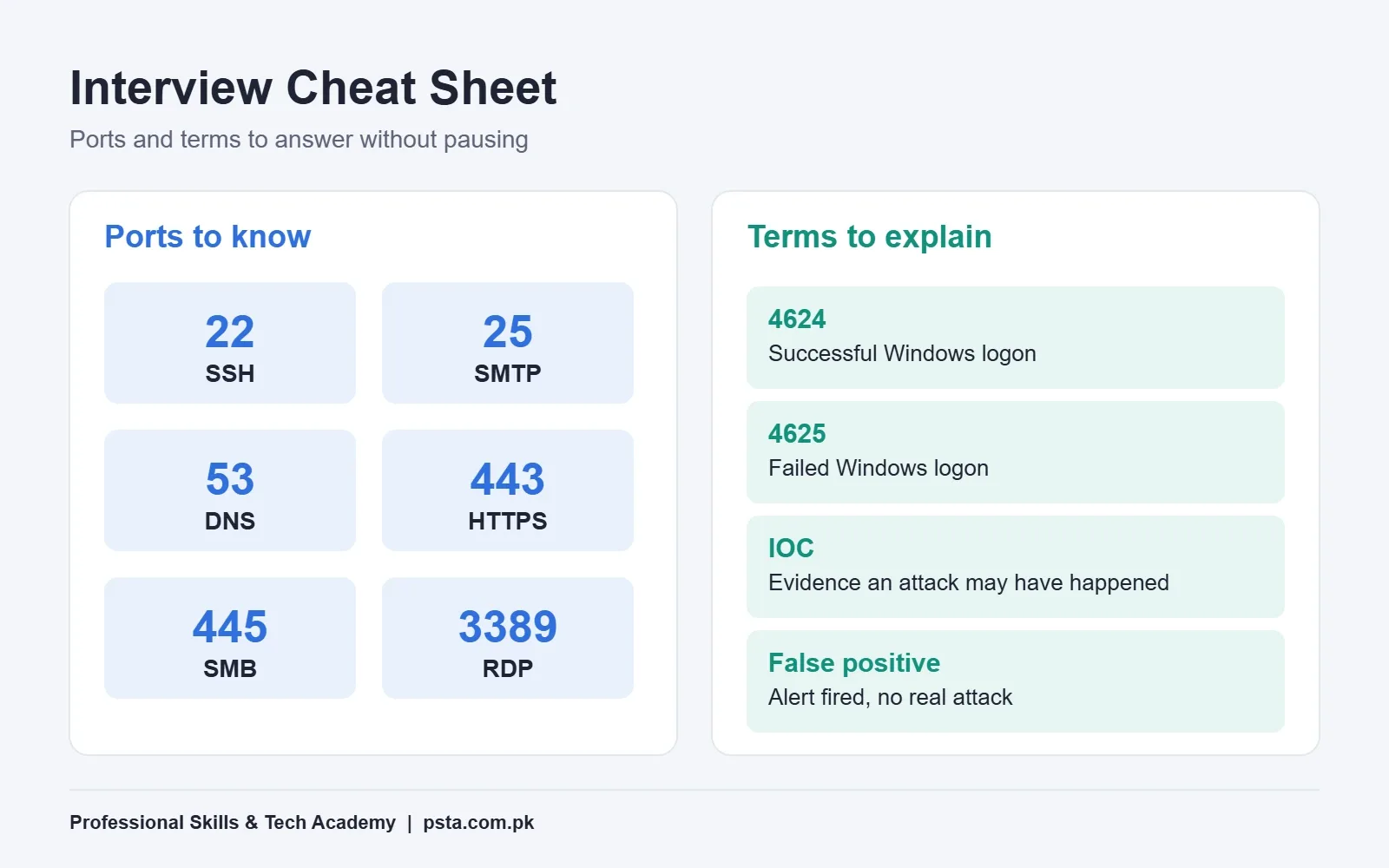
Q10. Which ports should you know?
Interviewers often fire a few port numbers at freshers. Learn these until you can answer without pausing:
| Port | Service | Why a defender cares |
|---|---|---|
| 22 | SSH | Remote admin on Linux; brute-force target |
| 25 | SMTP | Email sending; spam and spoofing |
| 53 | DNS | Name lookups; tunneling and poisoning |
| 80 / 443 | HTTP / HTTPS | Web traffic; most web attacks arrive here |
| 445 | SMB | Windows file sharing; worm spread |
| 3389 | RDP | Remote desktop; common ransomware entry |
If you want practice reading real packets, our Wireshark guide for beginners walks through captures you can open on your own laptop.
SOC Analyst Interview Questions on Logs and SIEM
For a Tier 1 SOC role, this section usually decides the result. Panels want to know whether you can look at an alert and make a sensible call.
Q11. What is a SIEM?
A SIEM collects logs from servers, firewalls, endpoints and apps in one place, then applies rules to raise alerts. IBM QRadar, Microsoft Sentinel, Splunk and Wazuh are common names. Mention whichever one you've used in a lab, even a free one.
Q12. What is a false positive, and why does it matter?
It's an alert that fires when nothing bad happened, like a backup job flagged as data theft. Too many of them cause alert fatigue, and real attacks get missed. A false negative is worse: an attack that triggers no alert at all.
Q13. What is an IOC?
An indicator of compromise is evidence that an attack may have happened: a known bad IP address, a file hash, a suspicious domain or a strange registry key. You search logs for IOCs from threat intelligence feeds to find affected machines.
Q14. What is MITRE ATT&CK?
It's a public knowledge base of attacker tactics and techniques, organized by goal, such as initial access, persistence and exfiltration. SOC teams map alerts to it so they can see which stage an attack has reached and where their detection has gaps.
Q15. Which Windows logs would you check for a suspicious login?
Start with the Security log. Event ID 4624 is a successful logon and 4625 is a failed one. Check the logon type, source IP and time. A burst of 4625s followed by a 4624 from the same IP is a classic sign of a password-guessing attack that finally worked.
Q16. EDR vs antivirus?
Traditional antivirus mainly matches known malware signatures. EDR records process, file and network activity on each endpoint, so analysts can investigate behavior and isolate a machine remotely. The Mobilink Bank ad mentioned earlier lists EDR and XDR among its skills.
Incident Response and Framework Questions
These show whether you stay calm and follow a process. The answer matters less than the order of your steps.
Q17. Walk me through how you'd handle a malware alert on a laptop.
Confirm it isn't a false positive. Isolate the laptop from the network using EDR or by unplugging it, but don't switch it off, because memory evidence would be lost. Note the time, user, file hash and process. Escalate to the L2 analyst or incident lead, then check whether other machines show the same hash.
Q18. Which security framework do you know?
The NIST Cybersecurity Framework is a safe answer. NIST released version 2.0 on February 26, 2024, built around six functions: Govern, Identify, Protect, Detect, Respond and Recover. Govern is the new one, covering how an organization makes and carries out security decisions.
Q19. What's the difference between an event, an alert and an incident?
An event is anything logged, like a user signing in. An alert is an event a rule flags as worth a look. An incident is a confirmed situation that harms or threatens the organization. Most alerts never become incidents, and that's normal.
Web Security and OWASP Top 10 Questions
Software houses and fintech firms like to test this area, even for SOC roles. Their own apps are the main target.
Q20. Name a few items from the OWASP Top 10.
The OWASP Top 10:2025 starts with Broken Access Control, then Security Misconfiguration and Software Supply Chain Failures. Injection now sits at fifth place. Mishandling of Exceptional Conditions is a new category in this edition. Knowing the current order shows you keep up. Our OWASP Top 10 2025 explainer covers each category in plain words.
Q21. What is SQL injection, and how do you prevent it?
It happens when user input is pasted straight into a database query, so an attacker can change what the query does. The fix is parameterized queries, plus input validation and a database account with only the permissions it needs.
Q22. What is cross-site scripting (XSS)?
XSS lets an attacker run their JavaScript in another user's browser, often through a comment box or search field that echoes input back. Output encoding, a Content Security Policy and cookies marked HttpOnly reduce the damage.
Scenario Questions: Thinking Out Loud
Scenario questions have no single right answer. The panel is listening to your reasoning. Speak in steps, and say when you'd escalate.
Q23. A staff member forwards an email saying their bank account will be blocked unless they "verify" through a link. What do you do?
Thank them for reporting it. Don't click the link. Check the sender's real address, the reply-to field and the link's actual domain. Search the mail gateway for the same sender or subject to find other recipients. If anyone clicked, reset their password, revoke active sessions and check their sign-in logs. Then block the domain and send a short warning to staff.
Q24. A finance user's account logs in from abroad at 3 a.m., minutes after a login from Lahore. What's your first move?
Treat it as "impossible travel" until proven otherwise. Check whether a VPN explains it. If not, disable the session, force a password reset with MFA, and look at what the account did after the foreign login, especially email rules and payment approvals. Escalate, because finance accounts are a favorite target for payment fraud.
To practice scenario-style cyber security interview questions, take any alert from a lab and explain it to a friend in under two minutes. If they can follow you, a panel will too.
Questions About Ethics, Law and Your Own Practice
Expect at least one question that checks your judgment. Employers handle customer data, and they want people who won't create legal trouble.
A common one is "Have you ever hacked anything?" The right answer is about permission. Say you practice only in your own lab or on legal training platforms. Testing someone else's system without written permission can be an offense under Pakistan's Prevention of Electronic Crimes Act (PECA). Then describe one lab you've built.
Another is "How do you keep your skills current?" Name real habits: a weekly lab, reading vendor advisories, following OWASP and NIST updates, or studying for a certification. If you're preparing for CompTIA Security+, note that the new SY0-801 version launched on November 17, 2026. The exam allows up to 90 questions and 90 minutes, and you need 750 to pass on a scale of 100 to 900. If you are unsure which exam to sit first, read our beginner certification comparison.
Don't forget the general questions. Most panels still open with "Tell me about yourself," so prepare a 60-second version that ends with why you chose security. Our post on answering "tell me about yourself" has a structure you can adapt.
A 14-Day Plan to Prepare for Cyber Security Interview Questions
Two weeks is enough to sharpen what you know. The key is to practice speaking, not only reading. Here's a plan that fits around classes or a job:
| Days | Focus | Output by the end |
|---|---|---|
| 1 to 2 | Read five current job ads closely | A list of the tools and skills they repeat |
| 3 to 4 | Fundamentals and encryption | Spoken answers to Q1 to Q5, recorded on your phone |
| 5 to 7 | Networking, ports and packet captures | One Wireshark capture you can explain |
| 8 to 10 | Logs, a free SIEM and Windows event IDs | One investigated alert, written as a short report |
| 11 to 12 | OWASP Top 10 and scenario practice | Answers to Q23 and Q24 without notes |
| 13 to 14 | Mock interview with a friend or mentor | A list of weak answers to fix |
Bring your written lab reports to the interview. A one-page investigation summary gives the panel something real to ask about, and it moves the conversation onto ground you know well. If you're still deciding which security role to aim for, the SOC analyst roadmap lays out the skills in order.
Where PSTA's Cyber Security Course Fits Your Prep
Many of the questions above come straight from the topics in our Cyber Security Course for Beginners. It runs for 12 weeks at beginner level. You can join live online from anywhere in Pakistan, attend on campus at Mandian, Old College Road in Abbottabad, or mix the two.
The seven modules start with the CIA triad and risk, then cover common attacks and vulnerability scanning. Later modules teach firewalls, VPNs and intrusion detection, followed by malware analysis, incident response, digital forensics and Pakistan's cyber laws. You finish with a case-study project and a written security report, which is exactly the kind of evidence a panel likes to see. The current course fee is listed as Rs. 45,000 on the course page.
If you already have the basics and want to go deeper into offensive testing, our advanced course in ethical hacking and penetration testing is the natural next step. You can compare all programs on the courses page. Once you have picked a batch, apply through the online admission page. Questions about batch timings can go to our team on WhatsApp at +92 314 5424399.
Record Five Answers Before Tomorrow
Pick five cyber security interview questions from this list, one from each section, and answer them into your phone's voice recorder. Play them back. Cut any answer that runs past a minute, and add an example to any answer that has none. Do this daily for a week, and your next interview will feel like a conversation you've already had.
Frequently asked questions
What questions are asked in a cyber security interview for freshers?
Freshers usually get questions on the CIA triad, threats and vulnerabilities, hashing and encryption, the TCP handshake, common ports, firewalls versus IDS and IPS, SIEM alerts, Windows logon events, and the OWASP Top 10. Expect at least one scenario, such as a phishing email or a suspicious login, plus a question on ethics and legal permission.
How do I prepare for a SOC analyst interview with no experience?
Build a small home lab, install a free SIEM such as Wazuh, and investigate a few alerts yourself. Write each investigation as a one-page report. Practise explaining Windows event IDs, IOCs and MITRE ATT&CK out loud. Lab reports give the panel real work to discuss, which makes up for missing job experience.
Do I need a certification before applying for cyber security jobs in Pakistan?
Not always. Many entry-level ads focus on skills such as SIEM, networking and Windows and Linux rather than a named certificate. A certification like CompTIA Security+ can still help your CV stand out. Practical lab evidence, a clear CV and confident interview answers matter just as much for a first role.
How long should my answers be in a technical interview?
Aim for 30 to 60 seconds for most questions. Start with a one-line definition, add an example, and stop unless the interviewer asks for more. Scenario questions can run to two minutes because the panel wants to hear your steps. Long answers without structure usually score lower than short, clear ones.
What if I don't know the answer to an interview question?
Say so honestly, then explain how you would find out, such as checking vendor documentation, a log or a lab test. You can also share the closest thing you do know. Panels prefer an honest, logical answer to a confident guess, because guessing in a real incident can cause damage.
Which programming language helps most in cyber security interviews?
Python is the most useful general choice for automating log checks and simple scripts. For Windows-heavy SOC roles, PowerShell is also valuable, and Bash helps on Linux servers. The Mobilink Bank SOC Analyst ad, for example, listed PowerShell, Python or Bash scripting as an advantage rather than a must.
Is ethical hacking practice legal for interview preparation?
Yes, if you practise only on your own lab machines or on training platforms that give you permission. Testing someone else's website, Wi-Fi or server without written authorization can be an offense under Pakistan's PECA law. Interviewers often ask about this, so mention your legal lab setup clearly.
Sources & references
- SOC Analyst job ad, Mobilink Bank (Rozee.pk) rozee.pk
- Careers: Cyber Security Department 2026, State Bank of Pakistan sbp.org.pk
- MoITT Cyber Security for Digital Pakistan posts (ProPakistani) propakistani.pk
- Skills Shortages Trump Headcount as Critical Cyber Challenge (Infosecurity Magazine) infosecurity-magazine.com
- NIST Releases Version 2.0 of Landmark Cybersecurity Framework nist.gov
- OWASP Top 10:2025 Introduction owasp.org
- CompTIA Security+ V8 (SY0-801) comptia.org
Last reviewed & updated on by Umar Qureshi. Written by the PSTA team in Abbottabad, Pakistan.

Umar Qureshi
Cyber Security & Ethical Hacking Course in Abbottabad - PSTA
Turn this guide into a career: hands-on training with real projects, online across Pakistan or on-campus in Abbottabad · 12 Weeks.
Comments
No comments yet — ask a question or share your experience.