Quick answer
Attackers reached Target's network through a refrigeration contractor's login in November 2013, planted malware on store tills and took about 40 million card accounts plus contact data for up to 70 million people. Security alerts fired but were not acted on. Target reported spending about $290 million by late 2015.
Key takeaways
- • The entry point was a contractor's stolen login, not a direct attack on Target's own staff.
- • Malware alerts fired in late November 2013, but Target judged they did not need immediate follow-up.
- • The U.S. Justice Department warned Target on December 12, before its own team found the breach.
- • Settlements included $18.5 million to 47 states and DC, up to $67 million to Visa issuers and $39.4 million to banks.
- • No government body in the sources reviewed has named the people who ran the attack.
- • Vendor access limits and network segmentation are the two lessons that matter most.
Table of contents 21 sections
- What Was the Target Data Breach?
- Target Data Breach Timeline: From Vendor Login to Public Notice
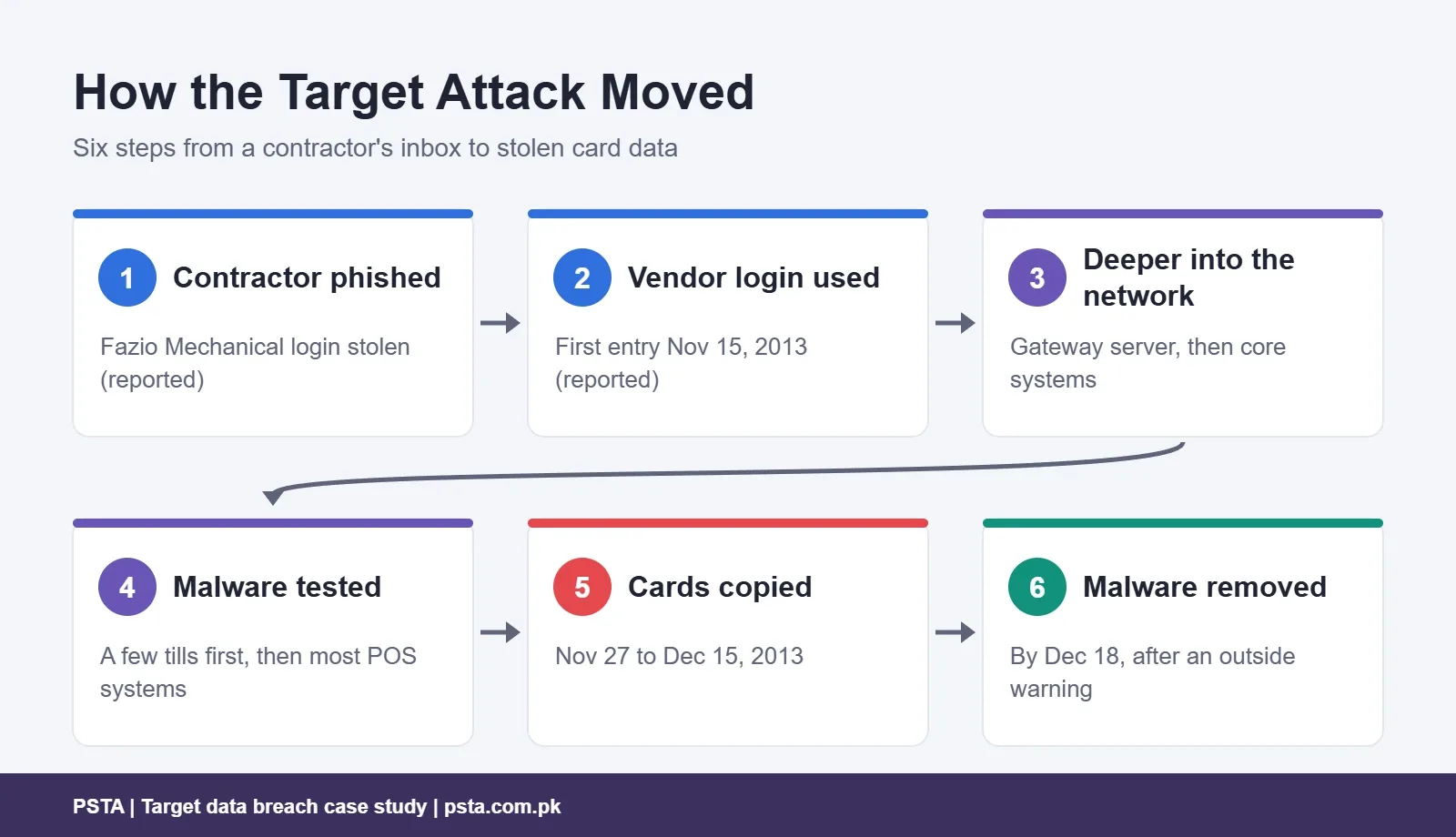
- How Did the Attack Work, Step by Step?
- Step 1: A Contractor's Login Is Stolen
- Step 2: The Attackers Move From the Vendor Area to Core Systems
- Step 3: The Malware Is Tested, Then Rolled Out
- Step 4: The Data Is Gathered and Sent Out
- Six Missed Chances Behind the Breach
- 1. A Vendor With a Door Into the Network
- 2. Weak Walls Between Vendor Systems and Card Systems
- 3. Malware Alerts That Did Not Lead to Action
- 4. Data Leaving Without Anyone Stopping It
- 5. An Outside Warning Arrived First
- 6. Card Technology That Made Stolen Data Easy to Use
- How Much Did the Target Data Breach Cost?
- Who Was Behind the Target Hack, and How Sure Is Anyone?
- What Happened After the Breach?
- What the Target Data Breach Means for Pakistan
- Seven Defensive Lessons From the Target Data Breach
- Tracing Attack Paths in PSTA's Cyber Security Labs
- Review One Vendor Account Before Friday
During the 2013 holiday rush, the Target data breach was already running inside the tills: card readers in Target's U.S. stores were quietly copying shoppers' card details as they paid. The thieves had not broken down the front door. They came in through a login that belonged to a small heating and refrigeration contractor.
This "what went wrong" analysis looks at the decisions around the malware, not only the malware itself. Here is what you will find:
- A dated timeline from the first vendor login to the public notice
- A plain-language picture of how the point of sale malware worked
- Six missed chances that turned a small foothold into a national breach
- The settlements, costs and leadership changes that followed
- Seven defensive lessons for banks, shops and software houses in Pakistan
What Was the Target Data Breach?
Target is one of the largest retail chains in the United States. In late 2013, criminals planted data-stealing software on its in-store payment terminals, known as point of sale (POS) systems. The software captured card details at the moment each customer paid.
Target first put the loss at about 40 million credit and debit card accounts, stolen between November 27 and December 15, 2013, as Computerworld summarized. On January 10, 2014, the company added a second layer in an update on the breach and its finances: names, mailing addresses, phone numbers and email addresses for up to 70 million people. Target said much of that contact data was partial and that it was not a new breach.
Because the two groups overlap, news reports describe the total as up to 110 million people. NBC News used that figure in its 2015 coverage. Later counts differ slightly. The 2017 multistate settlement notice from Virginia's attorney general lists more than 41 million card accounts and contact details for more than 60 million customers. That notice does not explain the gap, so this article gives both sets and names the source each time.
Target Data Breach Timeline: From Vendor Login to Public Notice
The dates below are U.S. dates. Target's head office is in Minneapolis. Pakistan is 11 hours ahead of that city in winter, so a mid-afternoon statement there lands here late at night. Rows marked "reported" come from journalists' sources rather than from Target or a government body.
| Date | What happened | Source |
|---|---|---|
| About two months before Nov 27, 2013 (reported) | A phishing email reportedly infects contractor Fazio Mechanical with password-stealing malware | Krebs's sources, via Dark Reading |
| On or about Nov 12, 2013 | The breach begins, according to state attorneys general | Virginia attorney general |
| Nov 15, 2013 (reported) | Attackers first log in to Target's network with the contractor's stolen credentials | Krebs's sources, via Computerworld |
| Nov 27 to Dec 15, 2013 | Card data is captured at store tills | Target, via Computerworld |
| Nov 30, 2013 (reported) | Malware alerts reach Target's security team in Bangalore and are passed to Minneapolis | Bloomberg Businessweek, via Business Insurance |
| Dec 12, 2013 | The U.S. Justice Department warns Target about suspicious card activity | Target's CFO in testimony, via Business Insurance |
| Dec 15 to Dec 18, 2013 | Target confirms the intrusion, then removes the malware and stops the data flow | Dark Reading |
| Dec 19, 2013 | Target announces the card breach publicly | Target |
| Jan 10, 2014 | Target discloses contact data for up to 70 million people and cuts its profit forecast | Target |
| March 2014 | Target confirms that alerts were raised; a Senate staff report lists missed chances | Business Insurance; NBC News |
| May 2014 | CEO Gregg Steinhafel resigns | Christian Science Monitor |
| 2015 | Settlements with shoppers, Visa card issuers, and banks and credit unions | NBC News |
| May 23, 2017 | $18.5 million settlement with 47 states and the District of Columbia | Virginia attorney general |
Notice the two start dates. The states say the breach began on or about November 12, while Krebs's sources put the first login on November 15. Neither source explains the three-day difference, and it does not change the lessons.
How Did the Attack Work, Step by Step?
The Target hack 2013 is easier to follow as four moves. None of them needed rare skills on its own. The harm came from how they linked up.
Step 1: A Contractor's Login Is Stolen
Fazio Mechanical, an HVAC and refrigeration firm in Sharpsburg, Pennsylvania, had a login to Target's network. Krebs's sources said it was used to monitor energy use and store temperatures, according to Computerworld. The company's owner gave a narrower account. He told reporters the access covered only electronic billing, contract submission and project management, as Dark Reading reported.
The same Dark Reading report says Krebs's sources blamed a phishing email. It reportedly carried Citadel, a banking Trojan built on older Zeus code. Citadel records keystrokes and saved passwords. Target did not confirm this detail, so treat it as well-sourced reporting rather than an official finding.
Step 2: The Attackers Move From the Vendor Area to Core Systems
According to the state settlement notice, the stolen login reached a gateway server. From there, the attackers used weaknesses in Target's systems to get into a customer service database and install malware. In plain terms, a door meant for a supplier opened onto hallways that led much deeper.
Step 3: The Malware Is Tested, Then Rolled Out
The attackers first tried their tool on a few cash registers, then pushed it to most of Target's POS systems, Computerworld reported. Point of sale malware of this kind grabs card data in the brief moment a terminal holds it. That happens before the payment goes out for approval. Security firm iSight Partners described the Target tool as a variant of a known POS family called BlackPOS, Computerworld noted.
Step 4: The Data Is Gathered and Sent Out
The settlement notice lists what the malware captured: names, phone numbers, email and mailing addresses, card numbers, expiry dates, security codes and encrypted debit PINs. The stolen records then had to leave Target's network. A U.S. Senate staff report found that automated warnings had shown how the attackers planned to move that data out, as NBC News reported from Reuters.
Six Missed Chances Behind the Breach
The Senate committee staff used a "kill chain" model, which splits an intrusion into stages. Their conclusion, per the NBC News report, was that Target had several chances to stop the attackers before the damage grew. Here are six, drawn from that report and from other reporting.
1. A Vendor With a Door Into the Network
The Senate staff found that Target gave network access to a third party that did not follow accepted security practices. This is classic third-party vendor risk. A contractor's laptop becomes part of your attack surface the day you hand over a login.
2. Weak Walls Between Vendor Systems and Card Systems
Jody Brazil, founder of the firewall company FireMon, told Computerworld that the breach was not technically fancy. In his view, proper network segmentation would have kept a contractor away from payment systems even with a valid login. He noted that the card industry's security standard, PCI DSS, names segmentation as a way to protect card data. The 2017 settlement later required Target to separate its card data environment from the rest of its network.
3. Malware Alerts That Did Not Lead to Action
This is the most discussed failure of the Target data breach. Bloomberg Businessweek reported that a FireEye tool flagged the malware on November 30. Target's team in Bangalore then passed the alert to Minneapolis, according to Business Insurance. Target spokeswoman Molly Snyder confirmed that its tools had flagged activity and that the team decided it did not need immediate follow-up.
The same report adds a detail Target did not confirm. Two people who reviewed FireEye's role said Target had switched off the tool's automatic malware removal before the attack. To be fair to the defenders, experts quoted in that story said large teams can receive hundreds of alerts a day. The useful lesson is that alert handling needs clear owners and clear thresholds.
4. Data Leaving Without Anyone Stopping It
Stealing card data is only half the job for a criminal. The data must also leave the network. The Senate staff said warnings about the attackers' exit routes went unanswered. Many teams watch traffic coming in more closely than traffic going out. That gap gives attackers a quiet exit.
5. An Outside Warning Arrived First
On December 12, the Justice Department warned Target about suspicious card activity. Target's chief financial officer, John Mulligan, told Congress that this warning started the company's investigation, according to Business Insurance. When banks or police spot a breach before you do, detection has failed inside your own walls.
6. Card Technology That Made Stolen Data Easy to Use
Target's own response points to this gap. The company committed $100 million to a chip-and-PIN system to guard against future breaches, the Christian Science Monitor reported. Chip cards create a one-time code for each in-store payment, which makes copied data much harder to reuse at a shop till. They do not stop an intruder from getting into the network.
How Much Did the Target Data Breach Cost?
The bill for the Target data breach arrived in pieces over four years. The table collects the figures from the sources linked in this article.
| Item | Amount | Source |
|---|---|---|
| Fourth-quarter 2013 forecast for U.S. adjusted earnings per share | Cut to $1.20 to $1.30, from $1.50 to $1.60 | Target, Jan 2014 |
| Fourth-quarter 2013 profit | Down 46% | Christian Science Monitor |
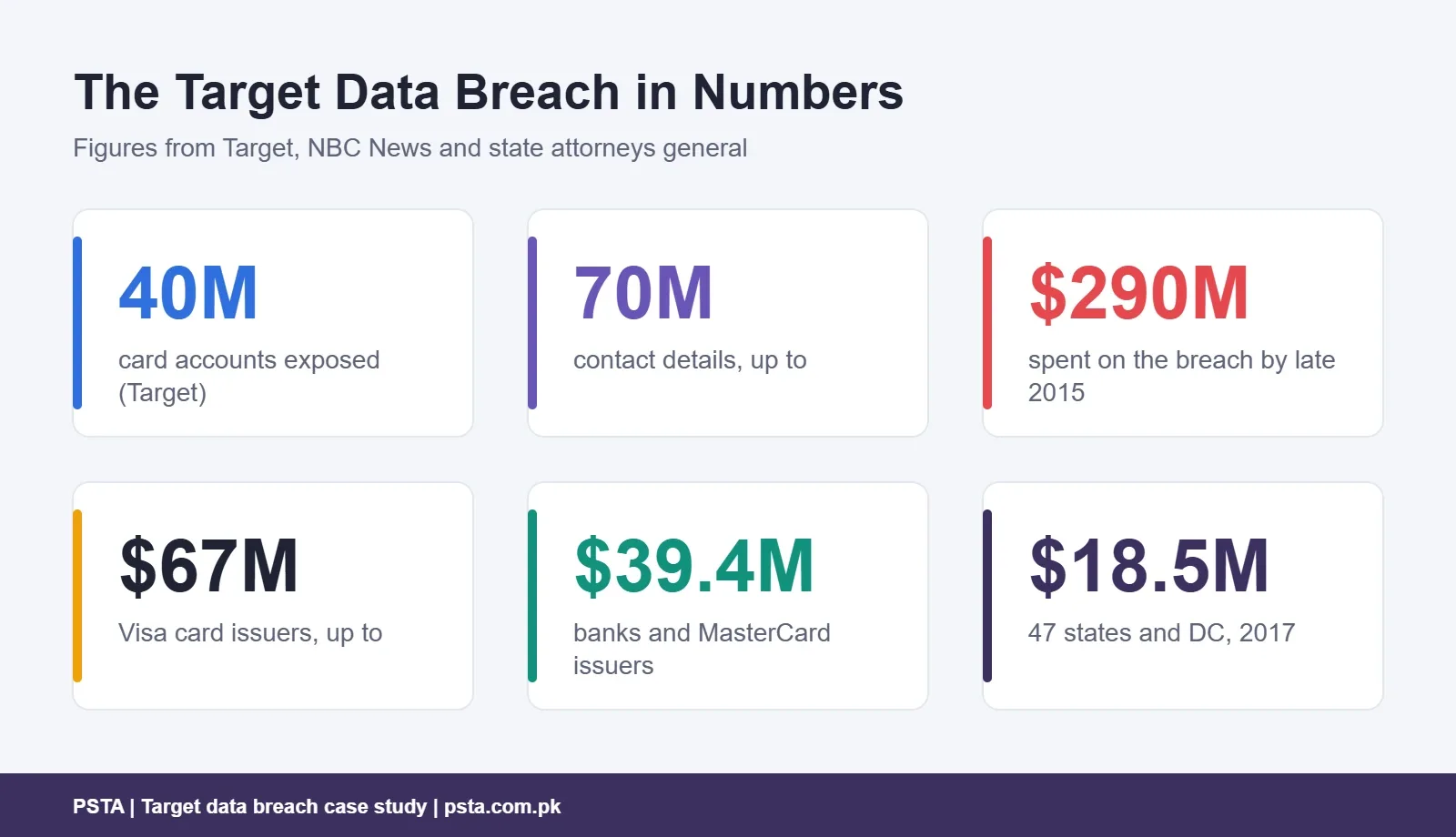
| Shoppers' class action | $10 million | NBC News |
| Visa card issuers | Up to $67 million | NBC News |
| Banks, credit unions and MasterCard issuers | $39.4 million | NBC News |
| 47 states and the District of Columbia | $18.5 million | Virginia attorney general |
| Total breach spending reported in late 2015 | About $290 million, with about $90 million expected from insurers | NBC News |
The $39.4 million deal split into up to $20.25 million for banks and credit unions and $19.11 million for MasterCard issuers, per NBC News. A first MasterCard deal had been rejected by card issuers who felt it was too small. Virginia's attorney general called the $18.5 million agreement the largest multistate data breach settlement up to that point.
Who Was Behind the Target Hack, and How Sure Is Anyone?
Attribution is the least settled part of the Target data breach. Unlike some cases in this series, no government body in the sources reviewed here named the people who ran the attack. Compare that with the Bybit hack, where the FBI publicly blamed North Korea. Here is how the evidence sorts by confidence:
| Claim | Status | Who said it |
|---|---|---|
| Attackers used a contractor's stolen credentials | Confirmed by the states' settlement notice | State attorneys general |
| The contractor was Fazio Mechanical | Reported; the firm confirmed a Secret Service visit | Brian Krebs's sources |
| The malware was a BlackPOS variant | Analyst finding | iSight Partners |
| Named Eastern European coders wrote BlackPOS | Allegation; no charges reported at the time | IntelCrawler |
In January 2014, the intelligence firm IntelCrawler linked a Russian teenager and a second coder to BlackPOS through a shared forum nickname, Computerworld reported. Its own president admitted that proving who sits behind a keyboard is hard. Computerworld's publisher withheld the names because the two had not been charged. Even if the link were correct, IntelCrawler said the tool was sold to other criminals. So the author and the people who robbed Target may not be the same.
What Happened After the Breach?
Target offered one year of free credit monitoring and identity theft protection to U.S. shoppers and said customers would have zero liability for fraudulent charges, according to its January 2014 update. Leadership changed within months. The chief information officer stepped down in March 2014. Gregg Steinhafel then resigned as CEO in May, after 35 years at the company, the Christian Science Monitor reported. CFO John Mulligan became interim CEO.
The Target breach settlement with the states in 2017 set out specific duties. According to the Virginia notice, Target had to:
- Run a written information security program with a named executive in charge.
- Hire an independent, qualified firm for a full security assessment.
- Keep the software on its network supported and patched.
- Encrypt cardholder and personal data under clear policies.
- Separate its card data environment from the rest of the network.
- Control access with password rotation and two-factor login for certain accounts.
Read that list again and you will see it mirrors the missed chances in the Target data breach. Regulators often write the lessons into the settlement.
What the Target Data Breach Means for Pakistan
You might think a U.S. retail case has little to do with a shop in Lahore or a bank branch in Abbottabad. The pattern travels well, though. Pakistani retailers, banks and hospitals use outside firms for POS support, air conditioning, CCTV and IT help. Many of those firms get remote access so they can work without visiting. Each one is a possible side door.
Pakistan has its own card history. In 2018, card data from Pakistani banks turned up for sale online, which we covered in the Pakistan bank data breach case study. Any business here that stores, processes or sends card data should know the PCI DSS rules on segmentation that Computerworld's sources cited.
For shoppers, the advice is simpler. Turn on SMS alerts for every card, use chip or tap payments where the terminal allows, and report unknown charges to your bank the same day. Vendor-driven breaches also show up in our Marriott data breach and Equifax data breach case studies.
Seven Defensive Lessons From the Target Data Breach
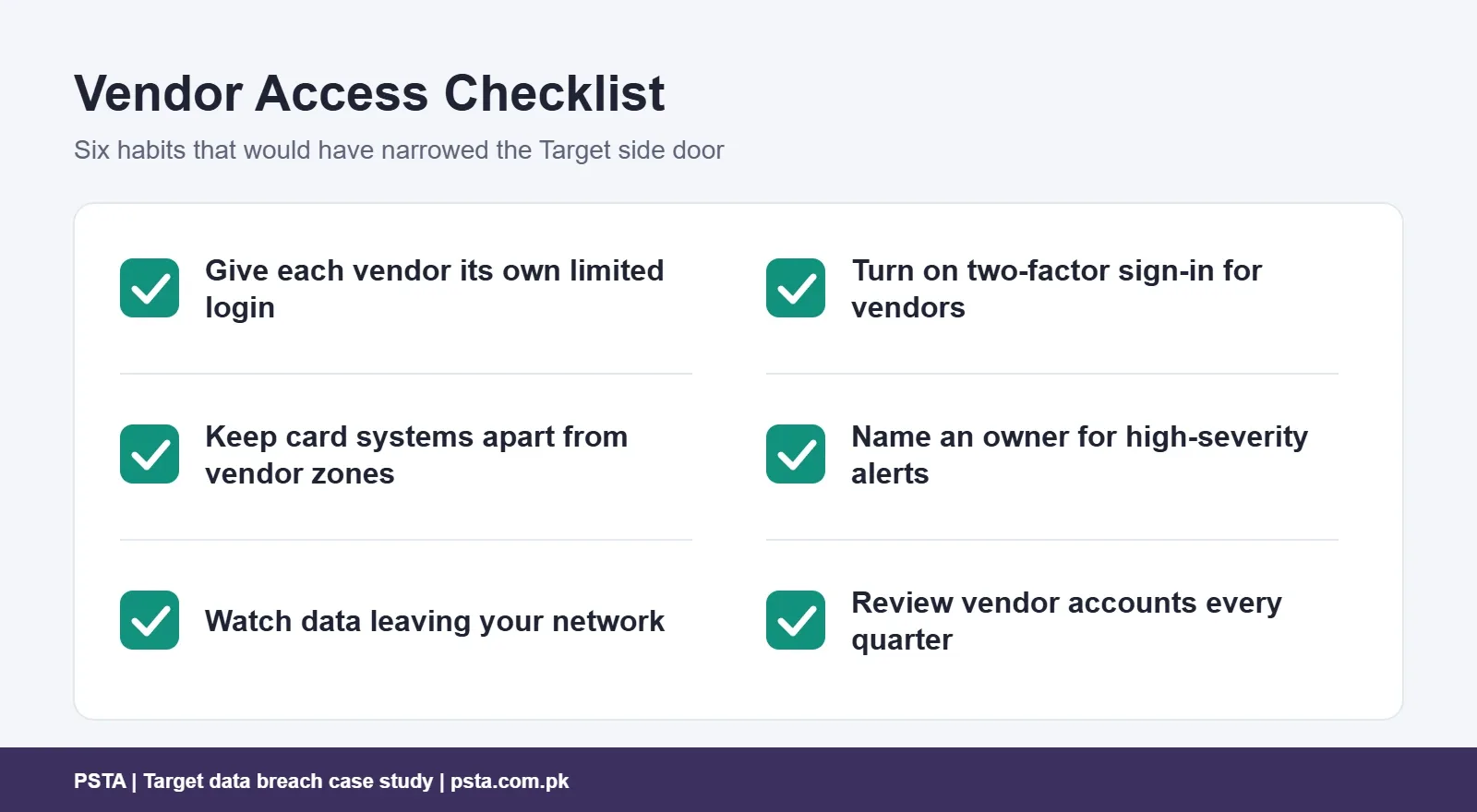
- Give every vendor its own limited account. Use two-factor login and allow only the systems that vendor needs for its job.
- Separate card systems from everything else. A contractor's portal should have no route to tills or payment servers.
- Name an owner for high-severity alerts. Decide in advance who must act and how fast, and tune tools so real alerts are not buried in noise.
- Watch data that leaves your network. Large or unusual outbound transfers from internal servers deserve the same attention as inbound attacks.
- Review vendor accounts every quarter. Disable logins for finished contracts and check what each active account can reach.
- Clean what you publish. Krebs reported that files on Target's supplier portal held metadata showing staff usernames and internal domain names. Strip metadata before posting documents.
- Rehearse the response. Know who calls the banks, the regulator and your customers, and practice it before you need it.
If you are new to the field, these seven points also make a good study list for entry certifications. Read our beginner certification guide for cyber security to see which exams test them.
Tracing Attack Paths in PSTA's Cyber Security Labs
Cases like this one are how we teach defense at PSTA. Inside our beginner cyber security and ethical hacking program, you rebuild an attack path on paper, then ask where a control, an alert or a better design would have broken the chain. The course runs for 12 weeks at beginner level. You can join on campus in Abbottabad, live online from anywhere in Pakistan, or as a hybrid. A new batch starts each month.
Three of its seven modules map directly onto the Target story. Module 4 covers firewalls, VPNs and intrusion detection systems. Module 5 covers malware analysis, threat intelligence and incident response. Module 7 closes the course with real incident case studies plus a final project of your own. If you later want to test networks like this with permission, PSTA's advanced penetration testing track is a sensible follow-on. For another full case study, start with the Binance hack explained, the first post in this series.
Review One Vendor Account Before Friday
Choose a single outside firm that holds a login to your network, whether it is a POS supplier, an AC contractor or an IT helper. Write down what that login can reach, whether it uses two-factor sign-in and when it was last used. If the answers surprise you, you have found your own version of the Target side door. If you want help reading the results, PSTA's trainers are glad to talk it through with you.
Frequently asked questions
How did hackers get into Target's network?
State attorneys general say the attackers used login details stolen from a third-party vendor to reach a gateway server. Reporting by Brian Krebs named the vendor as Fazio Mechanical, an HVAC contractor, and said a phishing email carrying password-stealing malware was the likely first step. From there the attackers moved deeper and reached the store tills.
How many people were affected by the Target data breach?
Target first reported about 40 million credit and debit card accounts. In January 2014 it added names, addresses, phone numbers and emails for up to 70 million people. Because the groups overlap, reports often cite up to 110 million people. The 2017 state settlement used slightly different counts of 41 million and 60 million.
Did Target ignore warnings before the breach?
Target confirmed in March 2014 that its security tools flagged suspicious activity and that its team decided it did not need immediate follow-up. Bloomberg Businessweek reported that a FireEye alert on November 30 was passed from Bangalore to Minneapolis. Experts noted that large teams receive many alerts, so the real gap was alert handling.
Was anyone arrested for the Target hack?
None of the official sources reviewed for this case study name the attackers. In January 2014 the firm IntelCrawler linked two Eastern European coders to the BlackPOS malware family, but no charges were reported at the time. Writing a malware tool is also different from running a specific attack, since the tool was reportedly sold to others.
How much did Target pay in settlements?
Reported settlements include $10 million to shoppers, up to $67 million to Visa card issuers, $39.4 million to banks, credit unions and MasterCard issuers, and $18.5 million to 47 states and the District of Columbia in 2017. By late 2015, Target said it had spent about $290 million on the breach overall.
Could chip cards have stopped the Target breach?
Chip cards would not have kept the attackers out of Target's network. They make copied card data much harder to reuse at a shop till, because each chip payment creates a one-time code. That is why Target committed $100 million to chip-and-PIN after the breach. Strong vendor controls and segmentation are still needed.
Could a breach like Target's happen in Pakistan?
Yes, the same pattern can happen anywhere a business gives outside firms remote access. Retailers, banks and hospitals in Pakistan use contractors for POS support, cooling, CCTV and IT help. If those logins can reach payment systems, one stolen password can expose card data, as Pakistan's own 2018 card dumps showed.
Sources & references
- Target: An update on our data breach and financial performance (Jan 2014) corporate.target.com
- Virginia Attorney General: Target to pay $18.5M over 2013 data breach oag.state.va.us
- NBC News (Reuters): Target missed many warning signs, Senate report nbcnews.com
- Business Insurance: Target says it declined to act on early alert businessinsurance.com
- Computerworld: Target breach and network segmentation computerworld.com
- Dark Reading: Target breach, phishing attack implicated darkreading.com
- NBC News: Target to pay $39.4 million to banks nbcnews.com
- Christian Science Monitor: Target CEO exits after data breach csmonitor.com
Last reviewed & updated on by Umar Qureshi. Written by the PSTA team in Abbottabad, Pakistan.

Umar Qureshi
Cyber Security & Ethical Hacking Course in Abbottabad - PSTA
Turn this guide into a career: hands-on training with real projects, online across Pakistan or on-campus in Abbottabad · 12 Weeks.
Comments
No comments yet — ask a question or share your experience.